
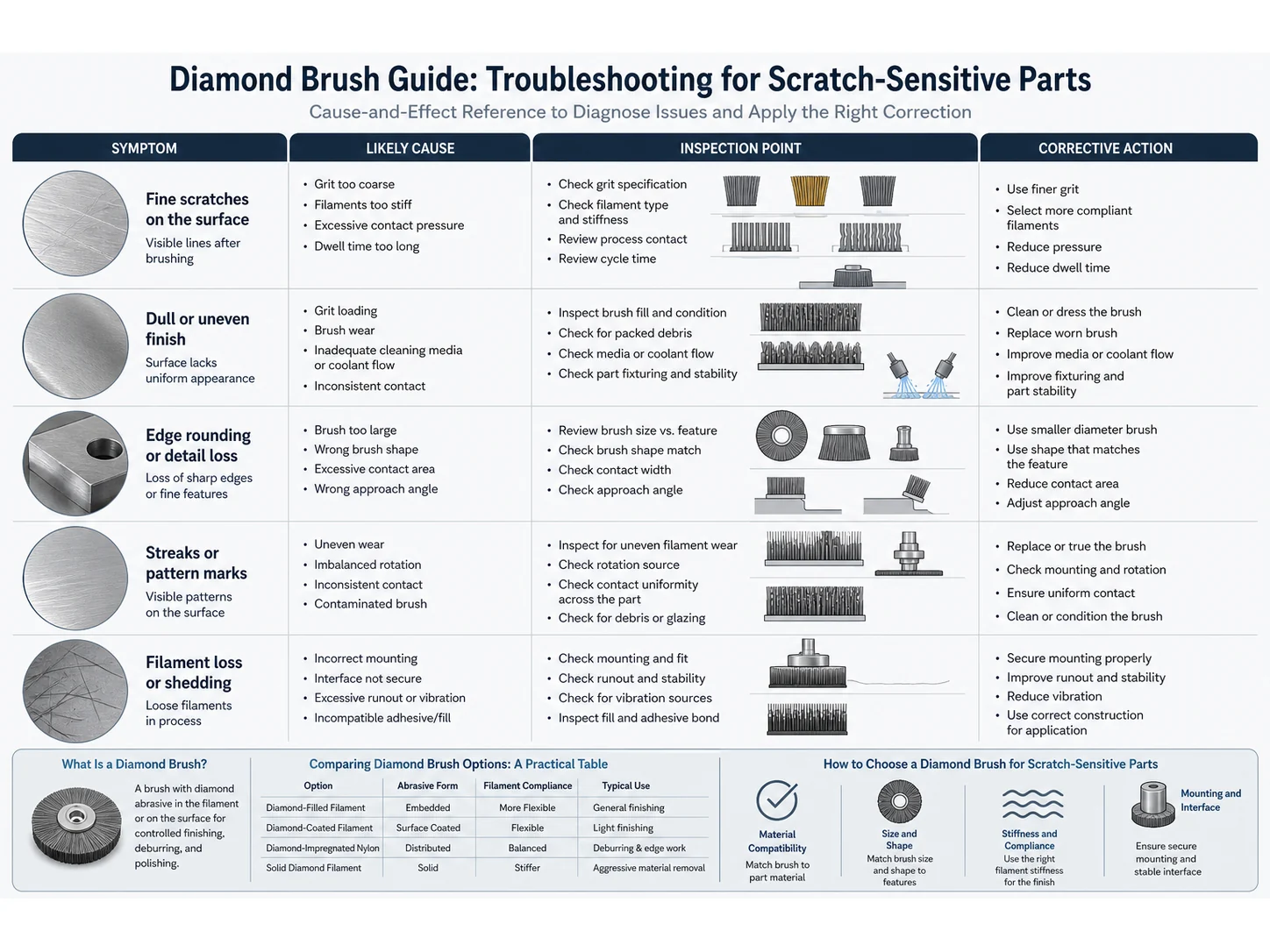
What Is a Diamond Brush?
A diamond brush is an abrasive filament brush where the working tips or the entire filament are embedded with industrial diamond particles. Unlike wire brushes that cut aggressively and can gouge soft substrates, diamond brushes offer controlled abrasion. The diamond particles provide hardness for removing residues, coatings, or contamination, while the filament base absorbs and distributes pressure to protect the substrate. They are used in metal finishing, mold cleaning, deburring, surface texturing, and precision parts cleaning where maintaining dimensional tolerance and surface finish is critical.
Common Diamond Brush Configurations
Not all diamond brushes work the same way. The combination of grit size, filament material, stiffness, and mounting method determines where a brush can be used safely. Here are the main levers you will evaluate:
- Grit size: Coarse (60–200 mesh) for heavy stock removal or thick coatings; medium (200–600 mesh) for general cleaning and light deburring; fine (600–3000 mesh) for surface conditioning and final finish.
- Filament material: Nylon (abrasive‑filled or bonded) offers flexibility and compliance; polypropylene or polyester filaments are used where chemical resistance matters; metal‑core filaments (stainless steel or brass) provide stiffness but increase scratch risk.
- Stiffness and trim length: Filament diameter, length, and bonding method control how much the bristles flex. Shorter, thicker filaments are stiffer; longer, thinner ones adapt to contoured surfaces.
- Mounting interface: Drill shank, arbor hole, keyed hub, or manual handle. The choice depends on whether the brush runs in a CNC spindle, robotic arm, hand drill, or manual operation.
Comparing Diamond Brush Options: A Practical Table
The table below overviews typical configurations and their best‑fit use cases for scratch‑sensitive work. Use this as a starting point for narrowing down specifications.
| Configuration | Typical Application | Surface Sensitivity | Key Consideration |
|---|---|---|---|
| Fine grit (≥800 mesh), soft nylon filament | Polished optical molds, medical implants, thin coatings | Very high – minimizes micro‑scratches | Check filament wear often; slower residue removal |
| Medium grit (400–600 mesh), glass‑filled nylon | Engine components, guide rails, ceramic surfaces | Moderate – balances cleaning speed with finish protection | Verify filament stiffness against substrate hardness |
| Coarse grit (100–300 mesh), stiff nylon or metal‑core | Heavy residue, casting flash, thick oxide layers | Low – not for polished surfaces | Perform sample test; risk of measurable stock removal |
| Abrasive‑filled elastomer filament | Contoured or irregular surfaces requiring conformability | High – excellent compliance on complex geometries | Temperature resistance may limit wet/chemical use |
| Metal‑core diamond filament (brass/stainless) | Stubborn carbon deposits, weld spatter, heavy de‑scaling | Very low – aggressive; scratches most sensitive substrates | Reserve for parts where surface finish is not critical |
How to Choose a Diamond Brush for Scratch‑Sensitive Parts
Material Compatibility
Match the diamond brush to the residue type and substrate material. For example, soft aluminum alloys require fine grit with compliant filaments to avoid galling, while hardened steel can tolerate medium grit nylon. When solvents or alkaline cleaners are used in the process, confirm that the filament and bonding resin are chemically resistant. Swelling or embrittlement will change stiffness during use and may cause scratching.
Size and Shape
Brush diameter, trim length, and face width must match the part geometry. A brush that is too small leaves un‑cleaned bands; one that is too large cannot access recesses and may apply uneven pressure. For internal bores or blind holes, a smaller diameter with a long trim length allows the filaments to reach the surface without the hub contacting the part. For flat surfaces, a wide‑face wheel brush provides uniform coverage.
Stiffness and Compliance
The ideal stiffness is high enough to remove the residue but low enough to prevent substrate damage. Test the brush on a non‑critical area or coupon first. If filaments snap or leave marks, the combination of grit and backing pressure is too aggressive. As a rule of thumb: for polished Ra < 0.2 µm surfaces, use fine grit with very flexible filaments and light contact force.
Mounting and Interface
Verify the arbor size, shank diameter, or mounting pattern against your machine or tool holder. In automated systems, runout and balance of the brush assembly affect contact consistency. A poorly mounted brush creates vibration that can cause chatter marks on sensitive surfaces. For manual operations, ergonomic handles with secure brush retention reduce operator fatigue.
Wet/Chemical Exposure and Hygiene
If the process uses water, cutting fluids, or chemical cleaning agents, choose a brush with moisture‑resistant filaments and a corrosion‑resistant hub (stainless steel or engineered plastic). In food, pharmaceutical, or medical manufacturing, brushes may need to withstand sterilization or autoclaving. Check filament and adhesive temperature ratings before specifying.
Common Specification Mistakes to Avoid
- Specifying grit by “look” instead of performance: Two brushes with the same mesh number can behave differently depending on diamond type, concentration, and filament material. Request a grit‑performance description or sample.
- Assuming “diamond” means “safe for any surface”: Diamond is the hardest abrasive; without compliance it will scratch. Always evaluate filament compliance first.
- Ignoring the break‑in period: New diamond brushes often need a short run‑in to round sharp filament tips. Skipping this can cause initial surface marking on delicate parts.
- Overlooking hub and core material: A metal hub that can contact the workpiece will scratch. Use brush designs with recessed or non‑metallic hubs.
- Choosing cost over fit: A cheaper brush that is too aggressive will cost more in rework or scrapped parts than a properly specified brush.
When a Diamond Brush Is the Wrong Choice
Diamond brushes excel at mechanical cleaning with abrasive action, but they have limits. If the part surface is softer than the filament backing material (e.g., pure gold or indium‑based coatings), even fine diamond grit can cause deformation. In those cases, non‑abrasive cleaning methods such as ultrasonic cavitation, laser cleaning, or chemical baths may be necessary. Additionally, when residues are highly tenacious and require substantial stock removal, a single diamond brush operation may be inefficient—consider a multistep process starting with a coarser tool and finishing with a fine diamond brush or polishing film. Finally, if hygiene requirements demand a fully non‑particle‑shedding environment, sealed or encapsulated brush designs should be evaluated, and sample testing with a qualified brush manufacturer is strongly advised.
Final Takeaway
The right diamond brush for scratch‑sensitive parts is rarely the most aggressive or the lowest-cost. It is the one whose grit size, filament compliance, and mounting interface add up to safe, efficient residue removal without altering the substrate. Start with the residue challenge, match the brush to the part’s surface sensitivity and geometry, and always validate through a sample test. A well‑specified diamond brush protects your part quality and reduces long‑term process cost.
Frequently Asked Questions
What grit size is safe for highly polished surfaces?
For surfaces with Ra below 0.2 µm, start with a diamond brush in the 1000–3000 mesh range mounted on very flexible nylon filaments. Even then, test on a representative coupon first.
Can diamond brushes be used with solvents or alkaline cleaners?
Yes, but you must verify chemical resistance of the filament and bonding resin. Nylon and polyester have different tolerances—consult the brush manufacturer’s compatibility chart for your specific chemical environment.
How do I measure for a custom diamond brush size?
Provide the minimum bore or cavity diameter, the depth to be cleaned, and the desired brush diameter (often 10-20% larger than the cavity). A detailed dimensioned drawing is the best way to avoid fit errors.
What is the difference between a diamond brush and a carbide brush?
Diamond brushes use harder, sharper abrasive particles that last longer and produce a more consistent finish on hard substrates. Carbide brushes may be less expensive but wear faster and can generate irregular scratches.
Can diamond brushes be sterilized?
Steam autoclaving is possible if the filament and adhesive are rated for the temperature and pressure cycle. Not all diamond brushes are autoclavable—confirm with the supplier before ordering for medical or food applications.
How can I reduce filament breakage?
Breakage often comes from excessive speed, over‑deflection, or chemical attack. Reduce RPM, lower contact pressure, and ensure the process liquid does not degrade the filament. A generous trim length also reduces stress at the root.
Is a sample test really necessary?
For scratch‑sensitive parts, yes. Even two brushes with identical specs can behave slightly differently. A test protects your parts and helps you document a safe process window for production.
Technical References
Which nylon grade fits this job — Nylon PA, PA6 Nylon or PA66 Nylon?
| Grade | Continuous temperature (°C) | Peak temperature (°C) | Water absorption | Hardness |
|---|---|---|---|---|
| Nylon PA | 93 | 121 | 0.3–9% by PA grade and conditioning | Medium to firm; filament diameter and trim length control bending force. |
| PA6 Nylon | 80–100 | 130–160 | 1.5–3.0% | Shore D 75–85 |
| PA66 Nylon | 100–120 | 150–180 | 1.0–1.8% | Shore D 80–88 |
| PA610 Nylon | 90–110 | 130–150 | 0.5–1.0% | Shore D 72–82 |
| PA612 Nylon | 90–110 | 130–150 | 0.3–0.7% | Shore D 70–80 |
Figures as published by Brushtec / DuPont. Confirm the exact grade against the supplier datasheet before ordering.
What should replace Nylon PA for scratch-sensitive parts?
- Nylon PA — Compare Nylon PA with PP, PBT, PET. Change material when wet stiffness, temperature, chemical resistance, conductivity, particle shedding, or surface marking becomes the limiting factor.
- AISI 304 Stainless Steel Wire — Use AISI 316 stainless steel wire for chloride, marine, dairy, beverage, chemical washdown, or higher pitting-resistance requirements. Use carbon steel for dry aggressive cutting and brass or abrasive nylon for lower marking risk.