
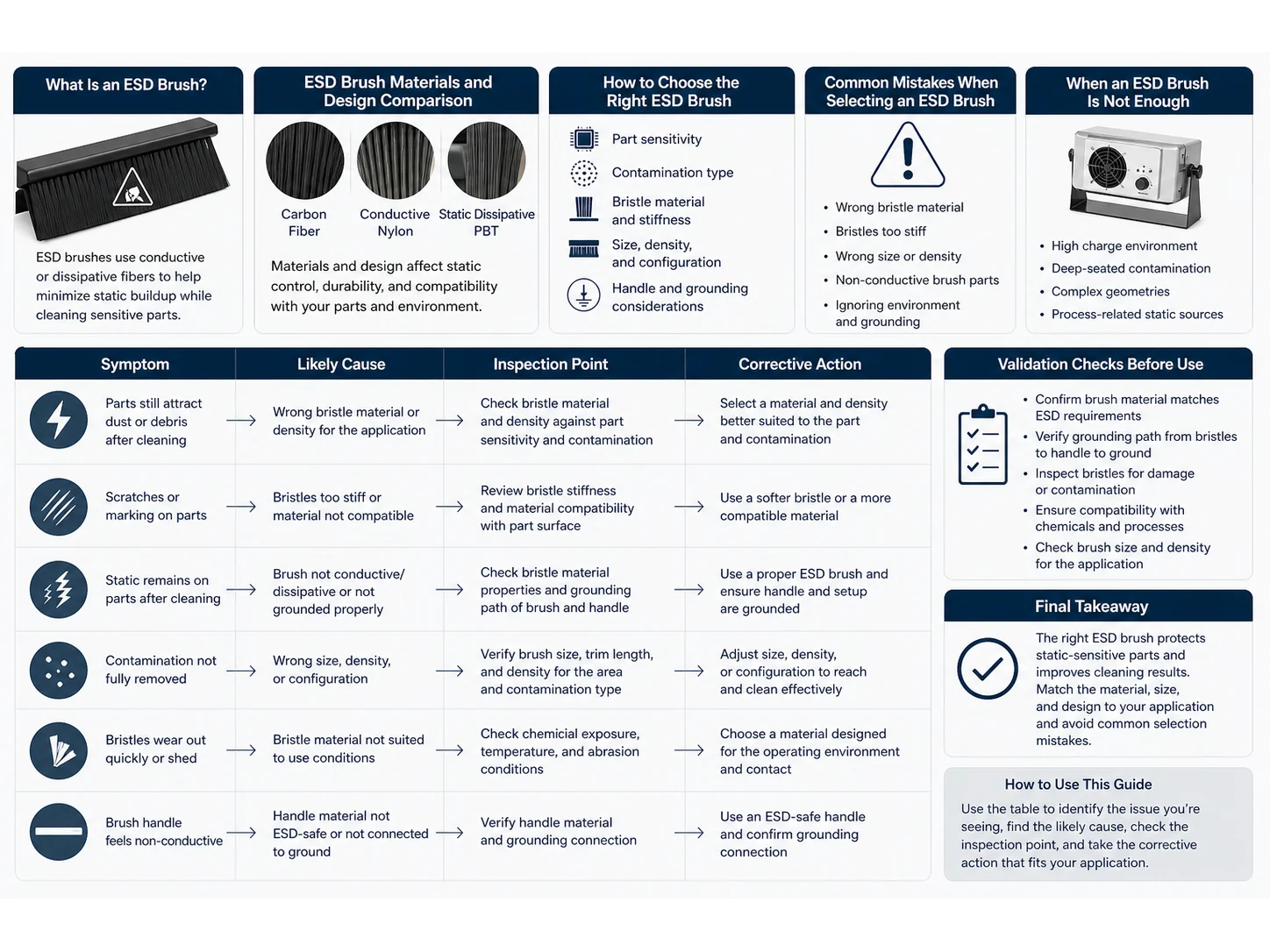
What Is an ESD Brush?
An ESD brush is a brush with bristles and a handle that are electrically dissipative or conductive, allowing static charges to flow safely to ground instead of accumulating. It provides a controlled path for static dissipation while mechanically removing particles from surfaces like PCBs, connectors, sensors, and cleanroom equipment. Unlike regular brushes, ESD brushes are rated by surface resistance (typically 10³ to 10⁹ ohms) and are essential where even a small discharge could destroy sensitive electronics.
Common Types of ESD Brushes
ESD brushes come in many styles, but most fall into a few practical categories based on bristle material, handle design, and intended use:
- Conductive fiber brushes – Bristles made from carbon-filled nylon or stainless steel fibers. Best for general electronics cleaning and contact maintenance.
- Natural anti-static brushes – Treated horsehair or goat hair. Soft and gentle for optics, sensors, and delicate connectors.
- Dissipative microfiber brushes – Microfiber with a conductive coating, often in flat or wide pads. Excellent for picking up fine dust without scratching.
- Metal core ESD brushes – Metal handle with conductive bristles, commonly used when the brush itself must be grounded or withstand harsh cleaning.
- Custom molded brushes – Engineered conductive polymers molded to unique shapes for automated machinery or proprietary equipment interfaces.
ESD Brush Materials and Design Comparison
| Type | Bristle Material | Typical Diameter/Size | Stiffness | Handle Option | Best For | Limitations |
|---|---|---|---|---|---|---|
| Conductive Fiber Brush | Carbon-filled nylon, stainless steel | 1/4″ to 1″ diameter | Soft to firm | Wood, plastic, anti-static | PCB cleaning, edge connectors | May shed fibers; quality varies |
| Natural Anti-Static Brush | Treated horsehair/goat hair | 1/4″ to 2″ diameter | Soft | Wood, anti-static plastic | Optics, sensors, delicate parts | Reduced chemical resistance, limited lifetime |
| Dissipative Microfiber Brush | Microfiber with conductive coating | Flat, 1/2″ to 3″ width | Very soft | Anti-static plastic | Dust removal on screens, lenses | Not for scrubbing; limited solvent use |
| Metal Core ESD Brush | Conductive bristles (carbon/steel) | Custom lengths | Medium to firm | Metal (groundable) | Heavy-duty cleaning, grounding through handle | Risk of short circuits if tip contacts live circuits |
| Custom Molded ESD Brush | Engineered conductive polymers | Custom shapes/sizes | Controlled | Any with grounding path | Automated lines, unique form factors | Higher cost and lead time; requires drawing review |
Mounting options like threaded studs or snap-in fittings are available for many industrial brushes and must be specified for automated equipment.
How to Choose the Right ESD Brush
Selecting an ESD brush involves more than picking a generic ‘anti-static’ label. Evaluate these factors for your application:
- Residue type – Loose dust, sticky flux, or fine powder? Conductive fiber brushes handle dry particles well; stringent cleanrooms may require low-lint microfiber.
- Surface sensitivity – Bare boards, conformal coated surfaces, or optical lenses? Softer bristles reduce scratching risk.
- Equipment interface – Manual handheld, robotic arm, or fixture? Brush size, handle shape, and mounting must match.
- Chemical exposure – Will you use IPA, acetone, or aqueous cleaners? Confirm bristle and handle material compatibility.
- Hygiene requirements – Cleanroom ISO class dictates maximum particles and outgassing limits. Look for certified cleanroom-grade ESD brushes.
- Maintenance frequency – Replacement intervals, washability, and robustness affect long-term cost. Stainless steel fibers outlast natural fibers.
- Custom size needs – If an off-the-shelf brush doesn’t fit, work with the supplier on a drawing review to define bristle density, trim length, and overall shape.
Common Mistakes When Selecting an ESD Brush
Avoid these frequent pitfalls:
- Assuming all ‘anti-static’ brushes are the same – Verify surface resistance and material. A brush might only be low-charging without a dissipative path.
- Ignoring bristle stiffness – Too firm for sensitive coatings can cause micro-scratches; too soft won’t remove caked-on residue.
- Overlooking handle ergonomics – For manual use, a comfortable, non-slip grip reduces operator fatigue and contamination risks.
- Forgetting cleanroom compatibility – A standard ESD brush may shed particles or contain silicone, ruining a cleanroom environment.
- Skipping grounding verification – An ESD brush is only effective if it can be reliably grounded. Test handle-to-ground continuity.
- Choosing by cost drivers alone – Cheaper brushes might lack consistent conductivity, wear out quickly, or contaminate parts.
When an ESD Brush Is the Wrong Choice
An ESD brush is a valuable tool but has limits. It should not replace a full static control program when:
- Static charges persist – If ESD events still occur, you may need ionizers, proper flooring, or humidity control in addition to the brush.
- Stubborn contaminants – For baked-on flux or heavy oxidation, an ESD-safe wipe with a specific solvent, or an ultrasonic cleaning step, may be necessary.
- Liquid cleaning processes – Brushes that shed fibers are poor choices for wet cleaning. Use ESD-safe swabs or wipes instead.
- Unique geometries – If no standard brush reaches a recessed area, a custom-designed ESD brush with a drawing review from the manufacturer is required.
- High-volume automated lines – Brushes for pick-and-place nozzles or stencil cleaning must be validated for wear, particle generation, and process compatibility.
Final Takeaway
The right ESD brush matches the residue, surface sensitivity, and operating environment. Always verify the brush’s surface resistance, bristle stiffness, and cleanroom rating. Pair the brush with proper grounding and periodic testing to maintain static control. When in doubt, request a sample or drawing review from a qualified supplier before committing to a large purchase.
Frequently Asked Questions
Can I use a regular brush for static-sensitive parts if I ground it?
No. The bristle material must be dissipative or conductive to prevent charge buildup. A regular insulating brush can generate static even if the handle is grounded.
What bristle stiffness is best for fine-pitch PCB cleaning?
Soft to medium stiffness, typically from conductive nylon or natural treated fiber, minimizes the risk of bending pins or scratching delicate traces.
How do I test if my brush is truly ESD-safe?
Use a surface resistance meter to measure the resistance from bristle tip to handle. The reading should fall between 10³ and 10⁹ ohms, depending on your ESD standard.
Can ESD brushes be used with isopropyl alcohol or other solvents?
Check the manufacturer’s chemical compatibility chart. Carbon-filled nylon and stainless steel fibers are generally resistant, but natural hair or some coated fibers may degrade.
How often should ESD brushes be replaced?
It depends on usage and environment. Replace if bristles become frayed, conductivity drops, or contamination risk increases. In cleanrooms, follow the facility’s validated replacement schedule.
Are all ESD brushes cleanroom compatible?
No. Only brushes specifically tested for low particle shedding, low outgassing, and non-contaminating materials are suitable for ISO Class cleanrooms. Look for cleanroom-rated ESD brushes.
Can I get a custom-sized ESD brush for a robotic cleaning station?
Yes, many manufacturers offer custom design services. Provide a drawing of the required dimensions, bristle pattern, and mounting interface for a feasibility review.
Technical References
- EOS/ESD Association — ESD Fundamentals
- EOS/ESD Association — Principles of ESD Control
- NIST — Metric SI
Which bristle material fits this job — Microfiber, AISI 304 Stainless Steel Wire or Nylon PA?
| Material | Continuous temperature (°C) | Peak temperature (°C) | Water absorption | Hardness |
|---|---|---|---|---|
| Microfiber | 80–120 | 140–170 | 0.2–1.0%Material Itself ; Structure Can Absorb 3–7 Times Its Own Weight | — |
| AISI 304 Stainless Steel Wire | 400 | 500 | 0% | Rockwell B 70–95 depending on temper and cold work |
| Nylon PA | 93 | 121 | 0.3–9% by PA grade and conditioning | Medium to firm; filament diameter and trim length control bending force. |
| Goat Hair | 50–70 | 90–110 | 12–20% | — |
Figures as published by Alleima; Brushtec / DuPont. Confirm the exact grade against the supplier datasheet before ordering.
What should replace Microfiber for static-sensitive parts?
- Microfiber — Compare Microfiber with Cotton yarn, wool, felt, soft PBT filament. Change material when wet stiffness, temperature, chemical resistance, conductivity, particle shedding, or surface marking becomes the limiting factor.
- AISI 304 Stainless Steel Wire — Use AISI 316 stainless steel wire for chloride, marine, dairy, beverage, chemical washdown, or higher pitting-resistance requirements. Use carbon steel for dry aggressive cutting and brass or abrasive nylon for lower marking risk.
- Nylon PA — Compare Nylon PA with PP, PBT, PET. Change material when wet stiffness, temperature, chemical resistance, conductivity, particle shedding, or surface marking becomes the limiting factor.
- Goat Hair — Compare Goat Hair with Boar bristle, goat hair, microfiber. Change material when wet stiffness, temperature, chemical resistance, conductivity, particle shedding, or surface marking becomes the limiting factor.