
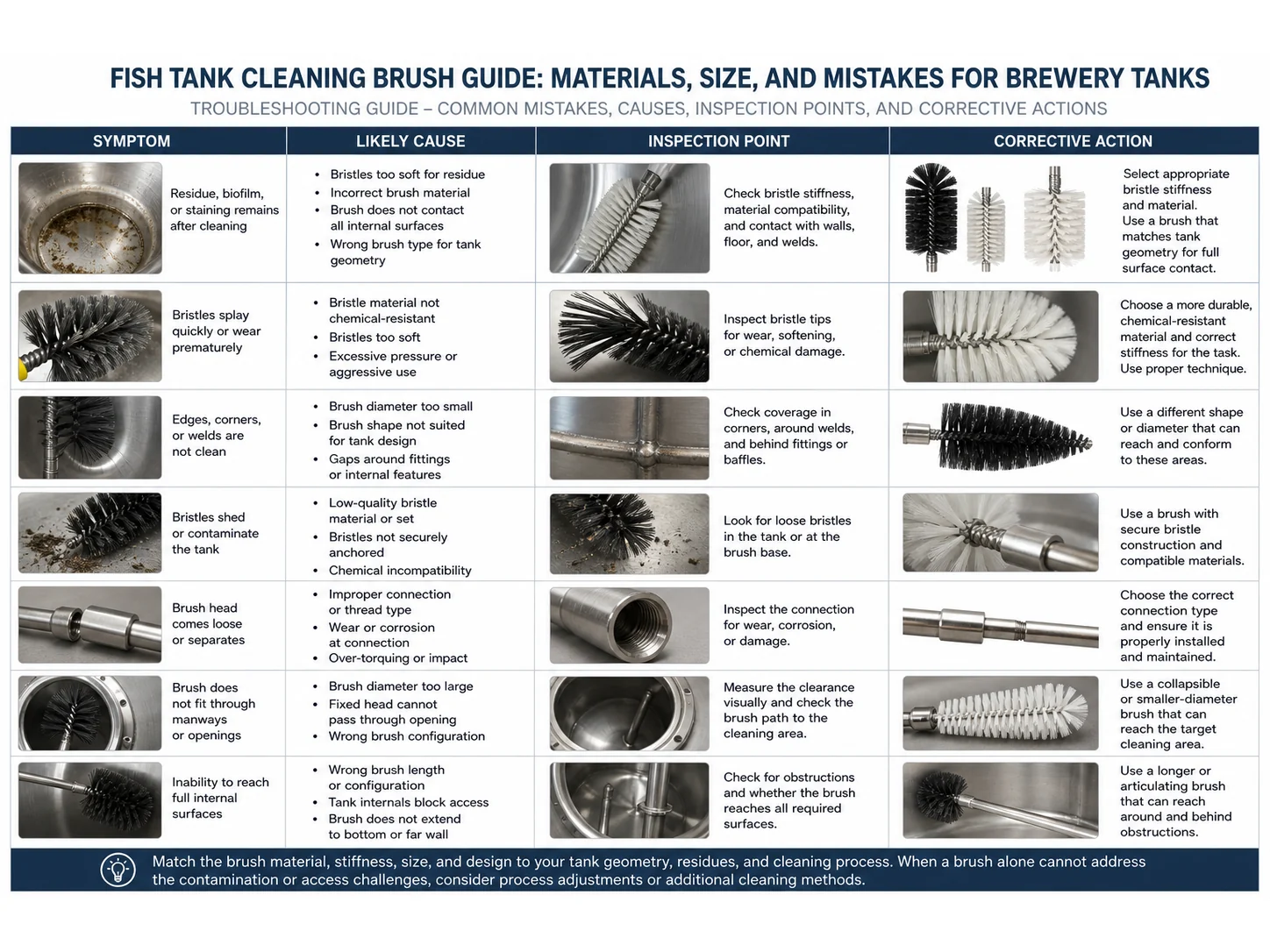
What Is a Fish Tank Cleaning Brush in a Brewery Context?
A fish tank cleaning brush is a long-reach brush originally designed for scrubbing aquarium surfaces. In a brewery setting, it becomes a targeted manual cleaning tool used to remove residue, biofilms, and light deposits from stainless steel tanks—especially in areas that automated clean-in-place (CIP) systems may leave behind, such as racking ports, sight glass fittings, and fermenter cones.
Key Material Options for Fish Tank Cleaning Brushes
Brush bristles and cores directly affect cleaning performance, surface safety, and chemical compatibility. Below are the most common materials used in brewery-compatible cleaning brushes.
| Bristle Material | Stiffness | Chemical Resistance | Max Temp (approx.) | Surface Risk | Best For |
|---|---|---|---|---|---|
| Nylon (polyamide) | Medium | Good; resists mild acids and alkalis | 120°F (49°C) | Low; safe on 304/316 SS | General residue, daily scrubbing |
| Polyester (PBT) | Medium-high | Excellent; tolerates most CIP chemicals | 180°F (82°C) | Low–medium; test on polished surfaces | Stubborn deposits, frequent hot cleaning |
| Polypropylene | Soft | Excellent; inert to many solvents | 150°F (66°C) | Very low | Gasket areas, delicate liners |
| Abrasive nylon (e.g., SiC-impregnated) | High | Good | 120°F (49°C) | Medium; can alter finish if overused | Beer stone removal; spot treatment only |
| Natural fibers (Tampico, horsehair) | Soft–medium | Poor; absorbs water and chemicals | Low | High contamination risk | Avoid in sanitary environments |
Handle and core materials also matter:
- Stainless steel core: excellent durability and chemical resistance; ideal for heavy use.
- Plastic-coated wire core: affordable, flexible, but may degrade with harsh chemicals or high heat.
- Fiberglass handle: lightweight, chemical-resistant, non-conductive; good for long reaches.
- Aluminum core: avoid in caustic environments—it can react and weaken.
Brush Design and Sizing Considerations
Brewery tanks have port openings, curved walls, and varying capacities. Matching brush design to the tank geometry prevents incomplete cleaning and operator fatigue.
- Diameter: Measure the smallest opening the brush must pass through. Choose a brush diameter slightly larger (10–20% oversize) for effective wall contact without excessive force.
- Length: Handle length must reach the furthest interior point while keeping the operator outside the tank. Add 6–12 inches for hand grip.
- Brush shape:
- Straight tube brush: best for pipes, racking arms, and narrow ports.
- Flat brush: covers larger, flatter areas like tank sidewalls.
- Bent or angled brush: reaches around corners or into cone bottoms of fermenters.
- Bristle pattern: Spiral-wound brushes provide 360° cleaning; tufted styles offer more aggressive spot scrubbing.
Comparing Common Fish Tank Cleaning Brush Types for Breweries
| Brush Type | Typical Use | Reach | Effectiveness on Curves | Suitable for Brewery Tanks |
|---|---|---|---|---|
| Straight tube brush | Pipes, sample ports | Long, narrow | Moderate | Yes—great for hard lines |
| Flat deck brush | Large flat surfaces, floor areas | Limited by handle angle | Poor on tight radius | For external tank tops or large manway rims |
| Bent brush (offset head) | Fermenter cones, dome tops | Good with long handle | Excellent | High—ideal for cone and shoulder cleaning |
| Flue/radiator brush | Deep, straight cylindrical runs | Very long | Minimal | Only for long straight lines, not tanks |
How to Choose the Right Fish Tank Cleaning Brush for Your Brewery
Use these decision factors to narrow down your options:
- Residue type: Light yeast and hop oils need medium nylon; beer stone may require polyester or abrasive nylon, but test on a coupon first.
- Tank surface finish: Electropolished or 2R finish demands softer bristles (polypropylene or fine nylon). 2B or mill finish tolerates stiffer brushes.
- Chemical exposure: If the brush will be used with acid or caustic washes, verify bristle and core material compatibility.
- Temperature: Hot cleaning cycles (above 140°F) require polyester or polypropylene; nylon may soften.
- Frequency: Daily use calls for durable stainless steel core; occasional use may be fine with a coated wire core.
- Ergonomics: For vertical tanks, a lightweight fiberglass handle reduces operator strain.
Common Mistakes When Selecting a Fish Tank Cleaning Brush for Brewery Tanks
- Using wire bristles or metal scrapers: These can embed in stainless steel, causing rust and pitting that harbor bacteria.
- Ignoring bristle stiffness: Too stiff can wear down the passive chromium oxide layer, leading to corrosion over time.
- Choosing the wrong diameter: A brush that’s too small won’t scrub effectively; too large can get stuck or wedge into openings.
- Not verifying chemical compatibility: An aluminum core exposed to caustic cleaners will corrode, contaminating the tank.
- Relying on natural fibers: They absorb moisture and chemicals, becoming a breeding ground for bacteria—unacceptable in sanitary brewing.
- Skipping sample testing: A small test (on a plate of the same tank material) can prevent costly finish damage.
When a Fish Tank Cleaning Brush Is the Wrong Choice
A manual brush is a valuable supplement, but it has limits. Consider other methods or expert input when:
- Heavy beer stone or mineral scale covers large areas—acid recirculation or mechanical buffing may be required.
- Deep pits or crevices exist in welds or gaskets; a simple brush cannot effectively clean these and may need a focused jet or disassembly.
- Validated sanitary processes demand reproducible cleaning; a manual brush stroke is operator-dependent and hard to validate.
- Complex tank internals (agitators, cooling jackets) require a brush that matches the exact contour—off-the-shelf shapes often fall short. A supplier drawing review or custom brush may be necessary.
- Sterile transfers or yeast propagation may need a dedicated, sterilizable brush with documentation.
Final Takeaway
A fish tank cleaning brush can be an effective, low-cost tool for spot cleaning brewery tanks when chosen with care. Match bristle material to your tank’s surface finish and chemical environment, select a handle length and brush diameter that reach the target area without compromising operator safety, and avoid common pitfalls like metal bristles or unvalidated shapes. When in doubt, test a sample on a representative surface first, and involve the brush supplier early if your tank geometry is unusual.
Frequently Asked Questions
Can I use any aquarium brush for my brewery tank?
Not without checking materials. Many aquarium brushes use natural fibers or metal cores that can contaminate or react with cleaning chemicals. Always verify bristle and core compatibility with your CIP solutions and tank surface.
What is the safest bristle material for stainless steel tanks?
Nylon and polypropylene are generally the safest because they are non-abrasive and chemically resistant. Polyester is also safe if you test its stiffness on a sample plate, but avoid abrasive-impregnated nylon unless you have a specific need and have done a surface finish check.
How do I measure for the correct brush diameter?
Measure the inside diameter of the smallest port or opening the brush must pass through. Select a brush diameter about 10–20% larger than that opening. The slight oversize ensures good wall contact while still being flexible enough to insert.
Does brush stiffness affect how well it removes beer stone?
Yes—stiffer bristles (polyester or abrasive nylon) are more effective at mechanically breaking beer stone, but they also increase the risk of scratching or dulling the tank’s finish. Always test on a non-critical area first and consider alternating with a softer brush for routine cleaning.
How often should I replace a brewery cleaning brush?
Inspect bristles for deformation, fraying, or chemical discoloration after each use. Replace the brush when bristles become flattened, noticeably softer, or if any core material is exposed. In high-use environments, this might be every few months.
Should I use a bent or straight brush for fermenter cones?
A bent brush (often with a 30–45° offset) is much more effective for the sloped cone section because it allows the bristles to make full contact without requiring the operator to lean dangerously over the manway. Straight brushes are better for the cylindrical sidewalls.
Can I sanitize my brush between uses?
Yes, if the materials allow. Rinse thoroughly with clean water, then soak in a sanitizing solution compatible with the bristle and core material (e.g., peracetic acid at recommended concentration). Allow to air dry completely, hanging bristles down to prevent moisture accumulation in the core.
Do I need a different brush for caustic cleaning cycles?
If your brush will be used while caustic (alkaline) cleaners are present, verify that the core material is compatible. Stainless steel cores are ideal; avoid aluminum or certain coated wires that may degrade. Polypropylene and polyester bristles handle caustic well, while nylon may lose stiffness over time with aggressive alkalis.
Technical References
- eCFR — 21 CFR 178.1010 Sanitizing Solutions
- eCFR — 21 CFR 177.1500 Nylon Resins
- eCFR — 21 CFR 177.1520 Olefin Polymers
- eCFR — 21 CFR 177.1630 Polyethylene Phthalate Polymers
- NIST — Metric SI
Which bristle material fits this job — Nylon PA, AISI 304 Stainless Steel Wire or Abrasive Nylon?
| Material | Continuous temperature (°C) | Peak temperature (°C) | Water absorption | Hardness |
|---|---|---|---|---|
| Nylon PA | 93 | 121 | 0.3–9% by PA grade and conditioning | Medium to firm; filament diameter and trim length control bending force. |
| AISI 304 Stainless Steel Wire | 400 | 500 | 0% | Rockwell B 70–95 depending on temper and cold work |
| Abrasive Nylon | 120 | 150 | 0.1–1.0% | Abrasive filament; stiffness and cutting level is controlled by PA base, grit type, grit size, filament diameter and trim height. |
| Horsehair | 60–80 | 100–120 | 8–15% | — |
Figures as published by Brushtec / DuPont; Alleima; Perlon. Confirm the exact grade against the supplier datasheet before ordering.
What should replace Nylon PA for fish tank cleaning?
- Nylon PA — Compare Nylon PA with PP, PBT, PET. Change material when wet stiffness, temperature, chemical resistance, conductivity, particle shedding, or surface marking becomes the limiting factor.
- AISI 304 Stainless Steel Wire — Use AISI 316 stainless steel wire for chloride, marine, dairy, beverage, chemical washdown, or higher pitting-resistance requirements. Use carbon steel for dry aggressive cutting and brass or abrasive nylon for lower marking risk.
- Abrasive Nylon — Compare Abrasive Nylon with PP, PBT, PET. Change material when wet stiffness, temperature, chemical resistance, conductivity, particle shedding, or surface marking becomes the limiting factor.
- Horsehair — Compare Horsehair with Boar bristle, goat hair, microfiber. Change material when wet stiffness, temperature, chemical resistance, conductivity, particle shedding, or surface marking becomes the limiting factor.