
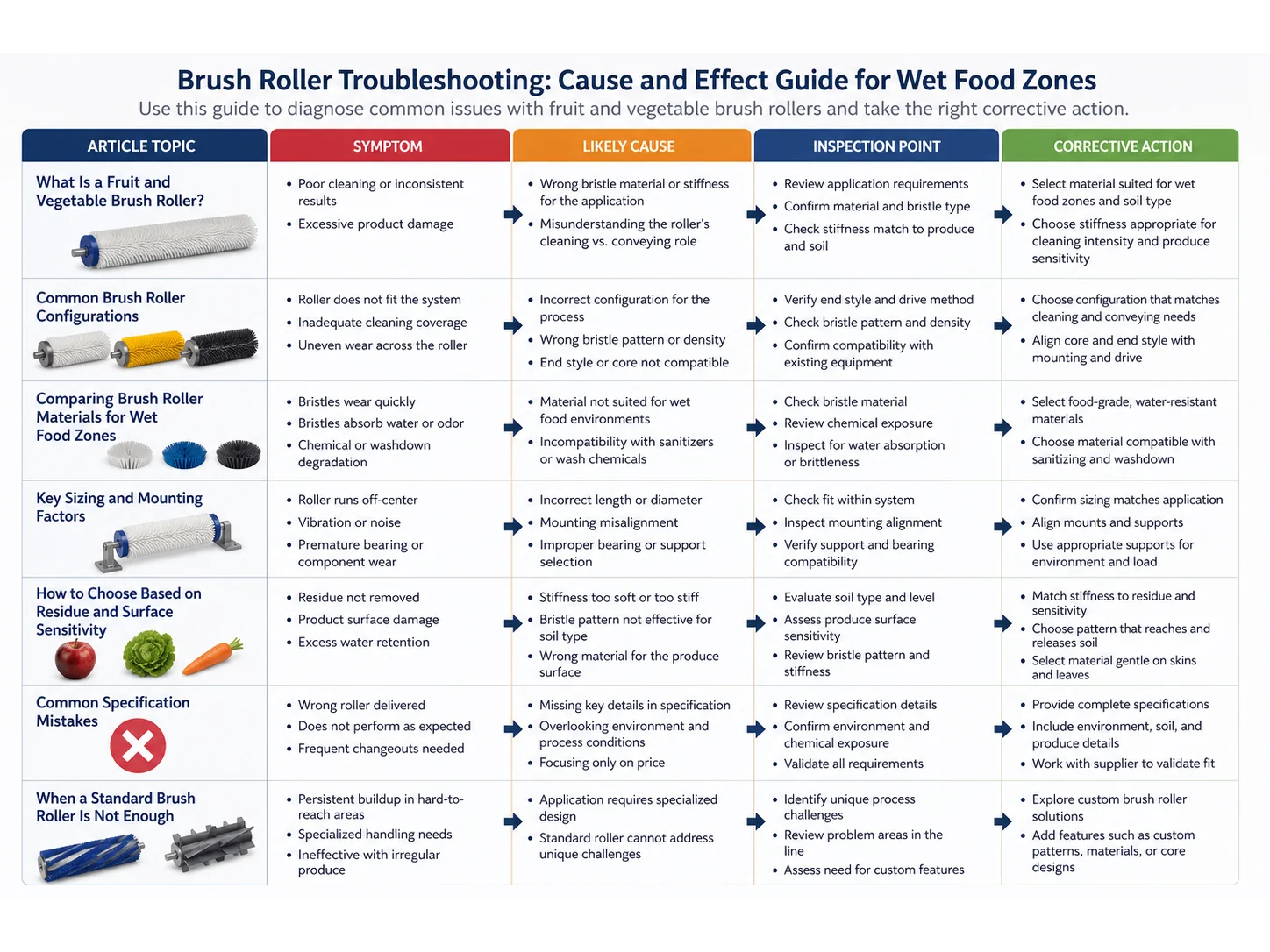
What Is a Fruit and Vegetable Brush Roller?
A fruit and vegetable brush roller is a rotating shaft fitted with bristles, flexible flaps, or abrasive-impregnated filaments, mounted inside washing, peeling, or polishing equipment. Its job is to scrub produce surfaces effectively in high-humidity, food-contact environments. The roller may be driven by a motorized shaft or idler mounts, and its design must balance cleaning aggression with gentle product handling—especially for thin-skinned or easily bruised produce.
Common Brush Roller Configurations
Most brush rollers for wet food zones fall into a few repeatable designs. While exact construction varies by supplier, understanding these core types helps you ask the right questions during specification.
- Strip brush rollers: Bristles are set in a metal or plastic channel and wound spirally around a central core. Good flexibility for uneven product surfaces, easy to replace individual strips.
- Wound brush rollers: Bristles are directly tufted or wound onto a continuous core. Often more compact and used where space is limited.
- Full-fit abrasive rollers: Instead of individual bristles, the entire roller surface is coated with abrasive grit embedded in nylon or other material. Best for heavy soiling or peel removal but can be too aggressive for delicate items.
- Combination rollers: Mix of soft bristles and abrasive sections for multi-stage cleaning in a single pass.
Comparing Brush Roller Materials for Wet Food Zones
Material selection is the most frequent point of confusion—and the most costly when done wrong. Below is a comparison of the most common bristle and core materials for fruit and vegetable processing in wet environments.
| Material | Typical Use | Wet Zone Suitability | Stiffness / Aggression | Temperature Limit | Key Considerations |
|---|---|---|---|---|---|
| Nylon 6 / 6.6 (plain) | Washing potatoes, root veg | Excellent | Medium to firm | Up to 200°F (93°C) | Resists water absorption; can be FDA-compliant when food-grade approved |
| Nylon with abrasive grit | Peeling, polishing | Good | Aggressive | Up to 200°F (93°C) | Embedded silicon carbide or aluminum oxide; reduces bristle count for equivalent cut |
| Polypropylene | Light scrubbing, leafy veg | Excellent, hydrophobic | Soft to medium | Up to 180°F (82°C) | Chemically resistant; won’t absorb water; may feel too flexible for heavy soil |
| Polyester (PET) | General wash lines | Good | Medium-firm | Up to 250°F (121°C) | Holds stiffness well in hot water; check FDA status by grade |
| Tampico / natural fiber | Hand wash, specialty | Poor for continuous wet | Soft | Not for hot water | Absorbs water, can harbor microbes; avoid in most automated wet zones |
| Stainless steel wire (wet-rated) | Heavy soil, abrasive peel | Excellent | Very aggressive | High | Only for sturdy produce; may require compatible core to avoid galvanic corrosion |
Note: Always confirm with your supplier that the assigned material meets FDA, EU, or your local food-contact regulations for the intended use.
Key Sizing and Mounting Factors
Getting the physical dimensions right prevents installation headaches and ensures uniform coverage across your conveyor or drum. Focus on these parameters:
- Overall diameter (OD): Determines contact arc with product. Larger diameters can scrub wider items, but may require more torque.
- Bristle trim length: Longer trim offers more flexibility and reach into crevices; too long can fold over and lose cleaning efficiency.
- Shaft / core type: Solid stainless steel for clamp-on mounts, hollow plastic core for slip-on shafts, or keyed hubs for driven rolls. In wet zones, prioritize sealed or stainless hardware.
- Face length: Must match your conveyor width with some overtravel to avoid unbrushed edges.
- Mounting style: Flange, bearing-supported, or quick-release designs all affect changeover time and water ingress.
How to Choose Based on Residue and Surface Sensitivity
Instead of starting with a material, start with the cleaning challenge:
- What residue? Light dust vs. caked mud vs. waxy peel vs. sticker adhesive. Light dust needs soft bristles; heavy mud may need stiff nylon; adhesive or peel may need abrasive-embedded rollers.
- How delicate is the surface? Berries and soft fruit (high sensitivity) demand polypropylene or very soft nylon with long trim. Root vegetables (low sensitivity) tolerate firm nylon or even steel.
- Is the line wet, dry, or alternating? In constant wet, avoid absorbent materials. If the zone runs dry then wet, ensure the roller doesn’t saturate and swell.
- Chemical exposure: Chlorinated wash water, peracetic acid, or alkaline peelers can degrade certain plastics. Polypropylene and nylon generally resist, but always request chemical compatibility data.
- Hygiene expectations: Smooth, non-porous bristles and sealed cores reduce microbial hideouts. If frequent swabbing or ATP testing is required, choose materials that withstand repeated sanitizer exposure.
Common Specification Mistakes
Even experienced buyers trip up on these avoidable errors:
- Ignoring the core material: A low-cost carbon steel core will rust in wet zones. Stainless steel or engineered plastic cores are standard for washdown.
- Overlooking FDA compliance proof: “Food-grade” is a claim; ask for documentation or third-party certification for the exact bristle compound and colorant.
- Copying stiffness from a different crop: What cleans carrots may bruise apples. Do not assume one durometer works for all.
- Choosing diameter by cost only: A smaller diameter may spin faster and cause excessive bristle wear or product bounce.
- Skipping shaft end details: Square, hex, keyway, or plain—mismatched connections cause downtime and unsafe field modifications.
- Forgetting to check maximum RPM and load rating: Exceeding limits leads to premature fatigue and bristle loss.
When a Fruit and Vegetable Brush Roller Is the Wrong Choice
Sometimes, no off-the-shelf brush roller will meet your requirements. Consider a custom design or alternative cleaning method when:
- Your produce shape is irregular and a single roller profile will miss shadowed areas.
- You need both gentle washing and aggressive cut in the same pass—a segmented or multi-material roll may be necessary.
- Cleaning validation data or pathogen reduction targets require documented performance that catalog items can’t Help confirm.
- The operating environment exceeds the temperature or chemical resistance of standard materials (e.g., steam blanching, high-acid flumes).
- Quick-change tooling is required but existing mounts don’t accommodate a standard roller. In these cases, request a supplier drawing review and a sample for line testing before committing to a full production order.
Final Takeaway: Match the Roller to the Real Washdown Task
A fruit and vegetable brush roller seems simple, but small misses in material, stiffness, or sizing create big problems in wet food zones. Start with the residue and product sensitivity, not with a favorite material. Insist on wet-zone proof points for the core, bristle absorption, and chemical compatibility. Pilot test before scaling up, and keep spare rollers on hand to avoid emergency substitutions that break your food safety plan. The right brush roller not only cleans better—it protects both your produce and your process.
Frequently Asked Questions
What bristle material works best for washing leafy greens?
Soft polypropylene or fine nylon bristle with a long trim length is usually preferred. These materials resist water absorption, are chemically tolerant, and provide gentle scrubbing without shredding delicate leaves.
Can I use the same brush roller for potatoes and apples?
It is risky. Potatoes often tolerate stiffer bristles and deeper trim for soil removal, while apples may bruise under the same aggression. Unless you run both crops at identical settings and have verified no damage, use separate roller sets for firm and tender produce.
How do I know if my brush roller is FDA compliant?
Ask the supplier for a written statement or certificate for the specific bristle compound and any embedded colorants. “Food-grade” is not enough. The material must meet 21 CFR requirements and be traceable by lot or formulation.
What diameter brush roller fits my existing washer?
Measure the distance from the shaft center to the product contact surface on your current roller, then check the mount and bearing dimensions. New rollers must match the original centerline height and shaft end style unless you are re-engineering the line.
How often should I inspect or replace brush rollers in a wet line?
Implement a visual check at least weekly for bristle flattening, missing tufts, and core corrosion. In high-volume or abrasive applications, you may replace rollers every 3 to 6 months. Keep a log and photos to identify wear trends before they affect cleaning.
Is a brush roller with a metal core safe for wet food zones?
Yes, if the core is stainless steel (304 or 316 grade) and all exposed metal is sealed or passivated. Avoid carbon steel, painted, or chrome-plated cores—they will rust and flake, creating foreign material risks.
Can I request a custom brush roller for irregular-shaped produce?
Yes. Suppliers often provide engineering support for profile rollers, multi-density zones, or special abrasive patterns. Always request a dimensioned drawing and a sample for testing before committing to a custom run.
What is the difference between a strip brush roller and a wound brush roller?
A strip roller uses replaceable brush channels wound around the core, which simplifies repair and offers flexibility. A wound roller is built directly onto the core, making it more compact and often stiffer, but harder to repair in the field. Choose strip for changeover flexibility; wound for tight spaces and higher stiffness.
Technical References
- eCFR — 21 CFR 178.1010 Sanitizing Solutions
- FDA — Food Code
- eCFR — 21 CFR 177.1500 Nylon Resins
- eCFR — 21 CFR 177.1520 Olefin Polymers
- eCFR — 21 CFR 177.1630 Polyethylene Phthalate Polymers
- eCFR — 21 CFR Part 117 Human Food CGMP and Preventive Controls
Which nylon grade fits this job — Nylon PA, PA6 Nylon or PA66 Nylon?
| Grade | Continuous temperature (°C) | Peak temperature (°C) | Water absorption | Hardness |
|---|---|---|---|---|
| Nylon PA | 93 | 121 | 0.3–9% by PA grade and conditioning | Medium to firm; filament diameter and trim length control bending force. |
| PA6 Nylon | 80–100 | 130–160 | 1.5–3.0% | Shore D 75–85 |
| PA66 Nylon | 100–120 | 150–180 | 1.0–1.8% | Shore D 80–88 |
| PA610 Nylon | 90–110 | 130–150 | 0.5–1.0% | Shore D 72–82 |
| PA612 Nylon | 90–110 | 130–150 | 0.3–0.7% | Shore D 70–80 |
Figures as published by Brushtec / DuPont. Confirm the exact grade against the supplier datasheet before ordering.
What should replace Nylon PA for wet zones?
- Nylon PA — Compare Nylon PA with PP, PBT, PET. Change material when wet stiffness, temperature, chemical resistance, conductivity, particle shedding, or surface marking becomes the limiting factor.
- AISI 304 Stainless Steel Wire — Use AISI 316 stainless steel wire for chloride, marine, dairy, beverage, chemical washdown, or higher pitting-resistance requirements. Use carbon steel for dry aggressive cutting and brass or abrasive nylon for lower marking risk.