
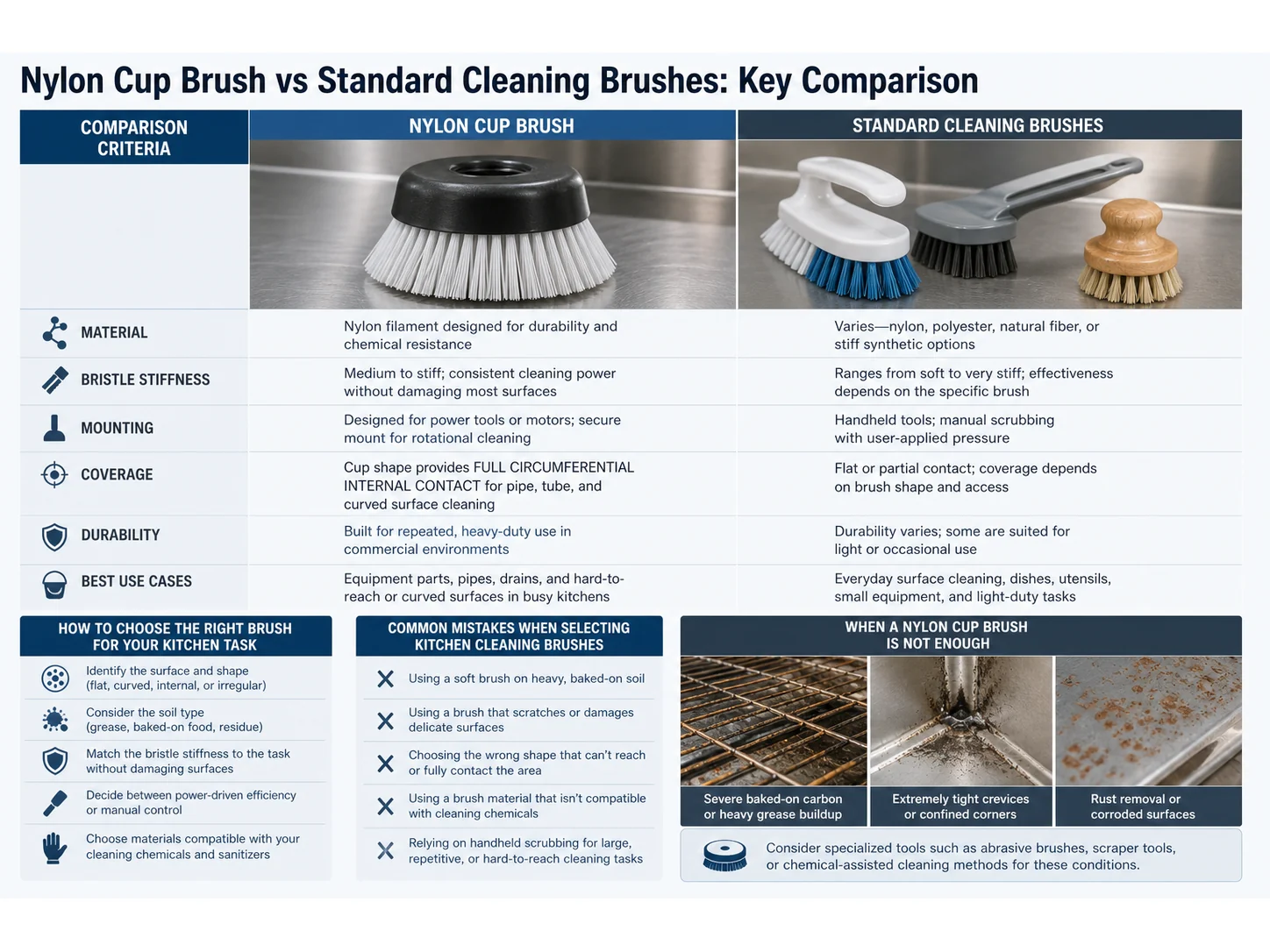
What Is a Nylon Cup Brush?
A nylon cup brush is a cleaning tool consisting of nylon filaments embedded in a cup-shaped hub that mounts onto a power tool, such as a drill or angle grinder. The cup shape allows the bristles to conform to curved surfaces, corners, and edges while the rotating action provides consistent cleaning pressure. Nylon bristles are available in non-abrasive and abrasive varieties—abrasive types contain silicon carbide or aluminum oxide grit for more aggressive material removal. These brushes are commonly used for removing light rust, paint, scale, baked-on food residues, and polishing metal surfaces in food preparation environments.
Common Types of Cleaning Brushes in Kitchens
Kitchens rely on several brush types for daily and deep cleaning. Standard hand brushes with nylon bristles are the most familiar—they require manual effort and work well for loose debris and light soiling. Scouring pads or sponges combine abrasive materials with detergents for scrubbing pots, pans, and surfaces. Wire cup brushes mount on power tools and use steel, stainless steel, or brass bristles for heavy rust and scale removal, but they can scratch softer metals and leave wire fragments. Nylon cup brushes bridge the gap between manual scrubbing and aggressive wire brushing, offering a safer, chemical-resistant option for powered cleaning in wet or sanitary environments.
Nylon Cup Brush vs Standard Cleaning Brushes: Key Comparison
| Attribute | Nylon Cup Brush (Non-Abrasive) | Nylon Cup Brush (Abrasive) | Wire Cup Brush | Hand Brush / Scouring Pad |
|---|---|---|---|---|
| Material | Nylon filaments (plain) | Nylon with embedded abrasive grit | Steel, stainless steel, or brass wire | Nylon bristles, abrasive fibers, or steel wool |
| Typical Stiffness | Medium to stiff | Stiff to very stiff | Very stiff | Soft to medium |
| Surface Safety | High; safe for stainless steel, plastic, non-stick coatings (when used gently) | Moderate; can scratch aluminum or coatings if grit is too coarse | Low; can scratch stainless steel, remove coatings, and leave metal particles | Varies; nylon brushes are generally safe; steel wool can scratch |
| Equipment Needed | Drill, die grinder, or angle grinder | Drill, die grinder, or angle grinder | Angle grinder or high-torque drill | Manual application |
| Best For | Light cleaning, polishing, removing loose debris, wet scrubbing | Removing light rust, paint, scale, baked-on grease, and surface preparation | Heavy rust removal, weld cleaning, stripping thick coatings on durable metals | Daily wipe-downs, scrubbing utensils, light degreasing |
| Wet/Chemical Resistance | Excellent; unaffected by water, most detergents, and mild acids | Excellent; abrasive grit is bonded and does not degrade quickly in chemicals | Poor for carbon steel (rusts); stainless or brass better but can still trap moisture and food particles | Nylon brushes are chemical-resistant; scouring pads may break down with harsh chemicals |
| Hygiene/Maintenance | Easy to rinse and sanitize; no metal particles left behind | Easy to rinse; grit may shed if heavily worn, requiring post-cleaning rinse of surfaces | Difficult to fully clean; bristles can trap bacteria and rust, posing contamination risk | Hand brushes can be sanitized; scouring pads should be replaced frequently to avoid bacterial growth |
| Skill Level Required | Low to moderate; power tool experience helpful | Low to moderate; pressure and speed control needed to avoid surface damage | Moderate to high; requires steady hand to prevent gouging and wire throw | None; manual use only |
How to Choose the Right Brush for Your Kitchen Task
Start by identifying the residue type and surface material. For light food soils on stainless steel or plastic, a non-abrasive nylon cup brush on a drill provides fast, consistent cleaning without scratching. If you need to remove baked-on carbon or light rust from oven interiors or grill grates, an abrasive nylon cup brush is effective and safer than wire. Always match the brush diameter to your power tool’s recommended speed range to prevent bristle fly-off or uneven wear. Consider whether the cleaning area is wet or involves chemicals: nylon brushes resist degradation, while wire brushes may corrode if not dried immediately.
Hygiene expectations matter in commercial kitchens. Nylon cup brushes are easier to sanitize because they have no tiny metal crevices that harbor bacteria. They also do not leave metal fragments that could contaminate food. For daily light cleaning, a standard hand brush or scouring pad is often more convenient and sufficient. Reserve powered cup brushes for periodic deep cleaning or maintenance. Custom sizes may be needed for specialized kitchen equipment with tight contours—in those cases, consult a supplier who can provide a brush drawing for review.
Common Mistakes When Selecting Kitchen Cleaning Brushes
- Using wire brushes on stainless steel: Carbon steel wire can leave particles that rust, causing discoloration and pitting. Even stainless steel wire brushes can scratch if too aggressive.
- Choosing stiffness over compatibility: A very stiff bristle might remove residue quickly but can damage soft metals, plastics, or non-stick coatings.
- Ignoring power tool compatibility: A cup brush with a large diameter run at excessive speed can be dangerous and wear unevenly. Always check the maximum RPM rating.
- Overlooking chemical exposure: Some detergents or sanitizers can degrade natural bristle or non-synthetic materials. Nylon is broadly compatible, but always verify with your cleaning chemical supplier.
- Skipping brush maintenance: After use, thoroughly rinse and dry the brush to prevent residue buildup and bacterial growth. Replace brushes when bristles are permanently bent or severely worn.
- Assuming one brush works for all tasks: A cup brush excels at powered cleaning of surfaces and edges, but it cannot replace a tube brush for inside pipes or a small detail brush for tight crevices.
When a Nylon Cup Brush Is the Wrong Choice
A nylon cup brush, even in abrasive form, has limits. For thick layers of rust, heavy scale, or industrial coatings, a wire cup brush or chemical stripping agent may be required. On extremely delicate surfaces like antiqued copper or certain polished plastics, even a soft nylon brush can leave micro-scratches—test in an inconspicuous area first. For food-contact surfaces that demand strict sanitation protocols, ensure the brush design allows complete disassembly or thorough rinsing; if not, a simpler manual brush that can be boiled or autoclaved might be safer. Additionally, cup brushes cannot reach deep inside narrow tubing or small-diameter pipes; a bottle brush or flexible tube brush is needed there. When a unique shape or bristle pattern is required for custom kitchen equipment, work with a brush manufacturer to review a custom drawing and, if possible, request a sample before full production.
Final Takeaway
No single brush solves every kitchen cleaning challenge. Nylon cup brushes offer an excellent balance of cleaning power, surface safety, and chemical resistance for many home and commercial kitchen tasks when paired with a drill or grinder. Standard hand brushes and scouring pads remain the go-to for daily manual cleaning. The key is to match the brush material, stiffness, and mounting to the specific surface, residue, and workflow of your kitchen. Invest in a few purpose-specific brushes and maintain them well to extend their life and keep your kitchen both clean and safe.
Frequently Asked Questions
Can I use a nylon cup brush on a standard kitchen drill?
Yes, most nylon cup brushes with a 1/4-inch hex shank or threaded arbor fit standard cordless drills. Check that the brush’s maximum RPM rating is not exceeded by your drill’s no-load speed to avoid bristle fly-off.
How do I clean and sanitize a nylon cup brush after use?
Rinse the brush under warm water immediately after use to remove food particles and cleaning chemicals. For sanitization, soak in a diluted bleach solution (following local health codes) or a quaternary ammonium sanitizer, then rinse and dry thoroughly before storage.
Is an abrasive nylon cup brush safe for stainless steel sinks?
Yes, when used with light pressure and a medium grit, abrasive nylon cup brushes can remove stains and restore a uniform finish without deep scratching. Always test on a small, hidden area first and avoid high-pressure or continuous dwelling in one spot.
What diameter cup brush should I use for cleaning oven interiors?
For most residential ovens, a 3-inch or 4-inch diameter cup brush works well. For commercial ovens with larger flat surfaces, a 6-inch brush can cover more area quickly. Choose a size that fits comfortably inside corners and around heating elements without forcing.
Can nylon cup brushes handle high-temperature cleaning?
Standard nylon bristles soften at temperatures above 200°F (93°C). For cleaning warm surfaces (e.g., just-cooled grills), allow the surface to drop below that threshold or use a brush with heat-resistant nylon grades. Steam cleaning environments require brushes specifically rated for high temperatures.
How often should I replace a nylon cup brush in a commercial kitchen?
Inspect the brush after each use. Replace it when bristles become permanently flattened, broken, or when the brush loses its cup shape. In high-volume commercial settings, brushes may need replacement every few weeks; lighter use can extend life to several months.
What’s the difference between a nylon cup brush and a wire cup brush for kitchen use?
Nylon cup brushes are generally safer for stainless steel and non-metal surfaces because they do not leave rust-prone metal particles. They resist chemicals and moisture. Wire brushes are more aggressive and better suited for thick rust or scale on durable metals, but they risk contamination and surface scratching in food environments.
Can I get custom-sized nylon cup brushes for unique equipment shapes?
Yes, many brush manufacturers offer custom diameters, bristle lengths, and mounting adapters. Provide a drawing with dimensions, desired bristle material, grit (if any), and shank type. Expect a longer lead time and possibly a minimum order quantity for custom designs.
Technical References
- CDC — Preventing Food Poisoning
- eCFR — 21 CFR 177.1500 Nylon Resins
- OSHA — 1910.242 Hand and Portable Powered Tools
- OSHA — 1910.215 Abrasive Wheel Machinery
- OSHA — Personal Protective Equipment
- FDA — Food Safety in Your Kitchen
Which bristle material fits this job — Nylon PA, AISI 304 Stainless Steel Wire or Abrasive Nylon?
| Material | Continuous temperature (°C) | Peak temperature (°C) | Water absorption | Hardness |
|---|---|---|---|---|
| Nylon PA | 93 | 121 | 0.3–9% by PA grade and conditioning | Medium to firm; filament diameter and trim length control bending force. |
| AISI 304 Stainless Steel Wire | 400 | 500 | 0% | Rockwell B 70–95 depending on temper and cold work |
| Abrasive Nylon | 120 | 150 | 0.1–1.0% | Abrasive filament; stiffness and cutting level is controlled by PA base, grit type, grit size, filament diameter and trim height. |
| Boar Bristle | 60–80 | 100–120 | 10–18% | — |
| PBT | 120–140 | 160–180 | 0.05–0.20% | Shore D 80–90 |
Figures as published by Brushtec / DuPont; Alleima; Perlon. Confirm the exact grade against the supplier datasheet before ordering.
What should replace Bottle & Container Brushes for kitchens?
- Bottle & Container Brushes — Bottle and container brushes are selected around an opening plus a larger vessel body and bottom geometry; tube and bore brushes are selected mainly around a long diameter-controlled passage. Closest alternative: Tube & Pipe Bore Brushes.
- Nylon PA — Compare Nylon PA with PP, PBT, PET. Change material when wet stiffness, temperature, chemical resistance, conductivity, particle shedding, or surface marking becomes the limiting factor.
- AISI 304 Stainless Steel Wire — Use AISI 316 stainless steel wire for chloride, marine, dairy, beverage, chemical washdown, or higher pitting-resistance requirements. Use carbon steel for dry aggressive cutting and brass or abrasive nylon for lower marking risk.
- Abrasive Nylon — Compare Abrasive Nylon with PP, PBT, PET. Change material when wet stiffness, temperature, chemical resistance, conductivity, particle shedding, or surface marking becomes the limiting factor.