
What Is a Precision Wafer Brush?
A precision wafer brush is a high-tolerance cleaning tool designed to remove residues from semiconductor wafers without causing physical damage or leaving contamination. Unlike generic cleaning brushes, it uses carefully selected materials, controlled bristle stiffness, and mounting options that fit automated wafer handling equipment. The goal is to achieve consistent cleaning results while protecting sensitive wafer surfaces.
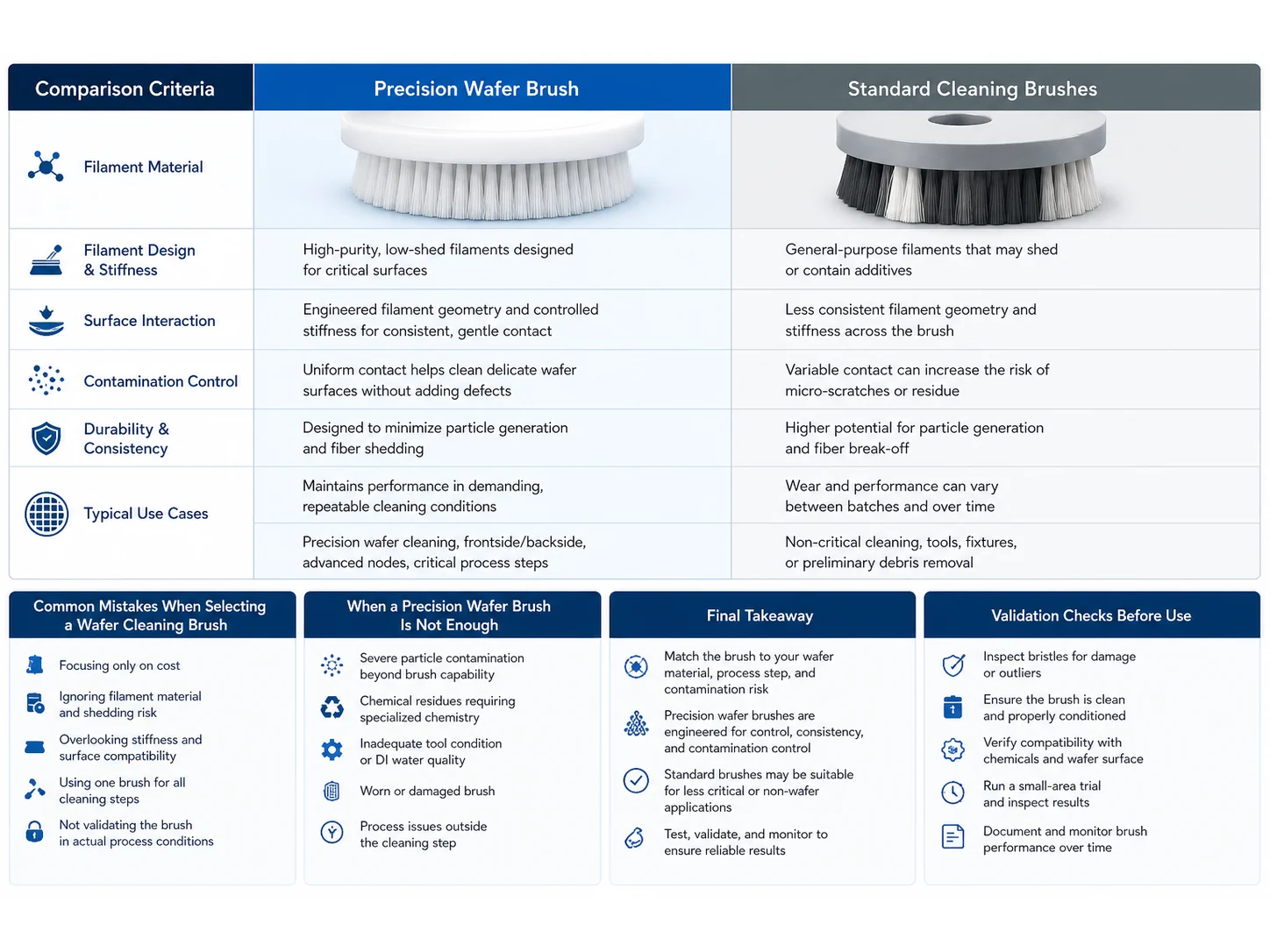
Standard Cleaning Brushes vs Precision Wafer Brushes
The table below highlights key differences between a precision wafer brush and a typical standard cleaning brush.
| Comparison Factor | Precision Wafer Brush | Standard Cleaning Brush |
|---|---|---|
| Material | PVA sponge, engineered microfiber, antistatic nylon | Generic nylon, polyester, natural bristle |
| Diameter Range | Tightly controlled, often custom to wafer size | Common stock diameters, wider tolerance |
| Bristle Stiffness | Precisely specified durometer for minimal surface stress | General purpose stiffness, may scratch |
| Handle / Core Design | Designed for tool chucks, automated mounting, balanced core | Simple molded or wooden handle |
| Contamination Risk | Low particle shedding, cleanroom compatible | Higher particle and extractable contamination |
| Typical Applications | Post-CMP, pre-diffusion, wafer reclaim | General parts washing, lab glassware |
How to Choose the Right Brush for Your Wafer Cleaning Process
Selecting between a precision wafer brush and a standard alternative depends on your process conditions and contamination budget. Evaluate these factors:
- Residue type: Slurry, organic films, or loose particles each require different brush materials and surface loads.
- Surface sensitivity: Soft dielectric films or metal lines demand very low durometer bristles to prevent scratching.
- Equipment interface: Automated wafer scrubbers require brushes with exact core dimensions and mounting features.
- Wet or chemical exposure: Brushes must resist acids, bases, or solvents without degradation or swelling.
- Hygiene expectations: Cleanroom class (e.g., ISO 4) limits particle generation and outgassing.
- Maintenance frequency: Brush life and replacement cost affect total cost of ownership.
- Custom size requirements: Non‑standard wafer diameters or tool fit may need a custom drawing review.
Common Mistakes When Selecting a Wafer Cleaning Brush
- Choosing by cost drivers alone: A low‑cost standard brush can become expensive due to wafer scrap or rework.
- Ignoring bristle stiffness: Too‑stiff bristles cause micro‑scratches; too‑soft may not clean effectively.
- Using a standard brush for precision steps: Standard brushes are not validated for particle release or chemical compatibility in wafer fabs.
- Overlooking core/handle material: A metal core can cause galvanic corrosion or contamination in wet chemistry.
- Neglecting cleanroom compatibility: Standard brushes often shed particles that violate air cleanliness limits.
When a Precision Wafer Brush Is the Wrong Choice
A precision wafer brush is an important tool, but it has limits. Consider these situations where a different or additional approach is needed:
- Full automation is required: Some high‑volume lines need integrated brush stations with in‑situ monitoring; a standalone brush won’t suffice.
- Residue demands alternative cleaning: For sub‑micron particles or stubborn films, megasonic or chemical spray cleaning may be necessary before brush use.
- Custom design is beyond stock: When existing brush geometry won’t fit, work with a supplier on a custom drawing review and sample validation.
- Process integration testing is missing: Always run a test on non‑production wafers to verify cleanliness and defect levels before full rollout.
Final Takeaway
The choice between a precision wafer brush and a standard cleaning brush comes down to process tolerance and contamination budget. For wafer‑level cleaning, a precision brush gives controlled stiffness, low particle shedding, and equipment compatibility that standard brushes cannot match. Evaluate your specific residue, surface, and equipment requirements, and involve a trusted supplier for custom fits and process testing when needed.
Real-Use Checks Before Daily Work
Before putting this brush into routine use, test it against the real working condition. Check the first cleaned part or area, the condition of the bristles, and where loosened debris goes after contact. If the result changes when static control, contact pressure, particle removal path, and sensitivity of nearby components changes, document the new setting instead of assuming the same brush will keep working.
A brush should not be used to hide a process problem. If residue returns immediately, if the surface changes more than expected, or if the brush must be forced to reach the target area, review the surrounding method first. In many applications, brushing works best with inspection, rinsing, vacuum support, machine adjustment, chemical compatibility checks, or a small sample trial.
Frequently Asked Questions
What materials are precision wafer brushes typically made from?
Common materials include PVA sponge, antistatic nylon, microdenier polyester, and various polymer blends. Each is selected for its chemical resistance, particle generation profile, and mechanical durability.
Can a standard brush be used for post‑CMP cleaning?
It is not recommended. Post‑CMP cleaning requires very low defect rates and controlled brush stiffness to avoid scratching delicate copper or dielectric surfaces. A standard brush almost always carries a higher contamination risk.
How do I know what bristle stiffness to choose?
Stiffness should match the hardest surface on your wafer. Softer films need lower durometer bristles. Many suppliers offer durometer options and can guide you based on your specific film stack and residue.
Do precision wafer brushes come in custom sizes?
Yes. While many suppliers offer standard diameters for common wafer sizes (100 mm, 150 mm, 200 mm, 300 mm), custom diameters, core shapes, and mounting features are often available through a drawing review process.
How often should wafer cleaning brushes be replaced?
Replacement frequency depends on process intensity, chemical exposure, and brush material. Some PVA brushes are replaced after a set number of wafers or cycles; others are monitored for visual wear or particle shedding. Always follow the brush supplier’s maintenance guidelines.
How can I avoid contamination from the brush itself?
Choose a brush that has been cleaned and packaged in a cleanroom environment, and ensure the core and bristle materials are low‑outgassing and particle‑tested. Pre‑rinsing brushes before use is also a common practice.
Where can I get a precision wafer brush matched to my equipment?
Work with a supplier that specializes in cleaning brushes for wafer fabrication. Provide your equipment model, wafer size, and cleaning chemistry details. A supplier should offer a drawing review or sample for process testing before you commit to a production order.
Technical References
- EOS/ESD Association — ESD Fundamentals
- EOS/ESD Association — Principles of ESD Control
- NISTIR 4653 — Metrology for the Semiconductor Industry
- ISO 14644-1 Cleanrooms and Associated Controlled Environments
Which bristle material fits this job — Nylon PA, PVA Sponge or Microfiber?
| Material | Continuous temperature (°C) | Peak temperature (°C) | Water absorption | Hardness |
|---|---|---|---|---|
| Nylon PA | 93 | 121 | 0.3–9% by PA grade and conditioning | Medium to firm; filament diameter and trim length control bending force. |
| PVA Sponge | 60 | 90 | — | Soft absorbent contact material; hardness/compression is controlled by foam or sponge density. |
| Microfiber | 80–120 | 140–170 | 0.2–1.0%Material Itself ; Structure Can Absorb 3–7 Times Its Own Weight | — |
| PBT | 120–140 | 160–180 | 0.05–0.20% | Shore D 80–90 |
Figures as published by Brushtec / DuPont; Perlon. Confirm the exact grade against the supplier datasheet before ordering.
What should replace Roller and Conveyor Brushes for precision wafer brush?
- Roller and Conveyor Brushes — Roller and conveyor brushes hold cylindrical line contact across a working width, including helix-wound builds where the filament path is set to move loosened material toward one side; a strip brush holds the same line without rotating, so it seals or wipes but cannot carry residue along the width.
- Nylon PA — Compare Nylon PA with PP, PBT, PET. Change material when wet stiffness, temperature, chemical resistance, conductivity, particle shedding, or surface marking becomes the limiting factor.
- PVA Sponge — Compare PVA Sponge with PU sponge, PP sponge, microfiber. Change material when wet stiffness, temperature, chemical resistance, conductivity, particle shedding, or surface marking becomes the limiting factor.
- Microfiber — Compare Microfiber with Cotton yarn, wool, felt, soft PBT filament. Change material when wet stiffness, temperature, chemical resistance, conductivity, particle shedding, or surface marking becomes the limiting factor.