
What Is Precision Cleaning and Why Does Brush Material Matter?
Precision cleaning is the removal of contaminants down to microscopic levels—often sub-micron particles—from critical surfaces like glass panels, silicon wafers, optical lenses, or medical implants. In automated lines, physical contact from a rotating roller or brush agitates and lifts contaminants while a fluid stream or vacuum carries them away. The brush material directly affects scratching risk, chemical compatibility, contamination pickup efficiency, and maintenance frequency. Choosing the wrong material can cause defects, downtime, or re-contamination.
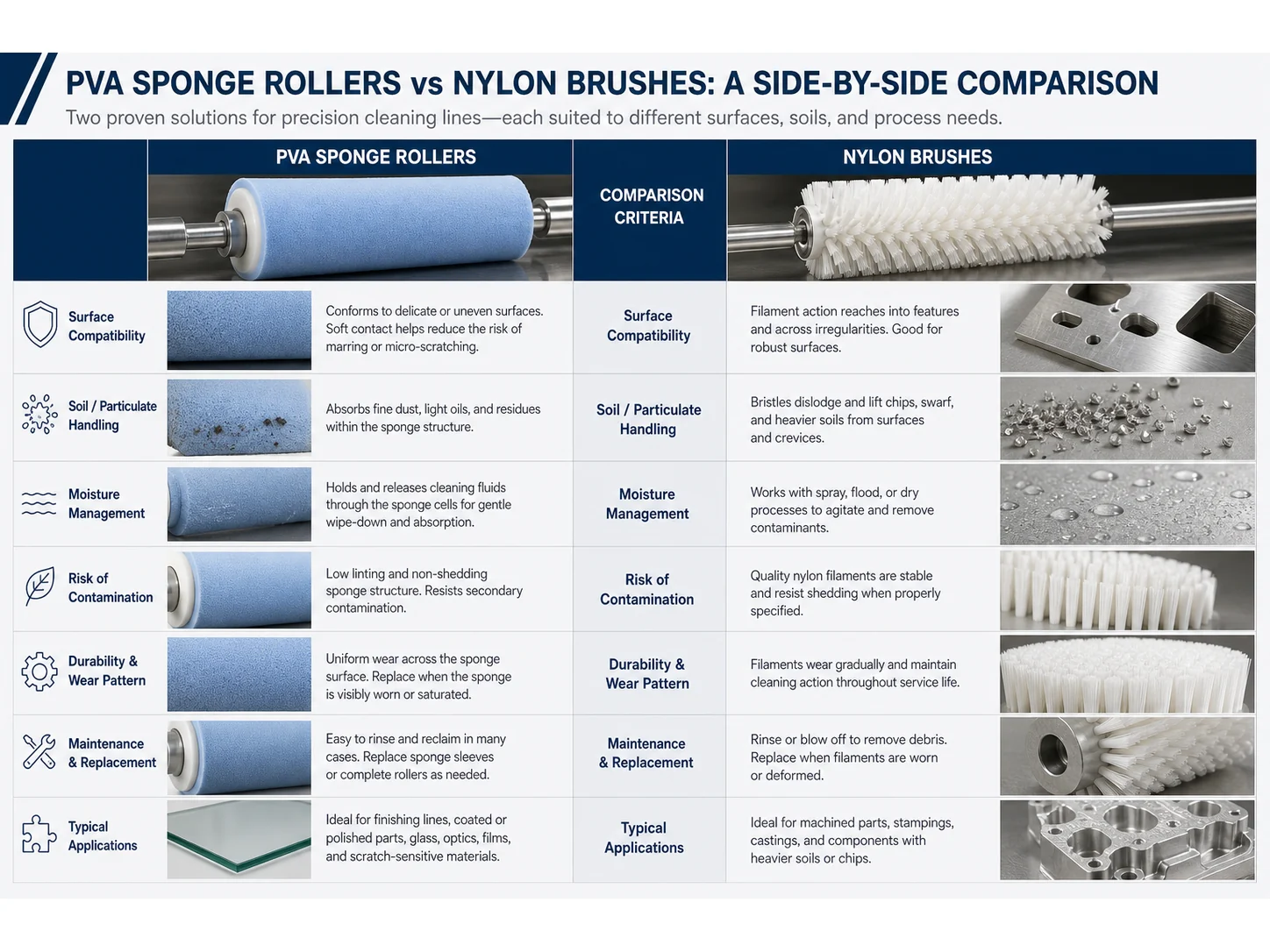
PVA Sponge Rollers vs Nylon Brushes: A Side-by-Side Comparison
The table below compares PVA sponge rollers and standard nylon filament brushes on key factors relevant to precision cleaning lines.
| Factor | PVA Sponge Roller | Nylon Brush |
|---|---|---|
| Surface Sensitivity | Very high; ultra-soft, low-scratch risk when properly conditioned | Depends on filament grade; soft nylon available but still higher scratch potential than PVA |
| Wet Operation | Requires continuous moisture; dries out and hardens if run dry, losing effectiveness | Works wet or dry; no hydration requirement |
| Dry Operation | Not suitable; sponge becomes brittle and abrasive | Suitable; wear rate varies with filament type |
| Temperature Limit | Typically ≤ 60°C (140°F); higher temperatures degrade PVA structure | Nylon 6: ~100°C (212°F); Nylon 6/6: up to 120°C (248°F) continuous |
| Chemical Exposure | Good with water, mild alkaline cleaners; swells or dissolves in strong acids, some solvents | Resistant to many hydrocarbons, alkalis, and mild acids; attacked by strong acids and phenols |
| Line Speed | Moderate (1-10 m/min typical); high speed can cause bounce or uneven contact | Can run at higher speeds (up to 20 m/min) with proper filament density and stiffness |
| Installation Space / Geometry | Typically larger OD rollers; need consistent wetting system integration | Can be made into thin wheels, small cups, or narrow rollers; easier to fit into compact machines |
| Maintenance / Replacement | Must be kept moist at all times; washing/conditioning required; limited shelf life if dried out | Simple mechanical replacement; no special storage; longer shelf life |
| Contamination Removal | Excellent for particles and light films; porous structure absorbs and traps contaminants | Good for adhered particles and heavier debris; may re-deposit if not flushed or vacuumed |
| Typical Applications | Post-CMP cleaning, glass panel scrubbing, optical film cleaning, solar wafer cleaning | Deburring, edge cleaning, PCB brushing, metal prep, package cleaning |
Common Types of PVA Sponge and Nylon Brushes for Precision Cleaning
When selecting a cleaning brush for a production line, you’ll encounter a few standard styles.
PVA Sponge Rollers:
- Cylindrical scrub rollers: Solid PVA sponge with uniform porosity and hardness (typically Shore A 5–40). Used as direct-drive or friction-driven contact rollers.
- Channeled or grooved rollers: PVA with machined spiral or straight channels to improve fluid transport and debris flushing.
- Hardness grades: Ultra-soft (for sensitive films) through firm (for higher cut rate on tougher residues). Softness is critical to avoid scratching.
- Porous structure: Open-cell design holds water and cleaning chemistry; acts like a brush and sponge simultaneously.
Nylon Brushes:
- Filament brushes: Nylon bristles set into a core. Filament diameter (0.04–0.30 mm / 0.0015–0.012 inch) controls stiffness and aggressiveness.
- Abrasive nylon brushes: Contain abrasive grains (silicon carbide, aluminum oxide) embedded in filaments. Used for more aggressive cleaning or light deburring. Use only when surface damage is allowed.
- Non-abrasive nylon brushes: Use smooth filaments for contamination removal without intentional abrasion.
- Brush styles: Wheel, cup, end, and roller forms exist. Mini cleaning nylon brushes suit small cavities or coffee equipment parts, while wide rollers serve flat panels.
How to Choose the Right Cleaning Tool for Your Precision Process
Match the tool to the contamination type and surface tolerance:
- If the surface cannot tolerate any scratching: Start with a soft PVA sponge roller under wet conditions.
- If the process is dry or involves heated surfaces: Nylon brush is the only option. Select filament grade and diameter based on required aggressiveness.
- If the contamination is sticky or caked: A nylon brush with abrasive or stiffer filaments may scrub better than a PVA sponge, which relies on absorption and swelling action.
- If chemical exposure is severe: Check compatibility tables. PVA is generally for mild pH; nylon withstands a broader chemical range.
- If line speed exceeds 10 m/min: Evaluate nylon brush designs with dense filament packing to maintain contact without skipping.
- If space is tight: Consider small nylon cup brushes or mini brushes; PVA rollers need larger diameter for mechanical integrity and water supply.
What to Confirm Before Ordering: Dimensions, Mounting, and Samples
Before issuing a purchase order or RFQ, confirm these details with the tooling supplier or manufacturer:
- Exact dimensions: Outer diameter (OD), inner diameter (ID) for bore-mounted rollers, face width (length), and total length with end features. Specify in mm or inch and tolerance grade.
- Mounting method: Shaft bore (with keyway or set screw), end stub shafts, quick-change hubs, or arbor adapters. Provide a drawing of the machine’s drive interface.
- Wetting and fluid ports: For PVA sponges, confirm the required wetting system (spray bar, immersion, or internal feed). Supply water quality and chemistry details.
- Sample or drawing reference: If replicating an existing brush, send a sample or a detailed drawing to avoid interface mismatches. Many suppliers can reverse-engineer a sample.
- Expected cleaning result: Define acceptance criteria: particle size removed (e.g., ≥ 1 µm), cleaning efficiency (%), max scratches per area, or residual contamination levels. This sets realistic performance targets.
- Operational parameters: Line speed, downforce (N or kg), duty cycle, and chemical concentration ranges. These influence material selection and wear life.
Common Mistakes When Selecting Cleaning Brushes for Precision Lines
- Running PVA sponges dry or semi-dry: This hardens the sponge, turning it into a harsh abrasive that scratches surfaces. A dry PVA roller often creates more defects than a nylon brush.
- Choosing nylon filament stiffness by cost alone: Softer nylon filaments cost more but are essential for scratch-sensitive substrates. Using a generic cleaning nylon brush on optical glass can ruin yield.
- Ignoring chemical swelling effects: PVA volume can increase 10-20% in certain chemistries, changing OD and contact pressure. Test compatibility before full deployment.
- Overlooking brush core material: Even if bristles are non-abrasive, a metal core can rust or contaminate the line. Stainless steel or engineered plastic cores are often required.
- Assuming one brush fits all speeds: At high speed, insufficient filament density leads to “bouncing” and incomplete cleaning. Groom and density up for high-speed lines.
When a PVA Sponge vs Nylon Brush Is the Wrong Choice
Physical brushing has limits. If the contamination is tenacious, the surface geometry is complex, or residues must be removed without re-deposition, consider combining the brush with another unit operation:
- Vacuum extraction: Mounted near the brush nip to immediately capture lifted debris, especially for dry processes. A cleaning vacuum brush roller or a vacuum with self-cleaning brush roller integrates both functions.
- Air knife / blow-off: Post-brush high-velocity air to remove moisture and loose particles. Prevents re-deposition on the next product.
- Mechanical scraper: For heavy, caked-on residues, a scraper bar ahead of the brush loosens bulk material, reducing brush loading.
- Clean-in-place (CIP) system: For enclosed machines, programmed spray cycles clean the brush itself between products, extending life and preventing cross-contamination.
- Ultrasonic bath or megasonic rinse: Used after brushing to remove sub-micron particles from recessed areas the brush could not reach. Often the final step in precision cleaning chains.
- Combination with chemical spray: Instead of relying on the brush to carry moisture, an upstream spray bar delivers the right chemistry, improving cleaning and reducing brush wear.
Final Takeaway: Matching the Brush to the Contamination and Surface
A PVA sponge roller is the go-to choice for wet, scratch‐sensitive applications where particles are small and surfaces are polished. It requires continuous moisture and moderate speeds. Nylon brushes, particularly with customizable filament grades, handle higher temperatures, dry conditions, and faster line speeds but impose more risk to delicate surfaces. The right decision starts with a clear definition of acceptable surface damage, contamination type, line environment, and cleaning chemistry. Always request a sample test or application review from the tooling manufacturer before scaling up.
Frequently Asked Questions
Can PVA sponge rollers be used with organic solvents?
Some PVA formulations tolerate alcohols and mild solvents, but strong solvents like acetone or MEK cause swelling, softening, or dissolution. Always test with a small sample or consult the manufacturer’s chemical compatibility data.
What is the typical replacement interval for nylon brushes in precision cleaning?
It depends on filament wear, contamination loading, and acceptable cleaning quality drift. In clean PCB or glass lines, brushes may be changed after 500–2,000 operating hours, or when visual inspection shows flattened, worn bristles that reduce cleaning efficiency.
Can a nylon brush scratch a glass substrate?
Yes, especially if the filaments are too stiff, abrasive-filled, or contaminated with hard particles. For glass panels, specify soft nylon brushes with non-abrasive filaments and implement proper filtration to avoid embedding grit in the bristles.
Is a PVA sponge roller suitable for dry cleanup on a conveyor?
No. A PVA roller must stay hydrated to remain soft and non-abrasive. Running it dry will harden it rapidly, likely causing scratches and particle shedding. Use a nylon brush or other dry-compatible media for dry processes.
What’s the difference between a nylon brush for cleaning cast iron and one for precision optics?
Cleaning cast iron typically uses coarse, abrasive-filled nylon filaments to remove scale or rust without regard for surface finish. Precision optics require fine, soft, non-abrasive filaments that will not create scratches or haze, often with strict cleanroom packaging.
Can I use the same PVA roller for multiple chemistries?
Only if the chemistries are chemically similar and the roller is thoroughly rinsed between changes. Even then, residual chemicals can degrade the PVA over time. Dedicated rollers per process chemistry are safer to avoid contamination and unpredictable swelling.
How do I specify a mounting method for a custom brush?
Provide the outer diameter, inner bore diameter, keyway dimensions (if applicable), and the method of drive (friction, keyed shaft, or set screws). A machining drawing or photo of the machine’s brush mount is most helpful for the supplier.
What if the brush alone can’t meet cleanliness specs?
Investigate adding a vacuum extraction hood, an air knife blow-off, or a downstream ultrasonic rinse. Often, a chain of two or three tool types—brush, vacuum, and spray—is needed to achieve single-digit particle test results.
Technical References
Which bristle material fits this job — PVA Sponge, Nylon PA or PA6 Nylon?
| Material | Continuous temperature (°C) | Peak temperature (°C) | Water absorption | Hardness |
|---|---|---|---|---|
| PVA Sponge | 60 | 90 | — | Soft absorbent contact material; hardness/compression is controlled by foam or sponge density. |
| Nylon PA | 93 | 121 | 0.3–9% by PA grade and conditioning | Medium to firm; filament diameter and trim length control bending force. |
| PA6 Nylon | 80–100 | 130–160 | 1.5–3.0% | Shore D 75–85 |
| PBT | 120–140 | 160–180 | 0.05–0.20% | Shore D 80–90 |
Figures as published by Brushtec / DuPont; Perlon. Confirm the exact grade against the supplier datasheet before ordering.
What should replace Handheld Detail Brushes when they stop working?
- Handheld Detail Brushes — Handheld detail brushes cover general precision cleaning; auto-detailing brushes impose tighter controls for painted, polished, leather, display, and trim surfaces.
- PVA Sponge — Compare PVA Sponge with PU sponge, PP sponge, microfiber. Change material when wet stiffness, temperature, chemical resistance, conductivity, particle shedding, or surface marking becomes the limiting factor.
- Nylon PA — Compare Nylon PA with PP, PBT, PET. Change material when wet stiffness, temperature, chemical resistance, conductivity, particle shedding, or surface marking becomes the limiting factor.
- PA6 Nylon — Compare PA6 Nylon with PA66, PP, PBT. Change material when wet stiffness, temperature, chemical resistance, conductivity, particle shedding, or surface marking becomes the limiting factor.