
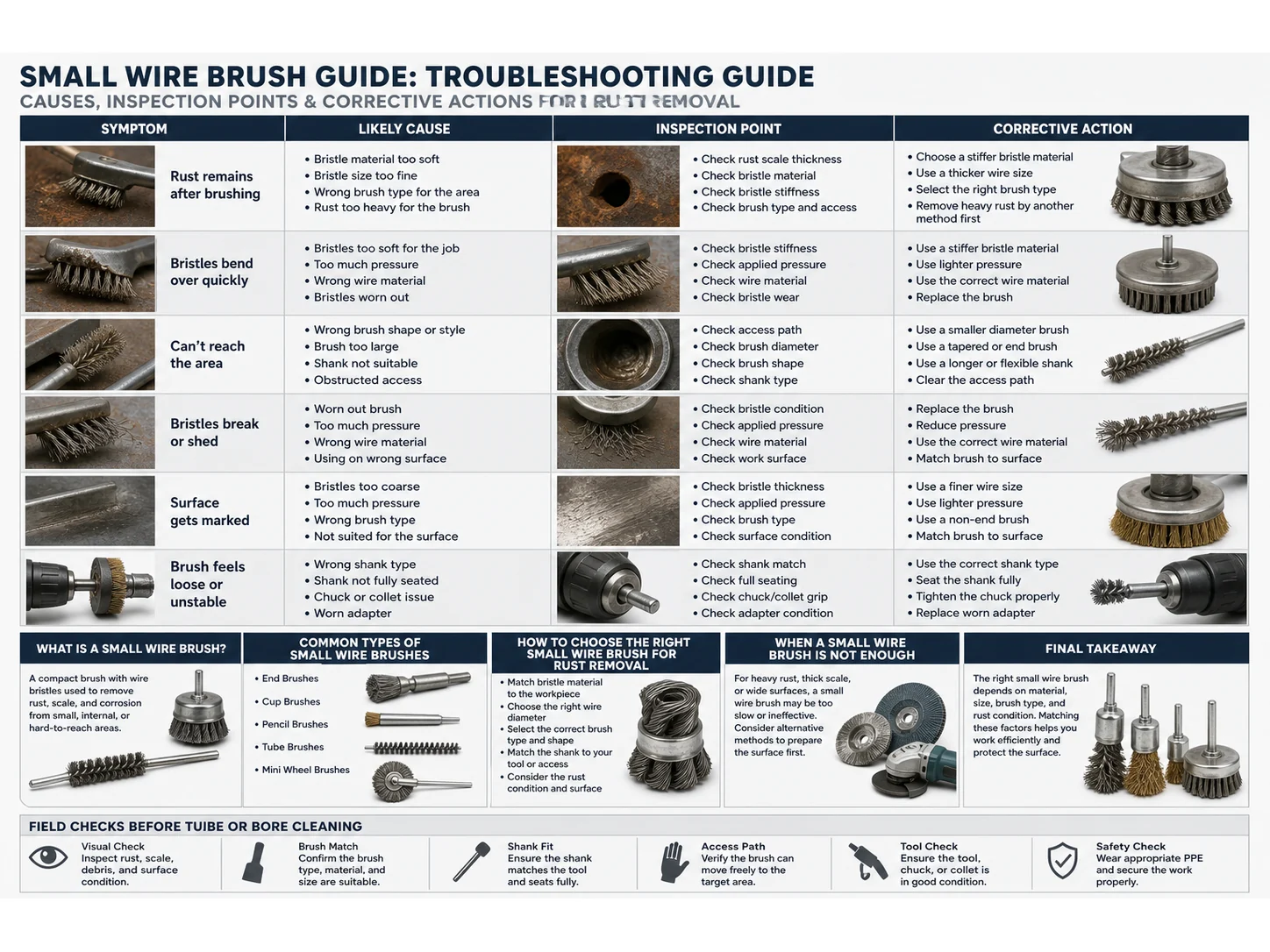
What Is a Small Wire Brush?
A small wire brush is a cleaning tool that uses short, stiff metal wire bristles to scrape away surface contaminants like rust, scale, and old paint. It is typically sized for single-hand operation or attachment to a rotary tool or drill, making it ideal for precision work in tight or irregular spaces.
Wire brushes come in many shapes and bristle materials, and the right choice depends on the base metal, the type of residue, and how much surface finish matters.
Common Types of Small Wire Brushes
The table below compares the most common small wire brush options based on bristle material, stiffness, and typical uses.
| Bristle Material | Typical Stiffness | Best for | Surface Compatibility | Notes |
|---|---|---|---|---|
| Carbon Steel | High | Heavy rust, paint, weld slag | Iron, steel | Can leave marks; may rust itself if not cleaned. |
| Stainless Steel | Medium‑High | Rust, oxidation, food‑safe cleaning | Stainless, aluminum, brass | Resists corrosion; less likely to contaminate surfaces. |
| Brass | Low‑Medium | Light rust, tarnish, delicate cleaning | Brass, copper, aluminum, non‑ferrous metals | Non‑sparking, softer than steel; wears faster. |
| Nylon/Abrasive‑impregnated | Low | Light surface prep, deburring | All metals, plastics | Will not scratch, but less effective on heavy rust. |
Small wire brushes also vary by form factor:
- Hand‑style brushes (toothbrush shape, pencil‑type, or bent‑loop wire brushes) offer maximum control for spot cleaning.
- Power‑tool mounted brushes (wheel, cup, or end brushes with a 1/4‑in shank) fit drills and rotary tools for faster, repeatable action.
- Miniature brush sets often include multiple diameters and materials for odd‑shaped cavities.
How to Choose the Right Small Wire Brush for Rust Removal
Use these factors to narrow your selection:
- Substrate material: Match bristle material to the base metal. Avoid carbon steel on stainless or aluminum to prevent galvanic contamination. Brass is gentler; stainless is a good all‑rounder for most metals.
- Rust severity: Flaky, heavy rust may require a stiffer, coarser brush like a knotted carbon steel wheel. Surface bloom can be handled with fine stainless steel or brass.
- Access & geometry: Deep recesses, threads, or narrow bores need a pencil‑style or end brush with the right diameter. Flat areas can use cup or wheel brushes.
- Mounting interface: Determine whether you’ll work by hand or with a drill/rotary tool. Power brushes speed up the job but generate heat and can be harder to control.
- Wet or chemical exposure: If using rust converters or lubricants, choose stainless or brass over carbon steel to avoid brush corrosion.
- Hygiene & cleanliness: Food‑grade or medical applications require stainless or brass to eliminate rust flecks. Carbon steel is not suitable where surface purity matters.
- Frequency of use: For occasional DIY rust removal, a small hand brush set is economical. For shop‑floor use, power brush attachments with replaceable hubs offer better value.
Mistakes to Avoid When Selecting a Small Wire Brush
- Using the wrong bristle material for the substrate: Carbon steel on aluminum leaves iron particles that can later rust, causing pitting.
- Ignoring bristle size and stiffness: A very stiff, thick‑bristle brush can gouge soft metals; too fine a brush won’t touch heavy scale.
- Choosing cost drivers over quality: low-cost brushes shed bristles quickly, creating a safety hazard and contaminating the work area.
- Misjudging the mounting fit: A brush shank that is too large or too small for the drill chuck or collet leads to slippage and poor control.
- Over‑relying on force instead of letting the tool do the work: Excessive pressure generates heat, shortens brush life, and can warp thin metal.
- Mixing brush materials in the same job without cleaning: Steel residue on a stainless brush can transfer and corrode later.
- Skipping a sample test: Always test on a hidden area to confirm the chosen brush removes rust without scratching or embedding debris.
When a Small Wire Brush Is the Wrong Choice
A small wire brush is excellent for localized rust removal, but it has limits:
- Large surface areas: Wire wheeling an entire car panel is inefficient; abrasive blasting or chemical dipping is more practical.
- Deep pitting or structural rust: A brush cannot remove rust embedded in deep pits. Needle scalers, media blasting, or electrolysis may be necessary.
- Heat‑sensitive parts: Thin sheet metal can distort from the friction of power brushes. Hand tools or chemical methods are safer.
- Precision surfaces: Bearing journals, shafts, or hydraulic rods require polishing‑grade abrasives, not wire bristles that can change dimensions.
- Safety‑critical components: Suspension springs or structural welds should be inspected by an expert; surface rust removal alone does not Help confirm integrity.
When in doubt, consult the manufacturer’s cleaning specifications or request a sample brush for testing before committing to a large batch.
Final Takeaway
Start with the base metal and rust severity, then choose a bristle material that cleans without damaging. Consider whether hand or power operation gives you the needed control, and never skip a test spot. Avoiding common specification mistakes saves time, extends tool life, and produces a better surface ready for coating or further treatment.
Frequently Asked Questions
Can I use a small wire brush on aluminum?
Yes, but choose stainless steel or brass bristles. Carbon steel brushes leave iron particles that will rust and damage the aluminum surface. Brass is the softest option and is often preferred for delicate aluminum parts.
How do I prevent rust after removing it with a small wire brush?
Immediately after wire brushing, clean the surface with a solvent to remove loose debris, then apply a rust inhibitor, primer, or protective coating. If the part will be stored, use a vapor‑corrosion‑inhibiting paper or a light oil film.
What size wire brush is best for cleaning small firearm parts?
Pencil‑type brushes or end brushes with a diameter of 3–6 mm work well for bores and recesses. For general surface cleaning, a 2‑row, crimped‑wire cup brush with a 1/4‑in shank offers a good balance of coverage and control.
Are small wire brushes safe to use on stainless steel?
Yes, but use a stainless‑steel bristle brush to avoid contamination. Never use a carbon steel brush on stainless steel; embedded carbon steel particles can cause rust spots (rouge) on the stainless surface.
How often should I replace a small wire brush?
Replace when bristles become flattened, worn unevenly, or start shedding. For power brushes, replace when the filament length is less than 30% of the original length, as performance and safety degrade rapidly after that point.
Can a small wire brush damage the metal surface?
Yes. Overly stiff bristles, excessive pressure, or high RPM can scratch, gouge, or discolor metal. Always match the brush stiffness to the hardness of the base material, and test on a non‑visible area first.
Will a small wire brush remove paint along with rust?
Yes, wire brushes can strip paint, but they may also blend the edges of existing paint layers unevenly. For intentional paint removal, a dedicated scraper or chemical stripper followed by wire brushing only for final cleaning gives cleaner results.
Which steel wire grade fits this job — AISI 304 Stainless Steel Wire, AISI 316 Stainless Steel Wire or Carbon Steel Wire?
| Wire grade | Continuous temperature (°C) | Peak temperature (°C) | Water absorption | Hardness |
|---|---|---|---|---|
| AISI 304 Stainless Steel Wire | 400 | 500 | 0% | Rockwell B 70–95 depending on temper and cold work |
| AISI 316 Stainless Steel Wire | 400 | 500 | 0% | Rockwell B 70–95 depending on temper and cold work |
| Carbon Steel Wire | 200–300 | 350–450 | 0% | Rockwell C 40–60 |
| Galvanized Steel Wire | 150–200 | 250–300 | 0% | Rockwell B 70–100 |
Figures as published by Alleima; Material manufacturer TDS / ISO / ASTM / industry reference. Confirm the exact grade against the supplier datasheet before ordering.
What should replace AISI 304 Stainless Steel Wire for rust removal?
- AISI 304 Stainless Steel Wire — Use AISI 316 stainless steel wire for chloride, marine, dairy, beverage, chemical washdown, or higher pitting-resistance requirements. Use carbon steel for dry aggressive cutting and brass or abrasive nylon for lower marking risk.
- Nylon PA — Compare Nylon PA with PP, PBT, PET. Change material when wet stiffness, temperature, chemical resistance, conductivity, particle shedding, or surface marking becomes the limiting factor.