
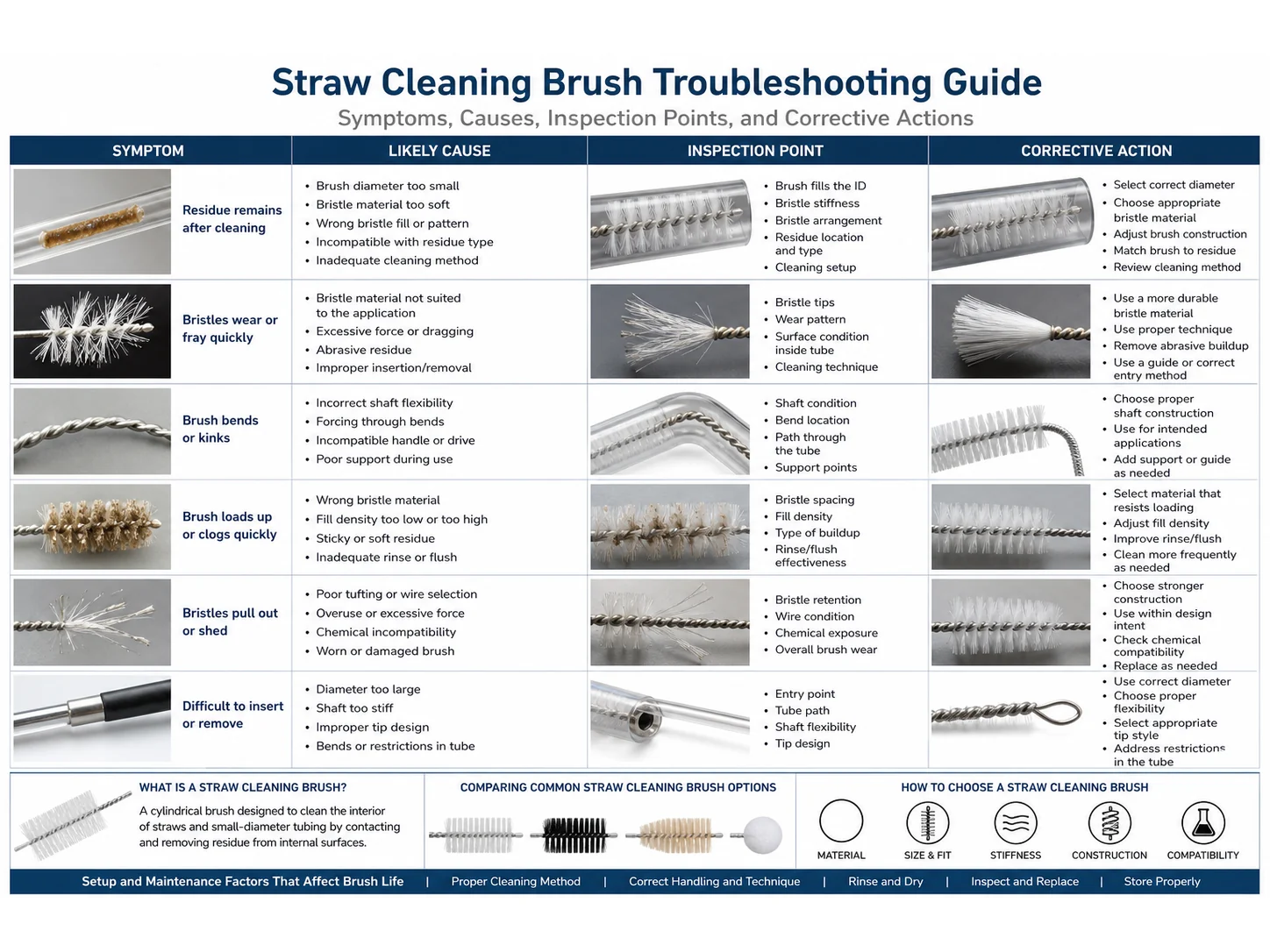
What Is a Straw Cleaning Brush?
A straw cleaning brush is a slender, flexible tool with bristles attached to a central core, engineered to clean the inside diameter of narrow tubing. In food and beverage settings, these brushes remove sticky syrups, protein films, mineral deposits, and biofilms that regular rinsing cannot dislodge. Unlike general-purpose bottle brushes, straw cleaning brushes are built with tightly controlled diameters, chemical-resistant materials, and often food-grade certifications to meet sanitary standards.
Comparing Common Straw Cleaning Brush Options
Selecting the right brush starts with understanding material and construction trade-offs. The table below compares four widely used configurations for food and beverage tubing.
| Bristle Material | Core / Handle | Typical Diameter Range | Best For | Avoid When |
|---|---|---|---|---|
| Soft nylon (0.15–0.30 mm filament) | Twisted stainless steel wire, plastic coated tip | 2 mm – 12 mm | Daily cleaning of silicone or plastic straws, light syrup residues | Dried-on caramel, hard mineral scale, or metal tubing that could fray bristles |
| Medium polyester (0.30–0.50 mm filament) | Twisted galvanized or stainless wire, loop handle | 4 mm – 20 mm | Protein shakes, dairy residues, frequent CIP exposure | Ultra-fine tubing below 3 mm; soft elastomer tubing that can be scratched |
| Stiff polypropylene (0.40–0.80 mm filament) | Stainless steel wire with molded plastic handle | 6 mm – 25 mm | Sticky sugar syrups, powdered drink mixes, moderately tough deposits | Delicate inner coatings, repeated autoclave cycles (may deform) |
| Soft brass or stainless steel wire bristles | Twisted stainless steel, often with long handle | 6 mm – 30 mm | Mineral scale in hard-water lines, stainless steel tubing, high-temperature steam cleaning | Plastic or silicone tubing; any application where metal fragments are a contamination risk |
How to Choose a Straw Cleaning Brush
Answer these five operational questions before ordering a brush or requesting a sample.
- Tube inner diameter and length. Measure the actual ID, not the nominal pipe size. A brush 0.5–1.0 mm larger than the ID provides good contact without jamming. For long tubing, verify the brush length reaches the farthest point where residue accumulates.
- Residue type. Sugary residues dissolve with warm water and a medium brush. Protein and fat require stiffer bristles and an appropriate detergent. Hard mineral films often demand a chemical soak and a wire brush.
- Tube material sensitivity. Silicone and soft plastics scratch easily; choose only nylon or polyester bristles with rounded filament tips. Stainless steel tubing can handle metal bristles but inspect for debris after cleaning.
- Chemical and temperature exposure. Confirm the brush material—especially the core and handle—withstands your cleaning chemicals (caustic, acid, chlorine) and temperatures (steam or hot water up to 121 °C for autoclaving). Polyester and stainless steel hold up better than nylon in aggressive CIP routines.
- Hygiene protocol. In high-purity operations, brushes should be easy to sanitize, color-coded to prevent cross-contact, and replaced on a fixed schedule. Some facilities move to single-use brushes for allergen zones.
Setup and Maintenance Factors That Affect Brush Life
Even a well-specified brush will fail early if these real-world conditions are ignored.
- Manual vs. automated use. Hand brushing allows a lighter touch. If the brush is mounted in a rotating fixture or drill, reduce diameter slightly and choose a stiffer core to prevent buckling.
- Wet vs. dry cleaning. Always lubricate the brush with water or detergent. Dry friction heats the bristles and can melt synthetic filaments or leave plastic residue inside the tube.
- Storage. Hang brushes vertically or store loose in a ventilated container. Trapped moisture between bristles promotes microbial growth, defeating the purpose of cleaning.
- Replacement triggers. Retire a brush when bristles show permanent bending, core kinks, or fraying. A worn brush contributes to under-cleaning and may shed filaments into product-contact zones.
Common Mistakes to Avoid
Even experienced teams fall into these specification traps. Check your current brush against this list.
- Buying by “straw size” only. A “standard straw diameter” varies from 5 mm to 8 mm. Always measure the exact internal diameter and note any taper.
- Ignoring core length. A brush that reaches a short straw may be too short for a 400 mm beverage dispensing line. Specify total usable length, not overall tool length.
- Using a single material for all products. A brush that works for fruit juices may corrode or swell when used with acidic cleaning chemicals or fatty dairy bases.
- Assuming all brushes are food-grade. Verify that the bristle material, adhesive (if any), and handle plastic meet FDA 21 CFR or EU 1935/2004 requirements for food contact articles.
- Sharing brushes across allergens. Color-coded brushes are a simple, low-cost measure to prevent cross-contamination between dairy, soy, and nut-based product lines.
When a Straw Cleaning Brush Is the Wrong Choice
A brush is only one part of a cleaning program. Know when to stop brushing and bring in a different solution.
- Complex lumen shapes. Tube bends, corrugated hose, or check valves may block full brush penetration. In-line clean-in-place (CIP) spray balls or foam-injection systems reach these zones more reliably.
- Validated sterilization requirements. In sterile filling lines, a manual brush cannot Help confirm a validated log reduction. Use verified CIP cycles or pre-sterilized single-use tubing assemblies where required.
- Embedded mineral scale. If a wire brush cannot remove scale, a chemical descaling protocol based on tubing material compatibility must precede mechanical brushing.
- Product may be sensitive to brush debris. Even the best brush can leave microscopic fragments. In vision-inspected beverage bottling or enteral nutrition, consider a final rinse with filtered water and a post-cleaning verification step.
Final Takeaway: Match the Brush to the Real Problem
A straw cleaning brush is not a universal tool. Start with a measured tube ID and a residue analysis, then select a material that balances cleaning aggression with surface protection. If possible, test a small quantity and visually inspect tubing under a borescope or white cloth wipe test before committing to a large order. When in doubt, request a supplier drawing that shows clear dimensions, bristle length, and material specification—not just a catalog photo.
Frequently Asked Questions
What size straw cleaning brush do I need for a standard drinking straw?
Most reusable drinking straws have an inner diameter between 5 mm and 8 mm. Choose a brush about 0.5 mm larger than the measured ID to ensure firm bristle contact without excessive force. For extra-wide smoothie straws (10–12 mm), a brush in the 10–12.5 mm range works best.
Can I use a test tube brush to clean beverage straws?
Laboratory test tube brushes often use harsh bristles or metal tips that can scratch food-grade plastics. Some are not made from FDA-compliant materials. It is safer to use a brush specifically listed for food contact unless a test tube brush is explicitly designated for food use and matches your tube diameter.
Are metal bristle brushes safe for food and beverage tubing?
Soft brass or stainless steel wire brushes can be used on stainless steel tubing, but they risk scratching plastic or silicone. Metal bristles can also break off and become a physical contaminant. If a metal brush is necessary, follow with a thorough rinse and inspection, and never use them on flexible goods that will be directly contacted by the final product without a post-cleaning verification step.
How often should I replace a straw cleaning brush?
Replace brushes at the first sign of bristle deformation, core kinking, or corrosion. In a high-use production setting, a monthly replacement schedule is typical, but more frequent changes may be needed if cleaning abrasive residues or using aggressive chemicals. Some operations date-stamp brushes and retire them after 100–150 cycles.
Can I put a straw cleaning brush in the dishwasher or autoclave?
Many nylon and polyester brushes can survive dishwasher temperatures up to 80 °C, but autoclave cycles (121 °C+) require heat-resistant materials such as PTFE-coated cores or all-stainless-steel construction. Check the manufacturer’s temperature rating before heat sanitizing.
How do I clean and sanitize the brush itself?
Rinse the brush thoroughly after each use with hot water and a compatible detergent. For food-contact brushes, soak in a sanitizing solution (e.g., 200 ppm quaternary ammonium or 50–100 ppm chlorine) per your facility’s SSOP, then air-dry completely. Never store a wet brush in a closed bag or container.
What handle style works best for production cleaning?
Loop handles are easy to grip and hang, but long straight handles (200 mm or more) are better for reaching into fixed dispensing lines. In high-volume operations, some suppliers offer brushes designed to chuck into a low-speed cordless drill—confirm the brush is rated for mechanical rotation before trying this method.
Can a straw cleaning brush replace a CIP or manual flush system?
No. A brush addresses mechanically adhered soil but cannot eliminate all microorganisms or remove soil from areas it cannot reach (valves, tees, flexible connections). It is best used as part of a written cleaning procedure that also includes a rinse, detergent circulation (or soak), a brush step, final rinse, and sanitization. In fully automated lines, a brush augments CIP but does not replace validated cleanability requirements.
Technical References
- FDA — Food Code
- eCFR — 21 CFR 177.1500 Nylon Resins
- eCFR — 21 CFR 177.1520 Olefin Polymers
- eCFR — 21 CFR 177.1630 Polyethylene Phthalate Polymers
- NIST — Metric SI
Which bristle material fits this job — AISI 304 Stainless Steel Wire, Nylon PA or Silicone?
| Material | Continuous temperature (°C) | Peak temperature (°C) | Water absorption | Hardness |
|---|---|---|---|---|
| AISI 304 Stainless Steel Wire | 400 | 500 | 0% | Rockwell B 70–95 depending on temper and cold work |
| Nylon PA | 93 | 121 | 0.3–9% by PA grade and conditioning | Medium to firm; filament diameter and trim length control bending force. |
| Silicone | 200–250 | 280–300 | 0.1–1.0% | Shore A 20–80 |
| AISI 316 Stainless Steel Wire | 400 | 500 | 0% | Rockwell B 70–95 depending on temper and cold work |
| PBT | 120–140 | 160–180 | 0.05–0.20% | Shore D 80–90 |
Figures as published by Alleima; Brushtec / DuPont; Perlon. Confirm the exact grade against the supplier datasheet before ordering.
What should replace Tube & Pipe Bore Brushes for straw cleaning?
- Tube & Pipe Bore Brushes — Tube and bore brushes work by radial contact inside a confined diameter; wire wheels and cups work mainly on external edges, profiles, welds, and broad surfaces.
- AISI 304 Stainless Steel Wire — Use AISI 316 stainless steel wire for chloride, marine, dairy, beverage, chemical washdown, or higher pitting-resistance requirements. Use carbon steel for dry aggressive cutting and brass or abrasive nylon for lower marking risk.
- Nylon PA — Compare Nylon PA with PP, PBT, PET. Change material when wet stiffness, temperature, chemical resistance, conductivity, particle shedding, or surface marking becomes the limiting factor.
- Silicone — Compare Silicone with PP, TPE, Nylon. Change material when wet stiffness, temperature, chemical resistance, conductivity, particle shedding, or surface marking becomes the limiting factor.