
Custom Cleaning Brush
Straw Cleaning Brush
Slim flexible straw cleaning brush with nylon bristles and stainless steel core. Cleans reusable straw interiors without scratching.
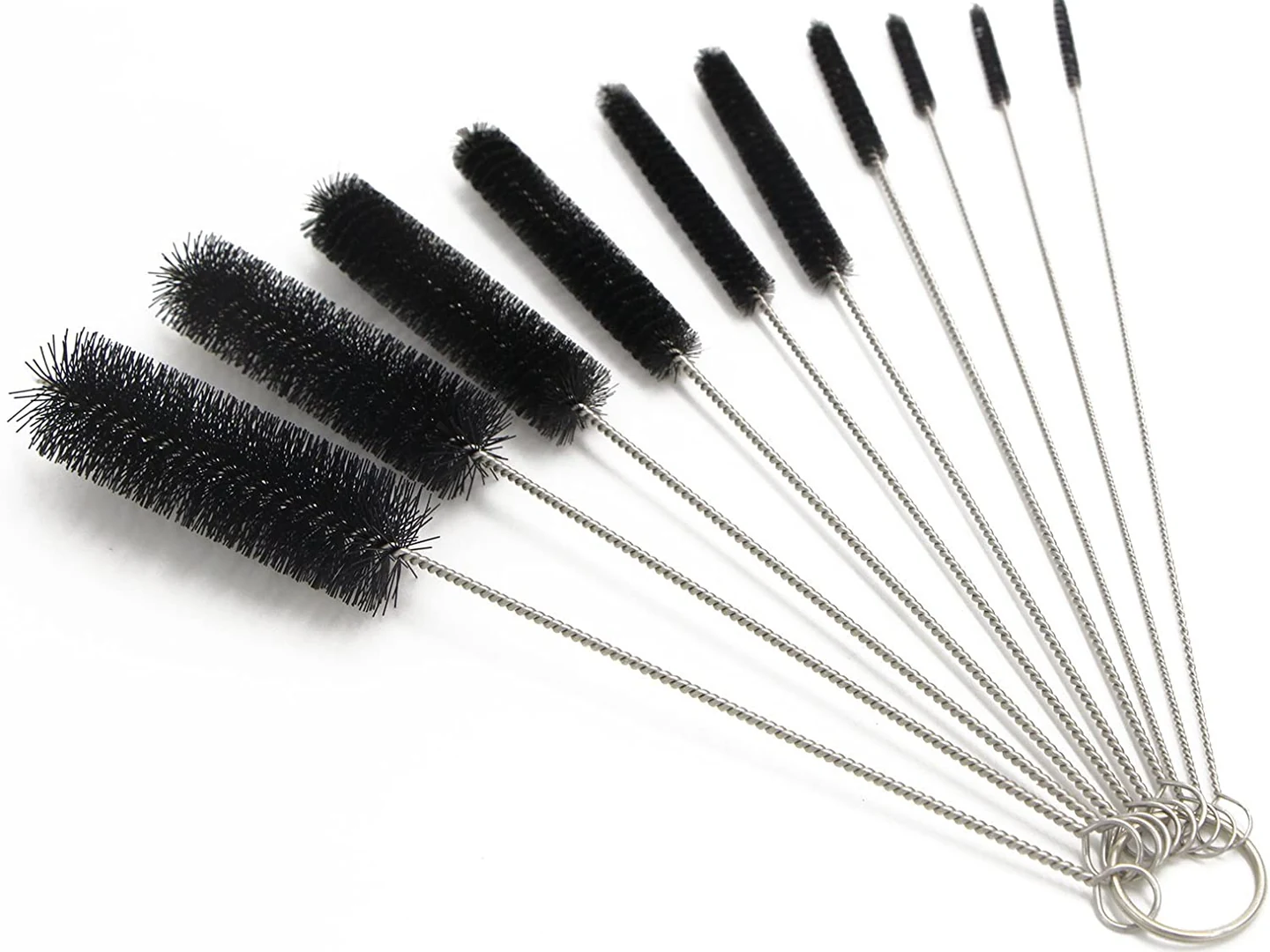
Small brush
500 pcs
Minimum order
Held in one hand: tube, bottle, detail and swab brushes — including long-handled ones with a small head.
Production lead time, once the specification is confirmed
- Up to 500 pcsWithin 7 days
- 501–50,000 pcsWithin 14 days
- Over 50,000 pcsWithin 21 days
Peak season can extend these times; the shipping date is confirmed in writing with your quotation. Sampling and shipping are quoted separately.
The Straw Cleaning Brush is a slim, flexible cleaning tool built around a twisted stainless steel core and soft nylon bristles, sized to reach and scrub the inner walls of reusable drinking straws. It removes beverage film, sugar residue, and pulp that accumulate inside narrow bores without scratching metal, glass, silicone, or plastic straw surfaces.
What can this brush do for you?
Reaches the full inner bore of narrow straws
The brush diameter range of 2 mm to 12 mm covers common reusable straw internal diameters, from slim 4 mm silicone straws to wide 10 mm smoothie straws. The flexible twisted wire core follows straight sections and gentle bends, so one brush can clean the entire length from end to end.
Scrubs film and residue without scratching
Nylon PA filaments are softer than stainless steel, glass, and hard plastics, and are formed with rounded tips. This lets the brush remove sugar, syrup, dairy film, and fruit pulp mechanically without leaving micro-scratches on the polished or coated interior of premium straws.
Conforms to the straw wall instead of just wiping
The bristle fill projects radially from the core and is sized slightly larger than the straw ID. When the brush is inserted, the filaments compress and create multiple contact points around the circumference. This wipes, scrapes, and scrubs simultaneously on push-pull and rotating strokes.
Withstands repeated use and washing
The twisted wire construction locks each filament between two wire strands, so bristles stay anchored during reversed pushing and pulling. The core in 304 stainless steel resists corrosion from water, mild detergents, and sanitizing solutions, extending the life of a brush used daily in foodservice or at home.
Built for convenient handling and drying
A loop end, straight wire handle, or molded plastic grip gives the user a secure hold while cleaning and a way to hang the brush to air dry. Proper drying prevents microbial growth inside the bristle fill between uses, keeping the brush itself hygienic.
What is a Straw Cleaning Brush?
A Straw Cleaning Brush is a narrow, flexible cleaning tool designed specifically for the internal bore of reusable drinking straws. It consists of a twisted wire core with radially projecting bristles along a defined working length, plus a handle section at one end. The brush is inserted into the straw opening, pushed through to the opposite end, and then pulled back with a twisting motion to loosen and remove residue attached to the inner wall.
It is primarily used as a maintenance cleaning tool in consumer kits, foodservice operations, and drinkware accessory programs. The nylon or PBT bristles are chosen to be aggressive enough to remove beverage film, sugar, and pulp, yet gentle enough to avoid damaging glass, metal, silicone, or plastic straw surfaces.
This brush is not a replacement for soaking, chemical cleaning, or industrial tube cleaning. It is intended for removing soft or softened residue from accessible drinking straw bores. Hardened mineral deposits, baked-on sugars, or heavily soiled industrial tubes require a different cleaning method or a different brush design.
Technical Specifications
The table below lists standard dimensions and options. Every parameter can be adjusted to match your straw dimensions and use conditions.
| Parameter | Value / Options |
|---|---|
| Brush working diameter | 2–12 mm, selected relative to straw ID; common stock: 4, 6, 8, 10 mm |
| Working length | 20–150 mm, adjustable to straw length; full-length cleaning up to 250 mm available |
| Overall length | 150–450 mm including handle section |
| Stem/core wire diameter | 0.5–1.2 mm, twisted construction |
| Core wire material | Galvanized steel, 304 stainless steel, or 316 stainless steel |
| Filament material | Nylon PA6 or PA66 standard; PBT available for higher stiffness or heat resistance |
| Filament diameter | 0.05–0.25 mm, typical 0.10–0.15 mm for straw brushes |
| Bristle-to-ID interference | Near-size for wiping rigid straws; 5–20% oversize for flexible polymer scrubbing; lower interference with wire-core brushes |
| Handle | Loop end, straight wire, or molded PP/PE grip; length 10–40 mm |
| Temperature resistance | Nylon filaments: up to 80°C continuous, 100°C short exposure; PBT: up to 120°C continuous |
| Chemical compatibility | Resists weak acids, alkalis, and common beverage and detergent solutions; not for strong solvents or acids |
| Packaging | Bulk, individual polybag, retail card, or custom kit packaging |
| Brush type | Custom Tube & Pipe Bore Brushes |
| How it is driven | Hand-guided |
| Cleaning target | reusable straw accessory kits sold, restaurant, and drinkware brand and promotional product program cleaning |
| Surface or part | metal, glass, plastic, walls, bores, bars, bends, and tubes |
| Residue or debris | sugar, pulp, beverage film, sugar residue, milk, protein, mineral deposits, and corrosion |
| Mounting / connection | Threaded Removable / Fixed |
All dimensions and materials shown are starting points. For a specific straw, we will recommend the combination that balances cleaning effectiveness, insertion force, and service life.
Where does this brush work best?
- Reusable straw accessory kits sold with metal, glass, silicone, or bamboo straws to consumers.
- Cafes, juice bars, smoothie shops, and restaurants that wash and reuse straws in-house.
- Drinkware brands and promotional product programs that include a cleaning brush as part of a branded straw set.
- Household maintenance of reusable straws used for smoothies, milk, protein shakes, and iced drinks.
- Travel and personal care kits where a compact, hangable brush is required.
How do I choose the right one?
Start with the straw internal diameter
Measure the straw ID with calipers or from the manufacturer specification. Choose a brush working diameter equal to the ID for gentle wiping of rigid materials like glass and metal. For flexible straws made of silicone or soft plastic, choose a brush diameter 5–20% larger than the ID so the compressed bristles create effective scrubbing contact. A brush that is too large will bind and may permanently bend the core; too small will slide without cleaning the walls.
Match the length and shape
The working length must reach the full internal length of the straw. For straight straws, the brush length can equal the straw length minus a small clearance at both ends. For bent or articulated straws, the brush must be long enough to pass through the bend and still reach the far end, and the core must be flexible enough to follow the bend without kinking. Check bend radius requirements before finalizing.
Select filament material for the residue and environment
Nylon PA6 is the standard choice for general beverage residue at ambient or warm temperatures. Nylon PA66 offers slightly higher heat resistance and stiffness. PBT filaments resist higher temperatures and are less hygroscopic, which suits repeated high-temperature sanitizing or heavier residue. If the cleaning process uses aggressive chemicals, verify material compatibility.
Choose the core wire for the environment
Galvanized steel core wire is economical for consumer retail and low-moisture use. For foodservice, humid conditions, or frequent dishwashing, choose 304 stainless steel to prevent corrosion and maintain brush integrity. For marine or high-chloride environments, 316 stainless is available.
Decide on handle style
A loop end is standard for hanging and drying. A straight wire handle is compact for travel kits. A molded plastic grip improves comfort and control for staff who clean many straws per shift, and it provides a surface for branding.
When another tool is a better fit
If the straw ID is below 4 mm, a fused-end pipe cleaner may be easier to insert than a twisted wire brush. If residue has hardened into scale or baked-on sugar, soak the straw in warm water or a cleaning solution first; the brush removes softened or loose debris, not hard deposits. For very fragile thin-walled glass straws, choose a lower interference and softer filament to avoid stress.
Can I customize this brush?
Straw cleaning brushes are configured around the actual straw dimensions and the cleaning conditions. To define a custom brush, provide the straw internal diameter, total length, shape (straight, bent, telescoping), straw material, number of straws cleaned per day, washing method (hand wash, dishwasher, chemical sink), and packaging or branding requirements. A sample straw or drawing helps significantly.
Adjustable parameters include:
- Brush working diameter and working length
- Overall length and handle configuration (loop, straight, molded grip)
- Filament material, diameter, stiffness, and fill density
- Core wire material and diameter (galvanized, 304 SS, 316 SS, coated)
- Bristle trim shape (straight, tapered, spiral)
- Handle color and grip material
- Branding options such as laser marking on metal handles, pad printing on plastic grips, or custom hang tags
- Packaging: bulk, individual polybag, retail hanging card, multi-pack kit, or private label retail packaging
If your project requires material documentation, food-contact testing, or third-party inspection, we can assist with those requirements during the customization process.
How do you confirm a straw cleaning brush has actually cleaned the surface?
How do I know if the brush will fit my straw?
Measure the straw internal diameter. The brush working diameter should be equal to the ID for rigid straws, or up to 20% larger for flexible straws. Insert the brush; it should go through with mild resistance and no binding. If it folds over at the opening, it is too large. If it slides through without touching the walls, it is too small.
Can this brush remove dried smoothie or milk residue that has hardened?
It can remove freshly dried film and soft residue. For hardened sugar or protein deposits, soak the straw in warm water or a mild detergent solution for 5–10 minutes before brushing. The brush works by mechanically lifting softened debris; it is not a substitute for soaking or chemical cleaners.
How should I clean and store the brush after use?
Rinse the brush under running water while gently squeezing the bristles to flush out trapped debris. Shake off excess water and hang it by the loop or handle to air dry completely. For commercial use, wash with detergent and sanitize according to your food safety regimen. Many nylon brushes can be cleaned in a top-rack dishwasher, but check the core wire ends for corrosion and replace if bristles shed or the wire bends permanently.
How do I verify that the straw interior is fully clean?
After brushing and rinsing, hold the straw up to a light source and look through the bore for cloudy film or spots. You can also pull a clean white pipe cleaner or cotton swab through; if it comes out with residue or color, repeat brushing. Focus on the middle section and far end, which are common missed areas.
Will the brush scratch metal or glass straws?
No, nylon filaments are softer than stainless steel and glass, so normal brushing will not scratch these surfaces. However, if the core wire is bent sharply and protrudes from the end or handle area, it could contact and scratch the straw. Inspect the brush before first use and round or file any exposed sharp wire.
Is this brush suitable for cleaning reusable silicone straws?
Yes. For silicone straws, choose a brush diameter 5–20% larger than the straw ID because silicone compresses and needs extra interference for effective scrubbing. Use a softer filament if the silicone wall is thin. The flexibility of the core helps the brush follow the silicone bends without kinking.
Guides that go deeper on this
Straw Brush Selection Guide
Read this guideGuideStraw Cleaning Brush for Plastic Straws: What to Compare
Read this guideGuideStraw Cleaning Brush: Material and Size for Beverage Tubing
Read this guideGuideStraw Cleaning Brush: Material and Size for Plastic Straws
Read this guideGuideStraw Cleaning Brush: Material and Size for Small Bores
Read this guideCustom Manufacturing RFQ
Describe Your Application
To quote this brush accurately, send the size, material, cleaning target, residue, quantity, and any available drawing or sample photo.
Drawing or photo optional — it speeds things up, it does not gate the enquiry.
Custom Brush RFQ
Send Your Brush Project
Upload a drawing, product photo, or sample photo and provide the core dimensions and cleaning conditions.
“We need a brush to remove wet residue from a stainless steel conveyor, about 800mm wide. The current brush wears quickly. We can send photos.”
“We sell drinkware and need a cleaning brush to include with the product. Quantity around 5,000 pieces.”