
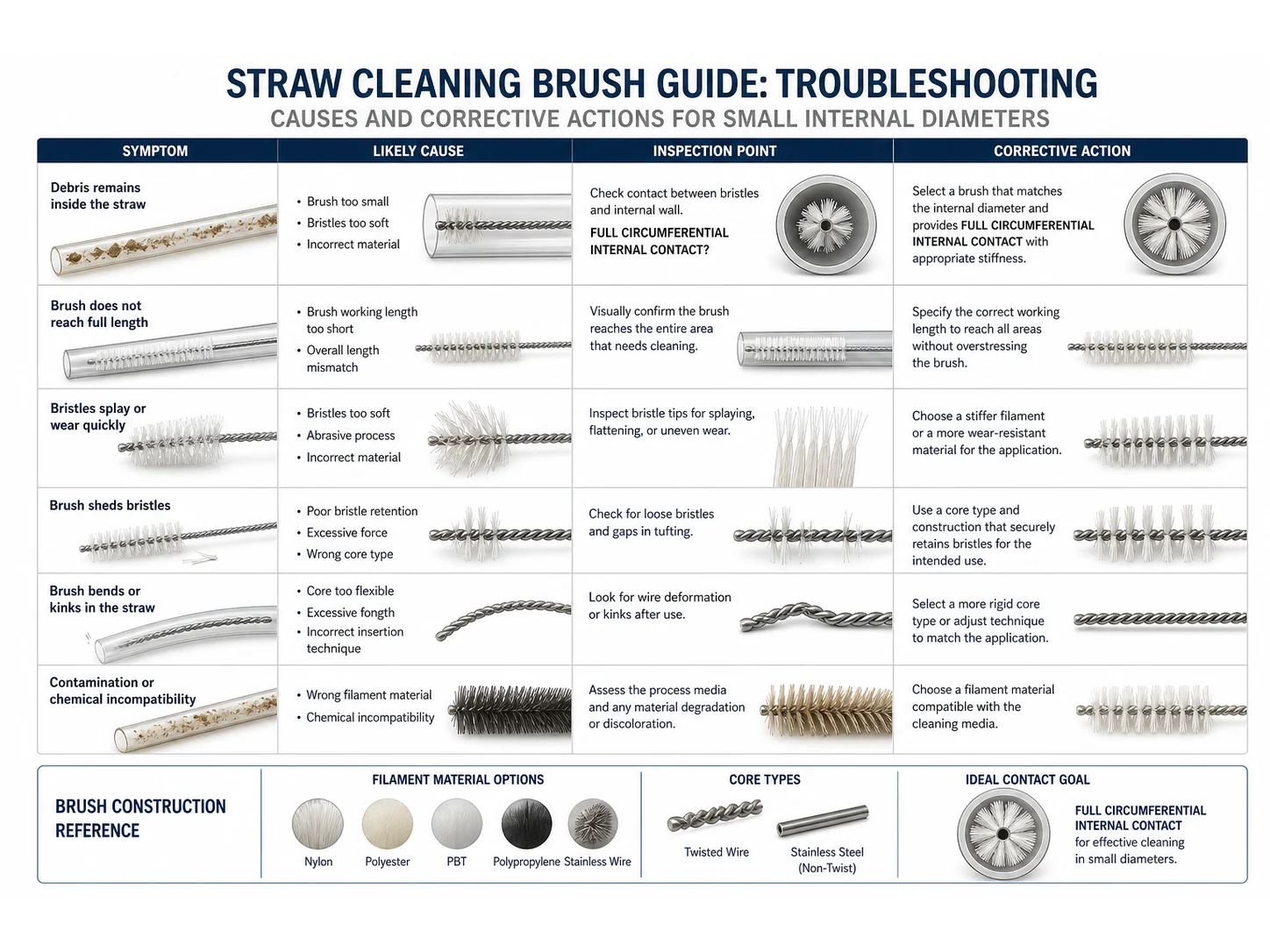
What Is a Straw Cleaning Brush?
A straw cleaning brush is a specialized narrow-diameter brush designed to clean the interior of small tubes, straws, capillaries, and similar cylindrical passages. The brush typically consists of a twisted wire core holding short bristles or filaments arranged in a spiral pattern. When passed through the tube, the brush scrubs away residues, deposits, or particulates that standard flushing or rinsing cannot remove.
Unlike larger pipe brushes, straw cleaning brushes must balance effective cleaning with the risk of scratching, lodging, or deforming thin-walled or precision tubes. The challenge becomes more acute as the inner diameter shrinks below about 6 mm, where filament packing, core strength, and overall brush profile dominate performance.
Common Material Options for Straw Cleaning Brushes
The filament material largely defines the brush’s aggression, chemical compatibility, and hygiene level:
- Nylon: Abrasion-resistant, available in multiple stiffness levels, good for general-purpose cleaning.
- Natural bristle (Tampico, horsehair): Softer, absorbent, often used where scratching must be avoided.
- Brass wire: Removes tough, adhered residues in metal tubes; leaves fine scratches.
- Stainless steel wire: For heavy-duty descaling and rust removal in hard metal tubes only.
- Polypropylene: Inert, chemical-resistant, often used in disposable lint-free applications.
- PTFE (Teflon): Ultra-low friction, highest chemical resistance, cleanroom compatible.
Comparing Materials, Stiffness, and Core Types for Small ID Cleaning
| Filament Material | Stiffness | Core Type | Diameter Range (mm) | Best For | Watch Out For |
|---|---|---|---|---|---|
| Nylon (soft) | Low–Medium | Single or double twisted wire, plastic core | 2–12 | Daily clean of plastic straws, sensitive tubing | May not remove baked-on residue |
| Nylon (medium/hard) | Medium–High | Twisted wire (stainless or galvanized) | 3–12 | General lab, dairy, beverage tubing | Check surface hardness to avoid scratching |
| Brass wire | Medium–High | Twisted steel wire | 3–10 | Carbon removal in metal tubes, injector sleeves | Leaves fine metallic traces; not for food contact |
| Stainless steel wire | High | Twisted stainless wire | 3–10 | Scale, rust, hard carbon in boiler or heat exchanger tubes | Aggressive; do not use on aluminum or plastic |
| Polypropylene | Low–Medium | Plastic or stainless core | 2–10 | Chemical sampling tubes, medical device lumens | Lower temperature ceiling; can melt |
| Tampico/horsehair | Low | Twisted wire, often galvanized | 3–12 | Polished, coated, or delicate surfaces | Loses shape faster; not for abrasive residues |
How to Size a Straw Cleaning Brush Correctly
Getting the diameter right is the single most common failure point. The brush should be slightly larger than the tube’s inner diameter—typically 0.2 to 0.5 mm oversize for filament brushes in the 2–10 mm range. This oversize ensures scrubbing contact while allowing the brush to pass through without excessive force. Too much oversize risks lodging; too little leaves residue behind.
Measure the tube ID with a pin gauge or caliper, not by guess. Then specify the brush diameter at the base of the bristles (core-to-tip) and confirm whether the supplier quotes overall diameter or filament length. Always communicate the exact ID, length of the dirty section, and any obstacles (bends, fittings, shoulders).
How to Choose a Brush Based on Your Application
Use these decision factors to narrow the field:
- Residue type: Soft, sticky residues (oils, gels) favor nylon or polypropylene. Caked, baked, or carbonized deposits may require brass or stainless wire—but check for tube material compatibility.
- Surface sensitivity: For polished or coated interiors, stick with natural fill or soft nylon. A quick scratch test on a scrap piece can save a tube lot.
- Equipment interface: Does the brush need a handle for manual use, a threaded stud for a drill, or a quick-change chuck? Handle material (wood, plastic, loop) matters in wet or chemical environments.
- Wet or chemical exposure: Confirm filament and core material resistance to your cleaning agents (e.g., NaOH, acid, solvent). Polypropylene and PTFE offer wide compatibility; natural fibers and some nylons may swell or degrade.
- Hygiene expectations: For food, beverage, or medical tubes, favor single-use disposable brushes or dedicated, validated reusable brushes that can be autoclaved or chemically sterilized. Document material traceability if required.
- Maintenance frequency: High-cycle automated lines may need quick-change brush holders and pre-determined replacement intervals to avoid filament shedding beyond acceptable limits.
- Custom size requirements: When off-the-shelf brushes don’t match your ID or length, contact a brush manufacturer with a drawing specifying ID, length, filament material, stem length, and handle/mount. Prototype samples help validate fit before a production run.
Common Mistakes When Specifying Straw Cleaning Brushes
- Choosing by cost drivers alone: The lowest-cost brush may shed, kink, or fail quickly, causing rework and product rejection.
- Ignoring core corrosion: Zinc-plated wire cores rust after chemical exposure if not replaced promptly; consider stainless cores for longevity.
- Specifying diameter as “the same as the tube”: This Help confirms zero cleaning action. Always oversize slightly.
- Overlooking filament length effect: A long bristle brush collapses and twists inside a small tube; shorter fill reduces binding.
- Assuming one material works for all chemistries: Nylon 6 swells in strong acids; polypropylene better for many chemicals.
- Not testing on sample tubes first: Filament aggression varies by supplier; a test batch prevents large-scale surprises.
When a Straw Cleaning Brush Is the Wrong Choice
A straw cleaning brush excels at removing loosely adhered, routine residues. It is not a substitute for:
- Hard scale or baked-carbon removal requiring reaming tools: Drill-mounted brushes or honing may be needed.
- Complex geometries with bends or elbows: A straight brush won’t reach; consider flexible spiral brushes or pull-through designs.
- Zero-contamination applications: Brushes shed some filaments; if your process cannot tolerate any particulates, look into non-shedding swabs, ultrasonic cleaning, or flush-only protocols.
- Verification of cleanliness without testing: A brush cleans, but validation requires borescope inspection, swab testing, or ATP measurement. Don’t assume a pass means clean.
Final Takeaway
Match the brush to the tube, the residue, and the required outcome—not just the cost drivers. A well-chosen straw cleaning brush protects your tubes, reduces downtime, and eliminates guesswork. Start by accurately measuring your tube ID, then select a filament material and core that resist your chemistry and deliver the right aggression. Test a sample, document the spec, and build it into your SOP.
Frequently Asked Questions
What is the difference between a straw cleaning brush and a test tube brush?
A test tube brush is a type of straw cleaning brush but often has a wider fan-shaped tip and longer handle for laboratory glassware. Straw brushes are typically more slender and designed for constant-diameter tubes, not flasks.
Can I use the same brush for food and industrial straws?
It is not recommended unless the brush is specifically validated and stored separately to prevent cross-contamination. Use dedicated brushes with food-grade materials and documentation.
How do I measure the inner diameter of a small tube for a brush?
Use pin gauges (most accurate) or a caliper. Measure at multiple points along the tube and use the smallest consistent reading. Never guess based on nominal tubing size.
What happens if I use a brush that is too stiff?
You risk scratching the tube interior, which can trap bacteria, accelerate wear, or impair flow in precision applications. Scratches also make future cleaning harder.
Why does my nylon brush break after a few uses?
Possible causes: core wire corroded from incompatible chemicals, excessive twisting force, tube bends that kink the wire, or using a brush with a core diameter too large for the tube.
Are there disposable straw cleaning brushes for single use?
Yes, many manufacturers offer low-cost polypropylene or nylon brushes with lightweight handles for one-time use in hygienic or validation-critical processes.
How can I get a brush for a tube diameter that is not standard?
Contact brush suppliers with a drawing. Provide your target ID, length to clean, and any special requirements. Expect to request a sample prototype before ordering a production batch.
Technical References
Which bristle material fits this job — Nylon PA, AISI 304 Stainless Steel Wire or Brass Wire?
| Material | Continuous temperature (°C) | Peak temperature (°C) | Water absorption | Hardness |
|---|---|---|---|---|
| Nylon PA | 93 | 121 | 0.3–9% by PA grade and conditioning | Medium to firm; filament diameter and trim length control bending force. |
| AISI 304 Stainless Steel Wire | 400 | 500 | 0% | Rockwell B 70–95 depending on temper and cold work |
| Brass Wire | 150–200 | 250–300 | 0% | Rockwell B 40–90 |
| Horsehair | 60–80 | 100–120 | 8–15% | — |
| AISI 316 Stainless Steel Wire | 400 | 500 | 0% | Rockwell B 70–95 depending on temper and cold work |
Figures as published by Brushtec / DuPont; Alleima. Confirm the exact grade against the supplier datasheet before ordering.
What should replace Tube & Pipe Bore Brushes for straw cleaning?
- Tube & Pipe Bore Brushes — Tube and bore brushes work by radial contact inside a confined diameter; wire wheels and cups work mainly on external edges, profiles, welds, and broad surfaces.
- Nylon PA — Compare Nylon PA with PP, PBT, PET. Change material when wet stiffness, temperature, chemical resistance, conductivity, particle shedding, or surface marking becomes the limiting factor.
- AISI 304 Stainless Steel Wire — Use AISI 316 stainless steel wire for chloride, marine, dairy, beverage, chemical washdown, or higher pitting-resistance requirements. Use carbon steel for dry aggressive cutting and brass or abrasive nylon for lower marking risk.
- Brass Wire — Compare Brass Wire with Steel wire, stainless wire, nylon. Change material when wet stiffness, temperature, chemical resistance, conductivity, particle shedding, or surface marking becomes the limiting factor.