
What Is a Straw Cleaning Brush?
A straw cleaning brush is a thin, flexible cleaning tool consisting of a central core (usually wire or plastic) surrounded by bristles, specifically shaped to pass through and scrub the inner walls of narrow tubes. Unlike general-purpose bottle brushes or test tube brushes, straw cleaning brushes are optimized for the small diameters and long lengths typical of reusable drinking straws, often made from materials like plastic, metal, or glass. Their primary job is to disrupt and remove organic residue, prevent microbial growth, and maintain hygiene without damaging the straw’s interior.
Common Materials for Straw Cleaning Brushes
When selecting a straw cleaning brush, the bristle material is the most important decision factor because it determines cleaning effectiveness, surface compatibility, and chemical resistance. The core and handle material are also important for durability and ergonomics.
- Nylon Bristles: Soft and non-abrasive, ideal for delicate plastic straws where scratching must be avoided. Good resistance to water and mild detergents but can degrade under prolonged exposure to strong acids or high heat.
- Polypropylene (PP) Bristles: Stiffer than nylon, offers better scrubbing action for sticky residues. Tolerates a wider pH range and is often used in food-contact cleaning tools. May still deform at temperatures above 80°C.
- Stainless Steel Wire Bristles: Highly durable and aggressive, suitable for metal or glass straws but not recommended for plastic straws because they will scratch or gouge the interior surface, creating crevices where bacteria can hide.
- Tampico or Natural Fiber Bristles: Made from plant fibers, these are moderately stiff and absorbent. They can hold cleaning solutions well but may retain moisture and are less common in high-volume cleaning environments.
- Plastic Core vs. Wire Core: Many straw brushes use a twisted wire core (often galvanized or stainless steel) to secure bristles. A plastic core (like nylon monofilament) is more flexible and less likely to scratch the straw’s interior if the bristles wear down, but it may not hold bristles as firmly over time.
Comparing Brush Materials for Narrow Plastic Straws
| Material Type | Best For | Abrasion Risk | Chemical Resistance | Typical Use Case |
|---|---|---|---|---|
| Nylon | Thin-walled plastic straws | Low | Good (mild cleaners) | Home and low-volume commercial cleaning |
| Polypropylene | Sturdy reusable plastic straws | Medium | Very good | Frequent cleaning cycles, sticky residues |
| Stainless Steel Wire | Metal or glass straws only | High (scratches plastic) | Excellent | Industrial or food processing with non-plastic straws |
| Tampico/Natural | Gentle scrubbing with solution retention | Low–Medium | Poor (acids/alkalis degrade fibers) | Specialty cleaning where absorbency is needed |
How to Choose the Right Size and Diameter
Sizing a straw cleaning brush incorrectly is a common and costly mistake. The brush must fit snugly enough to contact all interior surfaces but not so tightly that it becomes difficult to push through or causes excessive friction. Follow these guidelines:
- Diameter: Measure the inner diameter of your straws. The brush’s bristle diameter (the overall diameter including bristles) should be approximately 1–2 mm larger than the straw’s inner diameter to ensure effective contact without requiring extreme force.
- Length: The bristled portion should be at least as long as the straw, with an extra 1–2 cm for grip. For straws longer than 25 cm, consider a brush with a bendable or extra-long flexible core.
- Handle Design: For narrow straws, a thin wire loop handle or a small plastic knob prevents hand fatigue. If the brush will be used in volume, an ergonomic grip or compatibility with a quick-connect chuck for a low-speed drill can speed up cleaning.
- Tapered vs. Straight Brushes: Some straws have a flared end or variable diameter. A tapered brush can clean multiple diameters along its length, but a straight brush ensures uniform contact in straight-walled straws.
Key Factors: Stiffness, Handle, and Mounting Options
Beyond material and size, several factors influence whether a straw cleaning brush will work in your specific cleaning process:
- Bristle Stiffness: Soft bristles clean without scratching but may not remove dried-on protein shakes or smoothie residue. Medium-stiff bristles (like PP) are often a good compromise for plastic straws.
- Core Flexibility: If your straws have bends or curves, a wire core that can be shaped or a flexible plastic core is essential.
- Wet or Chemical Exposure: If you use sanitizing solutions (e.g., quaternary ammonium, dilute bleach, or enzymatic cleaners), verify that the bristle and core materials can withstand the pH and temperature without degradation. Nylon and PP are generally safe; natural fibers degrade quickly.
- Hygiene and Maintenance: Brushes must themselves be easy to clean and dry. Solid plastic handles or smooth metal wires reduce bacterial harborage points. Avoid open-cell foam grips in wet environments.
- Mounting for Machine Cleaning: In automated lines, the brush may need a standard shank, threaded end, or magnetic connector. Always confirm interface compatibility with your equipment manufacturer.
Common Mistakes When Selecting a Straw Cleaning Brush
Even experienced buyers can make avoidable mistakes. Watch out for these pitfalls:
- Choosing based on cost drivers alone: A very low-cost brush may use low-quality wire that rusts or bristles that fall out quickly, contaminating the straws.
- Ignoring the core material: A twisted wire core with sharp ends can scratch the interior of plastic straws if not properly tipped or if the end cap comes off.
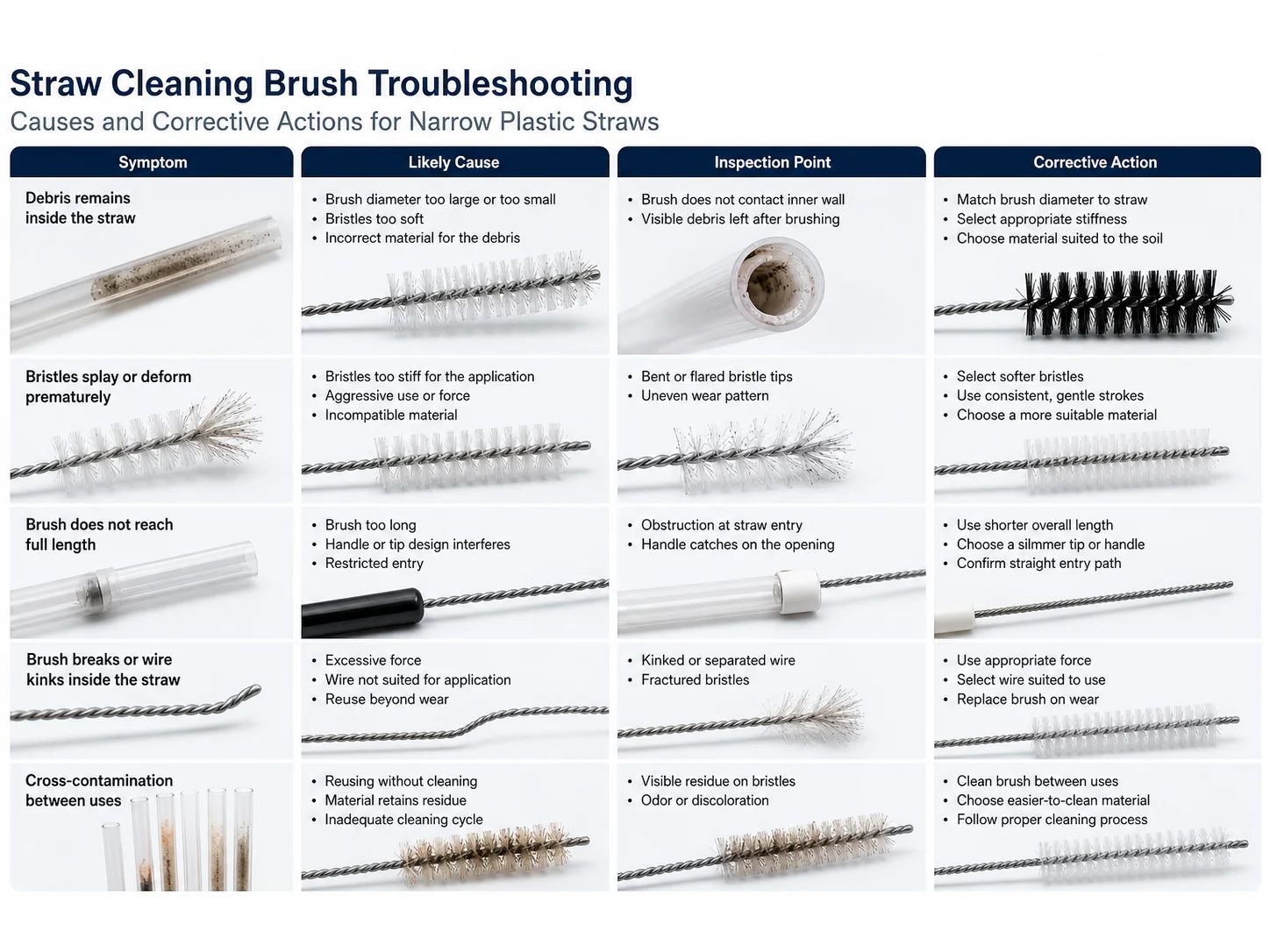
- Oversizing the brush: A brush that is too large in diameter will be difficult to insert and may stretch or split the straw.
- Using wire bristles on plastic: This scratches the surface, creating microscopic grooves that trap biofilm and accelerate bacterial growth.
- Not considering chemical compatibility: Some bristles (especially natural fibers or low-grade nylon) can swell, soften, or dissolve in aggressive cleaning chemicals.
- Skipping sample testing: Always test a small batch of brushes with your actual straws and cleaning process before committing to a large order.
- Assuming one brush fits all: Different straw diameters and materials may require different brushes. A brush that works for a 6 mm metal straw will not clean an 8 mm plastic straw effectively.
When a Straw Cleaning Brush Is the Wrong Choice
A straw cleaning brush solves many cleaning challenges, but there are limits:
- Deep biofilm removal: If the straw has not been cleaned for a long time, a brush alone may not remove established biofilm. A presoak with an enzyme-based cleaner or ultrasonic cleaning may be needed first.
- Very long or coiled straws: Straws longer than 30–40 cm or with tight coils may require a pull-through cleaning line or a dedicated flexible auger brush system.
- Mass production cleaning: Cleaning hundreds of straws per hour by hand with a brush is inefficient. Consider semi-automated systems where brushes are mounted on rotating spindles, or high-pressure spray systems if brush contact is not mandatory.
- Critical hygiene applications (medical, pharmaceutical): In these environments, single-use or sterilizable brushes with full certification and traceability are required. A generic straw cleaning brush may not meet regulatory standards.
- If straw interiors have complex shapes: Straws with internal baffles, sensors, or varying cross-sections may need custom-designed brushes with contour bristle patterns. Consult a supplier with in-house design capability and ask for a drawing review before placing an order.
Final Takeaway
Selecting the right straw cleaning brush for narrow plastic straws comes down to matching bristle material to surface sensitivity, verifying inner diameter fit, and avoiding the common mistake of using abrasive wire on soft plastic. Prioritize nylon or polypropylene bristles for plastic straws, measure your straws precisely, and test samples in your actual cleaning environment. If the cleaning challenge exceeds what a simple brush can handle, explore complementary methods like soaking, ultrasonic cleaning, or automated brushing systems.
Frequently Asked Questions
Can I use the same brush for metal and plastic straws?
It is not recommended. Metal straws can tolerate stiffer bristles, even stainless steel wire, but those same bristles will scratch plastic. Using a separate brush for each material prevents cross-contamination and surface damage.
How do I know if the brush is too stiff for my plastic straw?
Test on a sacrificial straw by brushing firmly for 10–15 seconds. Then rinse and hold the straw up to light. If you see fine scratches or a dulled interior surface, the brush is too abrasive. Switch to softer nylon.
What is the best way to measure the inner diameter of a straw?
Use a digital caliper to measure the opening. For thin plastic straws, apply light pressure to avoid deforming the straw. If you don’t have a caliper, insert known drill bit shanks until you find the largest that fits comfortably—that is your approximate ID.
Can I put straw brushes in a dishwasher?
Most straw brushes with nylon or PP bristles and plastic handles can withstand standard dishwasher temperatures on the top rack. However, frequent dishwasher cycles may accelerate wire core corrosion if the core is not stainless steel. Air drying after hand washing usually extends brush life.
How often should I replace a straw cleaning brush?
Inspect monthly. Replace when bristles become matted, wire ends protrude, rust appears, or cleaning performance drops. In commercial use, a monthly replacement cycle is common; in home use, every 3–6 months if used daily.
Are there brushes specifically made for reusable straws with a bend or flex section?
Yes. Look for brushes with a flexible center core (like nylon monofilament) or a malleable wire core that you can bend to match the straw’s shape. Some suppliers offer “flexible straw brushes” designed for bent or telescoping straws.
Can I use a test tube brush as a straw cleaning brush?
Test tube brushes often have a wider diameter and stiffer bristles because laboratory glassware can tolerate aggressive cleaning. A typical test tube brush is too large and abrasive for narrow plastic straws. Use a brush specifically designed for straw diameters.
What if my straw has dried-on smoothie residue that a brush can’t remove?
Soak the straw in warm water with a mild detergent or enzymatic cleaner for 15–30 minutes to loosen the residue. Then use the brush. If residue persists, consider a brush with slightly stiffer polypropylene bristles, but always check for abrasion.
Technical References
Which bristle material fits this job — Nylon PA, AISI 304 Stainless Steel Wire or Polypropylene PP?
| Material | Continuous temperature (°C) | Peak temperature (°C) | Water absorption | Hardness |
|---|---|---|---|---|
| Nylon PA | 93 | 121 | 0.3–9% by PA grade and conditioning | Medium to firm; filament diameter and trim length control bending force. |
| AISI 304 Stainless Steel Wire | 400 | 500 | 0% | Rockwell B 70–95 depending on temper and cold work |
| Polypropylene PP | 80–100 | 120–140 | ≤0.03% | Shore D 65–75 |
| AISI 316 Stainless Steel Wire | 400 | 500 | 0% | Rockwell B 70–95 depending on temper and cold work |
| PBT | 120–140 | 160–180 | 0.05–0.20% | Shore D 80–90 |
Figures as published by Brushtec / DuPont; Alleima; Perlon. Confirm the exact grade against the supplier datasheet before ordering.
What should replace Tube & Pipe Bore Brushes for straw cleaning?
- Tube & Pipe Bore Brushes — Tube and bore brushes work by radial contact inside a confined diameter; wire wheels and cups work mainly on external edges, profiles, welds, and broad surfaces.
- Nylon PA — Compare Nylon PA with PP, PBT, PET. Change material when wet stiffness, temperature, chemical resistance, conductivity, particle shedding, or surface marking becomes the limiting factor.
- AISI 304 Stainless Steel Wire — Use AISI 316 stainless steel wire for chloride, marine, dairy, beverage, chemical washdown, or higher pitting-resistance requirements. Use carbon steel for dry aggressive cutting and brass or abrasive nylon for lower marking risk.
- Polypropylene PP — Compare Polypropylene PP with Nylon, PBT, PET. Change material when wet stiffness, temperature, chemical resistance, conductivity, particle shedding, or surface marking becomes the limiting factor.