
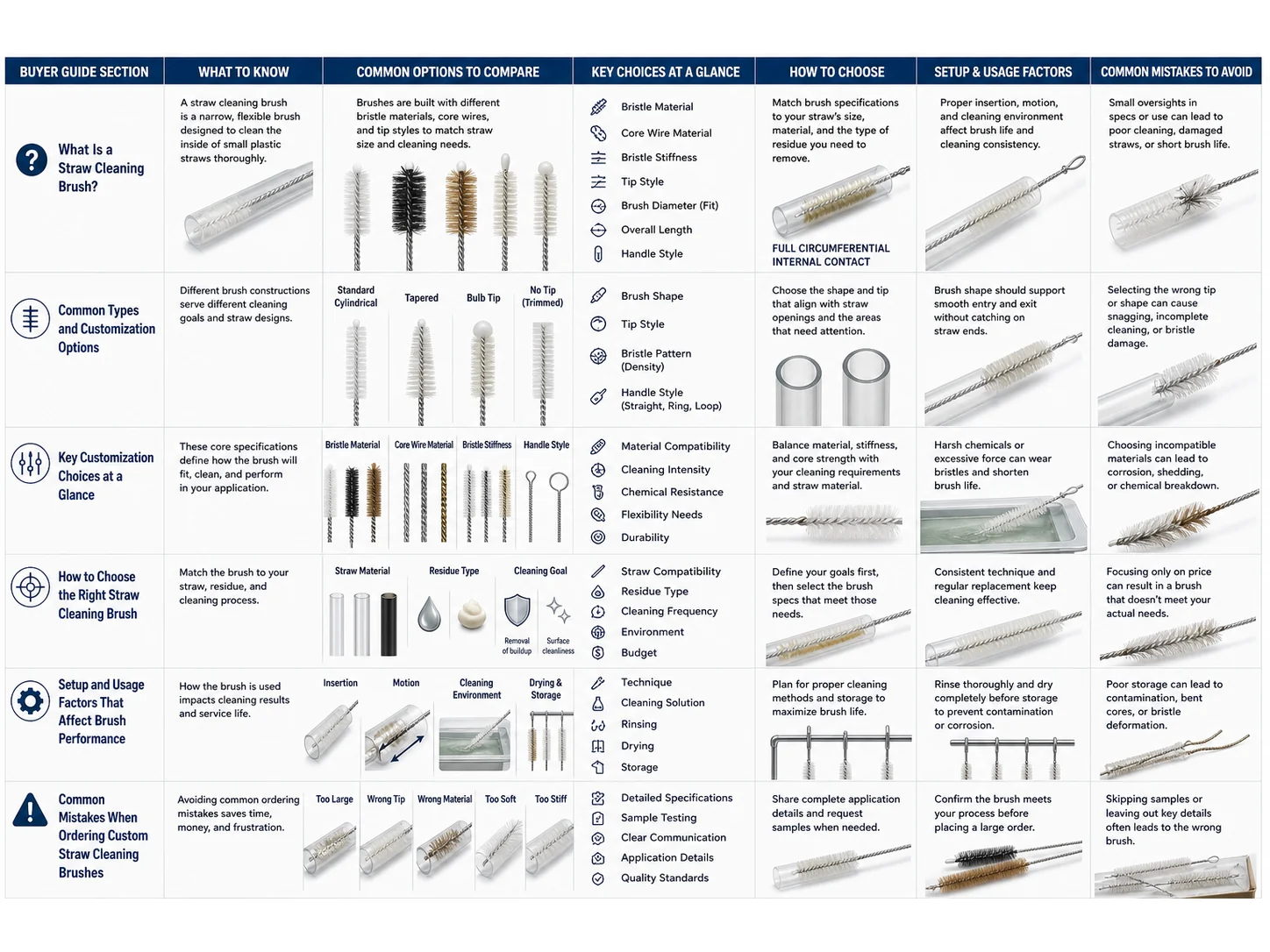
What Is a Straw Cleaning Brush?
A straw cleaning brush is a cleaning tool with a narrow, elongated core and bristles sized to reach inside tubes typically 5–10 mm in internal diameter. In commercial and institutional contexts, these brushes are not off-the-shelf kitchen gadgets but often custom-specified components chosen for compatibility with specific straw materials, cleaning chemicals, and handling frequency. The core may be twisted wire or plastic, and the bristles can be nylon, polyester, natural fiber, or metal. The right brush removes beverage residue, biofilm, and light deposits without damaging the straw’s inner surface.
Common Types and Customization Options
Before you request a custom straw cleaning brush, it helps to understand the main categories of choices. While the basic concept is simple, the details determine performance:
- Bristle Material: Nylon (general purpose, good chemical resistance), polyester (stiffer, more aggressive), natural tampico (gentler, absorbent), or stainless steel wire (for heavy-duty or high-temperature cleaning but risk scratching plastic).
- Core or Handle: Twisted galvanized or stainless steel wire (most common, lower cost, can rust if unprotected), twisted stainless steel (corrosion-resistant), plastic-coated wire (prevents scratching and rust), or fully plastic core (non-metallic, chemical-resistant).
- Bristle Stiffness and Density: Soft, medium, or stiff—affects cleaning aggression and surface compatibility.
- Diameter and Length: Overall brush OD must match the straw ID with appropriate interference for scrubbing. Brush length must reach the full straw length including any bends.
- Tip Shape: Rounded (prevents scratching the bottom), tufted, or threaded tip for attaching to machinery.
- Handle Design: Loop, twisted tail, plastic grip, or machine coupling (like a hex shank for rotary tools).
Key Customization Choices at a Glance
| Feature | Option A | Option B | Option C | Best When… |
|---|---|---|---|---|
| Bristle Material | Nylon | Polyester | Tampico | Nylon for everyday beverage residue; polyester for stubborn films; tampico for gentle scrubbing or natural/eco requirements. |
| Core Material | Twisted galvanized wire | Twisted stainless steel | Plastic-coated wire | Galvanized for dry, low-cost use; stainless for wet/chemical environments; plastic-coated to protect delicate straw ID from metal contact. |
| Bristle Stiffness | Soft (0.10–0.15 mm filament) | Medium (0.20–0.30 mm) | Stiff (0.40 mm+) | Soft for thin-walled or easily scratched plastic; medium as general purpose; stiff only when heavy buildup is present and plastic can withstand it. |
| Handle Type | Twisted wire loop | Straight shank with plastic grip | Machine fitting (hex, round) | Loop for manual hand cleaning; plastic grip for ergonomics and reusability; machine fitting for automated or semi-automated cleaning lines. |
| Tip Finish | Blunt cut | Epoxy rounded | Tufted end | Blunt may scratch; rounded safer for plastic; tufted for cleaning the straw bottom. |
How to Choose the Right Straw Cleaning Brush
Your choice should be driven by the specific cleaning conditions, not just the straw’s inner diameter. Run through these decision factors:
- Residue Type: Sugary syrups, dairy, smoothie pulp, or light dust? Heavier, stickier residues may need stiffer bristles or a slightly larger brush diameter for effective scrubbing. In contrast, light dust from storage might only require a soft wipe.
- Surface Sensitivity: Is the straw a soft plastic (polyethylene, silicone-like) or a harder plastic (tritan, acrylic)? Soft plastics scratch easily—choose softer bristles and a plastic-coated core. Harder plastics can tolerate medium stiffness but may still scratch if a metal core protrudes.
- Equipment Interface: Will the brush be used manually or mounted on a rotating spindle, ultrasonic bath, or automated line? Machine use demands a secure, standardized coupling that resists vibration and torque.
- Chemical and Moisture Exposure: If cleaning involves detergents, sanitizers, or hot water, avoid materials that corrode or degrade. Stainless steel core (304 or 316) is preferred for prolonged wet use. Nylon bristles resist most cleaning chemicals but can absorb water and soften.
- Hygiene and Sanitation Standards: For food-contact or medical applications, choose FDA-compliant bristle materials and corrosion-resistant cores. Smooth, non-absorbent materials reduce bacterial harborage.
- Maintenance Frequency and Brush Life: High-cycle operations (hundreds of straws per day) need durable constructions. Metal cores with secure bristle anchoring last longer than all-plastic counterparts but may eventually fatigue.
- Custom Size Requirements: Straws with varying internal diameters (tapered, corrugated, bent) may need a brush with graduated bristle lengths or flexible sections to maintain contact throughout.
Setup and Usage Factors That Affect Brush Performance
Real-world conditions often reveal gaps between a brush’s lab design and field performance. Consider these before finalizing specs:
- Wet vs. Dry Cleaning: A brush that works well with a lubricating cleaning solution may be too aggressive when used dry, causing friction and scratching.
- Stroke Speed and Length: In manual use, operators may use short, fast strokes that abrade the surface. Longer, slower strokes with proper interference clearance distribute wear more evenly.
- Storage Environment: If brushes sit in a wet, chemical-laden bucket between uses, even stainless steel cores can eventually pit unless passivated or made from higher-grade alloy.
- Straw Reuse Life: For reusable straws that will be cleaned hundreds of times, prioritize gentleness—hard bristles may shorten the straw’s usable life.
Common Mistakes When Ordering Custom Straw Cleaning Brushes
Even experienced buyers can overlook details that turn a promising sample into a rejected batch. Watch out for these pitfalls:
- Focusing Only on Diameter: A brush that fits inside the straw may still fail if bristles are too short to scrub the wall or if the core scrapes the ID at bends.
- Choosing by cost drivers Alone: The lowest-cost twisted-wire brush may rust after one wash cycle, shedding bristles into the straw. Total cost of ownership includes replacement and potential product loss.
- Ignoring Core Protrusion: In thin straws, the core’s cut end can scratch if not properly tipped or if the brush diameter is too close to the ID.
- Assuming All Plastics Are the Same: A brush that works on rigid polycarbonate might scratch acrylic or leave micro-abrasions on flexible LDPE.
- Skipping Sample Testing in Actual Conditions: Lab simulations often miss the variability of real residues, user technique, and chemical interactions. Always test prototypes in your typical workflow.
- Overlooking Food Safety Documentation: Even if the brush looks clean, materials may not be compliant for food contact. Request relevant declarations for bristles and coatings.
When a Straw Cleaning Brush Is the Wrong Choice
A dedicated straw cleaning brush solves many cleaning challenges, but it has limits. You may need a different approach if:
- The straw is extremely long or has multiple tight bends: A single straight brush may not navigate the turns effectively. Flexible spiral brushes or pull-through string brushes can help.
- Residue is hardened or mineral-based (e.g., dried concrete, scale): Aggressive stainless steel brushes or chemical soaking may be required, but these can damage plastic. Ultrasonic cleaning or enzymatic soaks are safer for the straw.
- The straw material is very soft or fragile (silicone, thin-walled TPE): Even soft-bristle brushes can tear or deform thin walls. Non-contact cleaning like high-pressure water jets or sonication may be better.
- Sanitation requirements demand validated log reduction (sterilization): A brush alone cannot Help confirm microbial kill. Pair mechanical cleaning with a validated sanitization process (autoclave, chemical sterilant, UV).
- High-volume production line integration: Manual brushing is slow. Automated brushing stations with precise control over rotation, stroke, and pressure, or even automated spray systems, might be more cost-effective.
Final Takeaway
Selecting a custom straw cleaning brush for narrow plastic straws isn’t just about finding the right diameter. It’s about matching bristle material, stiffness, core construction, and tip design to your specific residue type, straw plastic, chemical environment, and usage frequency. Start by defining your worst-case cleaning scenario, test samples with your actual straws and cleaning agents, and don’t ignore the small details like core tips and chemical compatibility. When in doubt, request a supplier’s material data sheet and consider whether a secondary cleaning method might also be needed.
Frequently Asked Questions
What bristle material is safest for reusable plastic straws?
Nylon is generally safe and effective for most reusable plastic straws. For very soft plastics or to avoid any micro-scratching, consider natural tampico or extra-soft polyester. Always avoid metal bristles unless you are cleaning a metal straw and scratching is not a concern.
Can I use a metal core brush inside a plastic straw without damaging it?
It depends on how the brush is constructed. A stainless steel core with a plastic coating or a securely insulated tip can be used safely if the brush diameter is correctly sized. However, bare metal cores can scratch the straw, especially at the tip and along the twisted wire. For sensitive plastics, a plastic-coated core or an all-plastic brush is the safer choice.
How do I measure my straw’s inner diameter to order the right brush size?
Use calipers to measure the narrowest section of the straw’s inner diameter (ID). The brush’s overall outer diameter (OD) should be approximately 0.5–1.0 mm larger than the straw’s ID for effective scrubbing without excessive force. If the straw has a bend or taper, measure at the tightest point and consider a brush with flexible or graduated bristle length.
What’s the difference between a straw cleaning brush and a test tube brush?
A test tube brush is typically designed for laboratory glassware with a fan-shaped tip and often uses natural or synthetic bristles on a twisted wire core. Straw cleaning brushes are generally longer and narrower, with bristles optimized for cleaning long, straight (or gently curved) tubes rather than the rounded bottom of a test tube. However, some brushes can serve both purposes if the dimensions and materials align.
Can I run a straw cleaning brush through a dishwasher or sanitizer?
The brush itself may or may not be dishwasher-safe depending on its materials. Nylon and polypropylene can warp under high heat. Metal cores can rust if not stainless steel. Check the brush material’s temperature and chemical tolerance before placing it in a dishwasher or sanitizer. For commercial cleaning, manual brushing followed by a separate sanitation step is often preferred.
How often should I replace a commercial straw cleaning brush?
Replace the brush when bristles show signs of matting, fraying, or shedding, or if the core bends permanently. In a high-volume setting, visual inspection before each shift is recommended. Maintaining a replacement schedule based on cycle count (e.g., every 5,000–10,000 straws) can prevent poor cleaning performance and potential bristle contamination.
Is it possible to get a custom brush that cleans both the straw interior and the exterior?
Yes, but it’s uncommon for a single brush to excel at both. Dual-action brushes with larger outer bristles exist, but they are more complex to design. For most applications, it’s more practical to use a dedicated straw cleaning brush for the interior and a separate sponge, cloth, or brush for the exterior, ensuring each surface gets the appropriate level of cleaning.
Technical References
Which bristle material fits this job — AISI 304 Stainless Steel Wire, Nylon PA or Silicone?
| Material | Continuous temperature (°C) | Peak temperature (°C) | Water absorption | Hardness |
|---|---|---|---|---|
| AISI 304 Stainless Steel Wire | 400 | 500 | 0% | Rockwell B 70–95 depending on temper and cold work |
| Nylon PA | 93 | 121 | 0.3–9% by PA grade and conditioning | Medium to firm; filament diameter and trim length control bending force. |
| Silicone | 200–250 | 280–300 | 0.1–1.0% | Shore A 20–80 |
| AISI 316 Stainless Steel Wire | 400 | 500 | 0% | Rockwell B 70–95 depending on temper and cold work |
| PBT | 120–140 | 160–180 | 0.05–0.20% | Shore D 80–90 |
Figures as published by Alleima; Brushtec / DuPont; Perlon. Confirm the exact grade against the supplier datasheet before ordering.
What should replace Tube & Pipe Bore Brushes for straw cleaning?
- Tube & Pipe Bore Brushes — Tube and bore brushes work by radial contact inside a confined diameter; wire wheels and cups work mainly on external edges, profiles, welds, and broad surfaces.
- AISI 304 Stainless Steel Wire — Use AISI 316 stainless steel wire for chloride, marine, dairy, beverage, chemical washdown, or higher pitting-resistance requirements. Use carbon steel for dry aggressive cutting and brass or abrasive nylon for lower marking risk.
- Nylon PA — Compare Nylon PA with PP, PBT, PET. Change material when wet stiffness, temperature, chemical resistance, conductivity, particle shedding, or surface marking becomes the limiting factor.
- Silicone — Compare Silicone with PP, TPE, Nylon. Change material when wet stiffness, temperature, chemical resistance, conductivity, particle shedding, or surface marking becomes the limiting factor.