
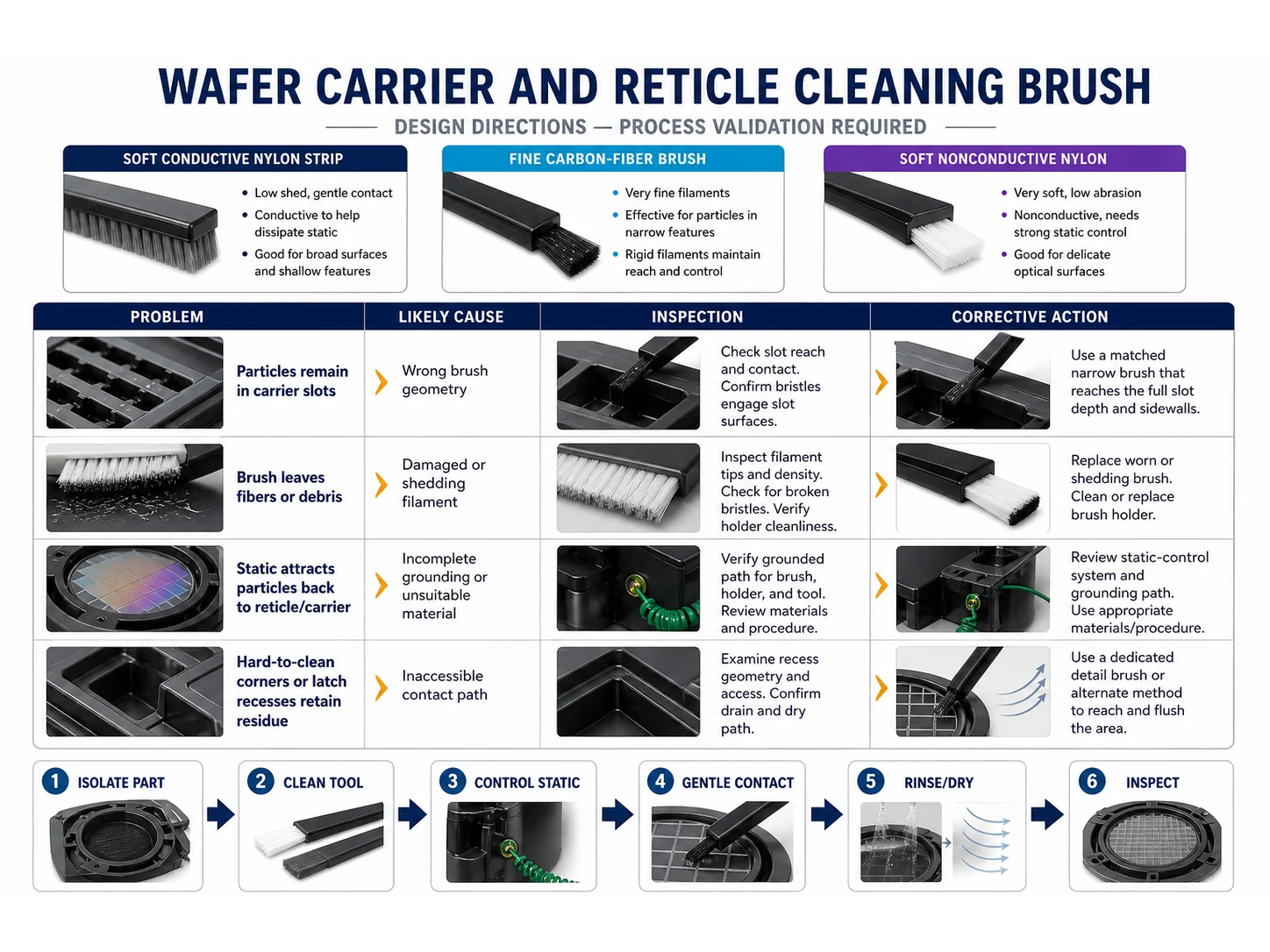
What Is a Wafer Carrier and Reticle Cleaning Brush?
A wafer carrier and reticle cleaning brush is a specialized tool used to remove particles, residues, and contaminants from carriers, cassettes, and reticle pods in semiconductor manufacturing. Unlike general-purpose brushes, these brushes must not themselves become a source of contamination. They are used in wet or dry cleaning processes, often in contact with sensitive surfaces where even micron-level shedding can cause yield loss.
Common Types of Cleaning Brushes
Several brush constructions are used for carrier and reticle cleaning, each with trade-offs:
- PVA (Polyvinyl Alcohol) sponges and brushes: Highly absorbent, soft, and low in particle shedding. Commonly used in post-CMP and carrier cleaning when wetted with DI water or chemicals.
- Nylon bristle brushes: Durable and chemical-resistant but can shed particles if not properly processed. Standard nylon is not inherently static-dissipative.
- Conductive fiber brushes: Incorporate carbon or other conductive elements to dissipate static charges. Used where ESD control is critical.
- Foam or composite brushes: Engineered structures that combine scrubbing action with reduced particle generation. May include reticulated foam pads.
Comparing Brush Materials and Structures
The following table compares key brush types by properties relevant to wafer carrier and reticle cleaning. Properties can vary by manufacturer and grade; always request material data.
| Brush Type | Contamination Risk | Static Dissipation | Chemical Resistance | Shedding Potential | Typical Use |
|---|---|---|---|---|---|
| PVA (sponge/tip) | Low (wet use) | None inherent | Good with many aqueous solutions; limited solvent tolerance | Very low when properly conditioned | DI water rinsing, mild chemical cleaning of carriers |
| Standard nylon | Moderate (dry use may generate particles) | None; charge buildup possible | Excellent acid and solvent resistance | Moderate, especially with dry brushing | Robust scrubbing where particles not ultra-critical |
| Conductive fiber (carbon-filled) | Low to moderate (depends on binder) | Good surface resistivity (10⁶–10⁹ Ω typically) | Moderate; check binder compatibility | Low with proper fiber bonding | ESD-sensitive reticle pod or carrier cleaning |
| Engineered foam | Low if cleanroom processed | May be static-dissipative if treated | Varies; foam can absorb solvents | Low; depends on cell structure | Automated wet stations, contact cleaning |
How to Choose the Right Cleaning Brush
Selection should be driven by the specific cleaning process, not by general brush categories. Consider these factors:
- Contamination sensitivity: For lithography-related parts (reticles, pods), a brush that sheds few particles is essential. PVA or low‑shedding conductive brushes are often preferred.
- Static-control requirements: If the cleaned surface is ESD-sensitive (e.g., reticles with pellicles), choose a brush with verified surface resistivity in the dissipative range (10⁶–10⁹ Ω). Conductive fiber or static‑dissipative foam can be suitable.
- Chemical exposure: The brush must withstand the cleaning solutions used (solvents, acids, bases). Nylon offers broad resistance, but PVA may swell in strong solvents. Always check compatibility with the brush’s binder or matrix.
- Equipment interface: Automated cleaning tools require brushes with precise dimensions, mounting features, and consistent wear characteristics. Manual cleaning allows more flexibility but demands attention to operator technique.
- Shedding tolerance: In critical areas, even a few particles can cause defects. Select brushes that have been tested for particle generation under your process conditions.
Setup and Usage Factors
Even the best brush can cause problems if used incorrectly. Pay attention to:
- Wet vs. dry cleaning: PVA brushes perform best when wet; dry use can cause friction, static, and shedding. Conductive brushes may still benefit from moisture to reduce particle re‑attraction.
- Grounding: A conductive brush must be grounded through the handle or equipment fixture to dissipate charge effectively. An ungrounded conductive brush is often no better than an insulative one.
- Cleaning and conditioning: New brushes may require pre‑rinsing to remove manufacturing residues. Regular inspection for wear, fraying, or discoloration helps prevent unexpected contamination.
- Operator handling: Use cleanroom gloves and avoid touching bristles to skin or unclean surfaces.
Common Mistakes in Brush Selection
Many cleaning issues stem from avoidable selection errors:
- Using general nylon brushes for sensitive applications: Unmodified nylon builds static easily and can shed particles, leading to reticle or wafer contamination.
- Ignoring static dissipation: A brush that does not dissipate charge can attract airborne particles to the cleaned surface or even cause ESD damage.
- Relying on unverified conductive claims: “Anti‑static” labeling is not enough. Request surface resistivity measurements and verify the brush meets your ESD control plan.
- Choosing by shape or convenience rather than material compatibility: A brush that fits the hand but degrades in your cleaning solvent will fail quickly.
- Overlooking shedding during break‑in: Some brushes release particles initially. A break‑in protocol (e.g., running the brush in a DI water bath) should be validated.
When a Wafer Carrier Cleaning Brush Is the Wrong Choice
Standard cleaning brushes reach their limit when:
- The process requires particle test results below a specified threshold (e.g., < 0.1 particles/cm²) that can only be confirmed by metrology.
- The tool or reticle manufacturer mandates a validated cleaning component—a brush that has passed qualification tests specific to that equipment.
- Cleaning occurs in an environment with strict chemical purity or outgassing limits, where brush materials must be documented for low extractables.
- Static control requirements demand surface resistivity outside the range offered by standard conductive brushes, requiring custom fiber blends or treatments.
In these cases, work with equipment suppliers or material experts to source qualified brushes and rely on process validation data before production use.
Final Takeaway
Select a wafer carrier or reticle cleaning brush by first identifying the contamination sensitivity, static-control needs, and chemical environment of your process. Match brush material and construction to those requirements, then verify performance under actual cleaning conditions. Avoid generic brush assumptions—what works for a cassette in a wet bench may not be safe for a reticle pod.
Frequently Asked Questions
Can I use any anti-static brush for wafer carrier cleaning?
Not necessarily. A brush marketed as anti-static may not meet the surface resistivity or particle cleanliness required for semiconductor use. Verify the resistivity range and request particle generation data.
What is the difference between a wafer carrier brush and a reticle cleaning brush?
Both must be low-shedding and static-safe, but reticle cleaning often demands even tighter particle control and may involve different chemical exposure. Reticle pod cleaning brushes often have softer tips to avoid scratching.
How do I verify that a brush is truly static-dissipative?
Request a supplier’s test report showing surface resistivity measured per ASTM D257 or equivalent. The resistance should typically fall between 10⁶ and 10⁹ ohms for dissipative properties.
Are PVA brushes always safe for cleanroom use?
PVA is popular because it generates few particles when wet, but quality varies. Ensure the PVA is cleanroom‑processed and free of contamination that could leach into cleaning solutions.
How often should cleaning brushes be replaced?
Replacement intervals depend on usage frequency, chemical exposure, and visual inspection. Look for signs of wear, stiffness change, or particle shedding, and replace before performance degrades.
Can I test brush shedding in-house?
Yes. A simple test: agitate the brush in a clean DI water bath, then sample the water with a particle test results or by filtering and inspecting the filter surface. This gives a relative comparison, but quantitative limits should come from your process requirements.
Do I need a different brush for solvent-based cleaning?
Often yes. Check the brush’s chemical compatibility chart. PVA can swell in organic solvents, while nylon or certain conductive fibers may be more resistant. Always test with your specific chemistry.
Technical References
- EOS/ESD Association — ESD Fundamentals
- EOS/ESD Association — Principles of ESD Control
- NISTIR 4653 — Metrology for the Semiconductor Industry
- ISO 14644-1 Cleanrooms and Associated Controlled Environments
Which nylon grade fits this job — Nylon PA, PA6 Nylon or PA66 Nylon?
| Grade | Continuous temperature (°C) | Peak temperature (°C) | Water absorption | Hardness |
|---|---|---|---|---|
| Nylon PA | 93 | 121 | 0.3–9% by PA grade and conditioning | Medium to firm; filament diameter and trim length control bending force. |
| PA6 Nylon | 80–100 | 130–160 | 1.5–3.0% | Shore D 75–85 |
| PA66 Nylon | 100–120 | 150–180 | 1.0–1.8% | Shore D 80–88 |
| PA610 Nylon | 90–110 | 130–150 | 0.5–1.0% | Shore D 72–82 |
| PA612 Nylon | 90–110 | 130–150 | 0.3–0.7% | Shore D 70–80 |
Figures as published by Brushtec / DuPont. Confirm the exact grade against the supplier datasheet before ordering.
What should replace Nylon PA when it stops working?
- Nylon PA — Compare Nylon PA with PP, PBT, PET. Change material when wet stiffness, temperature, chemical resistance, conductivity, particle shedding, or surface marking becomes the limiting factor.
- PVA Sponge — Compare PVA Sponge with PU sponge, PP sponge, microfiber. Change material when wet stiffness, temperature, chemical resistance, conductivity, particle shedding, or surface marking becomes the limiting factor.