
What Is a Strip Brush Channel?
A strip brush channel is the rigid metal or plastic housing that holds brush bristles in a linear form. Common profiles include flat, angled, and U-shaped channels. The channel provides structural support and a mounting interface to attach the brush to equipment. While bristle material often gets the most attention, the channel material directly influences corrosion resistance, weight, and how the brush integrates into an assembly.
Aluminum vs. Stainless Steel Channels: Key Differences
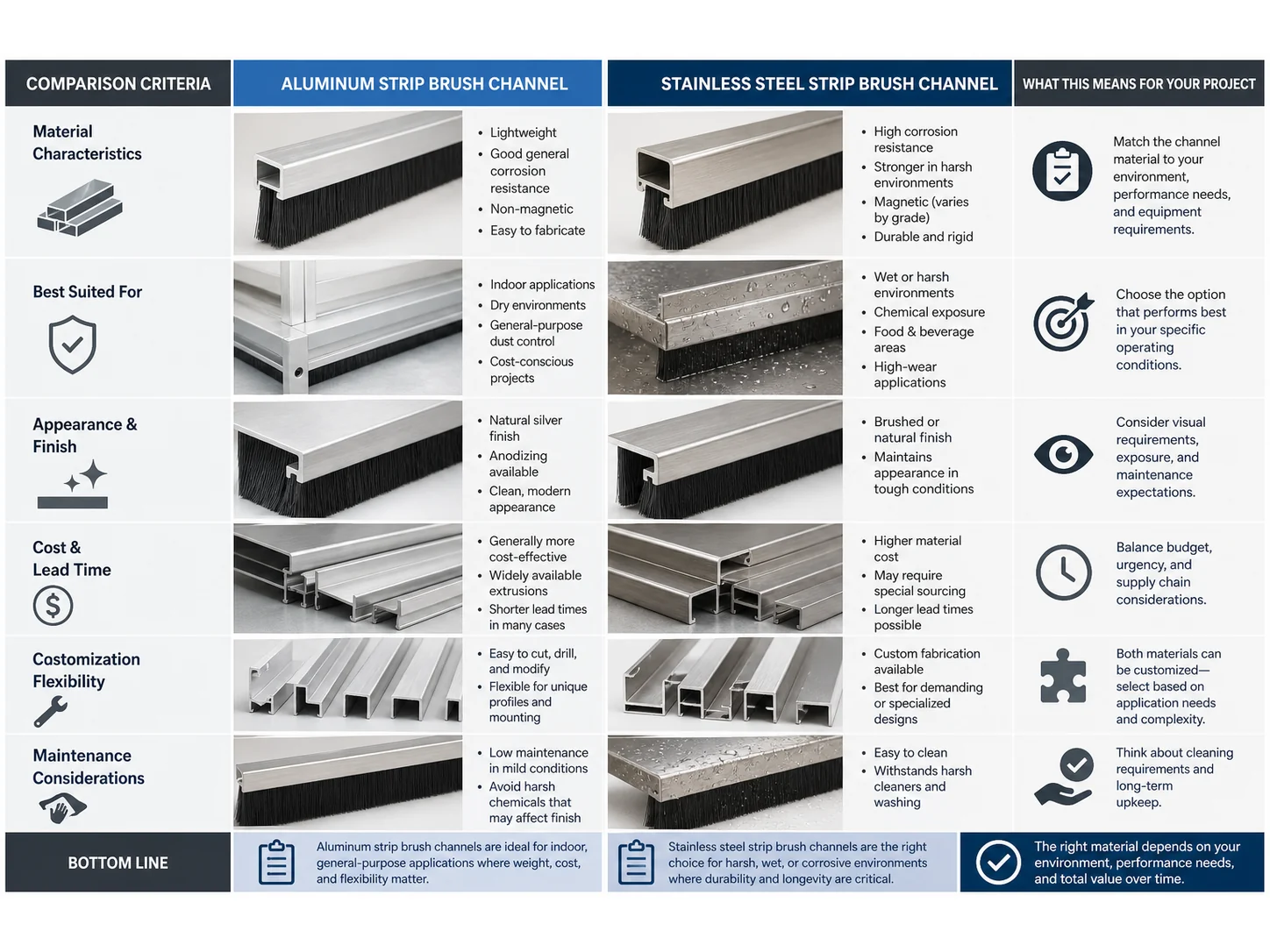
Both aluminum and stainless steel channels have distinct advantages. The better choice depends on operating conditions, weight requirements, and budget. Below is a comparison to guide material selection during customization.
| Factor | Aluminum Channel | Stainless Steel Channel |
|---|---|---|
| Weight | Lightweight, roughly one-third the weight of steel | Heavier; may require stronger mounting hardware |
| Corrosion Resistance | Natural oxide layer provides good resistance in mild environments; not ideal for chloride exposure | Excellent resistance to rust, chemicals, and moisture; preferred for washdown and outdoor use |
| Strength & Durability | Softer; can deform under high mechanical stress | Harder and more abrasion-resistant; retains shape under load |
| Cost | Generally lower material cost and easier to extrude | Higher raw material cost and more demanding fabrication |
| Thermal Conductivity | High; dissipates heat quickly | Lower; retains heat more than aluminum |
| Magnetic Properties | Non-magnetic | Some stainless steels are magnetic (e.g., 304 may be slightly magnetic after cold work, 316 is typically non-magnetic) |
| Typical Applications | Indoor sealing, light dust wiping, electronics enclosures, food packaging areas without harsh chemicals | Food processing washdown zones, marine environments, high-temperature areas, chemical exposure |
When to Consider Customizing Your Strip Brush Channel
Standard strip brushes come in common lengths, channel profiles, and materials. Customization becomes necessary when:
- Non-standard length or profile: Your equipment requires a continuous brush longer than off-the-shelf options, or a unique channel shape like a deep U-channel or special angle.
- Unusual mounting interface: The brush must fit into a proprietary slot, clip into a pre-existing groove, or integrate with an automated system that demands non-standard holes, notches, or bends.
- Extreme environment: Exposure to high heat, aggressive chemicals, or salt spray may require a specific stainless alloy (e.g., 316) or anodized aluminum for added protection.
- Weight-critical application: Lightweight aluminum can reduce overall machine weight, but only if corrosion and strength requirements allow.
- Combination of bristle and channel not stocked: You need a particular bristle material (e.g., anti-static nylon) set in a channel that is not mass-produced together.
Information to Include in a Custom Strip Brush RFQ
To avoid delays and ensure the brush meets functional requirements, include the following details when requesting a quote for a custom aluminum or stainless steel channel strip brush:
- Brush type and orientation: Straight, coiled, or punch-set strip brush; specify if bristles are on one side, both sides, or continuous around a shape.
- Dimensional details: Overall length, channel width, channel height, bristle trim length, and any critical tolerances. A drawing or CAD file is ideal.
- Bristle material and density: Material (e.g., nylon, polypropylene, horsehair, stainless steel wire), filament diameter, and rows of bristles per channel foot.
- Channel material and finish: Indicate preferred material (e.g., 6063 aluminum, 304 stainless steel), surface treatment (anodizing, passivation), and gauge or wall thickness if known.
- Mounting interface: Describe mounting holes, slots, brackets, or adhesive backing. Specify hole diameter and center-to-center spacing if holes are required.
- Quantity and expected usage: Initial order volume and estimated annual usage help the supplier recommend tooling and pricing.
- Application and operating environment: Explain what the brush will wipe, seal, or guide. Note temperature range, chemical exposure, speed, and frequency of use.
- Packaging and documentation: Any special packaging to prevent bending, certificates of conformance, or country of origin documentation if needed.
- Sample or prototype confirmation: State whether you require a pre-production sample for fit and function testing before full production.
Common Mistakes When Requesting Custom Strip Brushes
- Overlooking channel thickness: Thin channels can distort during handling or installation. If rigidity matters, specify a minimum wall thickness or material gauge.
- Assuming all stainless is equal: 304 and 316 stainless differ in chloride resistance. Using the wrong grade can lead to premature rust or pitting.
- Ignoring thermal expansion: Aluminum expands nearly twice as much as steel with temperature changes. Long runs in variable environments may need expansion gaps or flexible mounting.
- Skipping bend radius specifications: When a strip brush must follow a curved path, the channel must be pre-bent or slotted. Failing to provide the bend radius can result in a brush that kinks or pops out of the channel.
- Not confirming bristle-channel compatibility: Aggressive bristles like steel wire can abrade softer aluminum channels if the channel is also a wear surface. Consider a protective insert or choose stainless.
- Providing incomplete RFQ data: Missing any of the RFQ details (especially environmental conditions) often leads to requotes and extended production schedules.
Standard Strip Brush vs. Custom Solution: Where to Draw the Line
A standard strip brush is often sufficient when your application fits a known length, uses common materials, and mounts with standard brackets. Customization adds cost and production schedule, so it should be justified by one of these boundaries:
- Unique geometry: The mounting slot or shape cannot accept any off-the-shelf channel profile.
- Regulatory or safety requirements: Food-grade or cleanroom applications may demand specific alloys, surface finishes, or documentation that standard catalogs do not provide.
- Performance gap: Standard bristle-channel combinations fail prematurely in your environment; upgrading the channel material to a different alloy or adding a special coating fixes the issue.
- Integration with proprietary equipment: The brush is part of a machine-specific assembly and must match an existing part number exactly with no modifications.
When in doubt, consult with a brush manufacturer early. Sharing a drawing and application details allows them to recommend whether a stock item with minor modifications can work, or if a fully custom channel is warranted.
Final Takeaway
Choosing between an aluminum and stainless steel strip brush channel comes down to environment, strength, weight, and total cost of ownership. Customization is not just about getting a non-standard length—it’s about matching the entire assembly to the real-world conditions it will face. By providing a thorough RFQ and avoiding common specification mistakes, you can obtain a brush that fits correctly on the first try and lasts as intended.
Frequently Asked Questions
Can I use an aluminum channel in a washdown area?
Aluminum can corrode when exposed to aggressive cleaning chemicals or salt water. Stainless steel (preferably 316) is the safer choice for frequent washdown or outdoor marine environments.
Is it possible to get a custom strip brush with both aluminum and stainless parts?
In most cases the channel is a single metal piece, but some designs incorporate a stainless strip brush holder inserted into an aluminum frame. Discuss hybrid designs with your supplier if needed.
Does customizing the channel affect the bristle retention strength?
Not directly, as long as the channel groove dimensions are correct for the bristle type. A reputable manufacturer will validate the crimping or adhesive method regardless of channel material.
What if I don’t have a CAD drawing—can I still order a custom brush?
Yes. Provide a sketch with critical dimensions and take photos of the installation area. Many suppliers can create a shop drawing for approval before manufacturing.
How do I decide between anodized aluminum and bare aluminum?
Anodizing adds a harder, more corrosion-resistant surface and can be dyed for appearance. Choose it if the brush will be visible or face mild chemical exposure. Bare aluminum is acceptable in clean, dry indoor settings.
Are there standard lengths that help avoid custom charges?
Many stock channels come in 1‑meter or 4‑foot increments. Staying close to these sizes can sometimes allow a supplier to cut a standard piece to your length without custom extrusion tooling, reducing cost.
Can I request a sample before committing to a large order?
Yes. Most manufacturers offer pre‑production samples. This step is highly recommended to confirm fit, especially for custom channels. Ask about sample policy and production schedule in your RFQ.
What should I do if the brush fails during testing?
Share failure photos and details with the supplier. They can analyze whether the issue stems from bristle wear, channel deformation, or an environmental mismatch, and suggest a revised design.
Technical References
Which bristle material fits this job — AISI 304 Stainless Steel Wire, Nylon PA or Horsehair?
| Material | Continuous temperature (°C) | Peak temperature (°C) | Water absorption | Hardness |
|---|---|---|---|---|
| AISI 304 Stainless Steel Wire | 400 | 500 | 0% | Rockwell B 70–95 depending on temper and cold work |
| Nylon PA | 93 | 121 | 0.3–9% by PA grade and conditioning | Medium to firm; filament diameter and trim length control bending force. |
| Horsehair | 60–80 | 100–120 | 8–15% | — |
| AISI 316 Stainless Steel Wire | 400 | 500 | 0% | Rockwell B 70–95 depending on temper and cold work |
| PBT | 120–140 | 160–180 | 0.05–0.20% | Shore D 80–90 |
Figures as published by Alleima; Brushtec / DuPont; Perlon. Confirm the exact grade against the supplier datasheet before ordering.
When are Strip Seal Brushes the wrong choice for strip brush?
- Strip Seal Brushes — Use rubber lips, foam, labyrinth seals, air curtains, or rigid scrapers when pressure sealing or liquid containment is required.
- AISI 304 Stainless Steel Wire — Avoid using AISI 304 as the default in marine, brine, hypochlorite, and persistent chloride environments; use AISI 316 when higher pitting and crevice-corrosion resistance is required.
- Nylon PA — The nylon family spans several grades, so heat, moisture and chemical limits should follow the selected PA resin rather than a generic nylon value.
- Horsehair — Not for aggressive scrubbing or wet chemical process cleaning.
What should replace Strip Seal Brushes for strip brush?
- Strip Seal Brushes — Strip brushes create a linear barrier or guide; machine-table brush plates distribute load and support products over a broad area. Closest alternative: Machine Table Brush Plates.
- AISI 304 Stainless Steel Wire — Use AISI 316 stainless steel wire for chloride, marine, dairy, beverage, chemical washdown, or higher pitting-resistance requirements. Use carbon steel for dry aggressive cutting and brass or abrasive nylon for lower marking risk.
- Nylon PA — Compare Nylon PA with PP, PBT, PET. Change material when wet stiffness, temperature, chemical resistance, conductivity, particle shedding, or surface marking becomes the limiting factor.
- Horsehair — Compare Horsehair with Boar bristle, goat hair, microfiber. Change material when wet stiffness, temperature, chemical resistance, conductivity, particle shedding, or surface marking becomes the limiting factor.