
Custom Cleaning Brush
Industrial Film Web Cleaning Brush
Full-width contact brush in 300 to 5000 mm, built as a fixed strip or a rotating roller, clearing slitter fines from film before printing or winding.
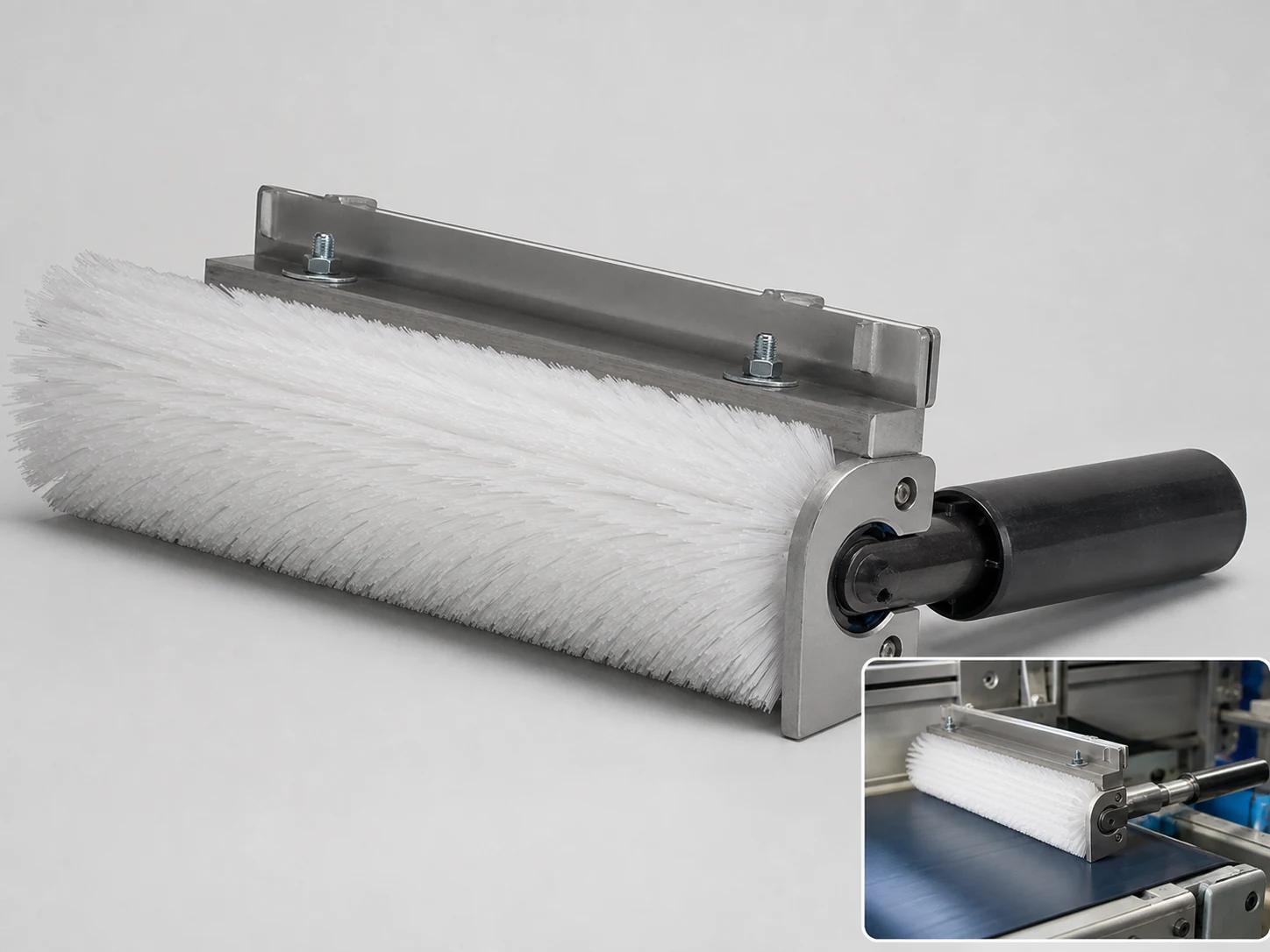
Large-format brush
100 pcs
Minimum order
Built one at a time on a core or channel: full-width rollers, sweeper brooms and long strip.
Production lead time, once the specification is confirmed
- Up to 100 pcsWithin 20 days
- 101–1,000 pcsWithin 30 days
- Over 1,000 pcsConfirmed with your quotation
Peak season can extend these times; the shipping date is confirmed in writing with your quotation. Sampling and shipping are quoted separately.
An Industrial Film Web Cleaning Brush is a full-width, line-mounted contact brush that removes loose dry contamination—dust, fibers, slitter fines, and static-attracted particles—from moving film, paper, and coated webs before printing, coating, laminating, slitting, or winding. It can be built as a stationary strip brush or a rotating cleaning roller, with grounded conductive filament options for static-sensitive webs and fine, soft fills that clean without scratching, stretching, or marking the material.
What can this brush do for you?
Full-width dry particle removal in a single pass
Brush strips are built to the web width, typically up to 5,000 mm, so the filament tips contact the entire surface from edge to edge. Slitter fines, paper dust, airborne fibers, and loose particles are lifted in the same pass the web is already making—no secondary cleaning stage or manual wiping is needed.
Grounded conductive filaments combat static-attracted contamination
Conductive nylon or antistatic fill connected to a grounded core or holder provides a controlled path for surface charge. This reduces the static force holding fine particles against polymer film and helps keep dislodged contamination from reattaching before the next process.
Soft contact protects film, coating, and sheet surfaces
Fine-diameter nylon, horsehair, or conductive filaments with controlled trim length apply contact pressure across many individual tips rather than through stiff bristle ends. The result is consistent wiping with low risk of scratch marks, haze, or surface deformation on sensitive coated papers and thin films.
No liquids, solvents, or drying stage required
The brush works dry, so it can be positioned immediately ahead of print, coating, lamination, or winding stations without adding moisture to the web. That keeps the cleaning step compatible with solvent-sensitive coatings and high-speed converting lines.
Replaceable strip and cartridge designs limit downtime
The filament strip can be supplied as a replaceable insert for the existing holder or as a complete roller assembly. When wear or a product change requires new fill, operators can change the strip or cartridge without rebuilding the full line fixture.
What is an Industrial Film Web Cleaning Brush?
An Industrial Film Web Cleaning Brush is a contact-type web cleaning element used on continuous converting and processing lines. In practice, it is installed at a chosen position in the web path—commonly after unwinding or slitting and before printing, coating, laminating, or winding—so that the moving film, paper, or sheet passes across the filament tips.
The brush may take two basic forms. A stationary strip brush is mounted in a fixed channel or holder and relies on web movement to create the contact action. A rotating roller brush runs in the web path and adds its own surface movement to the contact; it can be free-running, contact-driven, or motor-assisted depending on the line. In both forms, the job is the same: dislodge loose dry contamination with soft mechanical contact and allow capture, ionization, or the web path itself to carry it away from the critical process.
The brush is a dust-removal element, not a scrub or wash stage. It is selected when contamination is loose, dry, and lightly bound—dust, fibers, fines, slitter debris, or particles held by static charge. For wet residues, adhesives, heavy deposits, or contamination that requires chemical or abrasive action, a different cleaning method is needed.
Contact force is controlled primarily through engagement depth, trim length, filament diameter, and holder position, not by adding weight or pressure to the web. This design keeps the cleaning action predictable on thin gauge films, coated surfaces, and tension-sensitive materials.
Technical Specifications
The values below reflect standard industrial configurations for continuous film and web lines. Working width, brush form, fill, and interface are confirmed against the actual web path and holder during project review.
| Parameter | Value / Options |
|---|---|
| Brush form | Stationary strip brush or rotating roller brush; segmented builds available for wide webs |
| Working width | 300–5000 mm, matched to web width; wider lines supplied as aligned sections |
| Roller diameter | 60–300 mm for roller configurations |
| Trim length | 10–50 mm from filament root to tip |
| Fill materials | Soft Nylon PA, PBT, conductive/antistatic nylon, natural horsehair, or specified blends |
| Filament diameter | Approximately 0.05–0.30 mm, selected by surface sensitivity and contact pressure |
| Filament density | Set to maintain a continuous contact line across the web without visible channels or gaps |
| Core / holder | Aluminum profile, carbon steel, stainless steel, or engineered polymer; conductive builds include a continuous ground path |
| Shaft / journals | Stainless or plated steel with end journals or keyed interface to suit line drives and bearing carriers |
| Contact load | Set by engagement depth, trim length, and holder position; controlled to avoid web wrinkle, stretch, or surface marking |
| Static control | Conductive/antistatic fill with grounded core or holder available; non-conductive standard fill does not provide charge dissipation |
| Operating temperature | Standard polymer fills for dry service up to 80°C continuous; horsehair for lower-temperature dry applications; higher-temperature fills assessed per project |
| Mounting | Holder extrusion, bracket position, wrap angle, and shaft support configured to the line geometry |
| Brush type | Custom Strip Seal Brushes |
| How it is driven | Fixed in place, no drive of its own |
| Cleaning target | printing and prepress web path, coating and laminating line, and slitting and rewinding operation cleaning |
| Surface or part | webs, roller, web paths, sheets, edges, coated webs, channel, and boards |
| Residue or debris | dust, fiber, fines, particles, adhesive, loose particles, static-attracted particles, and wet residue |
| Mounting / connection | Holder extrusion, bracket position, wrap angle, and shaft support configured to the line geometry |
For conductive filament builds, the holder or core must be connected to machine ground at installation. A continuous ground path is part of the assembly; surface charge drainage only works as well as the line’s grounding connection.
Where does this brush work best?
Printing and prepress web paths
Flexographic, gravure, and offset web lines install the brush after unwinding or slitting and before print decks to reduce paper dust, coating fines, and loose fibers that can cause print voids or blanket contamination.
Coating and laminating lines
Film, foil, paper, and board moving into coating or laminating stations pass over the brush just before adhesive or coating application. Removing loose particles helps prevent inclusions, streaks, and coating defects.
Slitting and rewinding operations
Slitter dust and edge fines are produced directly on the line. A full-width contact brush positioned after slitting and before wind-up keeps the debris from being wound into finished rolls.
Cast film, blown film, and sheet extrusion
Freshly extruded polymer film and sheet pick up airborne fibers and dust before winding. The brush cleans the moving surface without adding water or chemicals and without leaving filament marks on the extruded surface.
Label stock, packaging film, and specialty converting
Release liners, face materials, coated papers, and thin flexible packaging webs benefit from a soft wiping contact that controls fiber and dust contamination ahead of die-cutting, inspection, or printing.
How do I choose the right one?
Start with the line geometry and brush form
Measure the available space at the desired web position, including entry and exit angles and the distance to the nearest guide roller. A stationary strip brush fits where there is a straight, accessible span; a roller configuration is the better choice when the web wraps over the brush, when a longer contact arc is needed, or when the brush must be driven at its own surface speed.
Set working width and engagement correctly
Working width should cover the full web, including any edge trim variation. Engagement is adjusted through the holder or bracket height, not by pressing the brush into the web. Too much engagement raises drag, filament bending, and scratch risk; too little leaves sections of the web uncleaned. During trial, a clean sample run under lights will show whether the contact line is continuous and whether the surface remains unmarked.
Choose the fill for the contamination and surface sensitivity
Use conductive/antistatic nylon when fine particles are held by static charge, and connect the holder or core to machine ground. Use soft fine nylon or natural horsehair on coated papers, thin films, or surfaces that cannot tolerate visible filament marks. Use PBT where the environment includes mild chemical exposure or where the filament must retain stiffness at higher line speeds. A denser fill and shorter trim create a firmer contact; a lighter density and longer trim give a softer, more conformable wipe.
| If your line has… | Then consider… |
|---|---|
| Fine particles on polymer film held by static | Conductive nylon fill in a grounded holder or core |
| Coated paper or thin film where marking is a risk | Soft fine nylon or horsehair with longer trim and moderate engagement |
| High-speed converting with paper dust or slitter fines | Dense nylon or PBT fill, shorter trim for firmer contact |
| Straight accessible span with limited wrap | Stationary strip brush |
| Longer contact arc or driven brush requirement | Rotating roller brush with shaft and bearing interface |
Confirm core, shaft, and mounting interface
Aluminum profiles keep the strip assembly light and are common on wide lines. Steel or stainless steel may be required for rigidity or process compatibility. Roller builds need shaft length, journal size, bearing centers, and drive interface defined against the line’s existing brackets or manufacturer drawings.
When this brush is not the right tool
Do not select this brush for wet residues, adhesives, greases, heavy surface deposits, or contamination that is chemically bonded or needs solvent washing. For those cases, a wash station, cleaning roll system, or other wet process is more suitable. If the web cannot tolerate any mechanical contact, use non-contact ionization and air/vacuum cleaning. If the static problem is severe, a conductive brush supports charge drainage but may still need to work together with active ionizers and extraction.
Can I customize this brush?
Industrial Film Web Cleaning Brushes are configured to the web path, not bought as fixed off-the-shelf dimensions. The most important inputs are web width, brush position, line speed, web material and thickness, contamination type and source, static conditions, operating temperature, existing holder or mounting dimensions, and wrap geometry for roller builds. A layout drawing or a photo of the existing holder speeds configuration and avoids interface errors.
From there, we can adjust:
- Working width and overall length—including segmented sections for wide lines and expansion joints for thermal movement
- Brush form—stationary strip, rotating roller, or multiple aligned sections
- Fill—soft nylon PA, PBT, conductive/antistatic nylon, horsehair, blends, dual-density, or custom fiber specification
- Trim length, filament diameter, and packing density to set contact softness and stiffness
- Core, holder, and channel profile—aluminum, steel, stainless steel, or polymer with the required rigidity and grounding path
- Shaft, journal, keyway, bearing interface, and drive connection for roller builds
- Grounding connection—ground lug, grounding strip, or continuous conductive core for conductive filament builds
- Mounting hardware and bracket positions to match existing line structure
- Color, marking, and identification coding for product or position identification
- Packaging—bulk, individually protected lengths, or project-specific packing for cleanroom or sensitive deliveries
For projects that require material declarations, documentation, incoming inspection plans, or third-party testing support, we can coordinate these as part of the customization review.
When is an industrial film web cleaning brush worn out rather than just dirty?
How can I check whether the brush is damaging the web?
Run a clean sample of the actual film or sheet through the brush at production speed and inspect it under oblique light for scratch lines, haze, or surface polish. If marks appear, reduce engagement depth, increase trim length, or switch to a softer filament material. Recheck after each adjustment rather than assuming the problem is solved.
Does the brush remove static charge or only the particles?
A standard non-conductive brush dislodges particles but does not dissipate surface charge. A brush with conductive or antistatic filament connected through a grounded core or holder provides a controlled path that can drain charge and reduce re-attraction. On heavily charged webs, active ionization and extraction may still be needed because the brush cannot prevent new charge from forming downstream.
How do I maintain the brush between production runs?
Vacuum the filament tips or blow them off with low-pressure, ionized air. Remove any fibers wound around the shaft or holder, and check the strip for flattened, hardened, or missing filament. Use only cleaning agents shown to be compatible with the fill material; aggressive solvents can embrittle nylon or damage natural hair.
When is it time to replace the brush strip or roller?
Replace when trim length has worn noticeably shorter than the original configuration, when the contact line becomes uneven across the web, or when surface defects and particle counts start to rise on the finished product. Keeping a meter or roll-count log makes the replacement point predictable.
Where in the line should the brush be installed?
Place it after the contamination source and as close as practical to the operation you want to protect—for example, after slitting and before printing, or after unwinding and before coating. Position vacuum extraction near the brush so dislodged particles leave the web path instead of settling or reattaching further along the line.
Can one brush clean both sides of the web?
No. A single contact brush cleans the surface it is mounted against. For two-sided cleaning, use two opposing brush assemblies positioned along the web path with the correct entry and exit geometry for each side, supported by appropriate guide rollers and extraction on both sides.
Guides that go deeper on this
Custom Manufacturing RFQ
Describe Your Application
For an accurate quotation, please provide the main dimensions, material preference, working surface, residue, quantity, and a drawing or photo.
Drawing or photo optional — it speeds things up, it does not gate the enquiry.
Custom Brush RFQ
Send Your Brush Project
Upload a drawing, product photo, or sample photo and provide the core dimensions and cleaning conditions.
“We need a brush to remove wet residue from a stainless steel conveyor, about 800mm wide. The current brush wears quickly. We can send photos.”
“We sell drinkware and need a cleaning brush to include with the product. Quantity around 5,000 pieces.”