What Is Brush Retrimming?
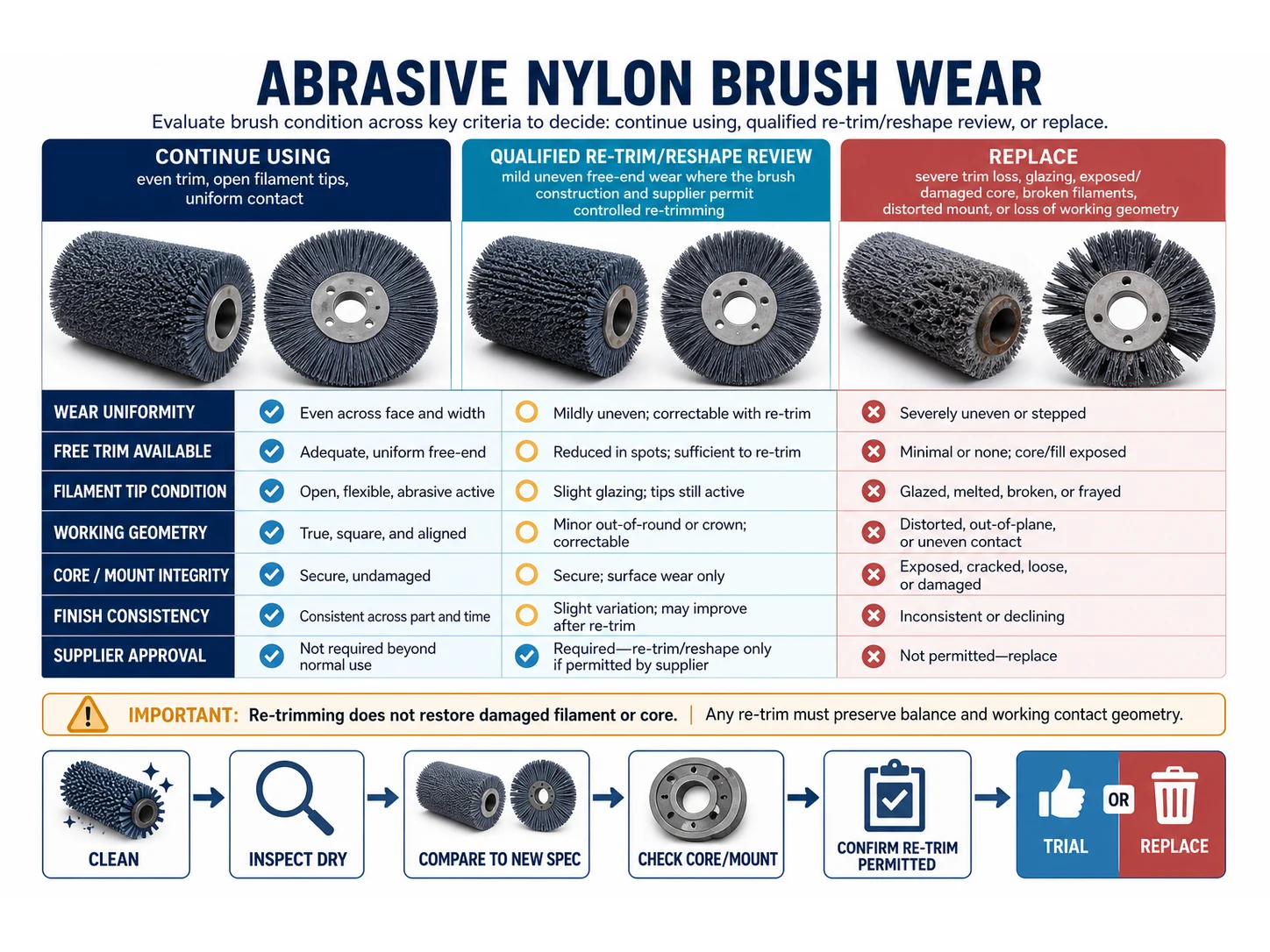
Retrimming is the process of removing worn fill material (bristles, wire, nylon, or abrasive filaments) from a brush’s core and installing new fill. The core—typically a metal hub, tube, or channel—stays in place. Retrimming restores the brush’s working surface to near-new performance at a fraction of the cost of a complete replacement, provided the core is structurally sound and dimensionally stable.
Types of Industrial Brushes Commonly Considered for Retrimming
Not every brush is a good retrim candidate. In general, large-diameter, high-cost, or custom-manufactured brushes offer the strongest justification. Common types include:
- Cylinder brushes for cleaning, conveying, and surface finishing
- Spiral wound tube brushes used in boiler, heat exchanger, and pipe cleaning
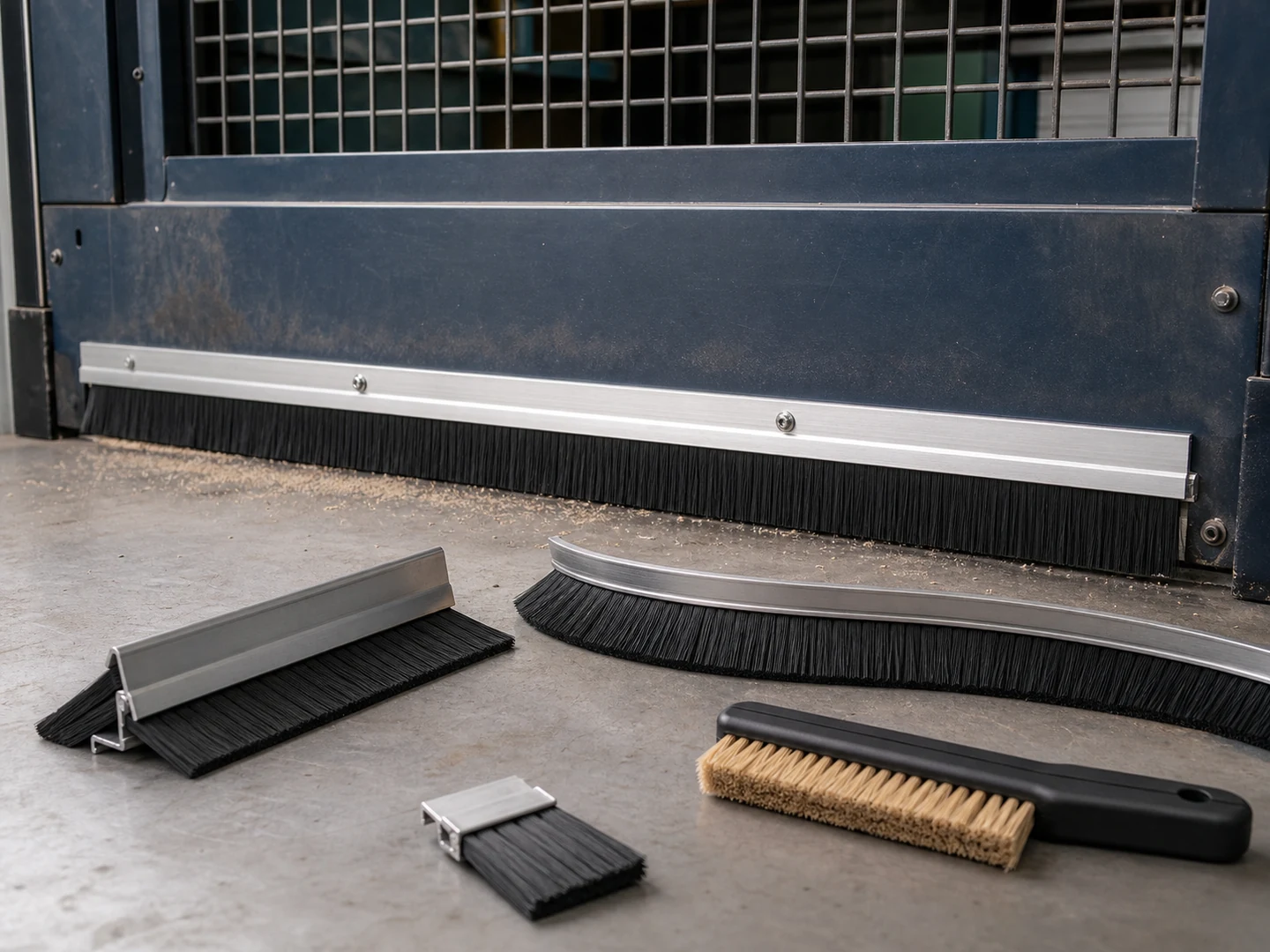
- Strip brushes on holders for sealing and guiding
- Roller brushes in conveyor and material handling systems
Extended-length brushes—such as 30-inch or 36-inch black nylon industrial tube brushes—are often retrimmed because their metal cores represent a significant share of the total cost.
Retrimming vs Replacement: A Head-to-Head Comparison
| Factor | Retrimming | Full Replacement |
|---|---|---|
| Initial cost | Typically 30–70% of new brush cost | 100% of purchase cost |
| production schedule | Often shorter if core is reusable and fill is in stock | May be longer for large or custom brushes |
| Core condition required | Must be free of cracks, deformation, or significant corrosion | New core eliminates any hidden defects |
| Performance support | Comparable to new when fill and technique are matched to application | Full buyer-supplied or equipment specification and warranty apply |
| Downtime | Can be scheduled during planned maintenance; avoids full asset production schedule | Requires ordering and shipping; potential work stoppage if no spare exists |
| Best for | Expensive, custom, or long-lead brushes with sound cores; non-safety-critical roles | Damaged cores, obsolete designs, or applications where failure risk cannot be tolerated |
How to Decide: Key Decision Factors
Use this checklist before choosing retrimming over replacement:
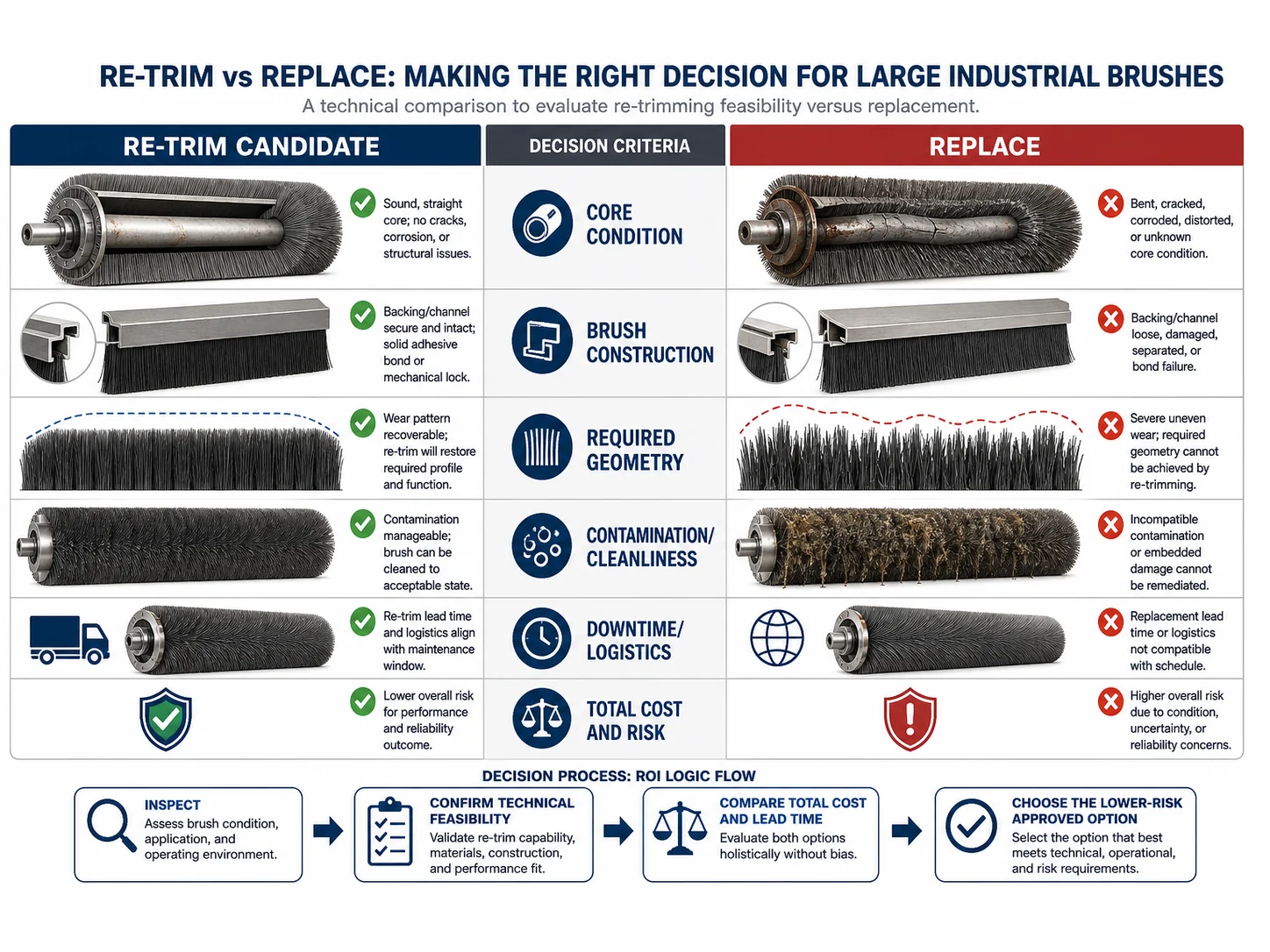
- Core integrity. Inspect for cracks, corrosion, bent shafts, or worn bearing seats. Any structural defect tips the scale toward replacement. For large brushes like a 60-inch black nylon tube brush, a bent core straight from handling can make retrimming impossible.
- Core material. Metal cores (steel, stainless, aluminum) generally tolerate retrimming. Plastic or composite cores degrade with heat cycles and impact, often making replacement the safer choice.
- Fill compatibility. If the old fill was custom or obsolete, confirm that the new fill material can be installed on the existing core. Some core designs limit re-filling methods.
- Application criticality. In surface-finishing or safety-related processes, even minor balance changes from retrimming can cause quality issues. When a high surface finish or tight tolerance is required, full new replacement may be necessary.
- Cost ratio. If retrimming costs exceed 60–70% of a new brush, replacement usually makes more economic sense once you factor in risk and remaining service life.
- Downtime tolerance. Retrimming can be faster if the core is available and a qualified shop is nearby. But if production loss is costly, having a spare new brush on hand may be the best strategy.
Simple ROI Logic for Retrimming
Compare total cost of retrimming (labor + fill + freight + internal handling) against total cost of replacement (new core + fill + freight + administrative overhead). When the core has 60% or more of its life remaining by hours, retrimming can often extend the brush’s useful life at 30–50% of the cost of replacement. Do not ignore intangible costs: if a retrimmed brush fails prematurely, the production loss can dwarf any upfront savings.
Common Mistakes When Choosing Retrimming vs Replacement
Avoid these frequent missteps:
- Assuming retrimming is always cheaper. Hidden damage, rush charges, or unique fill materials can push retrimming costs close to or above replacement.
- Ignoring core micro-cracks. Small cracks that grow in operation can cause catastrophic imbalance or brush failure, especially at high RPM.
- Overlooking bearing fit and shaft wear. A worn shaft can make a retrimmed brush run out-of-true, destroying the new fill prematurely.
- Neglecting production schedule reality. Some retrim shops have backlogs; a new brush may actually ship sooner.
- Not factoring in design changes. If the equipment manufacturer has upgraded the brush design for better performance, a new purchase may be a long-term improvement rather than a like-for-like swap.
When Retrimming Is Not an Option
Retrimming becomes off the table under these conditions:
- Core structural damage: bent shafts, cracked hubs, deep corrosion, or delaminated plastic cores.
- Size and handling limits: some extremely large brushes (e.g., 60-inch or larger) pose safety risks when handled without proper lifting equipment and jigs; some retrimming shops may not accept them.
- Obsolete core design: if the core’s mounting features are outdated and cannot accept current fill patterns without risking failure.
- Regulatory or standard changes: when the fill material must meet new hygiene, fire, or conductivity standards that the old core is not designed to support.
- Balancing requirements: high-speed or precision brushes that must be dynamically balanced as a complete assembly; retrimming may disrupt factory-set balance and exceed tolerance.
Final Takeaway: Making the Right Call
The retrimming vs replacement decision is rarely about cost alone. Start with a thorough core inspection, then compare total costs, downtime, and application risk. When the core is sound and the cost gap is wide, retrimming extends asset life at a clear advantage. When core damage, production schedule, or criticality tilt the scale, a new brush is the smarter investment. Document your decision criteria so the next maintenance cycle benefits from institutional knowledge.
Frequently Asked Questions
What is the typical cost difference between retrimming and replacing an industrial brush?
Retrimming generally costs 30–70% of a new equivalent brush. The exact savings depend on core complexity, fill material, and shop availability. When the core has extensive wear or the fill is exotic, retrimming can approach or exceed replacement cost.
Can all types of industrial brushes be retrimmed?
No. Only brushes with a sound, reusable core are candidates. Core type, mounting features, and manufacturing method determine feasibility. Strip, cylinder, and spiral brushes with metal cores are the most common retrim candidates.
How does retrimming affect brush performance?
When performed correctly with matched fill material and proper tension/staking, a retrimmed brush performs comparably to a new one. However, if the core has any hidden imbalance or the fill density changes, performance may suffer, particularly in precision finishing applications.
Is there a rule of thumb for when replacement is clearly better?
If the core has any crack, deformation, or the retrim quote exceeds 70% of new cost, replacement is usually the safer, more economical path. Also, if the brush is used in a safety-critical role, avoid retrimming unless an engineering review confirms equal safety margin.
How do I inspect a brush core for retrimming?
Use visual inspection for cracks and corrosion, dimensional checks for shaft runout and hub wear, and non-destructive testing (dye penetrant or mag particle) for large, expensive cores. Document findings; if any flaw exceeds approved tolerances, replace the core.
How long does retrimming take compared to ordering a new brush?
production schedules vary. Standard retrimming may take a project-specific schedule if fill material is in stock. Custom or long-lead new brushes can take a project-specific schedule. Always verify current shop schedules; during peak seasons, retrimming queues can exceed new-order production schedules.
What industries rely most on brush retrimming?
Industries with expensive, custom brush assets benefit most: boiler and heat exchanger cleaning (tube brushes), metal finishing, paper converting, food processing, and material handling. In these environments, a brush’s metal core can outlast the fill many times over, making retrimming a standard maintenance practice.