
Custom Cleaning Brush
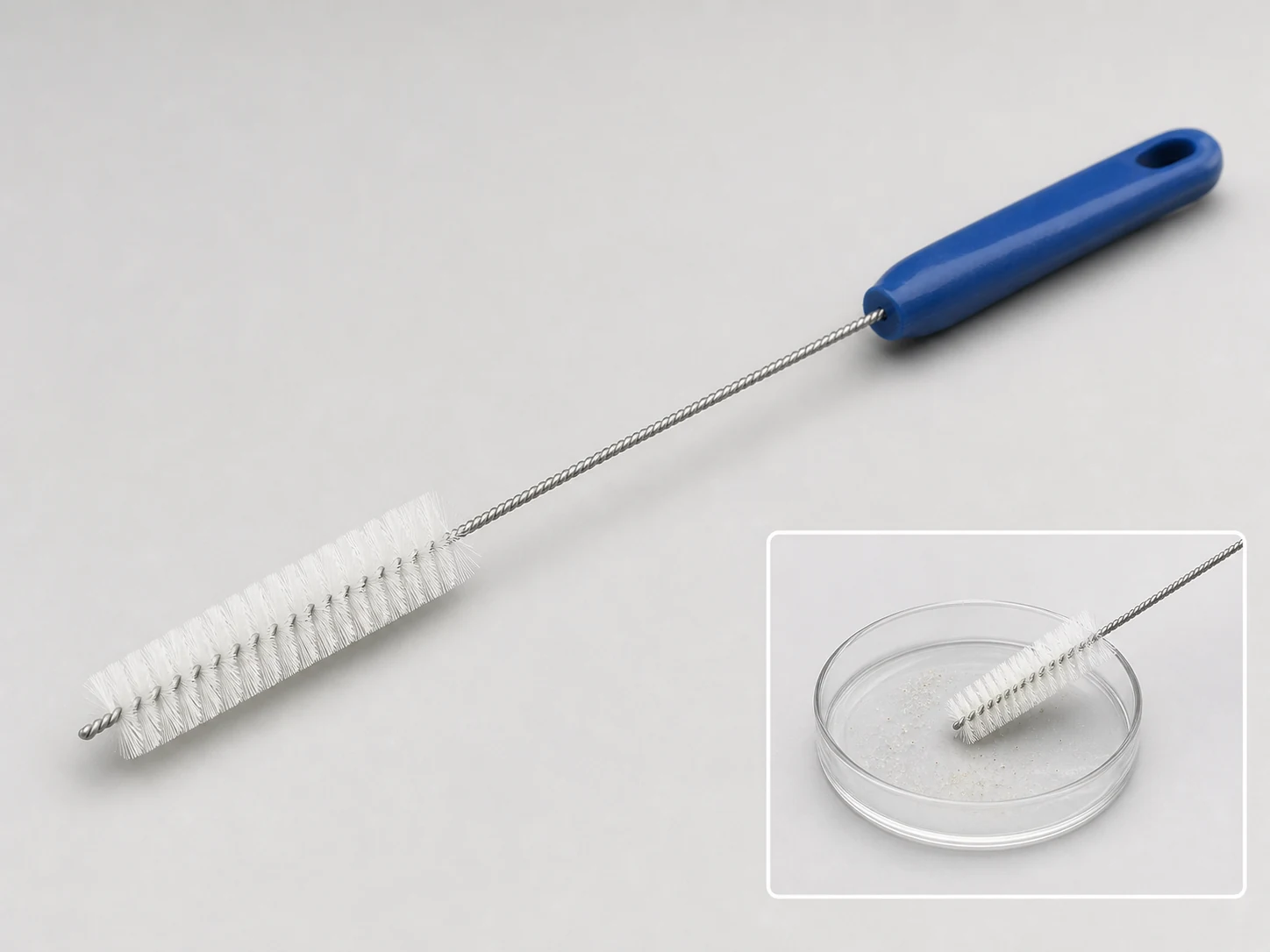
Petri Dish Brush
A circular bristle face sized to the dish bore, so one rotation covers base and lower sidewall without scratching glass or reusable plastic.
Small brush
500 pcs
Minimum order
Held in one hand: tube, bottle, detail and swab brushes — including long-handled ones with a small head.
Production lead time, once the specification is confirmed
- Up to 500 pcsWithin 7 days
- 501–50,000 pcsWithin 14 days
- Over 50,000 pcsWithin 21 days
Peak season can extend these times; the shipping date is confirmed in writing with your quotation. Sampling and shipping are quoted separately.
A round, hand-sized cleaning brush engineered to match the interior diameter of laboratory Petri dishes. It removes culture media residue, dried deposits, and detergent film from dish bases, sidewalls, rims, and lids without scratching glass or reusable plastic surfaces.
What can this brush do for you?
Round head mirrors the dish, so one rotation covers the entire base
The circular bristle face is sized to the dish’s internal diameter, letting you clean the entire base and lower sidewall with a single circular motion. There are no flat brush edges to leave dead spots in the dish corners or against the rim.
Rounded nylon or PBT bristles protect optical clarity
Bristle tips are end-rounded and made from nylon PA6/6 or PBT, both softer than glass and most reusable plastics. You can scrub dried agar or film off the dish without leaving scratch marks that scatter light or harbor contamination on the next use.
Rim and lid detail included in one tool
The outer bristle ring can reach into the dish rim and the inner edge of the lid where media often dries in a thin ring. This eliminates the need for a separate detail brush or cotton swab when washing standard reusable dishes.
Handles laboratory detergents and hot water cycles
Nylon and PBT bristles resist breakdown from common lab detergents, enzymatic cleaners, and repeated hot water washing. If your washing process includes bleach soaks or autoclaving, the handle and any internal parts can be specified accordingly.
Metal-free construction available for aggressive wash chemicals
For bleach, solvent, or other chemical exposure that would corrode metal staples or ferrules, the brush can be built with a fully plastic construction. This avoids rust contamination in the wash area and extends service life.
What is a Petri Dish Brush?
A Petri Dish Brush is a hand-guided cleaning brush with a round bristle face that matches the working diameter of reusable laboratory Petri dishes. It is intended for manual washing of glass or reusable plastic dishes between uses, not for disposable polystyrene plates that are discarded after one culture.
During use, the operator holds the handle and moves the brush in circular strokes across the dish base, then into the sidewall and rim. The bristle field should contact the full base without forcing the brush against the dish wall. Because the brush head is round and sized to the dish, one tool replaces improvised sponges, cloths, or bottle brushes that bend and miss the flat base.
The brush does not scrape, cut, or abrade the dish surface. It loosens attached residue so it can be rinsed away. In standard practice, dried or gelled media is usually pre-soaked before brushing; the brush then removes the softened film and any remaining particulate. It is part of a cleaning sequence that includes detergent, rinse, inspection, and, where required, further sterilization.
Technical Specifications
The standard range covers common reusable dish diameters. All values can be adjusted to your dish size and washing process.
| Parameter | Specification / Options |
|---|---|
| Head diameter options | 60 mm, 90 mm, 100–120 mm; other sizes from 35–150 mm on request |
| Overall length | 180–260 mm typical, matched to handle preference |
| Bristle material | Nylon PA6/6 or PBT |
| Bristle diameter | 0.15–0.40 mm, selected for stiffness and residue type |
| Trim length | 15–30 mm from face to ferrule or handle |
| Bristle density | Standard, medium, or dense fill per project |
| Handle material | Polypropylene, HDPE, or stainless steel (overmolded options available) |
| Metal parts | Optional metal-free construction |
| Operating temperature | Up to 100°C for continuous hand washing; autoclave-rated option on request |
| Chemical compatibility | Material selected for specified detergents, bleach dilution, or solvents |
| Color | Natural, white, blue, or custom color coding |
| Brush type | Custom Bottle & Container Brushes |
| How it is driven | Hand-guided |
| Cleaning target | reusable glass petri dish, dish washing station, and educational laboratory cleaning |
| Surface or part | glass, rims, plastic, sidewalls, bases, metal, bends, and plates |
| Residue or debris | detergent film, and dried deposits |
| Mounting / connection | Threaded Removable / Fixed |
Where does this brush work best?
- Reusable glass Petri dishes in microbiology and cell culture labs where agar media, broth, or gelatin residues must be removed between sterilization cycles.
- Dish washing stations in quality control, water testing, food safety, and pharmaceutical laboratories that process large numbers of reusable dishes daily.
- Educational laboratories where students clean glass dishes after culturing, and consistent results depend on residue-free, scratch-free surfaces.
- Dish lids and rims where dried media forms a ring that a flat sponge misses.
- Detergent and rinse film removal from dish bases after machine washing, restoring a clear surface for inspection.
How do I choose the right one?
Start by measuring the dish. Measure the internal diameter of the bottom dish (not the lid) in millimeters. Choose a brush head 2–5 mm smaller than the internal diameter so it rotates freely without binding against the sidewall while still covering the base. If you use multiple dish sizes, you may need one brush per size or a mid-range head for overlapping uses.
Match bristle stiffness to the residue. Softer, finer bristles (0.15–0.25 mm) remove light film, dust, and detergent residue with maximum gentleness. Medium bristles (0.25–0.35 mm) handle dried media that has been pre-soaked. Firmer bristles (0.35–0.40 mm) work for more tenacious, partially softened agar or deposits on heavily used dishes. If the residue is baked-on, carbonized, or strongly mineralized, a harsher scrubbing brush or a chemical soak may be more effective than any laboratory dish brush.
Consider the washing environment. If the brush will be used with bleach solutions or acidic cleaners, ask for PBT bristles and a metal-free or chemical-resistant handle. If the brush must survive autoclave cycles, request a heat-rated handle and confirm the exact temperature and frequency. If operators work at a deep sink or with wet gloves, choose a longer handle or an ergonomic grip.
For disposable plastic Petri dishes, a brush is rarely used because the dish is discarded after use. For very small dishes (under 35 mm) or dishes with deep concave bottoms, a custom small-diameter head or a detail brush may be more suitable. For optical-grade dishes where any bristle contact is a concern, consider a lint-free wipe or swab.
Can I customize this brush?
Because the brush must fit a specific dish and washing process, we build each order around your laboratory’s needs. Provide the internal dish diameter, dish depth, residue type, wash chemicals, temperature, and handle preference. A sample dish or drawing speeds up the fit confirmation.
- Head diameter — any size from 35 mm to 150 mm, matched to your dish ID
- Bristle material — nylon PA6/6 or PBT, with stiffness controlled by bristle diameter and trim length
- Bristle density — standard, medium, or dense fill for heavier or lighter residues
- Handle — length, straight or ergonomic shape, polypropylene, HDPE, stainless steel, or overmolded grip
- Metal-free construction — no metal staples, ferrules, or core for chemical wash environments
- Color coding — natural, white, blue, or custom colors to separate brushes by dish size, media type, or lab zone
- Marking — molded or printed identification on the handle or ferrule
- Packaging — bulk, individually wrapped, or project-specific packaging
If your project requires material documentation, third-party testing, or inspection support for cleanroom or GMP use, we can assist with those requirements during the customization process.
How do you confirm a petri dish brush has actually cleaned the surface?
How do I confirm the head diameter fits my dish?
Measure the dish’s internal diameter with calipers. The brush head should be 2–5 mm smaller than that measurement. If the brush binds when you turn it inside the dish, it is too large. If it leaves an unbrushed ring around the base edge, it is too small.
Do I need to presoak dried agar before brushing?
Yes. Dried or gelled media that has cured onto the dish should be soaked in warm water or detergent solution before brushing. The brush removes the softened film and remaining particles; forcing the brush against hardened media can bend bristles and slow cleaning.
Can this brush be autoclaved or sterilized?
Nylon and PBT bristles can withstand typical steam autoclave temperatures, but the handle material must also be rated for the cycle. If you plan to autoclave the brush, specify the temperature and frequency when ordering, and we will select a heat-tolerant handle assembly.
How do I keep dishes from being scratched over repeated wash cycles?
Use the softest bristle that still removes your residue, keep the bristles clean and free of embedded abrasive particles, and avoid applying downward force while rotating. Inspect the brush tips periodically; if they become frayed or stiff, replace the brush rather than increasing pressure.
Can one brush be used for different types of culture media?
If cross-contamination is a concern, dedicate a separate brush to each media type or lab zone, and use color coding. After each washing session, rinse the brush thoroughly, remove any lodged particles, and allow it to dry completely before the next use.
What should I check before each use?
Check for loose or missing bristles, cracks in the handle or ferrule, and any embedded residue. Rinse the brush and inspect the dish after the first stroke. If you see bristle pieces in the dish or scratches on the surface, stop using the brush and replace it.
Guides that go deeper on this
We have not written a guide specific to this one yet. The material that covers selection, filament, dimensions, maintenance and sourcing is collected in the technical resources library.
Custom Manufacturing RFQ
Describe Your Application
For a custom quote, we need the key dimensions, surface or part, residue, material preference, quantity, and reference image or drawing.
Drawing or photo optional — it speeds things up, it does not gate the enquiry.
Custom Brush RFQ
Send Your Brush Project
Upload a drawing, product photo, or sample photo and provide the core dimensions and cleaning conditions.
“We need a brush to remove wet residue from a stainless steel conveyor, about 800mm wide. The current brush wears quickly. We can send photos.”
“We sell drinkware and need a cleaning brush to include with the product. Quantity around 5,000 pieces.”