
Custom Cleaning Brush
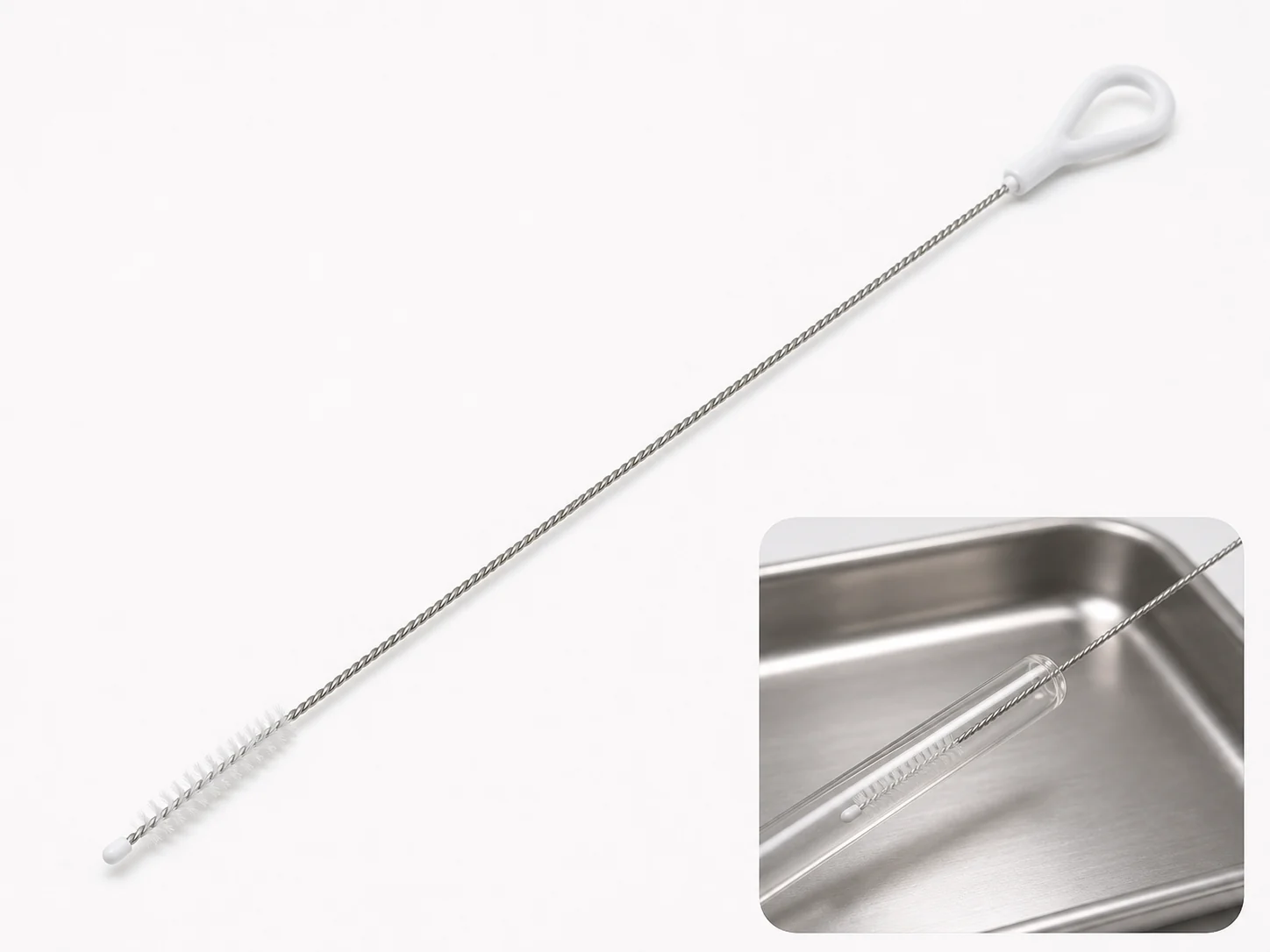
Pipette Brush
Reach pipette tips, tapered bores, and bulbs. PET, PBT, or nylon filaments on a flexible wire core. Custom diameters, lengths and double-ended designs.
Small brush
500 pcs
Minimum order
Held in one hand: tube, bottle, detail and swab brushes — including long-handled ones with a small head.
Production lead time, once the specification is confirmed
- Up to 500 pcsWithin 7 days
- 501–50,000 pcsWithin 14 days
- Over 50,000 pcsWithin 21 days
Peak season can extend these times; the shipping date is confirmed in writing with your quotation. Sampling and shipping are quoted separately.
A pipette brush built for cleaning the full internal length of volumetric, graduated, and serological pipettes. Its flexible twisted-wire core carries soft synthetic filaments from the narrow delivery tip through the wider bulb section, lifting reagent film, precipitates, powders, oils, and detergent residues without damaging glass bores or printed graduation marks.
What can this brush do for you?
One stroke reaches the tip, taper, and bulb
A single uniform brush cleans a single diameter. This pipette brush can be built with a narrow tip section and a larger body section so the same pull-through stroke contacts the delivery tip, the tapered bore, and the bulb area. The stepped or double-ended configuration eliminates the dead zones a straight brush leaves behind.
Cleans graduation marks without lifting the markings
Reagent film and precipitate collect inside etched or painted graduations first. Fine PET or PBT filaments flex into those recesses and work residue out without scraping the marking away. The twisted wire core stays centered in the bore while the filament tips, not exposed wire, contact the glass.
Follows tapered glass without binding
A thin, flexible twisted-wire core lets the brush pass through the tip opening and follow the pipette’s internal taper. When the tip diameter is matched to the bore, the brush slides in without force. If it binds, the diameter is too large for that pipette; if it never touches the wall, it is too small.
Holds up in wet laboratory cleaning routines
The stainless-steel core resists rust in repeated sink use, and filament options include PET polyester with low water absorption and PBT for stronger chemical resistance. This matters when the same brush is used daily with detergents, rinse water, and drying racks.
Configurable for contamination control
For trace analysis or high-purity work, the brush can be supplied as a disposable single-use tool or with color-coded handles that separate different reagent groups. Reusable configurations can be built from autoclave-tolerant materials when the sterilization cycle is specified before ordering.
What is a Pipette Brush?
A pipette brush is a hand-guided laboratory cleaning tool that uses a twisted stainless-steel wire core to hold rows of synthetic filaments along a working section. The user wets the brush with cleaning solution, inserts it through the pipette tip opening or mouth end, and moves it back and forth with a rotating action. The filaments scrub the internal bore while the flexible core follows the tapered passage.
The working section can be uniform, tapered, or built as a double-ended brush with different diameters for the delivery tip and the upper bulb. This is different from a bottle brush: pipette brushes are designed for much narrower passages and must not force a larger diameter through a fragile tip.
Typical filament materials are PET polyester, PBT, and nylon. PET absorbs little water and gives a soft-contact scrub; PBT tolerates stronger wash chemicals and higher temperatures; nylon offers more mechanical wear resistance when the taper can accept firmer contact. The brush removes attached residues that can be loosened by mechanical action. It does not replace presoaking, solvent flushing, or final rinsing.
Technical Specifications
The specifications below represent the standard build range for our pipette brushes. Tip diameter, working length, filament material, and handle style are sized to the specific pipette during ordering.
| Parameter | Value / Options |
|---|---|
| Working diameter range | 1–50 mm; narrow tip sections typically 1–10 mm, bulb and body sections up to 50 mm |
| Working length | 5–100 mm per brushing zone, matched to scale length or bulb depth |
| Overall length | 100–600 mm including handle, selected to pipette size |
| Stem core | 0.5–3.0 mm twisted stainless-steel wire, 304 or 316 with coated option |
| Filament diameter | 0.05–0.35 mm; finer filaments for narrow tips, heavier for bulb scrubbing |
| Filament material | PET polyester, PBT, or nylon PA; PBT for stronger chemical resistance, PET for low water absorption |
| Fill density | Light, medium, or heavy, matched to residue type and bore clearance |
| Handle / configuration | Loop handle, straight wire, T-handle, double-ended, or disposable bendable wire |
| Minimum practical bore | About 1.0 mm internal diameter for standard twisted-wire construction; below this use rinsing or single-use capillary tools |
| Sterilization compatibility | Reusable configurations can be supplied in autoclave-tolerant materials when the cycle is specified before ordering |
| Brush type | Custom Tube & Pipe Bore Brushes |
| How it is driven | Hand-guided |
| Cleaning target | volumetric and graduated glass pipette, burette tip, and sample tube cleaning |
| Surface or part | bores, glass, graduations, tubes, bulb sections, glass bores, tapers, and stainless-steel |
| Residue or debris | reagent film, precipitate, oil, powder, and detergent residue |
| Mounting / connection | About 1.0 mm internal diameter for standard twisted-wire construction; below this use rinsing or single-use capillary tools |
Where does this brush work best?
- Volumetric and graduated glass pipettes where reagent film and precipitate settle in the delivery tip after drainage.
- Serological and Mohr pipettes used with buffers, serum, oils, or suspensions, where inner-wall films form above the tip.
- Burette tips, dropping tubes, and narrow-bore glassware that a standard bottle brush cannot enter.
- Sample tubes, vials, and small glassware with narrow neck openings requiring internal scrubbing before decontamination or sterilization.
- Bulb interiors of volumetric pipettes when a larger-diameter section is specified for the upper body.
How do I choose the right one?
Measure the narrowest internal bore first
Use a pin gauge or caliper on the pipette tip and the bulb. The brush diameter should pass through the tip without force and still make wall contact. If the pipette tapers strongly, choose a stepped or double-ended configuration so the narrow section fits the tip and the larger section scrubs the bulb.
Match the filament to the residue and cleaning chemistry
| Condition / Residue | Suggested Filament |
|---|---|
| Aqueous reagent film, buffer salts, powders | PET polyester |
| Oils, grease, solvent residues | PBT, low swelling and good chemical resistance |
| Hot wash, alkaline or acid cleaning agents | PBT; confirm concentration and temperature |
| Low-scratch cleaning on painted graduations | Fine PET or soft nylon, trimmed to avoid core contact |
| Heavier precipitate that needs firmer scrubbing | Nylon PA or heavier PBT, after presoaking |
Set the reach and control
Overall length should let the user grip the brush near the mouth end and still bottom out at the tip. Working length must cover the calibrated area and the bulb. For very long narrow pipettes, a thicker wire core may be needed so the brush does not flex too much during insertion.
Decide between reusable and disposable
If cross-contamination between samples is a risk, choose a disposable brush or assign color-coded brushes to each reagent group. For routine cleaning of the same buffer or reagent, a reusable brush is practical. If the brush must survive autoclaving, state the exact cycle so the filament and handle can be selected accordingly.
When to choose a different method
Do not use a pipette brush in a bore below roughly 1 mm or in a passage that cannot be accessed in a straight line. Plastic disposable pipette tips should be discarded, not brushed. If the residue is baked on, protein-bound, or mineralized, presoak or soften it first; the brush removes loosened material but is not a substitute for chemical dissolution. Volumetric accuracy must be checked by calibration, not by brushing alone.
Can I customize this brush?
Pipette brushes are built to pipette dimensions, not off-the-shelf assumptions. Provide the pipette make and model or the internal diameter profile, residue type, cleaning chemicals, wash temperature, and sterilization requirement, and we will configure the brush to match.
- Diameter profile: uniform, tapered, stepped tip-to-bulb, or double-ended with different sizes on each end.
- Working length and overall length to match the exact pipette tube and user grip.
- Filament: PET polyester, PBT, or nylon; filament diameter, trim length, density, spiral or straight fill pattern.
- Core: stainless-steel grade, wire diameter, coated core, flexible or stiff construction, ball end or loop nose.
- Handle: wire loop, straight wire, T-handle, plastic grip, color coding, printed or laser marking.
- Configuration: single-ended, double-ended, disposable, or reusable.
- Packaging: bulk, individual bags, cleanroom-compatible packaging, or project-specific packing.
- Project support: material declarations, inspection documentation, and third-party testing can be arranged for application-specific requirements.
When is a pipette brush worn out rather than just dirty?
How can I confirm the brush fits my pipette before washing?
Insert the dry brush into a clean, empty pipette. It should slide to the tip without force and should make light contact with the inner wall along the way. If it catches at the taper or bottom, the diameter is too large. If it slides through without touching anything, it is too small.
Does the brush clean the entire bulb?
It does if you order a stepped or double-ended brush with a larger-diameter section matched to the bulb ID. A straight uniform brush sized for the delivery tip will pass through the bulb with little wall contact and leave residue there.
Can I share one brush between different reagents?
Only after thorough cleaning and only when the residue types are compatible. For trace analysis or critical work, sharing is not recommended because filament tufts can retain trace material. Use disposable brushes or color-coded dedicated brushes for each reagent group.
What does a worn pipette brush look like?
Flattened or splayed filaments, loose tufts, kinked wire, or visible rust on the core are replacement signals. If the brush no longer makes even wall contact or if filament tips have fallen away and exposed wire, replace it before it scratches the glass.
Can this brush be autoclaved?
It depends on the filament and handle materials. Autoclave-tolerant material combinations can be supplied when the exact cycle temperature, pressure, and duration are specified. The standard PET or nylon configuration should not be assumed autoclave-safe without confirmation.
Will brushing remove every trace from a pipette?
No. Brushing loosens and lifts attached residue, but loosened material must be rinsed away, and dissolved or emulsified residues may require a final solvent flush or soak. For analytical cleanliness, verify the final rinse or residue limit separately from the brushing step.
Guides that go deeper on this
We have not written a guide specific to this one yet. The material that covers selection, filament, dimensions, maintenance and sourcing is collected in the technical resources library.
Custom Manufacturing RFQ
Describe Your Application
For a custom quote, we need the key dimensions, surface or part, residue, material preference, quantity, and reference image or drawing.
Drawing or photo optional — it speeds things up, it does not gate the enquiry.
Custom Brush RFQ
Send Your Brush Project
Upload a drawing, product photo, or sample photo and provide the core dimensions and cleaning conditions.
“We need a brush to remove wet residue from a stainless steel conveyor, about 800mm wide. The current brush wears quickly. We can send photos.”
“We sell drinkware and need a cleaning brush to include with the product. Quantity around 5,000 pieces.”