
Custom Cleaning Brush
Regulated Firearm Bore Cleaning Brush
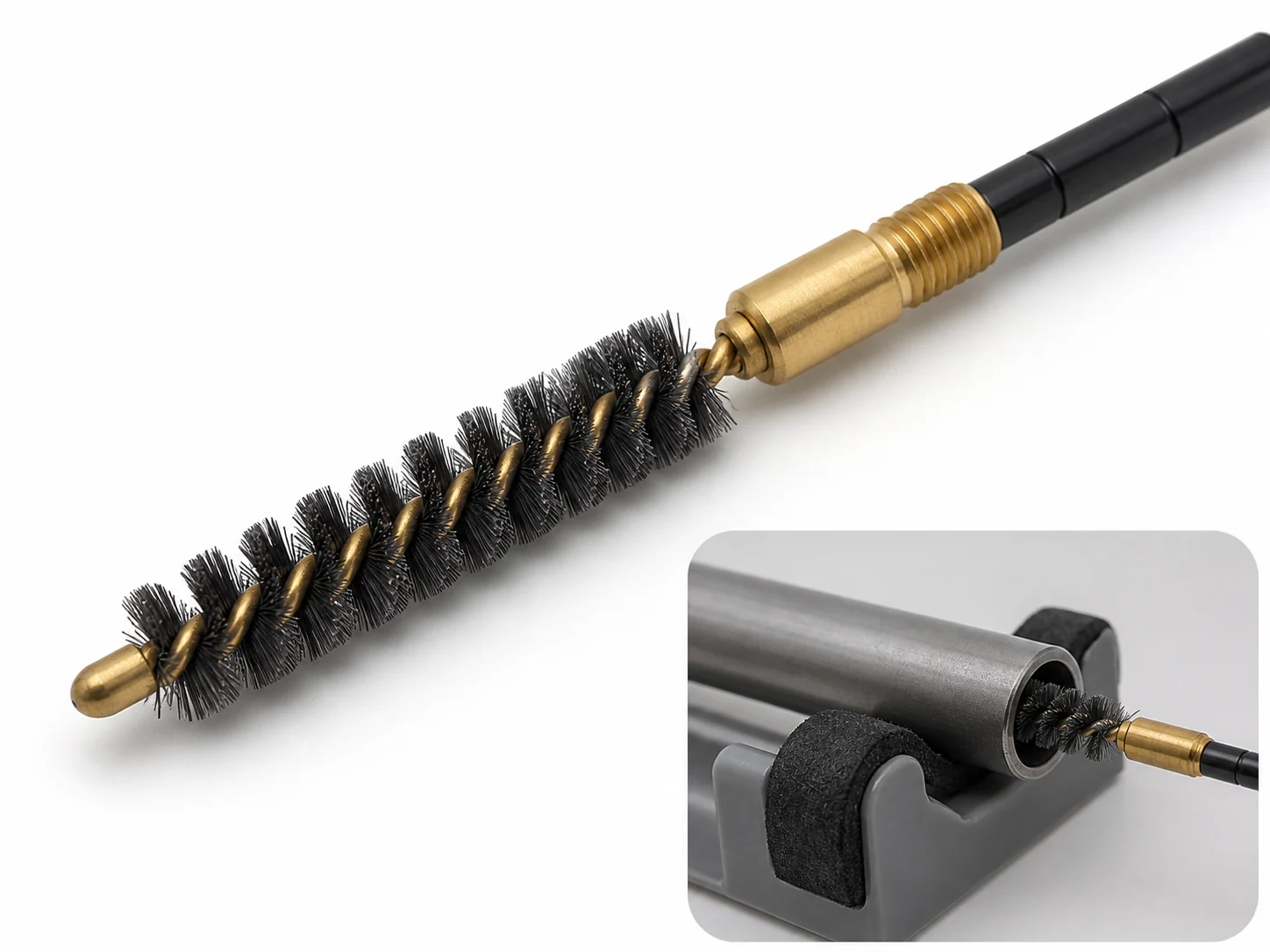
Caliber-specific phosphor bronze or nylon fill on 8-32, 10-32 or 5/16-27 threads, giving a repeatable mechanical step for bore and chamber cleaning.
Small brush
500 pcs
Minimum order
Held in one hand: tube, bottle, detail and swab brushes — including long-handled ones with a small head.
Production lead time, once the specification is confirmed
- Up to 500 pcsWithin 7 days
- 501–50,000 pcsWithin 14 days
- Over 50,000 pcsWithin 21 days
Peak season can extend these times; the shipping date is confirmed in writing with your quotation. Sampling and shipping are quoted separately.
A caliber-specific twisted-wire bore brush for removing carbon, powder, copper, and lead fouling from firearm barrel bores, rifling grooves, and chambers. Built with phosphor bronze or nylon fill and standard 8-32, 10-32, or 5/16-27 threaded interfaces, it gives armorers and maintenance teams a repeatable mechanical cleaning step for regulated firearm programs.
What can this brush do for you?
Follows the Rifling Profile Without Over-Compressing the Bore
The radial bristles are cut and twisted to a caliber-specific bore diameter, so they reach into the grooves while still sliding over the lands. This continuous land-and-groove contact removes powder residue and carbon that flat patches and mops leave behind, and it does so without forcing the core into a bowed condition that can chatter or bind inside the barrel.
Caliber-Matched Fill Density Prevents Inconsistent Scrubbing
Brush diameter, fill count, and bristle length are set for a specific bore and groove envelope rather than a universal size. That matters because an undersized brush only skims the land tops, while an oversized one compresses the bristles flat and pushes fouling ahead of the brush. A caliber-matched brush keeps working pressure constant through the full pass.
Bronze or Nylon Fill Covers Different Fouling and Surface Requirements
Phosphor bronze fill removes copper, lead, and moderate carbon with enough stiffness to break light deposits loose, yet it remains softer than barrel steel and common barrel linings. Nylon fill provides a non-metallic option for routine carbon removal, solvent-only protocols, or applications where any metal contact with a coated or treated bore should be avoided.
Standard Threads Let the Brush Mount Directly to Your Cleaning Rod
The threaded coupling is machined to the rod interface specified by your cleaning system—8-32 for pistol rods, 10-32 for rifle rods, and 5/16-27 for shotgun rods. Direct threading keeps the brush concentric with the bore and eliminates the wobble and off-axis wear that come from stacking adapters.
Double-Twisted Core Holds the Fill for the Full Push-Pull Cycle
The fill is mechanically locked into a twisted-wire core, not glued or press-fit. That structure lets the brush withstand repeated push-pull strokes from chamber to muzzle without shedding filaments into the bore—a requirement in regulated maintenance programs where foreign material left behind is a failure.
What is a Regulated Firearm Bore Cleaning Brush?
A Regulated Firearm Bore Cleaning Brush is a twisted-wire bore brush specified for firearms maintained under formal armory, duty, or compliance protocols. It works like any threaded bore brush: the coupling screws onto a cleaning rod, and the operator pushes or pulls the brush through the barrel so the radial bristles scrub the bore surface, rifling grooves, and the throat area ahead of the chamber.
Unlike a patch or mop, the brush is the mechanical step in the cleaning sequence. It loosens carbon, powder residue, copper, and lead fouling so a following solvent-soaked patch can lift the material out. The brush is not a final pass; it prepares the bore for solvent action and final dry or lightly oiled patches.
Construction is simple and service-proven: a steel core wire is double-twisted around radial fill material, with one end finished as a threaded stud. The fill can be phosphor bronze or nylon. The core diameter, brush overall diameter, working length, and thread are selected for the specific caliber, action type, and rod system.
For regulated environments, the brush provides repeatable geometry and predictable material behavior. It does not add any legal status to the firearm, and it does not replace the recordkeeping or inspection steps required by the operator’s maintenance program. However, it is built so that the mechanical cleaning action can be performed the same way on every issued weapon.
Technical Specifications
| Parameter | Value / Options |
|---|---|
| Brush form | Twisted-wire bore brush |
| Fill material | Phosphor bronze wire or nylon (PA) filament |
| Fill diameter | 0.006–0.012 in (0.15–0.30 mm), set by caliber and fouling load |
| Core wire | Music wire or stainless steel; diameter selected for brush size and push force |
| Brush diameter | Caliber-specific, matched to nominal bore and groove diameter; no universal fit |
| Working section length | Pistol: 1.5–2.5 in; rifle: 2–4 in; shotgun: 2.5–5 in; adjusted to chamber and throat reach |
| Overall length | Set to rod travel and barrel length, typically 3–8 in including threaded stud |
| Thread / interface | 8-32 (pistol), 10-32 (rifle), 5/16-27 (shotgun); other threads on request |
| Bristle retention | Double-twisted wire core; fill mechanically locked, not glued |
| Operating environment | Compatible with common bore solvents and CLP-type products; solvent exposure should be specified for nylon variants |
| Brush type | Custom Tube & Pipe Bore Brushes |
| How it is driven | Hand-guided |
| Cleaning target | duty pistol and service sidearm, precision rifle and match barrel, and military or defense small arm cleaning |
| Surface or part | bores, grooves, thread, chambers, plastic, and profiles |
| Residue or debris | carbon, powder, and powder residue |
| Mounting / connection | 8-32 (pistol), 10-32 (rifle), 5/16-27 (shotgun); other threads on request |
These are product-level starting points. Every dimension, thread, and fill parameter can be changed to match your cleaning rod system and firearm fleet.
Where does this brush work best?
- Duty pistols and service sidearms in law enforcement and security armories, where the brush is part of a scheduled post-range or post-qualification cleaning sequence for carbon ring and powder fouling.
- Precision rifle and match barrels where copper and lead control matters, and the brush must follow land-and-groove geometry without altering throat dimensions.
- Military or defense small arms maintained under preventive maintenance schedules, where repeatable bore cleaning between live-fire sessions keeps accuracy and reliability predictable.
- Smoothbore and rifled shotguns, where plastic wad residue, carbon, and light lead deposits accumulate in the bore and forcing cone area.
- High-volume range and rental fleets that see rapid carbon and lead buildup and need a durable threaded brush that survives frequent push-pull use.
- Gunsmithing and pre-inspection work, where a brush clears loose fouling so a borescope or gauge can show the true bore condition.
How do I choose the right one?
Start with an exact caliber and bore specification. Use the firearm manufacturer’s bore and groove dimensions, or measure with a bore gauge if the barrel is unknown. The brush diameter should be slightly larger than the groove diameter so bristles reach the bottom of the grooves, but not so large that the core binds or the rod flexes during the pass. A universal brush that is close enough will leave carbon in the corners or overload the core.
| Condition | Recommended fill |
|---|---|
| Copper, lead, or moderate carbon fouling; standard steel or chrome-lined barrels | Phosphor bronze |
| Routine carbon removal, solvent-only protocols, or coated/sensitive bore surfaces | Nylon |
| Ammonia-based copper solvent use with long soak times | Use bronze only for limited contact; flush after use |
Match the thread interface to your rod, not an adapter. Check the female thread on your cleaning rod or bore guide before ordering. 8-32 is common for pistols, 10-32 for rifles, and 5/16-27 for shotguns. Using an adapter adds eccentric wobble and can cause the brush to scrub unevenly. A direct-mount thread keeps the brush centered.
Set working length and core stiffness for the action. A short pistol action needs a short working section so the brush does not fold inside the frame. A rifle with a long throat may need a longer working section to reach the leade. Core wire diameter should be matched to the brush diameter; too thin a core will kink under push force, while too thick a core reduces bristle compliance.
Know when this brush is the wrong tool. A bore brush removes attached fouling, but it does not repair a corroded, pitted, or ringed barrel. If the barrel has mechanical damage or severe leading, evaluate the barrel condition separately. For lead-only removal in unlined or vintage barrels, test a small area or use a nylon option first. If the cleaning protocol requires absolutely zero metallic contact, choose nylon fill. If you are cleaning gas tubes or very small passages, a pipe-cleaner-style brush may be more appropriate.
Can I customize this brush?
Every configuration variable above can be set to your firearm fleet and cleaning system. To specify a custom bore brush, provide the exact firearm make and model or the bore and groove dimensions, the cleaning rod thread and pull direction, the dominant fouling type, and the solvents or CLPs used. If you are building a maintenance kit for multiple calibers, provide the full caliber list so we can recommend a set with matched threads.
- Caliber fit — brush diameter, fill length, and fill count set to the exact bore and groove envelope
- Fill material — phosphor bronze or nylon, with fill diameter and density adjusted to fouling type and surface sensitivity
- Core and working section — core wire material and diameter, working length, overall length, and stiffness profile
- Thread and coupling — 8-32, 10-32, 5/16-27, or project-specific thread; male or female configuration per rod system
- Color and marking — color-coded fill or handle, thread marking, laser marking, or identification coding for fleet management
- Packaging — bulk, armorers’ kit, individual sealed pouch, or project-specific packaging with labeling
If your regulated maintenance program requires material declarations, inspection documentation, or third-party testing support, we can assist with those project-specific requirements during the customization process.
What size fits the opening, and how is a regulated firearm bore cleaning brush cleaned afterwards?
How can I verify the brush diameter is correct before using it in the bore?
Insert the threaded end into the chamber or breech first and begin a dry, unforced pass. The brush should slide through with steady resistance but no binding; if the rod bows or you need to force it, the diameter is too large. If the brush passes with almost no contact and fouling remains after the solvent patch, the diameter is too small. For unknown barrels, use a bore gauge to confirm the groove diameter before selecting the brush.
Can I use the same brush to clean the chamber and the bore?
A bore brush is sized to the rifled bore, not to the chamber. The chamber is wider and often has its own shoulder and neck geometry. If the working section is long enough, it may reach the throat area, but for complete chamber cleaning a separate chamber brush or a longer working section specified for the chamber is the better tool. Tell us both geometries if the brush must cover both areas.
Is a phosphor bronze brush safe for chrome-lined, nitrided, or stainless barrels?
Phosphor bronze is softer than barrel steel and standard barrel treatments, so under normal hand pressure it does not damage these surfaces. For barrels with unusual coatings, vintage finishes, or unknown metallurgy, test on a non-critical area or select the nylon fill option. Do not use the brush to scrape or pry at the muzzle crown or chamber mouth.
How do I know when the brush is worn out?
Inspect the brush before each use. Replace it when the bristles stay flattened against the core instead of springing back, when the core wire has a permanent kink or set, when the threaded stud shows thread deformation, or when bristle loss becomes visible on the rod or patch. In high-volume armories, set a fixed replacement cycle based on round counts and cleaning frequency so worn brushes are pulled before they lose contact.
What should I do if bristles come off inside the barrel?
Stop the pass immediately, reverse the rod to remove the brush if possible, then run solvent-soaked patches from chamber to muzzle to flush loose material. Inspect the bore with a light or borescope to confirm no filament remains. If shedding recurs, switch to a brush with a different fill density or the nylon option; repeated shedding indicates the core twist is too loose for the bore size or the brush has reached end of life.
Does a bore brush work with all cleaning solvents and CLPs?
Most bore solvents, CLPs, and carbon removers are compatible with both bronze and nylon fill during normal brushing. Avoid prolonged soaking of a bronze brush in strong ammonia-based copper removers, and do not expose nylon fill to solvents that attack polyamide or to temperatures above the material limit. Check the solvent SDS and tell us the chemical family if the brush will be left submerged between uses.
Guides that go deeper on this
Custom Manufacturing RFQ
Describe Your Application
For an accurate quotation, please provide the main dimensions, material preference, working surface, residue, quantity, and a drawing or photo.
Drawing or photo optional — it speeds things up, it does not gate the enquiry.
Custom Brush RFQ
Send Your Brush Project
Upload a drawing, product photo, or sample photo and provide the core dimensions and cleaning conditions.
“We need a brush to remove wet residue from a stainless steel conveyor, about 800mm wide. The current brush wears quickly. We can send photos.”
“We sell drinkware and need a cleaning brush to include with the product. Quantity around 5,000 pieces.”