
Custom Cleaning Brush
100mm PP Acid Bottle Brush
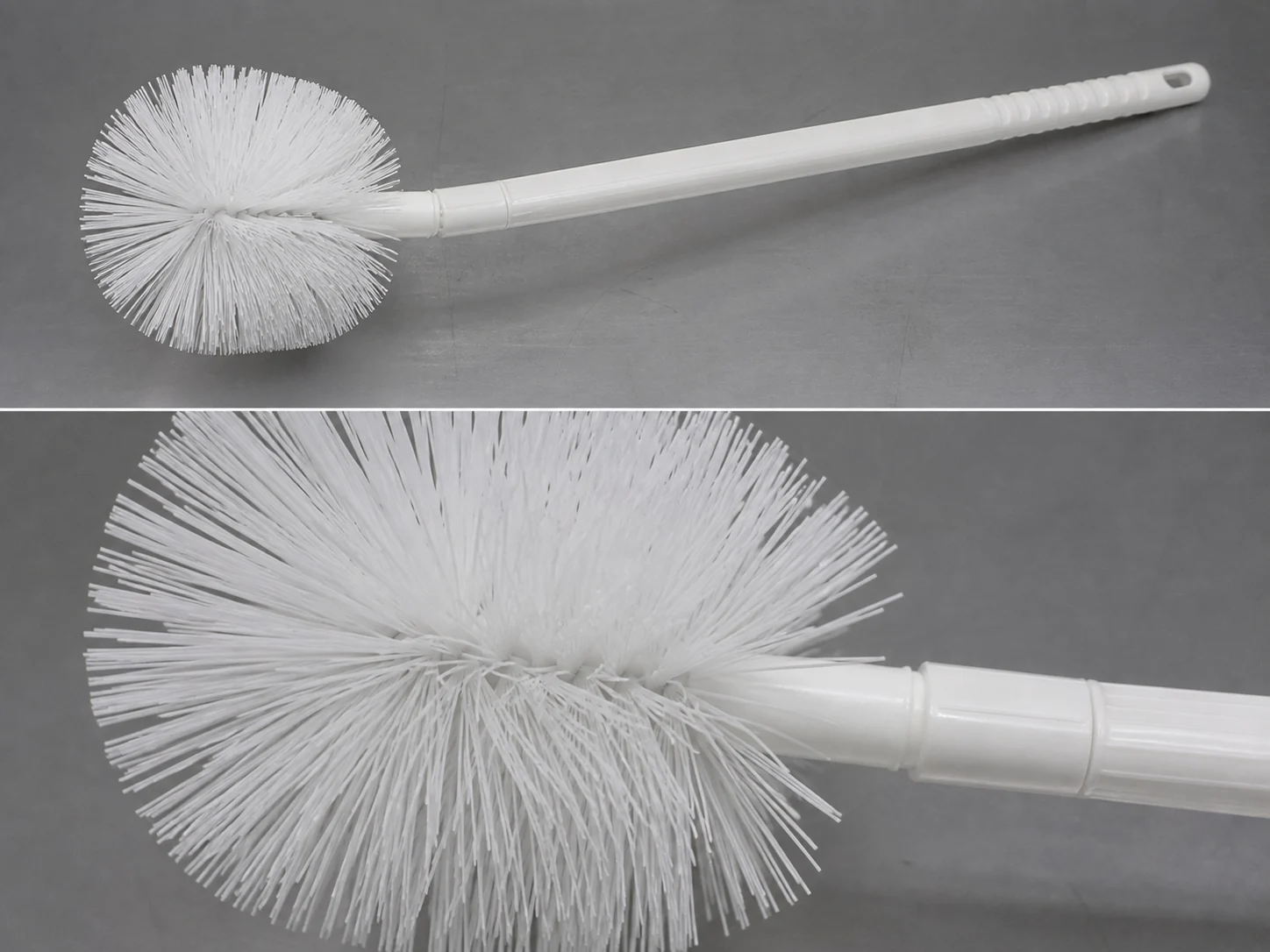
All-PP 100mm acid bottle brush with fixed 400mm handle for wide-mouth acid bottles, carboys, and chemical containers.
Small brush
500 pcs
Minimum order
Held in one hand: tube, bottle, detail and swab brushes — including long-handled ones with a small head.
Production lead time, once the specification is confirmed
- Up to 500 pcsWithin 7 days
- 501–50,000 pcsWithin 14 days
- Over 50,000 pcsWithin 21 days
Peak season can extend these times; the shipping date is confirmed in writing with your quotation. Sampling and shipping are quoted separately.
The 100 mm PP Acid Bottle Brush is a fixed-head, all-polypropylene cleaning tool for wide-mouth acid bottles, carboys, and chemical containers. It puts a 100 mm round PP bristle head and a 400 mm PP handle through the cleaning path so the interior walls, shoulders, and base can be scrubbed without exposing metal to the chemical environment.
What can this brush do for you?
Cleans the Full Circumference on Every Stroke
The 100 mm diameter round bristle pack contacts the sidewall all the way around as the brush is pushed, pulled, and rotated. A single pass breaks up liquid films, settled powder, and acid residue across a wider band than a flat or angled brush, which reduces the number of strokes needed to cover the interior.
Keeps the Wetted Path Plastic, Not Metal
The bristle material and the handle are both polypropylene. For acid bottles and chemical drums, that removes the risk of rust marks, metal contamination, or filament loss from a corroding wire core. The brush can be left in contact with compatible acid solutions without the cleaning tool itself becoming a contamination source.
Fixed Head Handles Push and Scrub Force
The head is fixed to the handle instead of mounted on a threaded or snap joint. When you press the brush against the base or drag it along the wall, the force goes into the residue rather than into loosening the connection. The cleaning action stays predictable even when the handle is wet or slippery.
Long Reach Keeps Hands Away From Chemicals
The 250 mm bristled section and 400 mm handle let the operator reach the bottom and lower shoulder of large acid bottles and carboys while keeping hands outside the opening. The 22 mm grip diameter provides a stable hold through the full stroke and during rotation.
Effective on Soft Residues Without Metal Scoring
PP filaments are firm enough to remove product films, powders, salts, and soft precipitates but softer than steel wire. On glass and plastic containers where metal brushes would leave scratches or reactive sites, this brush provides a less damaging mechanical action while still doing the cleanup work.
What is a 100mm PP Acid Bottle Brush?
A 100mm PP Acid Bottle Brush is a hand-guided cleaning brush made for the interior of wide-mouth chemical containers. The working end is a round radial bristle head with a 100 mm outside diameter and a 250 mm head length. The bristle pack and the handle are polypropylene, and the head is fixed to the handle in one in-line assembly.
During use, the operator inserts the head through the container mouth and works it along the sidewall, shoulder, and base with push, pull, and rotating strokes. A compatible detergent, rinse water, or cleaning solution carries away the loosened film and particles. Because the head is round, it matches the curve of cylindrical bottles, carboys, and drum shoulders better than a flat brush.
This is a brush for wide-mouth containers. The 100 mm head must pass through the narrowest opening, so it is not the right tool for small-neck laboratory reagent bottles. It is also not a replacement for chemical soaking or mechanical descaling when the deposit is hard mineral scale, baked-on solids, or carbonized residue.
Technical Specifications
The base configuration of the 100mm PP Acid Bottle Brush is listed below. Dimensions, filament pack, handle features, and color can be adjusted for a project.
| Parameter | Specification |
|---|---|
| Head diameter | 100 mm |
| Head shape | Round radial bristle pack |
| Head length | 250 mm |
| Handle length | 400 mm |
| Nominal overall length | 650 mm |
| Bristle material | Polypropylene (PP) |
| Handle and base material | Polypropylene (PP) |
| Grip diameter | 22 mm |
| Connection | Fixed head-to-handle |
| Exposed metal in wetted path | None in base configuration |
| Chemical compatibility | Common organic acids and many dilute mineral acids at room temperature; avoid concentrated nitric acid, hot concentrated sulfuric acid, strong oxidizing solutions, halogens, and aggressive solvent blends |
| Service temperature | 0°C to 80°C (32°F to 176°F) for routine cleaning; higher temperatures reduce filament stiffness and chemical resistance |
| Brush type | Custom Bottle & Container Brushes |
| How it is driven | Hand-guided |
| Cleaning target | acid carboy and wide-mouth acid jug, open-head chemical drum and pail, and plastic or glass mixing vessel and neutralization cleaning |
| Surface or part | containers, walls, metal, shoulders, drums, sidewalls, corners, and tanks |
| Residue or debris | salt, powder, scale, liquid film, carbonized residue, mineral scale, and particles |
| Mounting / connection | Fixed head-to-handle |
Where does this brush work best?
- Acid carboys and wide-mouth acid jugs used for bulk storage, transfer, or dispensing of dilute mineral and organic acids.
- Open-head chemical drums and pails that need an interior wall and base scrub between product changes or before disposal.
- Plastic or glass mixing vessels and neutralization tanks where acid films, powders, and settled salts build up below the liquid line.
- Laboratory aspirator bottles and large reagent jars with mouths wide enough to accept the 100 mm head.
- Electroplating, pickling, and rinse containers where acid salts and residual films form on the sidewall and bottom corner.
How do I choose the right one?
Measure the opening before choosing this head
Find the narrowest inside diameter of the mouth or neck. The 100 mm head must fit through it without bending the handle or permanently crushing the filaments. If the opening is smaller, this brush will not insert and you need a smaller head diameter or a tube brush.
Check the acid and temperature against polypropylene
PP resists many common organic acids and dilute mineral acids at room temperature, but no single polymer is compatible with everything. Concentrated nitric acid, hot concentrated sulfuric acid, halogens, and strong oxidizers can attack or embrittle the material. If the brush will sit in hot acid or aggressive chemistry, verify the specific combination before ordering.
Match the bristle pack to the residue
Standard PP filament works for liquid films, powders, and soft precipitated salts. If the deposit is dense or dried, a denser fill, thicker filament gauge, or stiffer trim can improve mechanical action. If the residue is hard scale or carbonized, use a pre-soak or chemical descaler and then brush; no PP brush should be the primary tool for that job.
Confirm the reach and grip
The 650 mm nominal overall length reaches the base of containers up to roughly 600 mm deep depending on hand position and neck height. Deeper vessels need a longer handle. The 22 mm grip is adequate for standard chemical gloves; for thick double-glove use, a larger grip or textured overmold can be specified.
| Condition | Recommendation |
|---|---|
| Narrowest opening is smaller than 100 mm | Use a smaller head diameter or a tube brush |
| Residue is a soft film or powder | Use this 100mm PP head in standard fill |
| Residue is hardened, dried, or mineralized | Increase filament gauge or density, or choose PBT/nylon only if acid compatibility allows |
| Strong oxidizing acid or temperature above 80°C | Select a different material or change the cleaning step |
| Metal-free wetted path is mandatory | Confirm the all-PP configuration with no exposed metal |
Can I customize this brush?
The 100mm PP Acid Bottle Brush is configurable for specific acid containers and cleaning procedures. To define a custom version, provide the narrowest mouth ID, body diameter, internal depth, residue type, acid and concentration, cleaning temperature, and whether metal in the wetted area is prohibited. A photo or dimensioned drawing of the container and mouth helps.
- Head diameter and shape — Reduce the diameter for smaller mouths, or change the profile to tapered, oval, or end-tuft for base corners.
- Head length — Adjust the 250 mm bristled zone for shorter jars or deeper tanks.
- Overall length and handle — Extend the handle, add a hanging hole, change the grip diameter, or add a non-slip surface for gloved use.
- Bristle pack — Set filament gauge, stiffness, fill density, trim profile, and color for chemical-area identification.
- Connection — Keep the fixed head or add a project-specific extension bracket or mounting interface.
- Marking and packaging — Add pad printing, laser marking, color coding, bulk cartons, individual wrapping, or kit packaging.
If the project requires material declarations, inspection records, or third-party testing for the specific cleaning process, we can support those requirements during the customization phase.
When is a 100mm PP acid bottle brush worn out rather than just dirty?
Will this brush fit through a standard narrow-neck reagent bottle?
No. A 100 mm head cannot pass through a 38 mm or 45 mm laboratory bottle neck. This brush is for wide-mouth acid bottles, carboys, and drums whose openings can accept the 100 mm head. For small necks, use a smaller head diameter or a tube brush.
Is there any metal that can contact the acid?
The bristle pack and handle are polypropylene, and the base configuration has no exposed metal in the wetted length. If your process requires a documented metal-free assembly, request that confirmation with the order so the specification is checked against your requirement.
What is the best way to check the brush before each use?
Inspect the bristles for flattening, shedding, discoloration, or a chalky surface, and check the handle for kinks or cracks. If the head no longer springs back to a round shape or has lost fill around the perimeter, replace it before it leaves filaments inside the vessel.
Can I use this brush with concentrated nitric acid?
Avoid it. PP is generally not a suitable material for concentrated nitric acid, hot concentrated sulfuric acid, strong oxidizers, or halogens. Even with diluted acids, confirm the specific concentration and temperature, because chemical compatibility changes with both.
How do I know the container is really clean after brushing?
After brushing, rinse the vessel with a compatible rinse water or solvent, then inspect the walls and base under light while still wet. A white lint-free wipe across the suspected area should show no visible film or color. If residue reappears after drying, repeat the wash-rinse sequence and check that the brush is reaching the base and shoulder.
Does brushing replace an acid rinse or neutralization step?
No. Brushing removes adhered material, but dissolved residue and trace acid must still be rinsed away or neutralized according to the process. The brush is part of the cleaning sequence, not a substitute for the final rinse or drying step.
Guides that go deeper on this
Custom Manufacturing RFQ
Describe Your Application
Send the key measurements, cleaning requirement, residue, material direction, mounting method, quantity, and drawing or photo.
Drawing or photo optional — it speeds things up, it does not gate the enquiry.
Custom Brush RFQ
Send Your Brush Project
Upload a drawing, product photo, or sample photo and provide the core dimensions and cleaning conditions.
“We need a brush to remove wet residue from a stainless steel conveyor, about 800mm wide. The current brush wears quickly. We can send photos.”
“We sell drinkware and need a cleaning brush to include with the product. Quantity around 5,000 pieces.”