
Custom Cleaning Brush
200mm PA66 Large Duct Brush
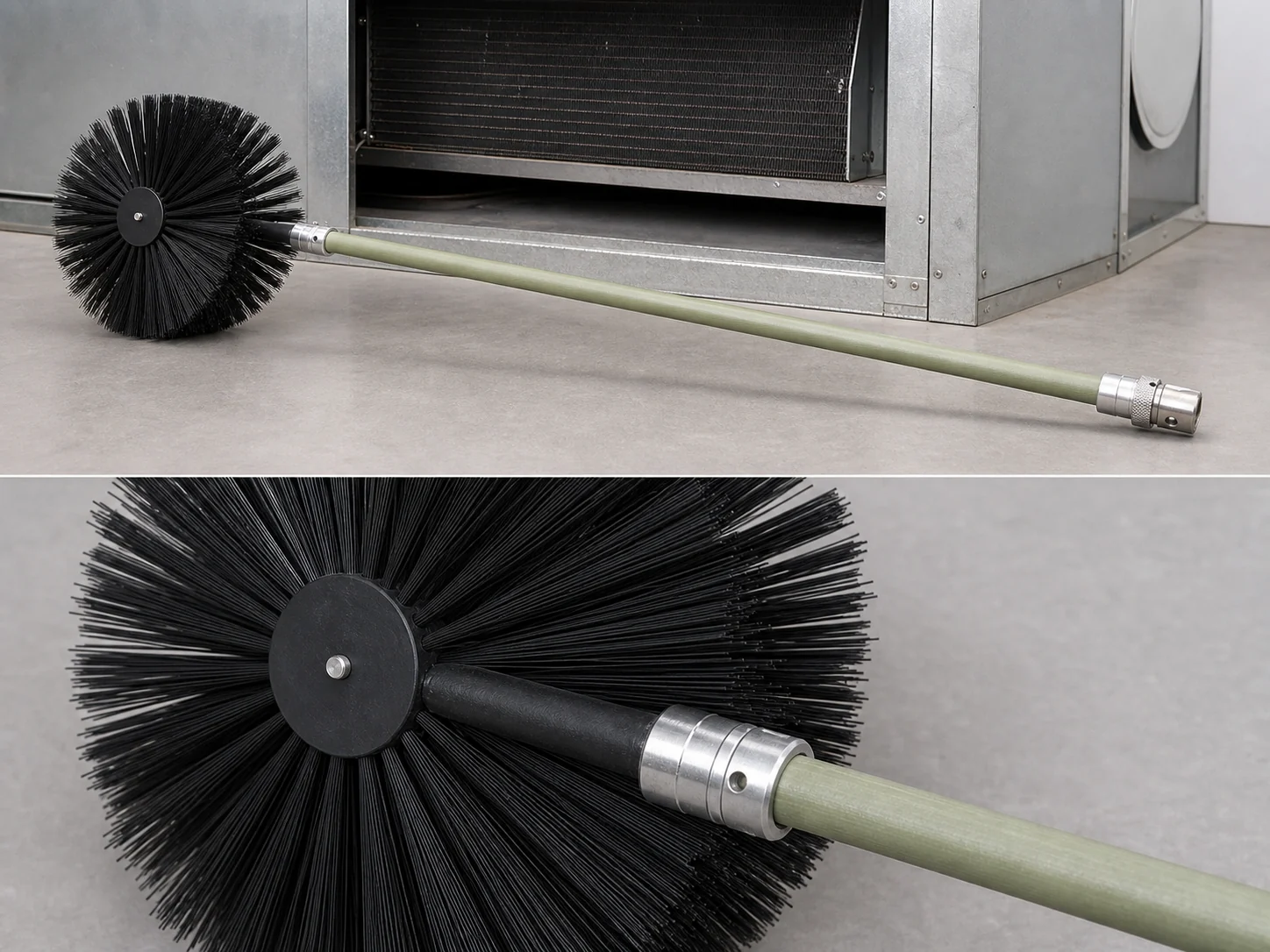
200mm PA66 large duct brush with a 400 mm head, 800 mm twist-core handle and quick-change coupling for HVAC duct, vent, fin and coil cleaning.
Medium brush
100 pcs
Minimum order
Worked with two hands or on a pole: chimney, gutter and pond-filter brushes, discs, cups and tank brushes.
Production lead time, once the specification is confirmed
- Up to 100 pcsWithin 7 days
- 101–5,000 pcsWithin 14 days
- 5,001–50,000 pcsWithin 21 days
- Over 50,000 pcsConfirmed with your quotation
Peak season can extend these times; the shipping date is confirmed in writing with your quotation. Sampling and shipping are quoted separately.
The 200mm PA66 Large Duct Brush is a wide-diameter HVAC cleaning brush built to clear dust, lint, pollen, soot film, and loose grease from duct walls, plenums, vent openings, and air-conditioning coil surfaces. Its large round PA66 filament head covers more area per pass, while the stainless twisted-wire core, 800 mm handle, and quick-change coupling provide the reach and drive options that deep air-handling sections usually require.
What can this brush do for you?
Wide 200 mm Coverage Reduces Pass Count
The 200 mm round head lets one push-pull or rotary pass treat a broad band of duct wall, so large supply or return plenums are cleared faster than with smaller-diameter duct brushes. The fill is dense enough to hold contact around the full circumference without forcing the operator to overlap strokes repeatedly.
PA66 Filaments Stay Stiff and Spring Back
PA66 nylon keeps its stiffness across the temperature range found in normal HVAC service, resists abrasion from sheet-metal edges, and does not soften in light detergents or damp conditions. The filaments recover their radial shape after being pushed through restricted access openings, so the brush continues contacting the duct wall instead of collapsing flat.
Twisted Stainless Core Holds the Fill Under Torque
The stainless steel twisted-wire core grips each filament bundle mechanically. Under hand or low-speed powered rotation, the head keeps its form and transmits torque along the full 400 mm working length, reducing lost filaments and preserving the effective diameter.
800 mm Handle Reaches Deep Sections
With the 32 mm grip and 800 mm handle, operators can work into return risers, plenum corners, and filter tracks without entering the duct. When more depth is needed, the quick-change coupling accepts extension rods or adapters instead of making the operator buy a different tool.
Quick-Change Coupling Connects to Existing Drive and Extension Systems
The coupling at the shank end makes swapping between brush heads, extension lengths, or a powered drive practical on site. Service crews can keep one handle and switch to a smaller or replacement head as duct sections change, reducing the tool count on the truck.
What is a 200mm PA66 Large Duct Brush?
A 200mm PA66 Large Duct Brush is a round, large-diameter brush tool that uses PA66 nylon filament clusters secured in a stainless steel twisted-wire core, fitted to an 800 mm handle and extension interface with a quick-change coupling. It is designed for cleaning the interior surfaces of air-conditioning and ventilation systems: galvanized duct walls, plenums, mixing boxes, louver backs, filter tracks, and coil faces carrying light dust, lint, soot, or loose grease.
During use, the operator either pushes and pulls or rotates the brush by hand, or connects it through the quick-change coupling to a powered driver. The filament tips contact the surface at a slight angle and dislodge debris; negative air or vacuum capture usually removes the loosened material. The brush does not polish or scrape; it mechanically removes loose deposits. Use it on dry to damp HVAC surfaces, keep powered rotation moderate, and avoid excessive radial pressure on thin aluminum fins.
Technical Specifications
The dimensions and filament parameters in the table represent the standard 200mm PA66 Large Duct Brush. We adjust them to the project when the duct geometry or cleaning procedure requires a different configuration.
| Parameter | Specification / Configurable Options |
|---|---|
| Head diameter | 200 mm |
| Head shape | Round, cylindrical fill profile |
| Working head length | 400 mm |
| Filament material | PA66 nylon |
| Filament diameter | 0.4–0.8 mm; 0.5 mm standard, selectable by job |
| Filament set | Heat-set for diameter retention and recovery |
| Core / stem | Stainless steel twisted wire |
| Handle length | 800 mm |
| Grip diameter | 32 mm |
| Overall length | 1,200 mm head plus handle without extension |
| Connection | Quick-change coupling; extension rods and powered-drive adapters available |
| Service environment | Dry or damp HVAC surfaces; confirm chemical compatibility before aggressive cleaning agents |
| Brush type | Custom Tube & Pipe Bore Brushes |
| How it is driven | Hand-driven on rods or a flexible shaft |
| Cleaning target | return and supply air duct interior, air handler plenum and mixing box, and ventilation louver and grille backside cleaning |
| Surface or part | coils, walls, duct walls, fins, aluminum, filters, tracks, and coil faces |
| Residue or debris | dust, lint, soot, grease, pollen, soot film, grease film, and loose deposits |
| Mounting / connection | Quick-change coupling; extension rods and powered-drive adapters available |
Where does this brush work best?
- Return and supply air duct interiors in galvanized and aluminum ductwork, where dust, lint, and pollen accumulate on the walls.
- Air handler plenums and mixing boxes, where the 200 mm head clears a wide section in a controlled number of passes.
- Ventilation louver and grille backsides, treating the interior face of large grilles from inside the duct.
- Evaporator and condenser coil faces with light soot, dust, or oily film, using light radial pressure and movement along the fin direction.
- Filter housing tracks and access-door frames where built-up lint blocks seating or airflow.
- Kitchen exhaust and range-hood duct pre-cleaning for loose grease film when combined with a suitable degreaser.
How do I choose the right one?
Match head diameter to the narrowest passage
For round duct, the 200 mm head needs clearance to pass connectors, dampers, and transitions. As a practical rule, choose a brush head at least 15 to 25 mm smaller than the narrowest accessible duct ID for straight runs, and more clearance for elbows or damper blades. For rectangular duct, use the clear opening, not the nominal size, and check the diagonal path through corners.
Choose filament stiffness from the surface and residue
PA66 filament diameter and trim length set working stiffness. A 0.5 mm filament with medium trim clears dust and lint from sheet metal. Choose 0.6 to 0.8 mm or shorter trim for heavier soot and caked dust. Choose 0.4 mm and longer trim for coil fins or coated surfaces. If the job needs aggressive removal from heavily contaminated or abrasive surfaces, consider an abrasive or wire-filled brush instead.
Set reach from the duct depth and extension method
The 800 mm handle covers the distance an operator can safely control. Add extension rods through the quick-change coupling for deep risers. Each extension shifts balance, so keep the total unsupported length within what the operator can guide without bowing the stem.
Decide hand or powered operation
Hand operation is enough for light dust and tight control. Low-speed powered rotation works for long straight runs. Keep RPM moderate, ensure the coupling is locked, and never let a long extension whip. High speed throws already-loosened debris and increases core fatigue.
Check the environment before committing
PA66 handles common HVAC service: damp surfaces, light detergents, oil-laden lint, and normal duct interior temperatures. If cleaning involves hot concentrated acids, strong alkaline immersion, or steam above PA66 practical limits, switch to a different filament material such as PBT, PP, or stainless wire.
| Operating situation | Recommended configuration |
|---|---|
| Large straight sheet-metal ducts, loose dust | Standard 0.5 mm PA66, hand or low-speed drive |
| Heavy lint and dust cakes in plenums | 0.6–0.8 mm PA66, shorter trim, low-speed drive |
| Aluminum fins or coated surfaces | 0.4 mm PA66, longer trim, light radial pressure |
| Deep risers beyond the 800 mm handle | Add extension rods and verify coupling lock |
| Aggressive chemical or high-temperature cleaning | Switch filament to PBT, PP, or stainless wire |
| Flexible ducts or tight bends | Use a smaller-diameter or more flexible brush, not the 200 mm rigid head |
Can I customize this brush?
We build this brush to the duct layout and cleaning procedure, not as a stock-only item. To define your configuration, provide the narrowest duct or opening size, duct section shape, accessible depth, surface material, residue type, cleaning chemical, expected cycle, and preferred drive or extension interface. A drawing or site photo helps us get the first sample right.
We can adjust the following:
- Filament: PA66 diameter from 0.3 to 1.0 mm, heat-set or straight, flagged tips, double-spiral or dense fill, trim length, and color.
- Head: diameter from about 150 to 300 mm or larger, head length from 300 to 600 mm, round or cylindrical profile, end tufts, and segmented or spiral fill.
- Core and stem: stainless steel twisted wire in 304 or 316, galvanized wire, or a polymer flexible core for metal-free or tight-radius applications.
- Handle: length, grip diameter, knurled, T-handle or loop handle, grip material, and hanging feature.
- Connection: quick-change coupling type and size, male or female end, thread or hex drive, and compatibility with your existing extension rods.
- Accessories: extension rods, spare heads, drive adapters, and multi-head cleaning kits.
- Packaging and marking: bulk carton, polybag, retail card, custom color, pad print, laser marking, and labeling.
If your project requires material declarations, batch inspection, third-party testing, or other acceptance documentation, we can arrange that support during the customization process.
When is a 200mm PA66 large duct brush worn out rather than just dirty?
Can the 200 mm head pass through a 200 mm duct opening?
No. A brush head needs working clearance. For straight round duct, target a duct ID at least 15 to 25 mm larger than the head diameter, and add more clearance where dampers, transition rails, or elbows exist. If the opening is close to 200 mm, specify a smaller head diameter instead of forcing the 200 mm head through.
Will this brush bend or collapse evaporator or condenser fins?
With correct technique, no. Use finer 0.4 mm filaments and light radial pressure, and work along the fin direction rather than across it. Straighten any existing bent fins with a fin comb before brushing. The brush removes surface dust and soot but will not repair impacted fins or dissolve hardened scale.
How do I check whether the brush head is still serviceable?
Measure the head diameter at several points along the 400 mm working length. Replace the head when diameter loss exceeds about 10 percent, when filament clusters fall out, or when the stainless core becomes visible through the fill. Also check for flat spots, permanently bent filaments, and broken wire ends that could scratch duct surfaces.
Can I extend the handle for deep vertical duct runs?
Yes. Extension rods attach at the quick-change coupling. Before each use, verify that all locked connections are fully seated and free of play. Limit total extension to what the operator can guide without side load, and reduce speed when using a powered driver with added length.
Does brushing replace vacuum extraction or chemical coil cleaning?
No. The brush loosens and moves debris; you still need vacuum or negative-air capture to remove what is dislodged. On coil surfaces, brushing supports wiping and detergent application but is not a replacement for deep chemical cleaning, pressure washing, or antimicrobial treatment required by the maintenance plan.
What should I check before first use in a new duct system?
Confirm the actual clear opening at every section, check for protruding screws, damper hardware, or sensor tubes that could catch the brush, and lock the quick-change coupling. Run a short hand test pass first. If the brush binds, squeaks, or twists the extension, stop and reduce the head diameter or switch to a more flexible stem.
Guides that go deeper on this
Custom Manufacturing RFQ
Describe Your Application
An accurate custom quote starts with the dimensions, working surface, residue, material choice, connection, quantity, and reference files.
Drawing or photo optional — it speeds things up, it does not gate the enquiry.
Custom Brush RFQ
Send Your Brush Project
Upload a drawing, product photo, or sample photo and provide the core dimensions and cleaning conditions.
“We need a brush to remove wet residue from a stainless steel conveyor, about 800mm wide. The current brush wears quickly. We can send photos.”
“We sell drinkware and need a cleaning brush to include with the product. Quantity around 5,000 pieces.”