
Custom Cleaning Brush
40mm P120 SiC Descaling Brush
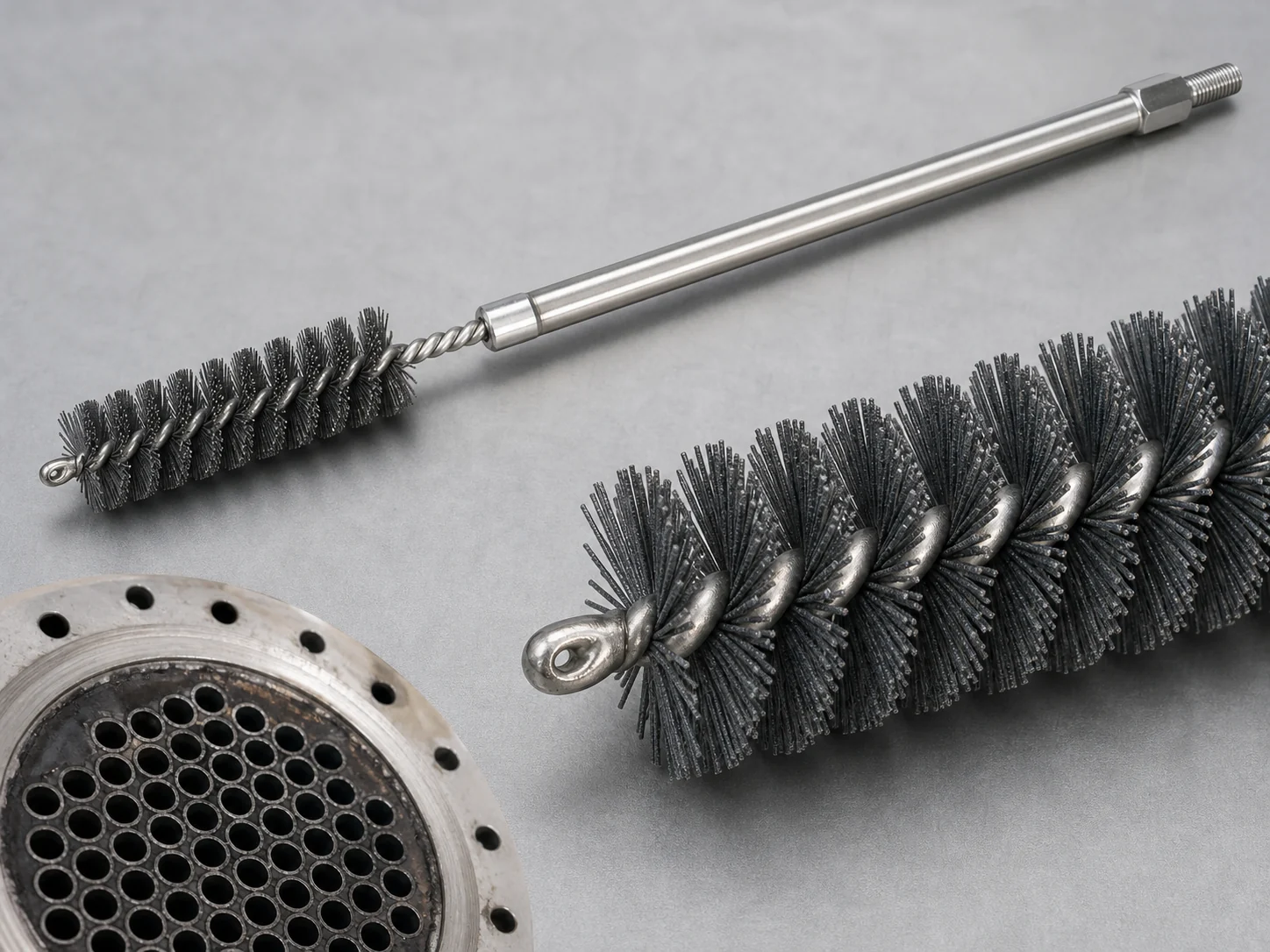
40mm round P120 silicon carbide abrasive nylon descaling brush with removable head and AISI 304 handle.
Small brush
500 pcs
Minimum order
Held in one hand: tube, bottle, detail and swab brushes — including long-handled ones with a small head.
Production lead time, once the specification is confirmed
- Up to 500 pcsWithin 7 days
- 501–50,000 pcsWithin 14 days
- Over 50,000 pcsWithin 21 days
Peak season can extend these times; the shipping date is confirmed in writing with your quotation. Sampling and shipping are quoted separately.
A 40mm P120 SiC descaling brush for cleaning scale, rust, and mineral deposits from the internal bores of heat exchanger tubes. The round abrasive nylon head provides full-circumference contact, while the removable head and AISI 304 stainless handle make it a practical maintenance tool for repeated tube work.
What can this brush do for you?
Full-circumference descaling in a 40mm bore
The round 40mm head holds abrasive filaments against the entire internal wall at the same time. In operation, push-pull and rotating strokes remove scale around the full circumference instead of leaving a clean strip at the bottom with residue still bonded to the top and sides.
Silicon carbide removes scale and rust without wire brush fallout
The bristles are abrasive nylon loaded with silicon carbide, so the deposit is cut by mineral grit embedded in a conformable filament rather than by exposed steel wire ends. This avoids broken wire bristles left inside the tube bundle, which can later cause corrosion or interfere with downstream equipment.
P120 balances bite and surface result
P120 is a working grit for descaling rather than a polish. It cuts hard water scale, rust stains, surface oxidation, and light mineral films while still producing a cleaned bore surface. For very heavy deposits, a coarser grit can be supplied before or after a chemical cleaning step.
150mm head length reduces the number of strokes
A 150mm working head covers more tube length per push-pull cycle than a short end brush, so the operator completes each tube faster and gets more even contact along the internal wall. The longer head also helps bridge small ID variations without concentrating wear at one point.
Threaded removable head keeps replacements simple
The head threads onto the 300mm AISI 304 stainless handle. When the abrasive nylon wears down, you replace only the head, not the entire tool. The same handle can also accept different diameter or grit heads if the maintenance program includes coarse descaling and a finer second pass.
Stainless handle suits wet and chemical cleaning routines
The AISI 304 handle and threaded connection resist rust from water, condensate, and common neutral cleaning solutions. It can be rinsed after use and stored in maintenance areas without the handle corroding the way a carbon steel shaft would.
What is a 40mm P120 SiC Descaling Brush?
A 40mm P120 SiC Descaling Brush is a maintenance tool built around a round brush section 40mm in diameter and 150mm long, mounted on a 300mm AISI 304 stainless handle. The working section uses abrasive nylon filaments loaded with P120 silicon carbide grain. The head is attached by a threaded connection so it can be removed and replaced independently of the handle.
In use, the brush is inserted into a heat exchanger tube bore, then worked with push-pull and rotating strokes. The abrasive nylon filaments flex enough to follow local diameter variation while the silicon carbide cuts attached scale, rust, and mineral deposits. P120 is a medium-fine abrasive grade: it is chosen when the operator wants to remove visible deposits and restore contact between the tube wall and the process fluid, not when the goal is a polished or dimensionally finished surface.
This is a descaling and deposit-removal brush, not a precision reamer, hone, or surface-finishing tool. It is intended for tube bores close to 40mm internal diameter where the round head can make full contact. It works wet or dry with the appropriate cleaning chemistry, but the handle and abrasive grade must still be matched to the actual service environment.
Technical Specifications
The standard configuration is listed below. Diameter, length, grit, thread interface, and handle construction can be adjusted for the tube bundle and cleaning method.
| Parameter | Standard Value / Configuration |
|---|---|
| Head diameter | 40 mm |
| Head shape | Round |
| Head length | 150 mm |
| Bristle material | Abrasive nylon with silicon carbide (SiC) grain |
| Grit size | P120 |
| Handle/base material | AISI 304 stainless steel |
| Handle length | 300 mm |
| Grip diameter | 15 mm |
| Connection | Threaded, removable head |
| Overall working length | Approximately 450 mm (head + handle) |
| Tube bore compatibility | Nominal 40 mm internal diameter; slight under/over size taken up by filament flex |
| Brush type | Custom Tube & Pipe Bore Brushes |
| How it is driven | Hand-guided |
| Cleaning target | shell-and-tube heat exchanger tube-side pass, condenser tube bundle, and power and process plant maintenance cleaning |
| Surface or part | tubes, bores, walls, tube walls, ports, long tubes, passages, and thread |
| Residue or debris | scale, rust, mineral deposits, corrosion, oil, oxide, and salt |
| Mounting / connection | Threaded, removable head; Nominal 40 mm internal diameter; slight under/over size taken up by filament flex |
For a powered rotary setup, the drive interface and speed limit must be confirmed at the design stage. The standard configuration is intended for manual push-pull and rotating use.
Where does this brush work best?
- Shell-and-tube heat exchanger tube-side passes — descaling waterside tube bores in chillers, condensers, coolers, and process exchangers where water hardness creates scale layers.
- Condenser tube bundles — removing calcium scale, iron oxide staining, and light corrosion deposits from the internal tube wall during scheduled outage or retubing preparation.
- Power and process plant maintenance — cleaning cooling water tube bores before eddy-current or visual inspection, or before returning a bundle to service.
- Marine heat exchangers and oil coolers — clearing tube bores with salt deposits, surface rust, and accumulated debris common after seawater or raw-water service.
- Maintenance and overhaul shops — routine descaling of 40mm tube ports, sleeves, and similar cylindrical passages where a round brush can be inserted from one end.
This brush is designed for straight or near-straight tube paths close to 40mm inside diameter. For U-bend tubes, very long tube runs beyond the total reach, or bores far outside the 40mm size, a different brush configuration is required.
How do I choose the right one?
Check the tightest internal diameter first
Measure the actual tube ID at the tightest point, not the nominal drawing size. Scale and deposits reduce the effective bore. The 40mm head should pass with firm, even contact; if you need a hammer to insert it, remove heavy scale first or go to a smaller head diameter. If the brush slides through without contact on the full wall, the bore is too large for this head.
Match the grit to the deposit type
P120 is suitable for medium scale, rust, and mineral film removal where the goal is a cleaned internal surface. If the tubes carry heavy hard mineral scale, carbonized residue, or deep corrosion product, use a coarser P60/P80 head or a mechanical/chemical descaling step first. If the job is final surface preparation before coating or inspection, a finer P240/P320 abrasive nylon or a plain nylon brush may be more appropriate.
Confirm reach and access
The 450mm total working length limits the brush to tube sections that can be reached from the access end. Longer tube runs require a longer handle, an extension, or working from both ends if the bundle design allows it. Make sure the straight handle path is unobstructed by bends, baffle edges, or ports.
Match the handle material to the cleaning environment
AISI 304 performs well with water, condensate, and neutral or mildly alkaline cleaning solutions. If the cleaning program uses chloride-containing cleaners, acid descaling chemistry, or seawater flushing, request AISI 316 or a coated handle option. Specify the chemicals and temperature up front rather than assuming the standard handle is suitable for every descaling bay.
When to choose another brush or cleaning method
If the tube has a U-bend, a flexible shaft tube brush or small-diameter twisted wire brush is needed. If the scale is thick enough to restrict flow or hide tube defects, chemical descaling or hydroblasting may be needed before brushing. If the tube material or coating cannot accept any abrasive alteration, use a non-abrasive brush or swab instead. This brush is for accessible, cylindrical 40mm bores where abrasive descaling is the intended maintenance step.
Can I customize this brush?
Yes. The standard 40mm P120 configuration can be adapted to the actual tube bundle and cleaning method. The most common changes include:
- Head diameter and length — adjusted to the measured tube ID and the contact length needed per stroke.
- Grit and abrasive — coarser or finer SiC grades, alternative abrasive types, or plain non-abrasive nylon for final passes.
- Filament construction — filament diameter, fill density, trim length, and crimp or straight filament profile to tune cut rate and flex.
- Connection type — thread size and pitch, male or female end, quick-release interface, or an adapter for a powered drive.
- Handle construction — AISI 304 or 316 stainless, longer or shorter handle, extension sections, knurled or ergonomic grip, hanging hole, and color coding.
- Marking and packaging — size or grit marking on the handle, replacement head packs, bulk packing, or individual packaging for spares programs.
To define a custom configuration, provide the nominal and measured tube ID, tube length, deposit type, cleaning direction and access, manual or powered operation, cleaning chemistry, temperature, and the number of tubes in the bundle. A drawing or sample brush helps match the thread and profile quickly. If the project requires material documentation, inspection support, or third-party testing, these can be handled as part of the customization scope.
Which filament survives the cleaning and still lasts on a 40mm P120 sic descaling brush?
How can I verify the brush actually fits my tubes?
Measure the minimum ID with calipers or a pin gauge at the tightest section, including any scale buildup. Then dry-fit the brush. It should pass with firm, even resistance and the filaments should show contact around the full circumference after one rotation. If the brush binds at the entrance or leaves only one contact band, re-measure and correct the head diameter.
Can I run this brush with a power tool?
The standard configuration is built for manual push-pull and rotating use. If the application requires powered rotation, provide the drive interface and intended RPM before ordering so the thread retention, balance, and abrasive nylon thermal limits can be confirmed. Do not run the standard threaded head at high speed without this confirmation.
How does P120 SiC compare with a steel wire brush for descaling?
A wire brush cuts deposits with exposed steel ends and can leave broken bristles or smeared metal in the bore. P120 SiC cuts with mineral grit carried in nylon, which wears progressively and reduces the risk of leave-behind metal contamination. However, very thick or tightly bonded scale is usually better handled by a coarser grit, chemical descaling, or a wire brush first, with the SiC brush used for the controlled final cleaning pass.
When should I replace the descaling head?
Replace the head when the filament length is visibly reduced, when the brush no longer maintains firm wall contact, or when descaling time per tube increases noticeably. Also inspect the threaded joint for wear, galling, or looseness. Because the head is removable, replacement only requires a new head and rechecking the thread engagement.
Does brushing replace chemical descaling or flushing?
No. Brushing removes surface-attached deposits, but loosened debris still has to be flushed from the tube. Heavy mineral scale or plugging may require chemical descaling or hydroblasting before brushing, and a final rinse should always follow the mechanical cleaning step. The brush is one operation in the tube cleaning sequence.
How should the brush be maintained between cleaning campaigns?
Rinse the head and handle to remove cleaning chemistry and loosened debris, dry the handle to prevent water spotting on the stainless steel, and store the brush straight in a dry area. Inspect the threads before each use and hand-tighten the head properly. Do not use the handle as a lever or pry bar, and avoid overbending long assemblies during transport.
Guides that go deeper on this
Custom Manufacturing RFQ
Describe Your Application
Send the key measurements, cleaning requirement, residue, material direction, mounting method, quantity, and drawing or photo.
Drawing or photo optional — it speeds things up, it does not gate the enquiry.
Custom Brush RFQ
Send Your Brush Project
Upload a drawing, product photo, or sample photo and provide the core dimensions and cleaning conditions.
“We need a brush to remove wet residue from a stainless steel conveyor, about 800mm wide. The current brush wears quickly. We can send photos.”
“We sell drinkware and need a cleaning brush to include with the product. Quantity around 5,000 pieces.”