
Custom Cleaning Brush
Brush Roller Film
Custom brush roller for dust, lint and static particle removal from film and web lines. Nylon, conductive or natural hair fill; 500–5000 mm working length.
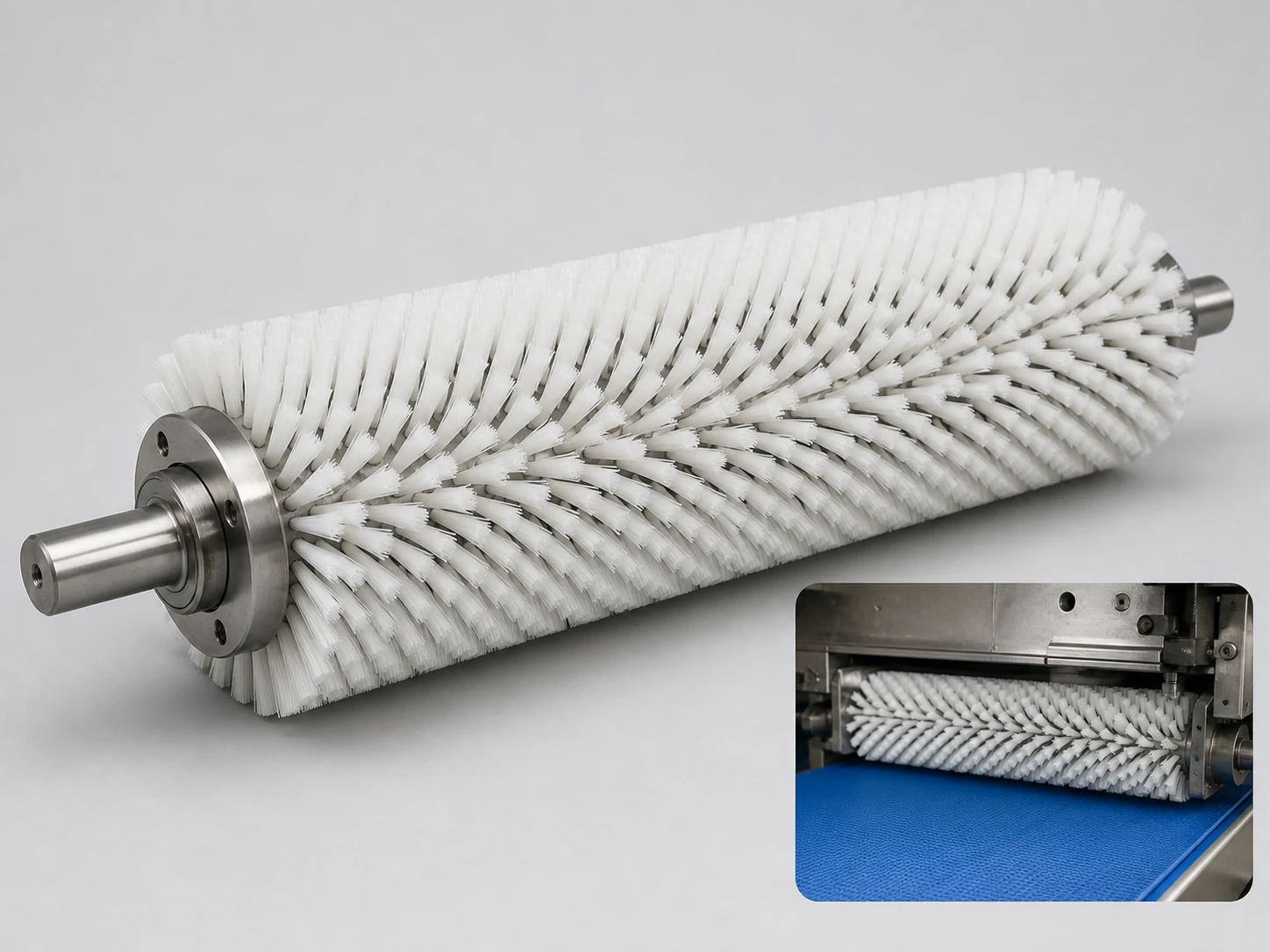
Large-format brush
100 pcs
Minimum order
Built one at a time on a core or channel: full-width rollers, sweeper brooms and long strip.
Production lead time, once the specification is confirmed
- Up to 100 pcsWithin 20 days
- 101–1,000 pcsWithin 30 days
- Over 1,000 pcsConfirmed with your quotation
Peak season can extend these times; the shipping date is confirmed in writing with your quotation. Sampling and shipping are quoted separately.
A custom cylindrical roller brush that installs in the web path of film converting, coating, printing, and laminating lines to lift dust, lint, fines, and static-attracted particles from moving plastic and coated web surfaces. Working length, core, shaft interface, filament material, and winding pattern are built to the line drawing so the roller drops into the exact cleaning position without modifying the machine.
What can this brush do for you?
Spans the full web width without missed strips
The filament face runs continuously across the working width, so there are no untreated lanes along the film. Close-wound, pitch-wound, or helical strip construction can be selected to match the particle load, and the roller works with the line’s vacuum or extraction hood to carry loosened material away from the web instead of redepositing it downstream.
Takes off particles that cling electrostatically
Static-attracted dust is one of the most common contamination problems on plastic film. When the project calls for it, conductive or static-dissipative filament is used and the core provides a grounding path, so charge can drain from the contact zone and particles release instead of snapping back onto the film.
Cleans without damaging sensitive film surfaces
Fine nylon filament, natural hair, or a selected blend makes soft, gentle tip contact with the moving web. Filament diameter, trim length, and engagement are set to remove dry particulate without haze, micro-scratching, or coating transfer marks on optical, metallized, or coated substrates.
Fits the existing machine geometry
Core diameter, end journals, keyways, flanges, and bearing seats are machined to the customer’s drawing. The brush becomes a direct replacement or add-on cleaning element, not a machine modification project.
Keeps loose particulate away from critical process steps
Because the roller is positioned ahead of corona treaters, coating heads, print decks, lamination nips, or slitting stations, contamination is removed before it can become a pinhole, print defect, lamination bubble, or wound-in roll defect.
What is a Brush Roller Film?
A Brush Roller Film is a rotating industrial brush cylinder mounted across a moving film or web. It contacts the web surface with a continuous filament face and mechanically sweeps away loose, dry particulate such as dust, lint, fiber fines, and static-attracted particles. The cleaning action is dry: the brush lifts and dislodges particles at the contact line, and the particles are then carried into an extraction stream or fall-away zone.
The roller is built on an aluminum or steel core. Filament is either wound directly onto the core as a close or pitch pattern, or assembled as a helical strip-roller fill. The filament tips do the work; the core, journals, and balance keep the face stable across the full web width at line speed. Unlike a stationary blade, wipe, or web cleaner bar, the rotating brush continuously renews its contact surface and does not pack debris against the film.
Contact engagement, brush surface speed relative to web speed, and filament stiffness are set from the actual process. There is no single insertion depth that works for every film, because the correct setting depends on the substrate, line speed, static condition, particle type, and the cleanliness requirement of the next process.
Technical Specifications
| Parameter | Value / Options |
|---|---|
| Working length | 500–5000 mm, made to line width plus edge allowance |
| Brush OD | 80–400 mm, selected from machine space and line speed |
| Core OD | 30–150 mm, based on journal size and deflection limit |
| Trim length | 10–60 mm; shorter trim gives firmer contact, longer trim is more flexible |
| Filament material | Nylon PA6/PA6.6, carbon-loaded conductive nylon, static-dissipative fiber, or natural hair |
| Filament diameter | 0.05–0.30 mm typical for fine film cleaning; other diameters available |
| Fill pattern | Close wound, pitch wound, or helical strip |
| Core material | Aluminum alloy or steel, selected for stiffness and rotating mass |
| Shaft / journal | Customer-specified diameter, keyway, flange, taper, or bearing seat |
| Operating environment | Dry or low-moisture process; material grade matched to temperature and solvent exposure |
| Rotation balance | Matched to the required line speed for stable full-width contact |
| Brush type | Custom Roller and Conveyor Brushes |
| How it is driven | Machine-driven, mounted in the equipment |
| Cleaning target | flexible packaging film line, optical and display film, and printing and label converting cleaning |
| Surface or part | webs, roller, substrates, coated webs, plastic, web paths, aluminum, and edges |
| Residue or debris | particles, dust, lint, fines, static-attracted particles, hair, adhesive, and pitch |
| Mounting / connection | Matched to the required line speed for stable full-width contact |
Working length, brush OD, core OD, and shaft details are taken from the machine drawing. Contact engagement is set from the process and the film’s response, not from a fixed insertion depth.
Where does this brush work best?
- Flexible packaging film lines — BOPP, PET, LDPE/LLDPE webs after unwinding and before corona treatment, coating, or lamination, where airborne dust, slitter fines, and roll-edge lint settle on the surface.
- Optical and display film — PET, PC, PMMA, and coated substrates ahead of hard coating or lamination, where micro-scratches and particle defects directly affect yield. Fine nylon, natural hair, or conductive fill is used for controlled contact.
- Printing and label converting — in-line ahead of corona treaters, print decks, or overprint varnish stations, where dust and paper/liner lint create print voids and plate contamination.
- Slitting, rewinding, and converting — after shear or razor slitting where edge lint and fines become airborne and redeposit on the web before windup.
- Technical film and tape production — battery separator film, capacitor film, medical film, and optical adhesive tape lines where particle counts correlate directly with downstream rejection and customer complaints.
How do I choose the right one?
Selection for this product is a process-fit exercise more than a catalog choice. Most dimensions come from the machine drawing and the film properties, not from a standard size list.
Start from the machine drawing
Collect the available mounting space, working width, existing shaft or bearing interface, and drive method. Brush OD and core OD must leave enough room for filament wrap and extraction airflow while keeping the roll stable across the full span.
Match the filament to the film and the contamination
Fine nylon is a good starting point for general packaging film and dry dust. Static-attracted material calls for conductive or static-dissipative filament with a grounded core path. Scratch-sensitive or optical-grade film may need natural hair or a softer filament blend. A thicker filament or shorter trim applies firmer contact but increases the risk of marking on thin or coated webs.
Match the winding pattern to particle size and air movement
Close winding gives the densest contact for fine dust. A pitch-wound face creates lighter, more open contact. Helical strip construction can be the better choice when larger loose debris must be moved along the roller face and into a collection channel or extraction position.
Set engagement from the process, not a default value
Run a trial with a controlled sample and check the outgoing web for particle removal and surface change. Increase engagement until the target clean result is achieved, but stop before the film shows haze, the coating marks, or the filament tips take a permanent set. Particle count testing or tape-lift inspection should drive the final setting.
Check core stiffness and balance at full line speed
A long working face with a small core can deflect in the middle and produce uneven contact. Confirm the core diameter, material, and balance level against the maximum line speed before release for production.
| Condition | Suggested configuration |
|---|---|
| Fine dust on general packaging film | Close-wound fine nylon, 0.05–0.20 mm filament, kiss contact |
| Static-attracted particles | Carbon-loaded conductive filament, grounded core path |
| Scratch-sensitive optical film | Natural hair or fine nylon, lower fill density, controlled surface speed differential |
| Larger loose debris | Helical strip fill, wider pitch, larger OD, extraction positioned at the discharge side |
| High-speed, wide-web line | Short trim 10–25 mm, steel core, dynamic balance matched to line speed |
When the contamination is wet, oily, silicone-based, adhesive, or sub-micron embedded, a dry brush cannot be the only cleaning step. Use the brush ahead of an adhesive-roll contact cleaner, solvent wash, ultrasonic cleaning, or plasma/corona treatment as the process requires.
Can I customize this brush?
Nearly every dimension and material can be adjusted. Send the machine drawing or line layout along with film type, thickness, line speed, current particle problem, static measurements, and any target cleanliness specification. A sample of the film and a photo of the mounting position help the design move faster.
- Working geometry — face width, brush OD, core OD, trim length, end journals, flanges, keyways, and quick-change adapters.
- Filament system — material, diameter, density, winding pattern, dual-zone fill, and natural hair or conductive blends.
- Core and balance — aluminum or steel body, grounding path, dynamic balance level, and surface treatment.
- Static control interface — grounded conductive filament construction and exposed core paths for connection to the machine grounding.
- Marking and packaging — roll labels, individual protective wrap, bulk replacement packaging, and installation instructions.
If your project requires material declarations, incoming inspection criteria, or third-party testing to support validation, include those requirements with the RFQ and we will confirm how they can be supported.
How do you confirm a brush roller film has actually cleaned the surface?
How do I know whether the brush engagement is too deep?
Run a short inspection sample and check both film and filament. If the film develops haze, micro-scratches, or coating transfer marks, or the filament tips take a permanent set, reduce engagement until particles are still removed without surface change. Particle count or tape-lift inspection on the outgoing web is the final check.
Does the roller need its own drive?
Most effective cleaning uses driven rotation with the brush surface speed set relative to line speed through a pulley, coupling, or line drive connection. An idler brush can work on lower-speed runs, but speed control, particle release, and filament contact become harder to hold consistent.
How should the brush be cleaned between runs?
Rotate the brush slowly and vacuum across the face, or use clean, dry, low-pressure air directed from the core outward. Do not scrub the filament face against a hard surface. Store the roller supported by the journals so the filaments do not rest on the floor or a flat surface.
Can one brush clean both sides of the film?
No. One roller contacts one face at a time. Two-sided cleaning requires two roller positions with proper supporting geometry between them. Specify the available machine space before adding a second station.
Will brushing make static worse?
Any rubbing contact can generate static charge. For static-sensitive film, use conductive or static-dissipative filament and verify that the core and shaft have a grounding path. This is one reason the film type and existing static readings should be supplied before the roller is built.
What should be checked when the brush stops removing particles?
Check filament tips for breakage, matting, or contaminant build-up; check core grounding continuity if conductive fill is used; check engagement and speed differential; and verify that the web path or backing roll has not shifted. If the filament density has visibly dropped or the face no longer springs back after contact, plan replacement.
Guides that go deeper on this
Abrasive Nylon Grit and Filament Selection
Read this guideGuideBrush Roller Conveyor Mistakes with Dry Dust
Read this guideGuideBrush Speed, Engagement, and Heat
Read this guideGuideConveyor Belt Cleaning Brush Design
Read this guideGuideFloor Scrubber Brush Selection: Disc Brush vs Roller Brush
Read this guideCustom Manufacturing RFQ
Describe Your Application
For a custom quote, we need the key dimensions, surface or part, residue, material preference, quantity, and reference image or drawing.
Drawing or photo optional — it speeds things up, it does not gate the enquiry.
Custom Brush RFQ
Send Your Brush Project
Upload a drawing, product photo, or sample photo and provide the core dimensions and cleaning conditions.
“We need a brush to remove wet residue from a stainless steel conveyor, about 800mm wide. The current brush wears quickly. We can send photos.”
“We sell drinkware and need a cleaning brush to include with the product. Quantity around 5,000 pieces.”