
Custom Cleaning Brush
Brush Roller Lithium Battery
Custom brush roller for lithium battery electrode lines. Soft nylon filaments remove loose coating particles from cathode/anode foil without scratching.
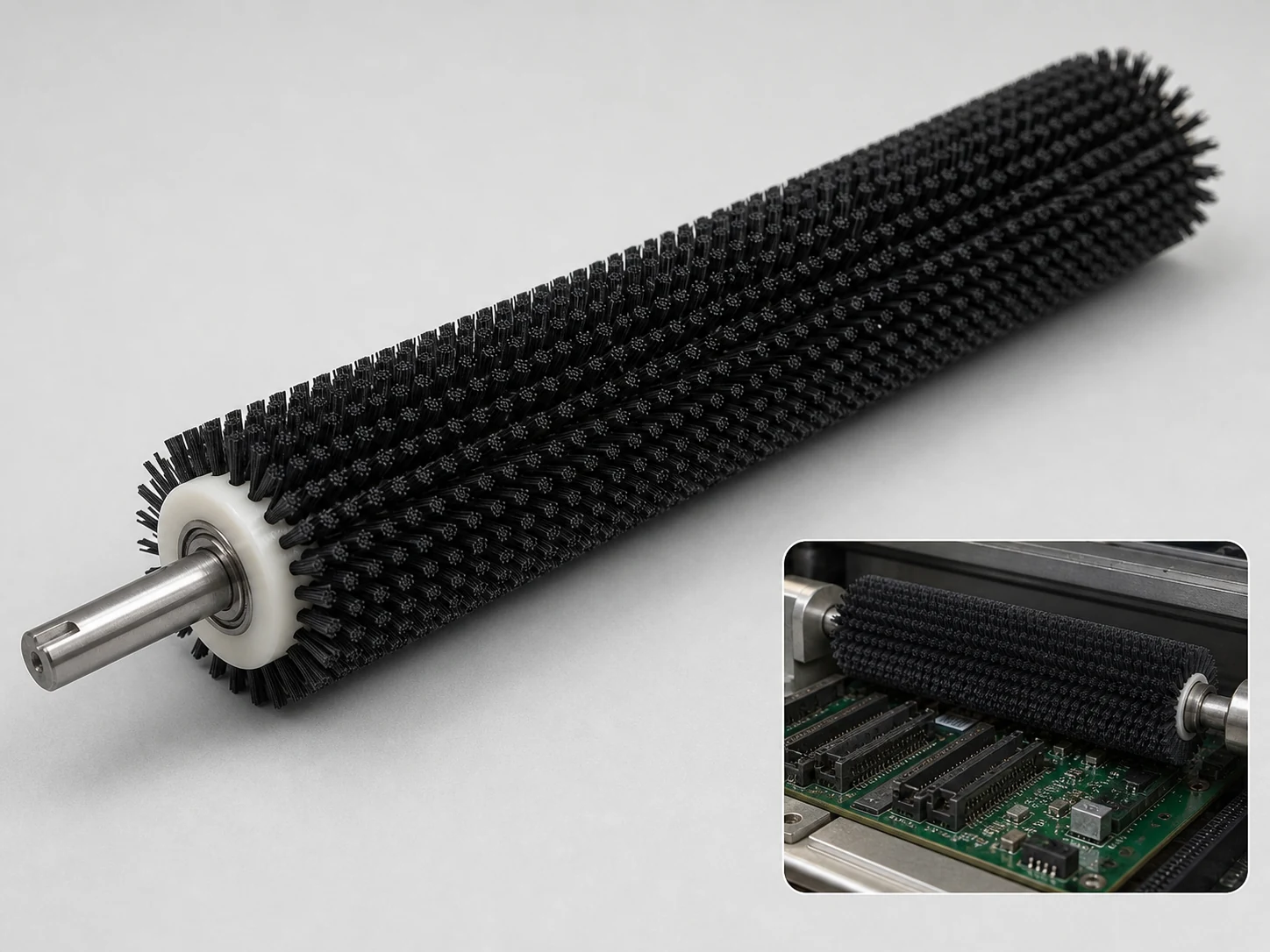
Large-format brush
100 pcs
Minimum order
Built one at a time on a core or channel: full-width rollers, sweeper brooms and long strip.
Production lead time, once the specification is confirmed
- Up to 100 pcsWithin 20 days
- 101–1,000 pcsWithin 30 days
- Over 1,000 pcsConfirmed with your quotation
Peak season can extend these times; the shipping date is confirmed in writing with your quotation. Sampling and shipping are quoted separately.
A rotary cleaning roller engineered for lithium battery electrode production lines, built to remove loose coating particles, electrode powder, and process dust from moving cathode and anode foil without disturbing the active coating. Soft non-metallic filaments and configurable static-dissipative construction keep the contact electrode-safe and particle-free.
What can this brush do for you?
Sweeps loose particles off coated foil, not into it
Freshly coated electrode web carries loose coating fines, edge flakes, and airborne dust that become defects if pressed into the active layer downstream. The nylon filament tips contact the surface at low load and lift these particles away from the coating, leaving the foil clean before calendering, slitting, or stacking. Because the contact is flexible and uniform, the brush removes debris rather than grinding it into the electrode.
Full-width contact with no dead zones
The roller form maintains continuous filament contact across the entire coated web width, including edges where loose particles tend to accumulate. Spiral or herringbone filament patterns prevent streaking that straight rows can create, so every point on the electrode sees the same cleaning action as the web passes under the roller.
Metal-free brushing for active electrode surfaces
Conventional metal wire brushes risk scratching the coating, smearing metal fines, or creating conductive bridges across cathode/anode layers. This brush roller uses nylon PA or antistatic/conductive polymer filaments only. There is no metal-to-electrode contact during normal operation, which protects both coating integrity and cell safety.
Static control where the line needs it
Electrode webs generate and hold static charge that attracts dust and causes particle agglomeration. For dry rooms and voltage-sensitive lines, the brush can be built with conductive or static-dissipative filaments and a grounded shaft. Charge drains through the brush holder to the machine frame instead of building up on the foil or the brush itself.
Made to drop into your existing line
Working length, roller OD, shaft diameter, journal details, and drive coupling are configured to match the existing roller position in the machine. No frame modifications are required. Replacement rollers match the original interface, so maintenance swaps are straightforward.
What is a Brush Roller Lithium Battery?
A Brush Roller Lithium Battery is a rotary cleaning component installed on lithium battery electrode production equipment to keep moving electrode web free of loose particles. It is typically mounted at a fixed position on the line, often after coating and drying, before or after calendering, or at the feed section of slitting and stacking machines. The roller rotates either with the web or against it, and its filament tips gently contact the coated foil surface, dislodging particles that have not bonded to the coating.
Unlike a scrub brush, the roller is not designed to remove adhered or baked residues. It works on loose contamination: electrode powder, metal fines from cutting, coating flakes, and general process dust. The removed particles are carried by the brush rotation and typically collected by a vacuum hood, air knife, or static bar positioned nearby. This makes the brush part of a contamination-control sequence rather than a standalone cleaning process.
Operating considerations include maintaining low contact force so the core never touches the electrode, choosing the correct filament material and density for the coating sensitivity, and ensuring that any conductive construction is properly grounded. Brush rollers used on electrode web are almost always non-metallic at the contact face; steel or brass fills are reserved for non-active machine surfaces.
Technical Specifications
| Parameter | Specification / Options |
|---|---|
| Brush form | Cylindrical roller for electrode/web dust removal and line cleaning |
| Working length | Project-specific; commonly 200–1500 mm to match coated foil width |
| Roller outside diameter | 60–150 mm including filament trim, selected for access and inertia |
| Core / shaft material | Aluminum, stainless steel, or composite, with insulating or conductive options per grounding needs |
| Journal / shaft ends | Machined to machine journals, keyway, or drive coupling as specified |
| Fill material | Nylon PA 6 or PA 6.6; optional conductive/antistatic nylon, PBT, or carbon-filled polymer for static control |
| Filament diameter | 0.10–0.30 mm, selected for coating sensitivity and particle removal force |
| Filament trim length | 15–40 mm, adjusted to maintain low contact load and adequate reach |
| Fill pattern | Straight, spiral, or herringbone; density configured to debris load |
| Surface resistance (antistatic/conductive) | 10^6–10^9 Ω when specified; grounding through shaft and holder |
| Contact condition | Low-load uniform filament contact; rigid core kept off electrode surface |
| Operating environment | Dry, low-humidity production area; temperature and chemical exposure reviewed per material |
| Brush type | Custom Roller and Conveyor Brushes |
| How it is driven | Machine-driven, mounted in the equipment |
| Cleaning target | post-coating electrode web, pre-slitting and pre-winding station, and dry room electrode cleaning |
| Surface or part | roller, webs, edges, sheets, metal, bars, rolls, and frames |
| Residue or debris | particles, dust, loose particles, powder, noise, fines, and loose contamination |
| Mounting / connection | Shaft-Mounted / Flange |
All dimensions and materials are configurable to the specific production line. Contact our engineering team with your roller position drawing and process details.
Where does this brush work best?
- Post-coating electrode web cleaning: After slot-die coating and drying, loose NMC, LFP, LCO, graphite, or silicon-based coating particles remain on the foil surface. The brush roller removes them before calendering or slitting.
- Pre-slitting and pre-winding stations: Clean webs reduce edge debris that can enter wound rolls and later contaminate cell assembly.
- Dry room electrode handling: In anode/cathode sheet preparation for stacking or winding, the roller keeps sheet surfaces free of dust that could cause internal short circuits after cell assembly.
- Calendering feed or exit sections: Where roller pressure can emboss loose particles into the coating, brushing before entry prevents that.
- Electrode inspection stations: Clean surfaces make optical or vision inspection more reliable by eliminating particle noise.
How do I choose the right one?
Match the roller to the web and machine interface
Measure the coated foil width, the available roller position, journal diameter and length, and the drive method (gear, timing pulley, friction). The brush roller must fit the existing roller slot and rotate at the correct speed relationship to the web. A roller that is too long touches frames; too short leaves uncleaned edges.
Select filament stiffness for coating sensitivity
Nylon PA is the standard for electrode web because it is soft enough to avoid scratching thin coatings yet firm enough to lift loose particles. For very soft or thick coatings, use a finer filament diameter and longer trim to reduce contact pressure. For stubborn but still loose debris, a slightly stiffer nylon or PBT can be used. Avoid metal wire on any active electrode surface.
Decide whether static control is required
If the line already has static bars, ionizers, or if the electrode material is highly static-prone, specify conductive or static-dissipative filaments and a grounded core/holder. Without grounding, the brush itself can generate static and re-attract particles. For lines with no static issue, standard nylon is sufficient and lower cost.
Choose the fill pattern and density
Straight rows are adequate for light dust; spiral or herringbone patterns give more uniform coverage on high-speed webs. Lower density allows particles to fall away rather than being trapped; higher density provides more contact points for heavily loaded webs. Work with our engineers to set the right balance.
When this brush roller is not the right tool
If the residue is strongly adhered to the coating, baked, or chemically bonded, brushing alone will not remove it and may damage the coating. Use a non-contact method such as air knife or vacuum, or a cleaning process before coating. If the surface is a metal machine part rather than coated foil, a wire brush roller can be used, but keep it off electrode surfaces. If the line operates in a wet or solvent-heavy environment, confirm material compatibility before selecting nylon.
Can I customize this brush?
Yes. Brush Roller Lithium Battery is built to the line’s measurements and process requirements, not sold as a fixed stock item. Provide the web width, roller position drawing or photo, journal dimensions, drive details, line speed, coating type and thickness, residue description, static control needs, and any environmental constraints.
We can adjust the following variables:
- Working length and roller OD
- Core/shaft material (aluminum, stainless, composite) and weight/balance
- Journal ends: bearing seats, keyways, set-screw flats, drive couplings
- Filament material: nylon PA6/PA66, PBT, conductive/antistatic polymer, carbon-filled nylon
- Filament diameter and trim length
- Fill pattern: straight, spiral, herringbone, and density
- Color and optional marking/identification (engraved or label)
- Packaging: individual protective sleeve or bulk crate for shipment
- Project support: material data sheets, inspection reports, third-party testing coordination if needed
How long does a brush roller lithium battery last before it needs replacing?
How do I know when to replace the brush roller?
Inspect the filament tips regularly during maintenance windows. Replace when filament length is worn down more than 30%, when you see flattened or permanently bent filaments that no longer recover, or when the brush stops removing particles effectively despite correct positioning. Also check for core runout, shaft damage, or loss of balance that causes vibration.
Can the brush roller damage the electrode coating?
Only if contact load is too high, the filament is too stiff, or a metal wire brush is mistakenly used. Our design keeps the rigid core away from the foil and uses soft nylon or polymer filaments with controlled compression. We recommend verifying contact pressure on a trial section before full production.
Does the brush remove all particles from the electrode?
No. It removes loose surface particles that are not adhered to the coating. Strongly bonded flakes, embedded metal particles, or residues from previous process steps may require other cleaning methods or process changes. The brush roller is one part of a particle-control strategy that should include cleanroom practices, static elimination, and periodic line cleaning.
Is this brush suitable for wet electrode processing?
The standard nylon PA construction is intended for dry environments. If the line involves solvents, high humidity, or direct liquid contact, the filament and core materials must be reviewed. Nylon absorbs moisture and can soften or change dimensions. Specify your process conditions so we can recommend compatible materials.
How does the conductive option prevent static buildup?
Conductive or static-dissipative filaments provide a controlled resistance path from the web contact point through the filament to the brush core and shaft. When the shaft is grounded to the machine frame, electrostatic charge drains away instead of accumulating on the foil. The target surface resistance range of 10^6–10^9 Ω allows charge dissipation without creating a direct short to the electrode.
Guides that go deeper on this
Abrasive Nylon Grit and Filament Selection
Read this guideGuideBrush Roller Conveyor Mistakes with Dry Dust
Read this guideGuideBrush Speed, Engagement, and Heat
Read this guideGuideConveyor Belt Cleaning Brush Design
Read this guideGuideFloor Scrubber Brush Selection: Disc Brush vs Roller Brush
Read this guideCustom Manufacturing RFQ
Describe Your Application
For an accurate quotation, please provide the main dimensions, material preference, working surface, residue, quantity, and a drawing or photo.
Drawing or photo optional — it speeds things up, it does not gate the enquiry.
Custom Brush RFQ
Send Your Brush Project
Upload a drawing, product photo, or sample photo and provide the core dimensions and cleaning conditions.
“We need a brush to remove wet residue from a stainless steel conveyor, about 800mm wide. The current brush wears quickly. We can send photos.”
“We sell drinkware and need a cleaning brush to include with the product. Quantity around 5,000 pieces.”