
Custom Cleaning Brush
Dust Removal Printing Brush
Custom dust removal printing brush with nylon PA or conductive fiber. Hand, strip, and roller forms for paper dust and lint removal in printing presses.
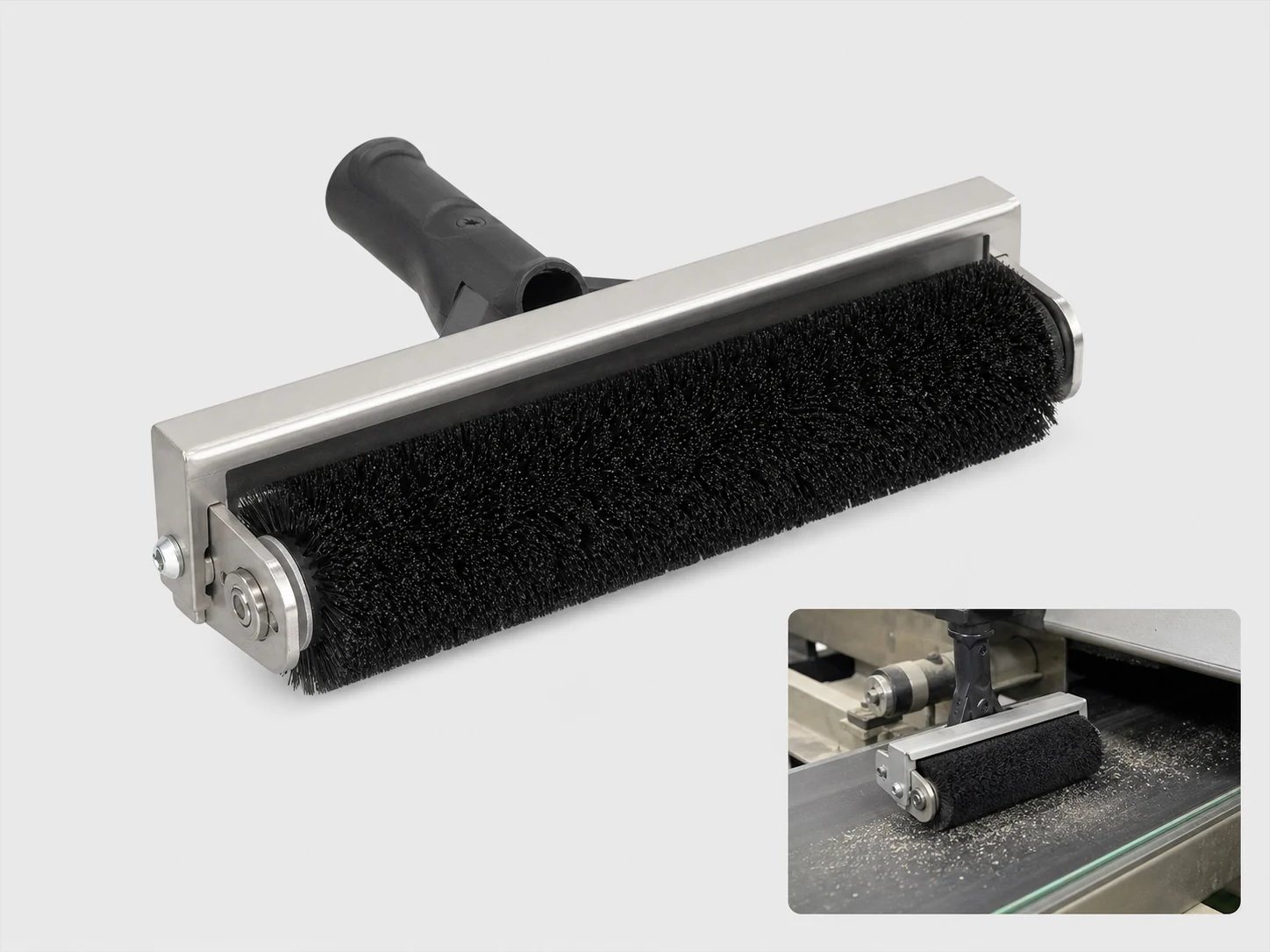
Large-format brush
100 pcs
Minimum order
Built one at a time on a core or channel: full-width rollers, sweeper brooms and long strip.
Production lead time, once the specification is confirmed
- Up to 100 pcsWithin 20 days
- 101–1,000 pcsWithin 30 days
- Over 1,000 pcsConfirmed with your quotation
Peak season can extend these times; the shipping date is confirmed in writing with your quotation. Sampling and shipping are quoted separately.
A dust removal printing brush is a low-shed, precision-contact cleaning tool that lifts paper dust, lint, and loose particles from printing substrates and press surfaces before they reach the image area. Available in hand, strip, and roller configurations with nylon PA or static-dissipative conductive fiber, it can be tailored to the exact mounting point and cleaning zone of your printing operation.
What can this brush do for you?
Stops dust-related printing defects at the source
Paper fibers, coating debris, and anti-offset powder that settle on the feed path or image carriers cause hickeys, voids, blanket piling, and premature plate wear. This brush sweeps those particles away before ink transfer, reducing rework and extending consumable life. The filament tips engage and lift debris rather than just pushing it along the surface.
Handles static-attracted fines that ordinary brushes miss
On film, coated stocks, and dry pressroom air, dust can cling to surfaces through static charge. When built with conductive carbon-filled nylon filaments and a grounded metal backing, the brush provides a discharge path so particles release into the airflow or collection system instead of re-sticking after each stroke.
Light-touch cleaning that protects sensitive materials
Trim length and filament flex are set so only the bristle tips contact the web, plate, or blanket. This keeps contact pressure low enough to avoid scratching coated paper, film, photopolymer plates, or rubber blankets while still removing loose particles effectively.
Configured for the actual mounting point
Unlike a generic dust brush, this product is built as a hand brush for manual plate and blanket cleaning, or as a strip, roller, or plate brush for continuous cleaning on a moving web or rotating cylinder. The geometry, width, and mounting hardware are matched to where dust accumulates in your specific press or converting line.
Low particle generation from the brush itself
Wear-resistant nylon PA filaments and secure staple-set anchoring minimize bristle shedding. A brush that drops its own fibers into the print area defeats its purpose, so material and construction are selected to keep the brush from becoming a secondary contamination source.
What is a Dust Removal Printing Brush?
A dust removal printing brush is a cleaning tool engineered specifically for printing and converting environments. It removes particulate contamination—paper dust, lint, coating fragments, spray powder, and static-attracted fines—from moving sheets, webs, or machine surfaces. It can be hand-held for manual wiping of plates, blankets, and feed tables, or machine-mounted as a strip or roller brush that continuously cleans the substrate path before, between, or after print units.
The working principle is controlled filament-tip contact. The brush does not scrub aggressively; instead, the filament ends make light contact with the surface and lift or dislodge particles as the surface or brush moves. In static-sensitive applications, conductive filament and a grounded holder allow the brush to neutralize charge so particles do not reattach. The brush is part of a broader contamination-control approach and works best when paired with vacuum extraction, air knives, or web cleaning systems as the process requires.
This is not a heavy-duty scrubbing brush for dried ink, adhesive residues, or caked-on contaminants. It is designed for dry particulate removal in a clean printing environment where surface preservation and consistent dust control matter more than aggressive mechanical action.
Technical Specifications
The dimensions, filament, and mounting can be adjusted to your press or converting line. The following table lists typical configuration ranges and the parameters we need to build the brush correctly.
| Parameter | Value / Options |
|---|---|
| Brush form | Hand, strip, roller, plate, disc, or tube based on cleaning zone |
| Working width / face length | Custom to web width or surface dimension, e.g., 50–2000 mm |
| Overall length (hand models) | 300–600 mm |
| Handle length (hand models) | 100–200 mm |
| Trim length | 20–60 mm, selected for contact pressure and surface sensitivity |
| Filament material | Nylon PA6 or PA66; conductive carbon-filled nylon option |
| Filament diameter | 0.05–1.2 mm, typical dust-removal range 0.10–0.30 mm |
| Filament density | Custom, based on particle size and risk of marking |
| Backing / holder / core | Aluminum, stainless steel, plated steel, or engineered plastic |
| Mounting interface | Brackets, clamps, shafts, flanges, or custom adapter plates |
| Static control option | Conductive filament grounded through metal backing and holder |
| Operating temperature | Up to 90°C continuous for nylon PA; higher on request |
| Chemical exposure | Resistant to common pressroom solvents and alkaline washes |
| Brush type | Custom Roller and Conveyor Brushes |
| How it is driven | Supplied hand-guided or machine-mounted |
| Cleaning target | sheet-fed offset press, coating and laminating line, and paper converting and finishing cleaning |
| Surface or part | roller, webs, substrates, plates, cylinders, sheets, web paths, and nozzles |
| Residue or debris | dust, particles, lint, powder, loose particles, fiber, fines, and adhesive residue |
| Mounting / connection | Brackets, clamps, shafts, flanges, or custom adapter plates |
Filament diameter, trim length, and density are the primary levers for controlling cleaning aggressiveness and marking risk. We will help you select these based on your substrate and dust load.
Where does this brush work best?
- Sheet-fed offset presses: mounted on feed tables, transfer sections, and delivery paths to remove paper dust and spray powder before they reach blankets and plates.
- Web offset and flexographic presses: installed as full-width strip or roller brushes on the web path before print units, after dryers, or at chill rolls to clean the moving web continuously.
- Digital and inkjet presses: pre-print cleaning of paper, film, and label stock to prevent dust-related nozzle clogging, banding, or image voids.
- Coating and laminating lines: substrate cleaning before coating application to avoid pinhole defects and coating contamination.
- Paper converting and finishing: removal of slitting dust, trim particles, and punching debris from cut sheets or rewind lines.
- Plate and blanket maintenance: hand brush for dry dusting of printing plates, blankets, and impression cylinders during makeready and shift changes.
How do I choose the right one?
Start with the cleaning location and motion. Is the surface stationary or moving? For manual wiping of plates, blankets, and small areas, a hand brush is appropriate. For a continuous moving web or a rotating cylinder, a strip or roller brush mounted across the full width will do the job without operator intervention.
Then match the filament to the particles and surface. Fine nylon PA filaments (0.10–0.20 mm) provide gentle, high-density contact for paper dust and lint on coated or delicate substrates. Slightly coarser filaments (0.20–0.30 mm) handle heavier debris or allow longer trim for more flex. If static charge is causing particles to reattach, specify conductive carbon-filled nylon and a grounded metal backing.
Control contact with trim length and density. Longer trim means more filament flex and lower contact force, which is safer for sensitive surfaces. Shorter trim gives firmer contact and more effective particle dislodgement on robust surfaces. Higher density catches finer particles but may increase marking risk; lower density reduces friction and heat on fast-moving webs.
Verify mounting and clearance. Measure the available space above or beside the web or cylinder, the bracket mounting pattern, and any rotating shaft dimensions. The brush must fit without interfering with adjacent components or creating pinch points.
Consider the operating environment. Dryer heat, solvent vapors, washdown chemicals, and continuous run hours all affect filament and backing selection. Nylon PA covers most pressroom conditions, but specify exceptional temperatures or aggressive chemistry so we can adjust the material package.
When another solution may be better: If the residue is liquid, sticky, or oily, a brush alone will not remove it—use solvent cleaning or vacuum extraction first. For extremely sensitive surfaces where even filament-tip contact is unacceptable, consider an air knife, ionizing bar, or ultrasonic cleaning. If the dust load is very heavy or abrasive, a vacuum-assisted brush or harder filament material like PBT may be more suitable.
Can I customize this brush?
Every printing line has different web widths, mounting spaces, and contamination profiles. We build these brushes to order around the following variables:
- Brush form and dimensions: strip length, roller diameter and face width, hand brush size, plate or disc diameter, tube ID/OD.
- Filament configuration: material (nylon PA6/PA66, conductive nylon, PBT), diameter, trim length, density, and staple-set pattern.
- Backing, holder, or core: aluminum, stainless steel, plated steel, or plastic; channel profile, mounting holes, end caps, and grounding terminals.
- Mounting hardware: brackets, clamps, flanges, shaft adapters, quick-release mechanisms, and static grounding wires.
- Color and marking: custom colors, laser marking, pad printing, label inserts, or part numbers for traceability.
- Packaging: bulk cartons, individual polybags, VCI paper for corrosion protection, or project-specific packing.
To define the right configuration, provide the following when you submit your inquiry: target substrate (paper grade, film type, coating), web or surface width, dust type and approximate particle size, line speed or cycle rate, static charge level if known, available mounting space, and whether the brush is for manual or machine-mounted use. If your project requires material declarations, inspection reports, or third-party testing, we can assist with those requirements during the customization process.
When is a dust removal printing brush worn out rather than just dirty?
How can I tell if the brush is making proper contact with the web?
After a short run, inspect the web surface. If you see a polished track or flattened filaments, the contact pressure is too high—increase trim length, reduce density, or adjust mounting. If dust remains visible in the cleaned area, the brush may not be engaging fully—check filament length, mounting height, and web tension.
Does the conductive fiber option eliminate static charge?
It dissipates static by providing a path to ground, but only if the backing and mounting hardware are properly grounded to the press frame. Verify that the ground connection has low resistance. The brush reduces static attraction but may not completely eliminate charge in severe cases; pairing with an ionizing bar can help.
Can I use the same brush for both paper and film?
Often yes, if the filament diameter and trim are chosen for the more sensitive material. Film surfaces scratch more easily, so specify finer filaments and a longer trim. We recommend testing on a sample or running a trial to confirm no marking before full production use.
How often should the brush be cleaned or replaced?
Clean the brush periodically with low-pressure air or a vacuum to remove accumulated dust from between filaments. Replace when filament tips are worn short, bent, or flattened; when the brush no longer maintains contact; or when shedding becomes visible. Establish a replacement interval based on run hours and dust load for predictable maintenance planning.
What should I check before mounting the brush?
Inspect the mounting surface for burrs, sharp edges, or protrusions that could cut filaments. Confirm that the grounding wire is connected if the brush is conductive. Verify clearance along the entire length of travel and check that the brush does not contact other machine parts during operation.
Can this brush remove dust from printing plates without scratching them?
Yes, with fine nylon filament, soft trim, and light hand pressure. Use a dedicated plate brush that has never been used on abrasive surfaces, and clean it before plate contact. Do not share brushes between plate cleaning and general machinery cleaning, as embedded abrasive particles can transfer and scratch the plate.
Guides that go deeper on this
Abrasive Nylon Grit and Filament Selection
Read this guideGuideBrush Roller Conveyor Mistakes with Dry Dust
Read this guideGuideBrush Speed, Engagement, and Heat
Read this guideGuideConveyor Belt Cleaning Brush Design
Read this guideGuideConveyor Brush Pressure: Residue Removal Without Belt Damage
Read this guideCustom Manufacturing RFQ
Describe Your Application
Please include the main sizes, application, residue, preferred material, interface, quantity, and any drawing or sample available.
Drawing or photo optional — it speeds things up, it does not gate the enquiry.
Custom Brush RFQ
Send Your Brush Project
Upload a drawing, product photo, or sample photo and provide the core dimensions and cleaning conditions.
“We need a brush to remove wet residue from a stainless steel conveyor, about 800mm wide. The current brush wears quickly. We can send photos.”
“We sell drinkware and need a cleaning brush to include with the product. Quantity around 5,000 pieces.”