
Custom Cleaning Brush
Gallon Bottle Cleaning Brush
Custom gallon bottle cleaning brush for one-gallon jugs, carboys, growlers, and lab bottles.
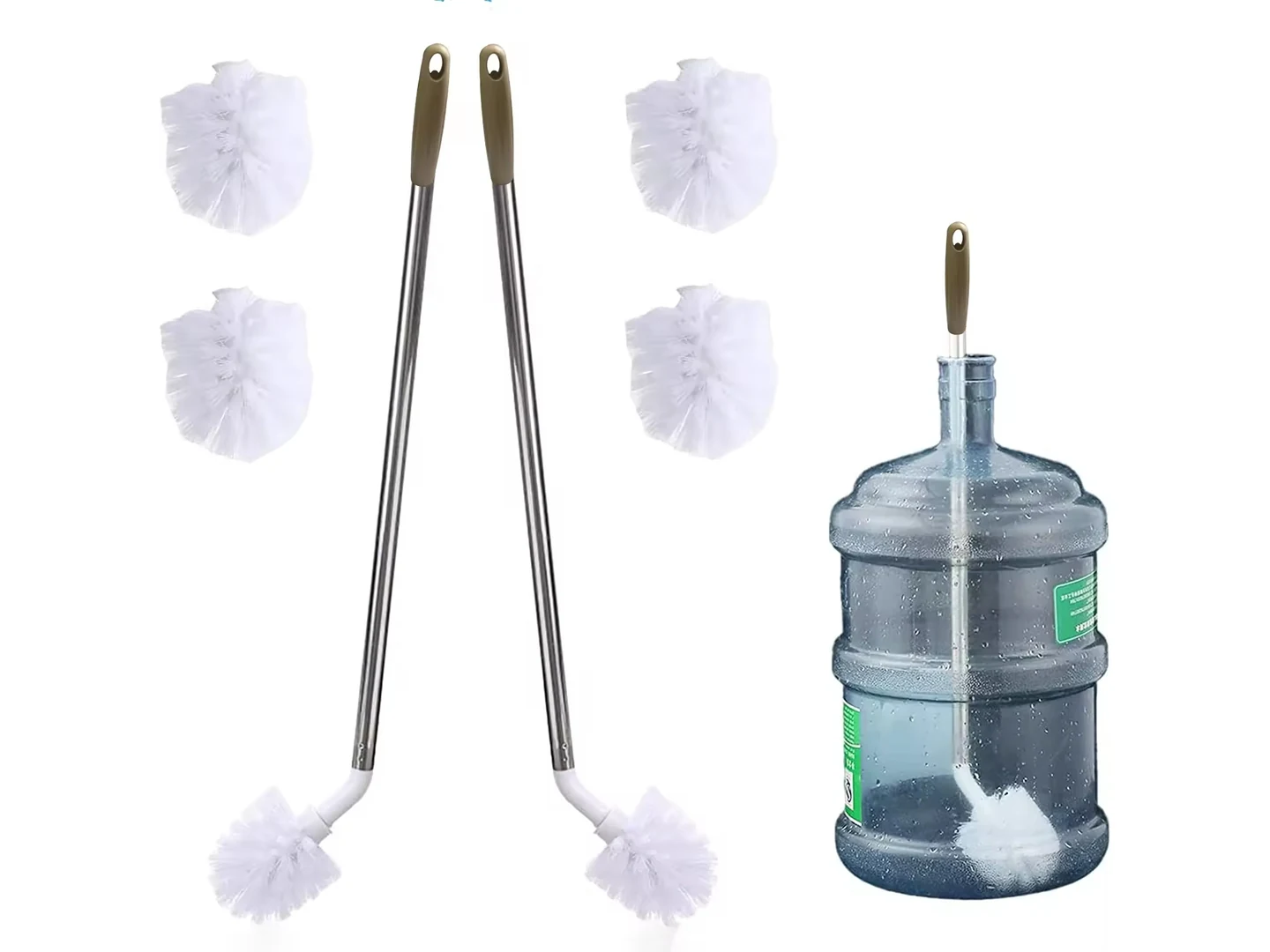
Small brush
500 pcs
Minimum order
Held in one hand: tube, bottle, detail and swab brushes — including long-handled ones with a small head.
Production lead time, once the specification is confirmed
- Up to 500 pcsWithin 7 days
- 501–50,000 pcsWithin 14 days
- Over 50,000 pcsWithin 21 days
Peak season can extend these times; the shipping date is confirmed in writing with your quotation. Sampling and shipping are quoted separately.
The Gallon Bottle Cleaning Brush is a long-handle, narrow-neck cleaning tool built to reach the full interior of one-gallon bottles, water jugs, carboys, growlers, and lab bottles—sidewall, shoulder, and base—through typical narrow openings. It is available with PP, nylon, or PBT tufted heads plus sponge or silicone contact options, with stem and handle matched to the cleaning cycle.
What can this brush do for you?
Long reach keeps your hands out of the bottle
Working head lengths from 120 to 300 mm and overall lengths up to 450 mm put the cleaning contact at the bottom of a one-gallon container while the operator’s hand stays outside the neck. That means the same brush covers the sidewall, shoulder, and base in one stroke instead of using a short bottle brush for the neck and something else for the bottom.
Collar fit and wall contact are not the same dimension
The tufted, tapered, or compressible head is engineered to pass the narrowest part of the neck, then let the filaments recover against the bottle wall. A brush that only fits the opening will leave most of the wall untouched; one that only fits the body will bind at the neck. This brush is sized from both.
Separate contact zones for the shoulder, wall, and base
The forward section follows the sidewall; the head can be rounded or tapered to trail into the shoulder curve; the working end can be tufted, sponge-covered, or molded so the bottom transition gets the same attention as the neck area. Straight cylinder brushes often skip the base; this one is configured so the base is part of the stroke.
Filament hardness follows the residue, not the bottle size
Fine 0.10–0.30 mm filaments take off liquid films, odor deposits, and soft beverage residues. Medium to firm 0.30–0.50 mm nylon or PBT filaments scrub settled yeast, powder residue, and early biofilm. Polypropylene fill is specified when the wash line uses aggressive detergents or sanitizers that would degrade other plastics.
Open tufts drain and rinse between uses
Standard tufted construction lets removed residue and wash solution drain away under rinse water instead of packing inside the brush. For multi-bottle cleaning lines, that reduces the chance of carrying film from one gallon bottle to the next and keeps the tool ready for the next wash cycle.
Operator-safe grip and clean storage
The handle can be straight, looped, or ergonomically shaped with a hanging hole so the damp brush dries off the work surface. Long-handle versions support cleaning at a standing station or over a deep sink without extended wrist bending.
What is a Gallon Bottle Cleaning Brush?
A Gallon Bottle Cleaning Brush is a manual cleaning tool made for the interior of one-gallon / 3.8 L liquid containers with narrow openings. It is used on water dispenser jugs, one-gallon glass carboys and growlers, beverage dispensing bottles, laboratory solvent and reagent bottles, and reusable brewing or juice containers.
During use, the brush is inserted through the neck and worked with push, pull, and rotating strokes. The head should contact the sidewall, follow the shoulder, and finish on the bottom—the three places a plain rinse leaves film and sediment. The head geometry and filament stiffness decide whether the brush wipes a thin film from the wall, scrubs settled residue from the base, or both.
This is not simply a small bottle brush with a longer handle. The stem stiffness, head diameter, tuft collapse, and handle geometry are chosen from the bottle profile and the cleaning task. Standard configurations cover common one-gallon neck and body sizes; highly shaped or narrow-neck containers are dimension-matched before production. The brush is a manual mechanical cleaning step; it pairs with a rinse and sanitizing cycle and is not intended for baked-on scale or high-torque rotary cleaning.
Technical Specifications
The values below are standard project configurations for a gallon bottle cleaning brush. We can adjust each dimension, material, and head form to your bottle and cleaning cycle.
| Parameter | Value / Options |
|---|---|
| Head diameter | 20–70 mm, selected from the bottle body and neck ID; tuft length and density are matched to recovery after neck passage |
| Working head length | 120–300 mm from the forward shoulder to the base tip or tufted end |
| Overall length | 200–450 mm, including handle; selected so the operator controls the stroke without reaching into the bottle |
| Filament diameter | 0.10–0.30 mm for liquid film and fine residue; 0.30–0.50 mm for sediment, yeast, and heavier biofilm |
| Head form | Cylindrical tufted, tapered tufted, rounded tufted-end, sponge-covered, or molded silicone contact |
| Fill materials | Polypropylene (PP), nylon (PA6/PA66), or PBT; trimmed, flagged, or crimped filaments for customer-specific contact |
| Neck fit | Standard configurations for bottle neck IDs from roughly 20–25 mm up to 70 mm; exact entry confirmed from minimum neck opening; smaller necks use tapered or reduced-tuft versions |
| Stem / handle | PP or nylon stem; rigid stainless steel core option for extra reach support; straight, looped, or ergonomic grip handle with hanging feature |
| Operating environment | Ambient wash solutions and rinse water standard; higher temperature or chemical exposure grades specified per project detergent and concentration |
| Brush type | Custom Bottle & Container Brushes |
| How it is driven | Hand-guided |
| Cleaning target | water dispenser and cooler jug, glass and stainless growler and gallon carboy, and laboratory reagent and solvent bottle cleaning |
| Surface or part | sidewalls, shoulders, containers, necks, walls, glass, narrow openings, and profiles |
| Residue or debris | sediment, yeast, oil, beverage residue, odor deposits, powder, syrup, and scale |
| Mounting / connection | Fixed |
The two dimensions to verify first are the minimum neck opening and the usable internal depth. Everything else—tuft stiffness, head form, and handle—follows those two.
Where does this brush work best?
- Water dispenser and cooler jugs. Reusable one-gallon or 4 L PET and polycarbonate water bottles accumulate a clear-to-cloudy wall film and occasional mineral haze that rinsing alone does not remove. The brush reaches the full interior without scratching standard plastic sidewalls.
- Glass and stainless growlers and gallon carboys. Homebrew and craft beverage operations need the shoulder and bottom cleaned after fermentation, serving, or syrup and yeast sediment. A tufted-end head handles the bottom without requiring a separate pad.
- Kombucha, cold-brew, and juice dispensing jugs. Sugary beverage residues, culture buildup, and odor deposits require regular interior agitation; filament options scrub the film while remaining compatible with wash-down detergents.
- Laboratory reagent and solvent bottles. Four-liter narrow-neck bottles reused for solutions or media benefit from defined head geometry and chemical-compatible PP or PBT fill, especially when cross-sample contamination is a concern.
- Food and ingredient gallon containers. Syrups, oils, concentrates, or powders leave odor and film behind after emptying; brush contact goes to the wall and base without leaving fibers behind when the correct filament is chosen.
How do I choose the right one?
Start with the narrowest opening. Measure the minimum internal neck diameter with the cap or threads removed. The head and tufts must enter cleanly, but the filaments should spring out enough to contact the sidewall. If the head is too large, it folds and loses contact; if it is too small, it rubs only a central strip. Give us the minimum opening, not just the average.
Match the head form to the contact problem. A cylindrical tufted head maximizes sidewall contact on straight-wall gallon jugs. A tapered or rounded profile follows the shoulder and bottom curve better. A tufted end or sponge-tipped head gives targeted bottom scrubbing, and a molded silicone head is the choice when the bottle has an internal coating or a polished finish that must be protected from filament contact.
Choose filament stiffness from the residue, not the bottle volume. Light liquid films, oils, and odor compounds come off with finer filaments. Settled yeast, soft sediment, or early biofilm need medium to firm filaments and higher fill density. Heavy mineral scale or baked-on deposits usually require a more aggressive brush type or a chemical pretreatment; a standard gallon bottle cleaning brush is not a scale-removal tool.
Set the reach to your work position. Overall length should allow a full push stroke to the bottom with the operator still controlling the brush near the neck. Tall dispensing equipment may need a longer handle; table-height washing stations benefit from shorter handled configurations and a hanging loop for storage.
Consider the wash chemistry. PP and PBT generally offer better resistance to repeated detergent and sanitizer exposure, while nylon is a good general-purpose choice when mechanical toughness matters and moisture absorption is not a problem. Specify the cleaning chemical and contact time so we select the right filament, stem, and overmold.
| Condition | Recommended configuration |
|---|---|
| Neck opening below about 30 mm | Tapered or reduced-tuft head; shorter filament length for clean entry |
| Scratch-sensitive glass or coated bottle | Sponge-wrapped or molded silicone contact; soft PP filament |
| Stubborn film, yeast, or biofilm | PBT or nylon filament at 0.30–0.50 mm with higher tuft density |
| Bottom residue is the main problem | Rounded or tufted-end head with bottom-facing tufts |
| Repeated hot or chemical washes | PP or PBT fill with chemical-compatible stem and handle |
When a different tool is the better answer: use a spiral or tube brush when the opening is too narrow for a tufted head and the bottle is mostly tubular. Use a drum or barrel brush when the container is larger than about 5 gallons or has an open top. Use a wire brush only if the surface and residue truly require metal contact, which is not the normal case for beverage and water gallon bottles.
Can I customize this brush?
Gallon bottle cleaning brushes are project-specific by nature. We can modify the head geometry, filament set, stem, and handle to fit the bottle and the cleaning line. For a custom configuration, provide the bottle neck ID, body ID, internal depth, surface material, residue type, wash chemical and temperature, and whether cleaning is manual or assisted. A drawing, CAD file, or sample bottle shortens the engineering step.
Commonly adjusted elements:
- Head geometry — working length, head diameter, taper, rounded tip, tufted end, sponge or silicone contact area, and multi-diameter profiles for shaped bottles.
- Filament pack — PP, nylon, or PBT; filament diameter, length, density, trim pattern, flagged or crimped tips, and color coding.
- Stem and handle — stem diameter and length, rigid or flexible core, stainless insert for weight or support, straight or ergonomic grip, hanging hole, and overmold material.
- Neck fit — head collapse and tuft recovery dimensioned to the minimum neck opening so the brush enters without binding.
- Marking and identification — custom handle color, molded logo, pad print, or color stripe for wash-zone or product-line separation.
- Packaging — bulk cartons, individual bags, retail-ready sleeves, or line-side dispensing packaging.
If your project requires material declarations, inspection protocols, third-party test support, or product documentation, we can assist during the customization process rather than applying a generic certificate to every configuration.
When is a gallon bottle cleaning brush worn out rather than just dirty?
What is the smallest bottle neck opening this brush can clean?
Standard tufted configurations enter neck openings down to about 20–25 mm after the tufts compress. For narrower openings, we reduce the head diameter and tuft length or use a tapered profile. The final judgment is always made from the minimum internal neck opening, not the cap thread outer size.
How can I verify the brush reaches the bottom and the shoulder of my gallon bottle?
Insert the brush into an empty bottle with a known depth and mark the handle where the neck ends. Withdraw it and compare the distance from the mark to the brush tip against the distance from the neck to the bottom and shoulder. You can also rotate the brush at full insertion, wipe the base with a clean white cloth after brushing, and check for remaining film under side light.
Will the filaments scratch glass or coated gallon bottles?
PP, nylon, and PBT filaments are softer than glass and do not scratch it under normal manual brushing. If the bottle has an internal lining, coating, or polished finish that must be preserved, choose a sponge-wrapped or molded silicone head with a stem that keeps metal or hard plastic away from the wall. Avoid allowing a stainless core to contact the bottle.
Can this brush be used with sanitizing chemicals or hot water?
Yes, provided the configuration is specified for your wash conditions. Polypropylene and PBT filaments are good choices for many detergent and sanitizer solutions. Hot water above typical wash-down temperatures, strong oxidizers, or extended soak times require confirmation before we select the stem and adhesive-free construction. Tell us the chemical, concentration, temperature, and contact time.
Does brushing alone sanitize the bottle?
No. Brushing loosens attached film and residue, but it does not sterilize or substitute for a validated rinse and sanitizing step. Use brushing as the mechanical step in the sequence—soil removal first, then rinse, then sanitize or sterilize according to your process.
What should I check during routine inspection to know when to replace the brush?
Check that filaments are still present and flexible, the head is centered on the stem, the handle shows no cracks or looseness, and the brush drains and dries between uses. Replace if tufts have fallen out, the head has become permanently bent, or the brush leaves visible residue after the same stroke count that previously produced a clean bottle.
Guides that go deeper on this
Custom Manufacturing RFQ
Describe Your Application
For a custom quote, we need the key dimensions, surface or part, residue, material preference, quantity, and reference image or drawing.
Drawing or photo optional — it speeds things up, it does not gate the enquiry.
Custom Brush RFQ
Send Your Brush Project
Upload a drawing, product photo, or sample photo and provide the core dimensions and cleaning conditions.
“We need a brush to remove wet residue from a stainless steel conveyor, about 800mm wide. The current brush wears quickly. We can send photos.”
“We sell drinkware and need a cleaning brush to include with the product. Quantity around 5,000 pieces.”