
What Is a Dental Lab Cleaning Brush?
A dental lab cleaning brush is a precision cleaning tool used to remove residue from dental instruments and small components. It typically features a small diameter stem, a handle or rotary mounting shaft, and bristles made of nylon, natural fiber, brass, or stainless steel. Unlike a general-purpose bottle brush or test tube brush, a dental lab cleaning brush is designed to match the exact shape, surface sensitivity, and cleanliness requirements found in dental instrument reprocessing.
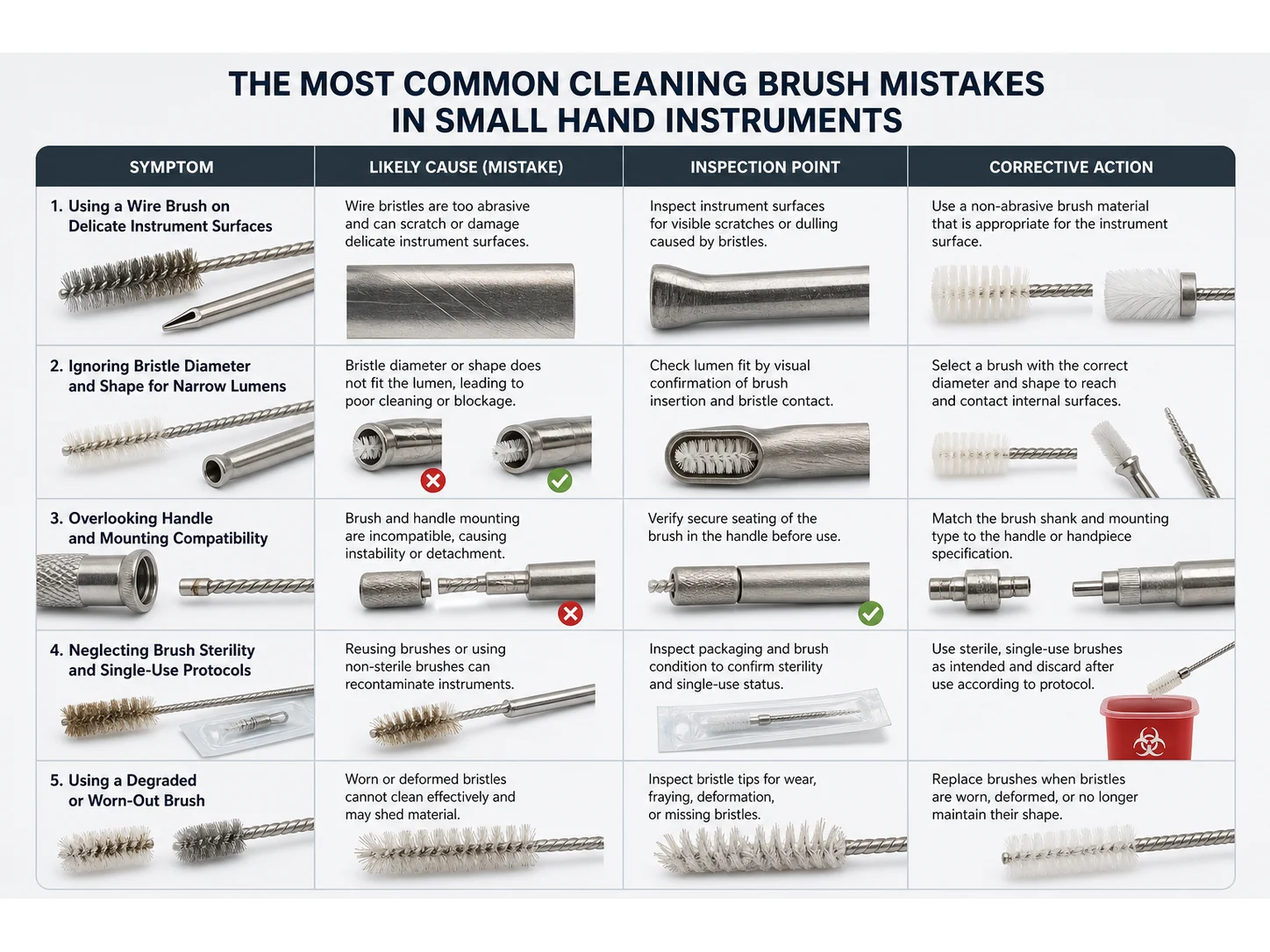
The Most Common Cleaning Brush Mistakes in Small Hand Instruments
1. Using a Wire Brush on Delicate Instrument Surfaces
Stainless steel or brass wire brushes are aggressive and can scratch mirrors, scaler tips, and coated surfaces. Scratches create micro-crevices where biofilm and debris hide, increasing infection risk and dulling sharp edges. Reserve wire brushes only for robust stainless steel components that specifically tolerate abrasive cleaning, and always verify the manufacturer’s recommendation.
2. Ignoring Bristle Diameter and Shape for Narrow Lumens
Endo files, ultrasonic scaler inserts, and micro-surgical tips have tiny internal channels. A brush with too large a core or stiff, thick bristles cannot enter the lumen effectively. A brush that is too small may not make sufficient contact. Always match the brush diameter to the instrument’s internal diameter, and choose bristle patterns (spiral, straight, tufted) that reach all areas.
3. Overlooking Handle and Mounting Compatibility
Hand-held brushes work for manual station cleaning, but automated or rotary-driven brushes require a correct shank size. A common mistake is purchasing a brush with a standard hand-held handle when the workflow runs on a contra-angle or latch-type rotary handpiece. Confirm whether the brush will be used manually, in a rotary tool, or in a dedicated cleaning station before ordering.
4. Neglecting Brush Sterility and Single-Use Protocols
Reusing a contaminated brush without proper sterilization spreads cross-contamination. Even with sterilization, bristles can trap debris and degrade after a few cycles. Many dental labs now use single-use brushes for critical instrument cleaning to maintain hygiene. Ensure your protocol defines brush life, cleaning method (autoclave, chemical bath), and visual inspection before reuse.
5. Using a Degraded or Worn-Out Brush
Bent bristles, fraying, discoloration, or splayed tufts are clear signs the brush no longer cleans effectively. A worn brush can leave residue behind, introduce fibers into the instrument, and even cause injury. Set a replacement schedule based on visual inspection or cycle count, not just when the brush falls apart.
6. Choosing Based on cost drivers Alone Instead of Instrument Compatibility
A low-cost brush that does not match the instrument’s material, size, or geometry can cause more harm than good. The real cost includes instrument damage, re-cleaning time, and potential infection control failure. Prioritize technical fit—bristle material, core wire, stem length, and chemical resistance—over unit cost drivers.
Dental Lab Cleaning Brush Selection: A Quick Comparison Table
| Brush Type | Best For | Not Recommended For | Key Considerations |
|---|---|---|---|
| Soft Nylon Bristle | Plastic, mirrors, coated instruments, fine optics | Heavy cement or hardened debris | Non-scratch, autoclavable, chemical resistant |
| Medium Nylon Bristle | General instrument cleaning, burs, forceps | Extremely delicate optical surfaces | Good balance of cleaning power and surface safety |
| Natural Fiber (hair) Brush | Polishing paste removal, dusting, sensitive surfaces | Wet environments with chemicals | May swell or degrade with solvents; limited durability |
| Brass Wire Brush | Robust stainless steel instruments, heavy carbon removal | Aluminum, titanium, coated or sharp-edged tools | Will scratch; use only when metal-to-metal contact is acceptable |
| Stainless Steel Wire Brush | Extreme debris removal on non-critical components | Any instrument involved in patient care without a protective coating | Highest scratch risk; rarely used directly on clinical instruments |
How to Choose the Right Brush: 5 Decision Factors
- Instrument Material and Surface Finish: Identify whether the instrument is stainless steel, titanium, plastic, or has a mirror finish. Softer metals and coated surfaces demand non-abrasive bristles.
- Residue Type: Light dust and polishing paste may only need a soft brush. Temporary cements, dried blood, or hard deposits may require a stiffer brush with chemical assistance.
- Lumen or Groove Geometry: Measure the smallest internal diameter or crevice. The brush core plus bristles must fit without jamming, but bristles must still make contact with the walls.
- Chemical and Sterilization Exposure: Check if the brush will contact enzymatic cleaners, disinfectants, or be autoclaved. Nylon generally withstands typical dental lab chemicals and steam, while natural fibers may break down.
- Workflow and Mounting: Determine manual vs. rotary use. For rotary, verify the shank diameter (e.g., 2.35 mm contra-angle) and RPM tolerance. For manual use, ergonomic handle length and grip matter in a high-volume setting.
When a Dental Lab Cleaning Brush Is the Wrong Choice
A dental lab cleaning brush is an essential physical cleaning step, but it cannot replace proper chemical or ultrasonic cleaning. For internal channels with complex bends or blind holes, an ultrasonic bath with appropriate detergent is required to reach areas a brush cannot. Similarly, proteinaceous debris often needs enzymatic pre-treatment before brushing. Relying solely on a brush risks leaving behind invisible contaminants. Combine manual brushing with validated automated cleaning methods and visual magnification inspection for the highest safety standard.
Key Takeaways for Preventing Mistakes
- Match bristle material to instrument surface sensitivity; default to soft nylon unless hard debris demands more aggression on robust instruments.
- Select the correct diameter and bristle length for the smallest lumen or groove you plan to clean.
- Confirm mounting type (hand-held vs. rotary) and shank size before ordering.
- Treat dental lab cleaning brushes as consumables. Inspect frequently and discard when bristles show wear.
- Always combine brushing with validated chemical and ultrasonic cleaning steps when reprocessing critical instruments.
Frequently Asked Questions
Can I use a wire brush for all dental instruments?
No. Wire brushes are abrasive and can scratch delicate surfaces, creating hiding spots for bacteria. Use them only on non-patient-contact stainless steel parts that explicitly tolerate metal brushing, and never on mirrors, coated tools, or fine scalers.
What size brush should I use for endodontic files?
Choose a brush with a narrow core diameter that fits inside the file’s lumen without forcing, but with bristles long enough to scrub the wall. Many labs use a 2–3 mm diameter nylon brush with a spiral bristle pattern. Always test a sample with the exact file sizes in your inventory.
How often should I replace a dental lab cleaning brush?
Replace the brush when bristles become bent, splayed, or discolored. In a high-volume lab, this may be daily for manual brushes and after five to ten autoclave cycles for reusable ones. Single-use brushes should be discarded after each instrument batch to prevent cross-contamination.
Are nylon brushes safe to autoclave?
Most medium- and high-temperature nylon brushes are autoclave-safe up to 135°C (275°F), but repeated cycling will eventually degrade the bristles. Always check the manufacturer’s maximum temperature and sterilization compatibility, and inspect after each cycle.
Can I use the same brush for cleaning and polishing paste?
It is not recommended. Polishing pastes can embed grit between bristles, which may later scratch other instruments. Dedicate brushes to specific tasks or use single-use brushes for each residue type.
What is the advantage of a spiral bristle pattern?
A spiral pattern allows the brush to follow the internal thread of a lumen or reach around corners better than straight tufts. It is useful for cleaning inside cannulated instruments, aspiration tubes, and threaded handpiece connections.
How do I test a brush before bulk order?
Request a sample and test it on the most challenging instrument in your inventory. Check for fit, bristle contact, material compatibility, and sterilization tolerance. Also evaluate handle or shank fit if production use involves rotary tools.
Can a brush replace ultrasonic cleaning?
No. A brush only reaches surfaces you can physically access, while ultrasonic cavitation cleans hidden internal passages and blind holes. Use brushing as a pre-treatment or post-treatment step, not a sole cleaning method for hollow or complex instruments.
Technical References
- CDC — Disinfection and Sterilization Guideline
- OSHA — 1910.1450 Occupational Exposure to Hazardous Chemicals in Laboratories
- NIOSH — Pocket Guide to Chemical Hazards
- FDA — Reprocessing Medical Devices in Health Care Settings
- CDC — Dental Infection Prevention and Control Summary
Which bristle material fits this job — Nylon PA, AISI 304 Stainless Steel Wire or Brass Wire?
| Material | Continuous temperature (°C) | Peak temperature (°C) | Water absorption | Hardness |
|---|---|---|---|---|
| Nylon PA | 93 | 121 | 0.3–9% by PA grade and conditioning | Medium to firm; filament diameter and trim length control bending force. |
| AISI 304 Stainless Steel Wire | 400 | 500 | 0% | Rockwell B 70–95 depending on temper and cold work |
| Brass Wire | 150–200 | 250–300 | 0% | Rockwell B 40–90 |
Figures as published by Brushtec / DuPont; Alleima. Confirm the exact grade against the supplier datasheet before ordering.
What should replace Nylon PA when it stops working?
- Nylon PA — Compare Nylon PA with PP, PBT, PET. Change material when wet stiffness, temperature, chemical resistance, conductivity, particle shedding, or surface marking becomes the limiting factor.
- AISI 304 Stainless Steel Wire — Use AISI 316 stainless steel wire for chloride, marine, dairy, beverage, chemical washdown, or higher pitting-resistance requirements. Use carbon steel for dry aggressive cutting and brass or abrasive nylon for lower marking risk.
- Brass Wire — Compare Brass Wire with Steel wire, stainless wire, nylon. Change material when wet stiffness, temperature, chemical resistance, conductivity, particle shedding, or surface marking becomes the limiting factor.