
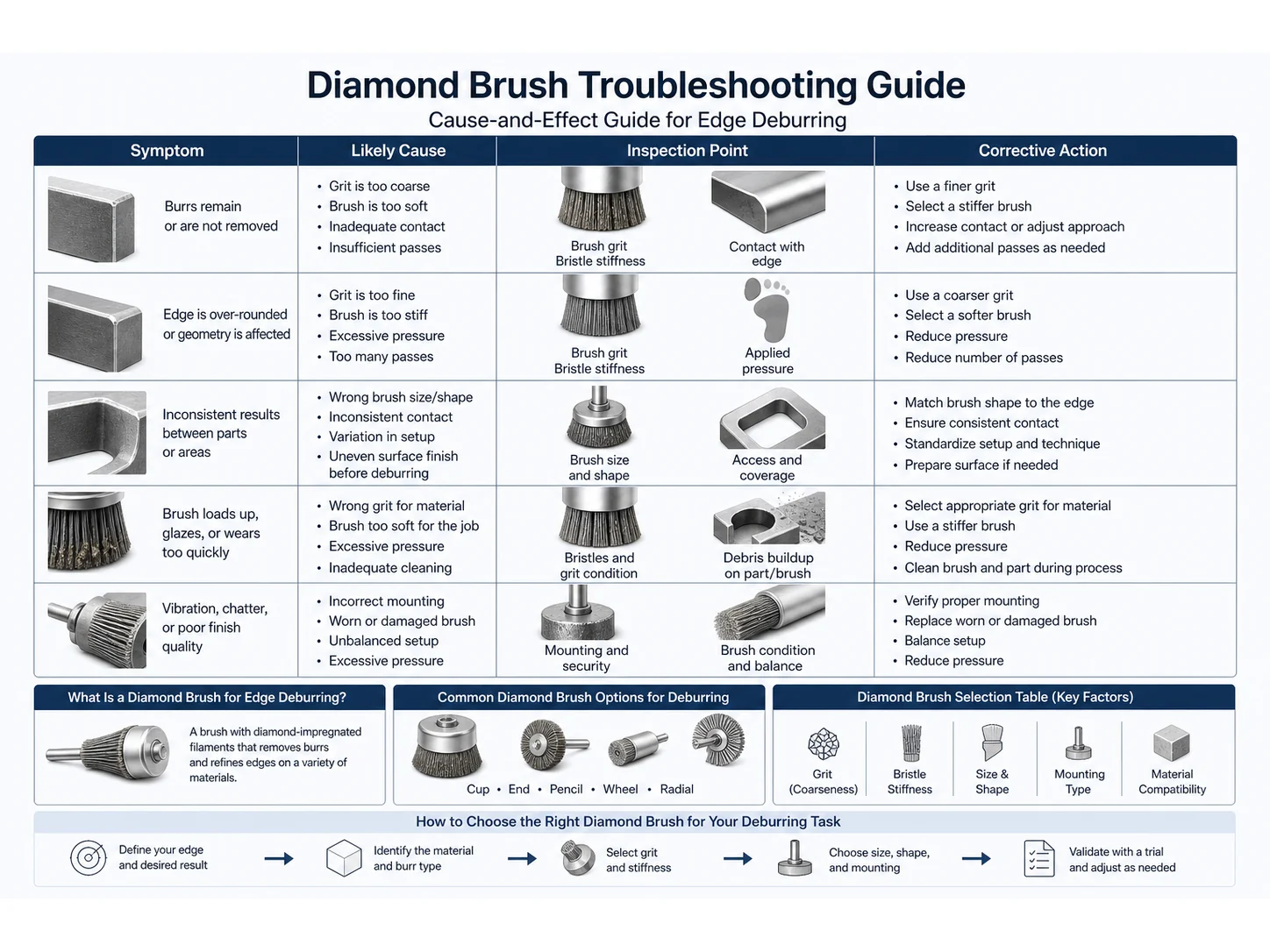
What Is a Diamond Brush for Edge Deburring?
A diamond brush is a surface conditioning tool that carries millions of sharp, durable diamond abrasive points embedded in or bonded to flexible filaments. In edge deburring, it removes burrs, sharp edges, and micro-fractures left by machining, stamping, or cutting without altering part dimensions. The diamond abrasive makes it suitable for hard-to-machine materials—including carbide, ceramics, hardened steels, and glass—where conventional brushes wear too quickly or fail to produce consistent results.
Common Diamond Brush Options for Deburring
Not all diamond brushes work alike. The following variables define performance, cost, and maintenance frequency.
- Bristle base and diamond type: Nylon filaments impregnated with synthetic diamond grit are the most common for edge blending. Metal wire with diamond coating offers higher aggression but may leave micro-scratches.
- Grit size: Coarse grits (e.g., 80–120) remove heavy burrs quickly; medium grits (200–400) balance stock removal and surface finish; fine grits (600–1200) polish and impart low Ra values.
- Bond matrix: Resin bonds provide flexibility and cooler cutting, ideal for thin edges and delicate parts. Metal bonds last longer and cut more aggressively, suited for high-volume deburring on robust workpieces.
- Filament shape and arrangement: Round or rectangular bristle cross-sections, straight or crimped filaments, and cup, wheel, end, or cylinder brush forms each influence the contact pattern and reach into slots or bores.
- Mounting interface: Common options include shank (for CNC spindles), arbor hole (for bench grinders or robotic heads), and quick-change discs.
Diamond Brush Selection Table
| Feature | Resin-Bond Nylon Diamond Brush | Metal-Bond Wire Diamond Brush | Diamond Flexible Abrasive Brush |
|---|---|---|---|
| Best for | Light to medium deburring, edge blending on carbide, ceramic, hard steel; surface finish Ra < 0.8 μm | Heavy burr removal on large steel or cast iron components; high stock removal | Complex geometries, internal passages, fine surface conditioning |
| Typical grit range | 80–800 | 120–600 | 120–1200 |
| Stiffness | Medium; controlled by filament diameter | High; aggressive cutting | Low to medium; conforms to part shape |
| Typical diameter range | 50–300 mm (cup/wheel) | 100–400 mm | 6–50 mm (miniature) to 100+ mm (wheel) |
| Mounting | Arbor, shank, quick-change | Arbor, flange | Shank, mandrel, arbor |
| Coolant compatibility | Wet or dry; light oils or water-soluble coolants | Prefer dry or minimal mist; can rust if wet | Wet or dry; coolant extends life |
| Maintenance/ replacement cycle | Moderate; resin wears with use, exposing fresh diamond | Long; metal bond holds grit firmly, but filament fatigue can occur | Shorter when aggressively used; designed for compliance, not heavy stock removal |
How to Choose the Right Diamond Brush for Your Deburring Task
Start with these decision factors:
- Workpiece material hardness and brittleness. Carbide and ceramics need diamond. Softer metals may work with CBN or conventional abrasives, but diamond provides consistency across mixed production lines.
- Burr size and location. Heavy, attached burrs require lower grit and higher stiffness; fine feather burrs or micro-edges need finer grit and softer bristle interaction.
- Edge quality requirements. Check your print’s edge break callout (e.g., 0.1–0.3 mm radius) and Ra target. A finer grit or more compliant bond may be necessary to avoid secondary polishing steps.
- Machine interface and speed. Verify brush maximum RPM rating against your spindle or drive speed. A shank-mounted cup brush may require a holder that fits your machine taper.
- Wet vs. dry process. Diamond cuts effectively without coolant, but wet conditions reduce heat and dust. Choose a bond and base material resistant to your coolant chemistry.
- Production volume and cycle time. Metal-bond brushes offer longer life in high-volume settings; resin-bond brushes produce finer finishes and may be more economical for short runs or frequent changeovers.
Common Mistakes When Specifying or Using a Diamond Brush
- Choosing grit size by instinct instead of testing. Coarse grit removes material fast but can create secondary burrs or micro-cracks. A grit size that worked on one alloy may be too aggressive for another.
- Ignoring bristle stiffness for the edge geometry. Stiff bristles on a thin wall can chatter or deflect the part, causing uneven radii. Match stiffness to part rigidity.
- Overlooking shank diameter and holder compatibility. A 3 mm shank brush may not clamp securely in a ½-inch collet without an adapter, leading to runout and poor finish.
- Assuming all diamond brushes are coolant-resistant. Some bond systems deteriorate in water-based coolants, especially at elevated temperatures. Confirm chemical compatibility with your supplier.
- Running the brush at the wrong speed or direction. Exceeding the maximum RPM or reversing rotation can cause bristle breakage and flinging of abrasive particles.
- Skipping trial runs and relying solely on catalog specs. Surface speed, pressure, and tool path interact differently on complex geometries. A short performance run on actual parts reveals need for adjustment.
When a Diamond Brush Is Not the Right Solution
Diamond brushes excel at edge deburring, but they are not a universal fix. Consider alternative methods when:
- Burrs are massive or deeply attached. Heavy belt grinding, filing, or milling may be needed before a brush can finish the edge.
- The part material is too soft (e.g., aluminum, copper). Diamond can clog or excessively load if the base material smears easily. Non-woven abrasives or CBN brushes may be more effective.
- Edge tolerance is extremely tight (e.g., sub-0.05 mm radius). A standard brush may not provide enough control; a robotic or CNC-guided chamfering tool may be required.
- Internal features are inaccessible. If the brush cannot physically reach the edge such as a deep, narrow cross‑hole, think mini‑diamond hones or abrasive flow machining.
- Cross-contamination risk is high. Diamond particles embedded in soft metals or hygienic applications may require a different abrasive that is easier to detect and remove.
Final Takeaway on Diamond Brush Selection
Choosing a diamond brush for edge deburring is about matching the abrasive bond, grit, bristle stiffness, and geometry to the specific material, edge quality target, and production environment. Avoid defaults—test real-world samples, verify machine limits, and document the successful configuration for repeat purchases. The right brush reduces secondary finishing, lowers rejection rates, and pays for itself quickly in a high-mix manufacturing environment.
Frequently Asked Questions
What is the difference between resin-bond and metal-bond diamond brushes?
Resin-bond brushes use a polymer matrix to hold diamond grit, giving them more flexibility and cooler cutting action. Metal-bond brushes use sintered metal to hold the diamond, providing longer life and more aggressive cutting. Resin is better for delicate edges; metal-bond for heavy burr removal on robust parts.
How do I specify the correct diameter for my CNC machine?
Measure the clearance around the target edge, including part fixturing and any obstacles. The brush diameter must rotate freely without collision. Also consider whether a cup, wheel, or end brush provides the best access. Record the shank or arbor size your tool holder requires.
Can I use a diamond brush wet and dry interchangeably?
It depends on the bond system. Many resin-bond brushes tolerate both, but some coolants can soften the resin. Metal-bond brushes may rust if used wet without rust inhibitors. Always check the manufacturer’s recommendation for coolant compatibility.
What grit size gives a surface finish of Ra 0.4 µm or better?
Typically, a diamond grit of #320 or finer will approach Ra 0.4 µm, but the result depends on brushing pressure, speed, and part material. A test using your actual process parameters is the only way to confirm. You may need to go up to #600 or #800 for a reliable finish.
How often should I replace a diamond brush?
Replacement is condition-based, not time-based. Look for loss of cutting efficiency, uneven edge radii, or visible bristle wear that changes the brush profile. In a well-controlled process, some resin-bond brushes last thousands of parts; metal-bond versions can last even longer. Track part quality metrics rather than assuming a fixed interval.
Do diamond brushes need a special balancing procedure?
Most small- to medium-diameter brushes (up to about 200 mm) come pre-balanced from the manufacturer. Larger cup or wheel brushes may require trimming or dynamic balancing if used at high surface speeds. Always follow the supplier’s RPM limits and mounting instructions.
Can I order a diamond brush in a non-standard shape or custom filament density?
Yes, many brush manufacturers offer custom tooling. You can specify the overall dimensions, bristle density, trim length, and even the abrasive concentration. Provide a drawing of the edge profile and your target cycle time. Expect a longer lead time for the first order, and always validate performance with a small sample run before committing to production quantities.
Is a diamond brush suitable for stainless steel edge deburring?
Yes, but with caution. Diamond can micro-cut stainless steel effectively, but it may embed particles if the brush is too aggressive or if the stainless is soft (e.g., annealed 304). Use a finer grit and a resin bond to reduce contamination risk. Post-process cleaning and passivation may be needed for critical applications.
Technical References
- OSHA — Metalworking Fluids
- World Stainless — Corrosion Resistance of Stainless Steels
- NIST — Metric SI
Which steel wire grade fits this job — AISI 304 Stainless Steel Wire, AISI 316 Stainless Steel Wire or Carbon Steel Wire?
| Wire grade | Continuous temperature (°C) | Peak temperature (°C) | Water absorption | Hardness |
|---|---|---|---|---|
| AISI 304 Stainless Steel Wire | 400 | 500 | 0% | Rockwell B 70–95 depending on temper and cold work |
| AISI 316 Stainless Steel Wire | 400 | 500 | 0% | Rockwell B 70–95 depending on temper and cold work |
| Carbon Steel Wire | 200–300 | 350–450 | 0% | Rockwell C 40–60 |
| Galvanized Steel Wire | 150–200 | 250–300 | 0% | Rockwell B 70–100 |
Figures as published by Alleima; Material manufacturer TDS / ISO / ASTM / industry reference. Confirm the exact grade against the supplier datasheet before ordering.
When is AISI 304 Stainless Steel Wire the wrong choice for edge deburring?
- AISI 304 Stainless Steel Wire — Avoid using AISI 304 as the default in marine, brine, hypochlorite, and persistent chloride environments; use AISI 316 when higher pitting and crevice-corrosion resistance is required.
- Nylon PA — The nylon family spans several grades, so heat, moisture and chemical limits should follow the selected PA resin rather than a generic nylon value.
What should replace AISI 304 Stainless Steel Wire for edge deburring?
- AISI 304 Stainless Steel Wire — Use AISI 316 stainless steel wire for chloride, marine, dairy, beverage, chemical washdown, or higher pitting-resistance requirements. Use carbon steel for dry aggressive cutting and brass or abrasive nylon for lower marking risk.
- Nylon PA — Compare Nylon PA with PP, PBT, PET. Change material when wet stiffness, temperature, chemical resistance, conductivity, particle shedding, or surface marking becomes the limiting factor.