
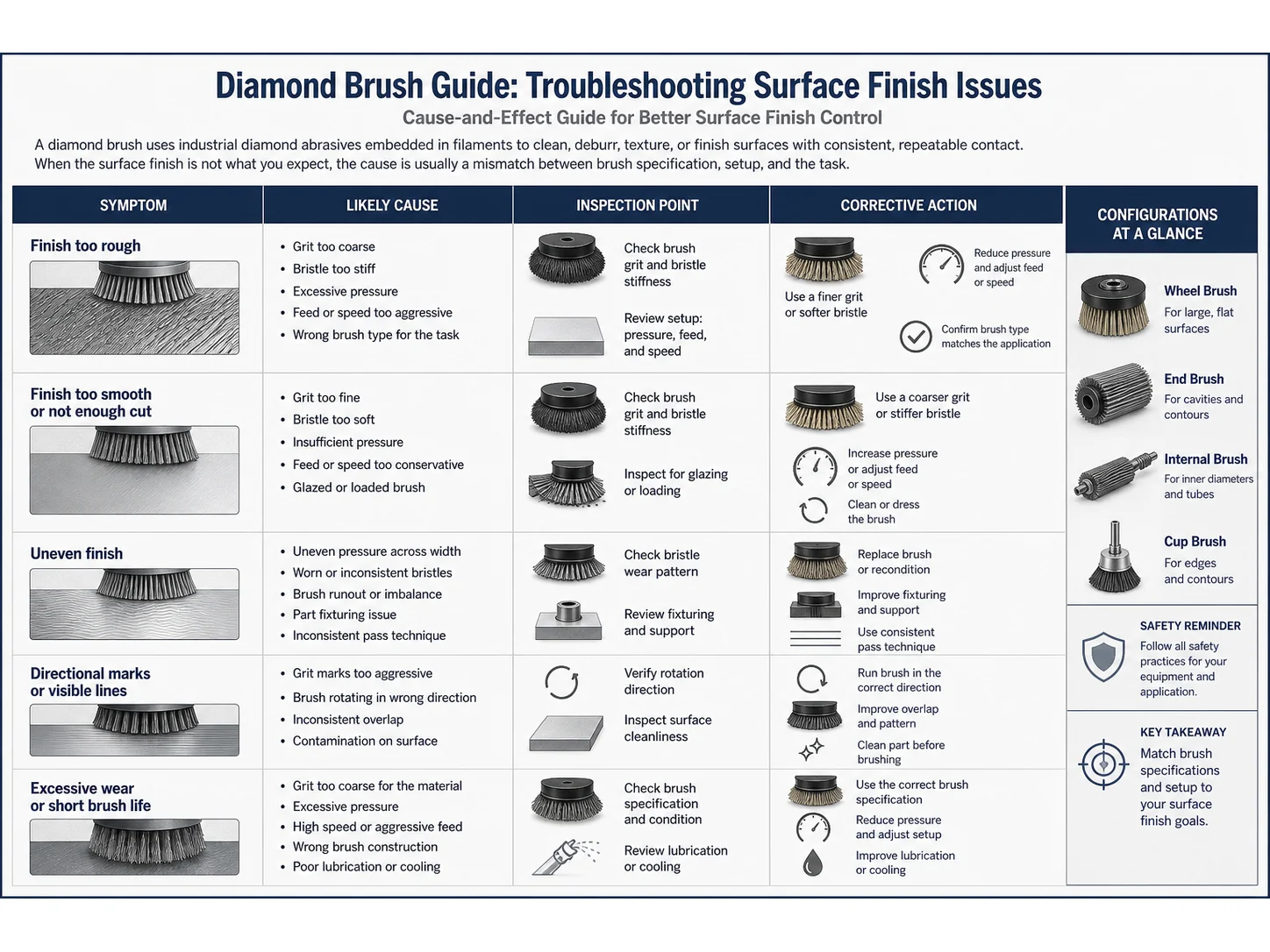
What Is a Diamond Brush?
A diamond brush is a surface finishing tool that combines the flexibility of a brush with the cutting ability of diamond abrasives. Unlike typical abrasive brushes that use ceramic or silicon carbide, diamond brushes use industrial diamond grit in a filament matrix (resin, metal, or electroplated) to remove material, blend surfaces, or create a specific roughness. They are widely used in metalworking for coil stock, stampings, machined parts, and tooling where consistent surface finish is critical.
Key Diamond Brush Material and Construction Options
Diamond brushes are built around three main choices: filament material, core/body, and mounting interface. The filament type determines aggressiveness, life, and compatibility with fluids. Resin-bonded filaments embed diamond in a resilient polymer for fine finishes; metal-bonded filaments use sintered metal for longer life and aggressive stock removal; electroplated filaments have a single layer of diamond on a metal wire for precise cutting edges. Core materials are typically aluminum or steel, chosen for rigidity and weight—aluminum for lighter, high-speed applications, steel for durability in tough environments.
Comparing Diamond Brush Configurations: A Practical Selection Table
| Characteristics | Resin-Bonded Diamond | Metal-Bonded Diamond | Electroplated Diamond |
|---|---|---|---|
| Typical Diameters | 3–14 in (75–355 mm) | 4–16 in (100–400 mm) | 4–12 in (100–300 mm) |
| Stiffness Level | Medium–High (depends on grit & filler) | Very High | Medium |
| Core/Handle Material | Aluminum or steel | Steel | Steel or aluminum |
| Mounting Types | Arbor hole, keyed shaft, flange mount | Flange mount, arbor hole | Keyed shaft, arbor hole |
| Best Surface Finish Needs | Fine finishing, light deburring, satin finishes | Aggressive deburring, edge radiusing, broke finishing | Sharp-edge breakdown, consistent micro-deburring |
| Typical Residue Types | Micro burrs, light oxidation | Heavy burrs, scale, deep oxide | Sharp fine burrs, edge clean-up |
| Wet / Chemical Exposure | Good with water-based coolants; avoid strong acids | Excellent with oils and coolants | Limited; bond may fail with aggressive chemicals |
| Maintenance Notes | Periodic dressing to expose fresh diamond | Long life, minimal dressing | Single-layer; replace when diamond wears off |
How to Choose the Right Diamond Brush for Surface Finish Control
Selecting a diamond brush starts with the workpiece and the process. Consider these factors:
- Residue type: Soft, gummy burrs call for a more open, resilient filament structure; hard, brittle burrs need stiffer, more aggressive diamond exposure.
- Surface sensitivity: Copper, brass, or soft alloys want a less aggressive brush to avoid gouging. Hardened tool steels can take a metal-bond brush for rapid material removal.
- Equipment interface: Check spindle speed, power, and arbor size. A large-diameter brush on a low-speed machine may not cut effectively; a small brush on a high-power spindle can overheat.
- Wet or chemical exposure: Operations that use flood coolant, cutting oils, or chemical cleaners must match the filament bond to that environment. Resin bonds may soften in certain solvents.
- Hygiene and contamination risks: In food, medical, or electronics production, metal-bond brushes may shed less abrasive debris, and stainless steel cores are preferred over aluminum.
- Maintenance frequency: Brushes that need frequent dressing or have shorter life cycles increase downtime. Factor lifecycle cost when comparing options.
- Custom size requirements: Odd diameters, special face widths, or non-standard mounting can often be accommodated through custom brush manufacturers, but lead times and minimums will apply.
Setup and Usage Factors That Affect Surface Finish
Even the best-specified diamond brush will disappoint if the operating parameters are wrong. Speed, pressure, and motion all change the way diamond interacts with the surface. Higher speeds with light pressure can give finer finishes; high pressure at lower speeds increases stock removal but may leave deeper scratches. Brush oscillation or indexing helps avoid patterns. Always start with a test coupon to dial in the right combination for your Ra or RMS target.
Common Specification Mistakes to Avoid
- Choosing by grit size alone: Grit number is only part of the story. Filament length, density, and bond type determine how the grit is presented. A finer grit in a stiff brush can be more aggressive than a coarser grit in a soft brush.
- Ignoring core material compatibility: Aluminum cores can corrode in acidic wash-downs; steel cores can rust in water-based coolants unless coated. Verify upstream chemical compatibility.
- Assuming all mounting styles are the same: The interface must match the machine’s spindle or adapter. A keyway mismatch can cause slippage or runout, ruining finish and brush life.
- Overlooking filament length and stiffness interaction: A long filament flexes more, which can be good for blending but bad for edge radiusing. Pair filament length with the desired aggressiveness.
- Neglecting hygiene or contamination specs: In clean rooms or food-grade lines, any shed abrasive particles are a problem. Specify brushes with minimal free-grit release or use sealed brush designs.
- Over-specifying abrasiveness: Using a metal-bond brush on aluminum simply removes material too fast and increases scrap. Match abrasiveness to the material’s hardness.
When a Diamond Brush Is Not the Best Choice
Diamond brushes excel on hard, tough materials, but they are not universal solutions. On very soft substrates like pure annealed aluminum, they can be too aggressive and may need a non‑abrasive nylon brush instead. For high‑volume, heavy stock removal on large steel coils, a belt grinding or set of flap wheels might be faster and cheaper. Also, complex internal geometries or deep recesses may not allow even brush contact. When surface finish requirements are exceptionally tight (< 2 µ-in Ra), a diamond brush may need a secondary lapping or polishing step. In every new application, a sample test run with documented parameters is the safest way to confirm the right choice.
Final Takeaway: Matching Specifications to Real Surface Finish Goals
The right diamond brush balances filament material, stiffness, size, and mounting with the real‑world conditions of your production line. Start with the official finish spec (Ra, Rz, etc.), then work backward through material hardness, residue type, and process environment. Avoid common mistakes by involving your brush supplier early—share part drawings, cycle times, and chemical exposures—and always validate with a pilot run before full‑scale commitment.
Frequently Asked Questions
Can diamond brushes be used on aluminum and stainless steel?
Yes. On stainless steel, they perform very well for deburring and finishing. For aluminum, use a softer resin-bond brush and lighter pressure to avoid galling or deep scratching.
What grit size do I need for a satin or mirror finish?
A general starting point: 800–1200 grit for a satin look, 1500–2000 for pre‑mirror, and finer for final polish. Actual results depend on speed, pressure, and filament flexibility.
How often should a diamond brush be dressed?
Resin-bond brushes usually need periodic dressing when cutting rate drops. Metal-bond types may run for hundreds of hours without dressing. Electroplated brushes are sacrificial and cannot be dressed.
What is the difference between resin and metal bond diamond brushes?
Resin bond wears a little faster but gives a smoother finish and is more forgiving on complex shapes. Metal bond lasts much longer and is better for aggressive stock removal on hard metals.
Can these brushes run wet or with coolant?
Yes, but check compatibility. Most metal‑bond and many resin‑bond brushes handle water‑based coolants well. Strong alkaline or acidic wash-downs may damage resin and require a special bond formulation.
Are custom sizes always more expensive?
Not necessarily. Small diameter or width changes may use existing tooling. True custom configurations (special core, exotic filament length) will have engineering and setup charges but can save long‑term costs by improving yield.
What mounting standard should I specify?
Common options are an arbor hole with keyway (NEMA standards), a captive shaft with flat, or a tapered hub. The safest approach is to provide a drawing of your machine’s spindle or existing tool holder to the supplier.
Do I need to run a test before ordering a full batch?
Strongly recommended. A small pilot order lets you dial in the exact brush configuration and operating parameters without risking production stoppages or inconsistent finish on customer parts.
Technical References
Which steel wire grade fits this job — AISI 304 Stainless Steel Wire, AISI 316 Stainless Steel Wire or Carbon Steel Wire?
| Wire grade | Continuous temperature (°C) | Peak temperature (°C) | Water absorption | Hardness |
|---|---|---|---|---|
| AISI 304 Stainless Steel Wire | 400 | 500 | 0% | Rockwell B 70–95 depending on temper and cold work |
| AISI 316 Stainless Steel Wire | 400 | 500 | 0% | Rockwell B 70–95 depending on temper and cold work |
| Carbon Steel Wire | 200–300 | 350–450 | 0% | Rockwell C 40–60 |
| Galvanized Steel Wire | 150–200 | 250–300 | 0% | Rockwell B 70–100 |
Figures as published by Alleima; Material manufacturer TDS / ISO / ASTM / industry reference. Confirm the exact grade against the supplier datasheet before ordering.
When is AISI 304 Stainless Steel Wire the wrong choice for surface finish control?
- AISI 304 Stainless Steel Wire — Avoid using AISI 304 as the default in marine, brine, hypochlorite, and persistent chloride environments; use AISI 316 when higher pitting and crevice-corrosion resistance is required.
- Abrasive Nylon — Exposed grit can change a surface finish, and high heat or aggressive chemicals can weaken the polymer carrier.
What should replace AISI 304 Stainless Steel Wire for surface finish control?
- AISI 304 Stainless Steel Wire — Use AISI 316 stainless steel wire for chloride, marine, dairy, beverage, chemical washdown, or higher pitting-resistance requirements. Use carbon steel for dry aggressive cutting and brass or abrasive nylon for lower marking risk.
- Abrasive Nylon — Compare Abrasive Nylon with PP, PBT, PET. Change material when wet stiffness, temperature, chemical resistance, conductivity, particle shedding, or surface marking becomes the limiting factor.