
What Is a Fish Tank Cleaning Brush?
A fish tank cleaning brush is a cleaning tool characterized by soft, non-metallic bristles, a flexible or jointed handle, and a design that prioritizes safe contact with acrylic or glass surfaces. Unlike heavy-duty scrub brushes, it leans toward gentle but effective mechanical action that loosens residue without gouging the substrate. In aquarium use, this means sponge pads, nylon bristles, or silicone edges that wipe away algae films. In a dairy or food-processing context, the same non-scratch, corrosion-resistant properties become interesting for stainless steel vessels and plastic tubing where surface finish matters.
For industrial parts-cleaning process selection, contaminant classes, mechanical cleaning systems, and residue removal, this article cites ASM International — Choosing a Cleaning Process, ASM International, 1996; contaminant classes and mechanical cleaning process selection.
Understanding Milk Residue and Surface Cleaning Challenges
Milk residue isn’t just a simple liquid film. It contains casein proteins, butterfat, and calcium phosphate that, when dried or heated, form a tenacious, often semi-transparent layer. Left on stainless steel, plastic, or glass, it can harbor bacteria and impair CIP (clean-in-place) performance. The cleaning tool must:
- Mechanically disrupt the residue without scratching the surface, because scratches give bacteria a foothold.
- Withstand frequent chemical exposure to alkaline detergents, acid rinses, and hot water.
- Reach into crevices such as pipe bends, tank nipples, and narrow filler necks.
This combination of chemical durability, surface safety, and geometric reach is exactly where the fish tank brush vs standard brush conversation begins.
Common Types of Cleaning Brushes for Tank and Tube Applications
When selecting a brush for milk residue, you will typically encounter these categories:
- Standard nylon utility brushes – stiff bristles, crimped or stapled, good for open tanks but can scratch softer metals or plastics.
- Stainless steel wire brushes – aggressive, may be required for baked-on residues but risk damaging polished stainless surfaces.
- Bottle and tube brushes – medium stiffness, often with a twisted-wire core, sized for specific pipe diameters.
- Fish tank cleaning brushes – soft non-scratch bristles, flexible handle, often jointed or bendable, intended for delicate surfaces.
- Custom brush rolls and specialty brushes – built to exact diameter, length, and material for CIP or automated cleaning stations.
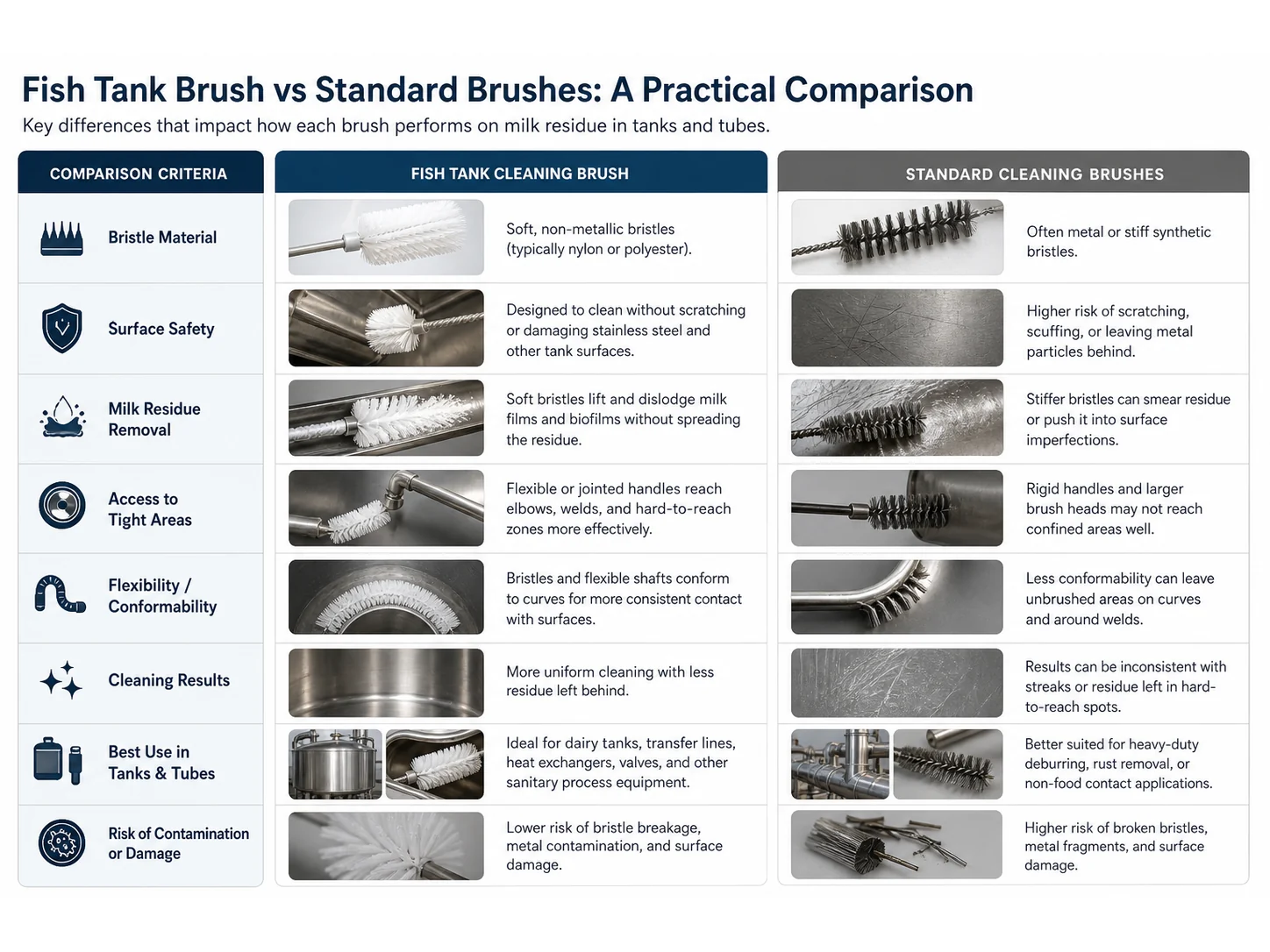
Fish Tank Brush vs Standard Brushes: A Practical Comparison
The table below highlights the key differences in material, stiffness, and behavior that affect milk residue cleaning performance.
| Attribute | Fish Tank Cleaning Brush | Standard Nylon Utility Brush | Stainless Steel Wire Brush | Twisted-Wire Tube Brush |
|---|---|---|---|---|
| Bristle Material | Soft nylon, sponge, or silicone | Medium to hard nylon or polyester | Stainless steel wire | Nylon, polypropylene, or abrasive grits |
| Stiffness | Low; conforms to contours | Medium to high; aggressive scrubbing | Very high; can remove scale | Medium; designed to scrub without scratching |
| Surface Safety | Excellent; will not scratch glass, acrylic, or polished stainless | Moderate; may leave micro-scratches on softer finishes | Poor; will scratch even hard stainless steel | Good when correct bristle material chosen |
| Handle / Core | Flexible plastic, jointed or bendable wire | Rigid plastic or wood handle | Rigid handle or wheel mount | Twisted galvanized or stainless steel wire |
| Mounting Options | Usually hand-held; some with hose-attach swivel adapters | Hand-held, screw-in pole, or drill attachment | Angle grinder, drill, or manual handle | Manual, extension rods, or machine-driven chucks |
| Milk Residue Suitability | Fresh or light residue on sensitive surfaces | Dried residue on durable stainless tanks | Baked-on carbonized residue (not for routine milk stone) | Pipe interiors, valve bodies, and port threads |
| Chemical Resistance | Good with common detergents; check silicone in strong caustics | Excellent in alkaline and acid solutions | Excellent; but can rust if grade is low | Depends on bristle material; polypropylene best for chemicals |
| Hygiene & Sanitary Design | Non-absorbent bristles easy to rinse; may have crevices in joint | Can trap debris at staple holes | Wire can harbor milk stone in small crevices | Wire core can rust and trap residue; choose all-stainless cores |
How to Choose the Right Brush for Milk Residue Cleaning
Your choice should be driven by five real-world factors, not by the brush category alone:
- Surface sensitivity – Polished stainless tanks and sight glasses demand non-scratch bristles. A fish tank brush naturally meets this, but so can a properly specified nylon tube brush.
- Residue age and hardness – Fresh milk film rinses easily. A soft fish tank brush can handle it. If the residue has dried, been pasteurized on, or contains scale, you need the higher stiffness of a standard brush or a twisted-wire tube brush.
- Equipment geometry – For narrow pipes (less than 2 inches), a twisted-wire tube brush is the standard solution. A fish tank brush may be too flexible to exert pressure inside a pipe. For open tanks, a long-handle fish tank brush can reach corners without scratching.
- Chemical exposure and temperature – If your cleaning protocol uses hot caustic (over 140°F) and strong acids, verify the bristle material. Nylon 6.6 is widely resistant; some silicone blends can soften. Standard industrial brushes often have rated temperature limits.
- Hygiene and inspection requirements – In food-grade facilities, brushes should be color-coded, non-absorbent, and easy to sanitize. A fish tank brush with a closed-cell foam pad is simple to rinse, but its flexible joint might collect debris. A seamless molded handle on a standard brush may be easier to validate.
Common Mistakes When Choosing a Brush for Milk Residue
- Assuming all “soft” brushes are safe for all surfaces – Softness varies. A soft brush that traps abrasive milk stone particles can act like sandpaper on a polished tank.
- Neglecting handle and core material in wet environments – A plain steel core or handle will rust, contaminate the surface, and degrade quickly. Always confirm stainless or plastic construction when moisture is constant.
- Using a fish tank brush in a high-pressure CIP application – These brushes are not designed for automated, high-turbulence cleaning; they may disintegrate or leave plastic fragments.
- Ignoring chemical compatibility – Even a brush label “alkali-resistant” can fail if the actual bristle type is not specified. Ask for a datasheet if you regularly cycle through acid, caustic, and hot water.
- Choosing by cost drivers or availability alone – A low-cost brush that scratches a $20,000 tank or leaves behind residue is a false economy.
When a Fish Tank Cleaning Brush Is the Wrong Choice
A fish tank cleaning brush works well for light films and sensitive interior finishes, but it reaches its limit in several practical situations:
- Baked-on or carbonized milk stone – After high-heat processing, the residue hardens into a mineralized layer. Only a medium-to-stiff bristle brush or a specialized cleaning pad can remove it without excessive chemicals.
- Deep internal pipe cleaning – The fish tank brush’s flexibility becomes a disadvantage when you need to push it through a 10-foot pipeline with multiple bends. A properly sized twisted-wire tube brush or a pigging system is required.
- Sanitary certification requirements – If your plant requires brushes certified by 3-A, EHEDG, or similar, a fish tank brush intended for aquariums will not have that documentation. You may need a custom brush with full material traceability.
- High-volume, repetitive cleaning – In a production environment where operators clean dozens of tanks per shift, ergonomics and durability matter. A fish tank brush handle may fatigue the wrist, and the soft bristles wear faster than industrial-grade bristles. In such cases, requesting a sample draw-up from a brush supplier for a custom design is a practical path.
Final Takeaway
There is no universal “best” brush for milk residue. The fish tank cleaning brush excels when surface safety, flexibility, and light residue removal are the priorities—especially on polished stainless, sight glasses, or small delicate fittings. When the residue is heavy, hardened, or found deep inside pipes, standard tube brushes or stiffer utility brushes take over. Match the bristle material, stiffness, and core construction to your specific residue, surface finish, and chemical protocol. If in doubt, run a small test patch, and involve a brush supplier who can recommend or draw a custom solution based on your exact tank geometry and cleaning cycle.
Frequently Asked Questions
Can I use a fish tank brush for daily cleaning of a milk bulk tank?
Yes, if the tank interior is polished stainless steel and the residue is fresh and light. For heavy or dried-on milk stone, a stiffer nylon brush or a dedicated tank brush with a longer handle and more aggressive bristles is a safer, more efficient choice.
Does bristle color indicate stiffness or material?
Not consistently. Color coding is often used for hygiene cross-contamination control (e.g., white for food contact), but stiffness and material are independent of color. Always check the manufacturer’s specification for bristle type (nylon 6, nylon 6.6, polypropylene, etc.) and diameter.
How often should I replace brushes used on milk residue?
Inspect bristles for splaying, matting, or trapped debris at least weekly. If bristles lose their shape, no longer spring back, or the core material is exposed, replace the brush immediately. In high-use environments, monthly replacement is common.
Can a fish tank brush handle alkaline CIP detergents?
Most fish tank brushes use nylon bristles, which have good resistance to mild caustics and acids at low temperatures. However, concentrated hot caustic (over 3%, above 60°C) can degrade nylon over time. Check the brush material against your specific cleaning chemical concentration and temperature.
What if my tank has internal coils or agitators that trap milk residue?
A fish tank brush with a flexible head can reach around coils and baffles where standard rigid brushes can’t. However, ensure the bristle is soft enough not to damage any delicate sensors or soft plastic components. If the residue is thick, consider a stiffer brush but protect the surfaces with a controlled angle.
Is a longer handle always better for milk tank cleaning?
Not necessarily. A longer handle improves reach but reduces the pressure you can apply to the bristle tips, which can slow down cleaning. Choose a handle length that allows comfortable two-handed operation while keeping the brush bristle in full contact with the surface.
Can I attach a fish tank brush to a drill for faster cleaning?
Most consumer fish tank brushes are not designed for drill chucks; the flexible joint or handle may snap. If you need rotary cleaning for milk residue, look for a purpose-made tube brush or tank brush with a standard shaft diameter (e.g., 1/4 inch) that fits a drill or a dedicated cleaning machine.
What should I look for if I need a custom brush for a unique tank shape?
Work with a brush supplier to provide drawings of your tank, including all nozzles, baffles, and internal features. Specify the residue type, cleaning chemical, and desired surface finish (Ra value). The supplier can design a brush roll or a specialized hand brush that matches the geometry without compromising surface safety.
Technical References
- FDA — Food Code
- eCFR — 21 CFR Part 117 Human Food CGMP and Preventive Controls
- eCFR — 21 CFR 178.1010 Sanitizing Solutions
- ASME — Y14.5 Dimensioning and Tolerancing
Which bristle material fits this job — Nylon PA, AISI 304 Stainless Steel Wire or Silicone?
| Material | Continuous temperature (°C) | Peak temperature (°C) | Water absorption | Hardness |
|---|---|---|---|---|
| Nylon PA | 93 | 121 | 0.3–9% by PA grade and conditioning | Medium to firm; filament diameter and trim length control bending force. |
| AISI 304 Stainless Steel Wire | 400 | 500 | 0% | Rockwell B 70–95 depending on temper and cold work |
| Silicone | 200–250 | 280–300 | 0.1–1.0% | Shore A 20–80 |
| PBT | 120–140 | 160–180 | 0.05–0.20% | Shore D 80–90 |
| Microfiber | 80–120 | 140–170 | 0.2–1.0%Material Itself ; Structure Can Absorb 3–7 Times Its Own Weight | — |
Figures as published by Brushtec / DuPont; Alleima; Perlon. Confirm the exact grade against the supplier datasheet before ordering.
What should replace Handheld Detail Brushes for fish tank cleaning?
- Handheld Detail Brushes — Handheld detail brushes cover general precision cleaning; auto-detailing brushes impose tighter controls for painted, polished, leather, display, and trim surfaces.
- Nylon PA — Compare Nylon PA with PP, PBT, PET. Change material when wet stiffness, temperature, chemical resistance, conductivity, particle shedding, or surface marking becomes the limiting factor.
- AISI 304 Stainless Steel Wire — Use AISI 316 stainless steel wire for chloride, marine, dairy, beverage, chemical washdown, or higher pitting-resistance requirements. Use carbon steel for dry aggressive cutting and brass or abrasive nylon for lower marking risk.
- Silicone — Compare Silicone with PP, TPE, Nylon. Change material when wet stiffness, temperature, chemical resistance, conductivity, particle shedding, or surface marking becomes the limiting factor.