
What Is a Power Scrubber Brush?
A power scrubber brush is a motor-driven cleaning attachment that uses rotating bristles to dislodge and remove dirt, residues, scale, coatings, or debris from a contact surface. It can be a standalone handheld tool, a floor machine disc brush, a cylindrical roller mounted on a conveyor or vacuum inlet, or an abrasive end brush for heavy-duty metal cleaning. The key point: the bristles do the work—so the material, density, and geometry of the bristles must match both the surface and the contamination.
Common Types and Bristle Materials
Power scrubber brushes fall into a handful of design families, each serving a different industrial cleaning function. The table below maps the most common brush types against the cleaning conditions they suit best.
| Brush Type | Typical Bristle Material | Surface Sensitivity | Wet / Dry | Chemical / Temp Tolerance | Maintenance Access | Example Applications |
|---|---|---|---|---|---|---|
| Floor scrubber disc brush | Polypropylene, Nylon, Abrasive nylon | Low to medium | Wet | Mild acids/alkalis, up to ~60°C | Easy, tool-free release | Concrete, tile, epoxy floors |
| Cylindrical roller brush | Nylon, Polyester, Tampico | Medium to high | Dry or damp | Limited chemical resistance; max ~80°C dry | Bearings require periodic service | Vacuum brush rollers, conveyor belt cleaners, glass washing machines |
| Cup brush / end brush | Wire (steel, stainless, brass), Abrasive nylon | Very low (aggressive) | Dry | Stainless wire for corrosive environments | Easy mount on grinder or drill | Weld cleaning, paint removal, deburring |
| Mini hand-held power brush | Nylon, Brass wire, Tampico | High (fine surface) | Dry or damp | Limited to mild cleaners | Manual brush change | Coffee machine grouphead cleaning, espresto machine portafilter, drain pipe cleaning |
| Chimney / flue brush | Polypropylene, Abrasive nylon, Steel wire | Extremely low (abrasive) | Dry | Resistant to soot and mild acids; max ~120°C | Threaded rod or quick-connect | Chimney sweeping, duct cleaning |
Among bristle materials, nylon (general purpose, good flexibility), polypropylene (stiff, chemical-resistant), abrasive nylon (grit-impregnated for light scouring), and metal wires (carbon steel, stainless, brass) cover most needs. The choice hinges on whether the surface can tolerate abrasion and whether chemicals, moisture, or heat is present.
How to Choose the Right Power Scrubber Brush
Walk through these decision points before ordering a replacement or specifying a new brush for a powered cleaning system:
- Surface sensitivity and finish: Can the surface handle aggressive wire bristles, or does it require non-scratch nylon? Polished stainless, chrome, or sensitive floor coatings demand softer filaments.
- Contamination type: Grease, carbon deposits, scale, dust, food residues, or corrosive byproducts each require a different filament chemistry and tip geometry.
- Wet or dry operation: Wet cleaning lubricates bristles and can use softer materials, but some filaments absorb water and lose stiffness. Dry cleaning often needs stiffer, heat-resistant filaments.
- Chemical and temperature exposure: Acidic or alkaline cleaning agents, sanitizers, or steam exposure can degrade nylon or natural fibers. Polypropylene, polyester, and stainless wire hold up better.
- Machine compatibility: Check the brush’s core or drive mechanism—disc brush clutch plate, roller shaft diameter and keyway, thread size for cup brushes, or quick-change collar. Match the machine’s RPM range and torque to the brush’s maximum safe speed rating.
- Dimensions and mounting: Record outer diameter, face width, trim length, bore size, and mounting method. A drawing or sample brush often avoids measurement errors.
- Expected cleaning result: Define pass/fail criteria—visual cleanliness, surface roughness change, particle test result, or absence of residues. This helps the supplier recommend the correct filament grade and density.
- Life expectancy and maintenance: Ask about typical brush life in operating hours, how bristle wear is detected (trim length, visual unevenness), and whether the brush can be revaered or must be replaced.
Setup and Usage Factors
Even the best-matched brush won’t perform if installed or operated incorrectly. Pay attention to:
- Installation space and clearance: Roller brushes need enough housing space for shaft access and bearing lubrication. Disc brushes require vertical clearance to drop the brush deck.
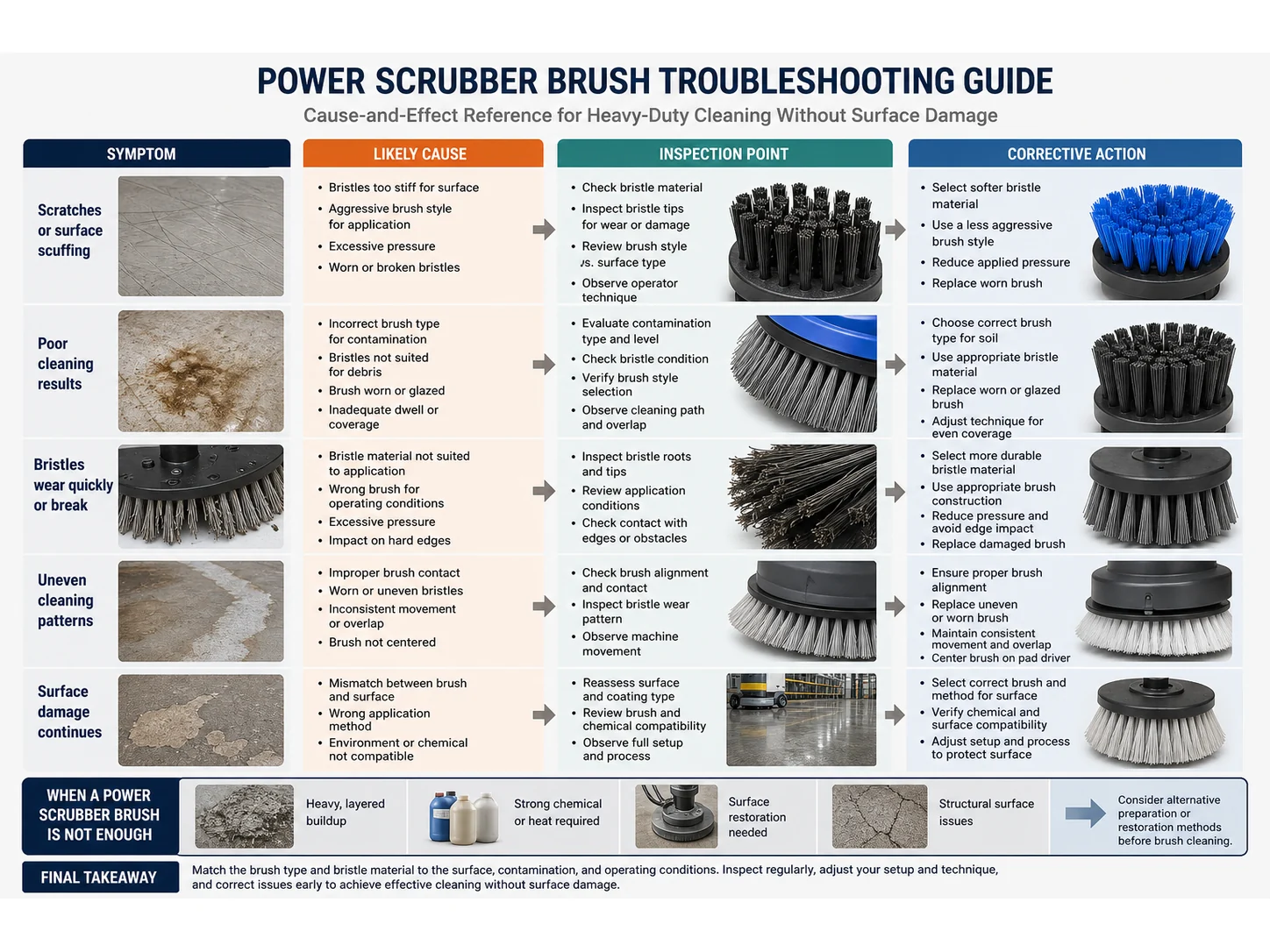
- Alignment and pressure: Uneven pressure causes uneven bristle wear and streaky cleaning. Adjust the brush-to-surface contact pattern to cover the full working width evenly.
- Line speed or travel speed: For conveyorized systems, too high a surface speed can cause bristles to “skip” over contamination. Match brush RPM and filament overlap to the travel speed.
- Inspection routine: Check bristle condition weekly; look for matting, melting, chemical softening, or bent wires. A worn brush reduces cleaning performance and can damage surfaces.
Common Mistakes
Avoid these frequent errors when selecting or using power scrubber brushes:
- Choosing by cost or looks rather than technical fit: A low-cost brush that damages a floor or leaves residue generates more cost in rework or equipment downtime.
- Ignoring chemical compatibility: Degraded bristles can shed fragments into sensitive process areas (food zones, cleanrooms) or lose cleaning effectiveness suddenly.
- Overlooking mounting dimensions: Even a 2 mm difference in bore diameter can prevent proper installation. Always provide a drawing or send a sample brush.
- Using a dry brush in a wet application without checking material: Nylon absorbs water and softens; natural fibers swell and fall out. Confirm filament suitability for the exact moisture level.
- Running at excessive RPM: Exceeding the maximum speed rating can centrifuge bristles outward, cause imbalance, or snap filaments—creating a safety hazard.
- Not matching brush aggressiveness to the job: Wire brush on vinyl tile destroys the floor; soft tampico on heavy scale removes nothing. Select grade based on the removal difficulty scale.
When a Power Scrubber Brush Is the Wrong Choice
Rotary brushing is excellent for moderate, open-surface contamination removal, but it reaches a boundary where other methods become necessary:
- Heavy caked or thick scale: A scraper or high-pressure water jet may be needed ahead of brushing to reduce the load on bristles.
- Dust and fine particles: Brushing alone can aerosolize harmful dust. Combine with a vacuum extraction system or run the brush inside an enclosed vacuum head.
- Moisture-sensitive electronics or deep cavities: Brushing may push debris further into crevices. Ultrasonic cleaning or CIP (clean-in-place) might be safer.
- Validation-critical food or pharma surfaces: A brush cannot support complete biofilm removal; CIP, steam, or chemical sanitizing must follow brushing.
- Drying requirement after wet brushing: An air knife or blower system should follow the brush to remove residual moisture and prevent water spots or corrosion.
- Extremely delicate surfaces: Soft foam, delicate fabrics, or polished optical surfaces demand non-contact methods or specialized gentle brushes that are beyond standard power scrubber designs.
Always evaluate whether brushing should be a standalone solution or part of a multi‑step cleaning process.
Final Takeaway
Selecting a power scrubber brush is a practical engineering decision: define the surface and contamination first, then pick a brush type and bristle material that can safely attack the residue without harming the substrate. Verify mounting dimensions, confirm wet/dry/chemical boundaries, and plan for regular inspection. When in doubt, consult an application engineering team with a detailed drawing or sample—the right brush pays for itself in longer life and fewer cleaning cycles.
Frequently Asked Questions
Can I use the same brush for wet and dry cleaning?
It depends on the bristle material. Some nylon grades absorb moisture and lose stiffness when wet, making them ineffective for dry scrubbing afterwards. Polypropylene handles wet/dry cycles better. Always verify the filament’s moisture absorption rate before switching modes.
What bristle material is safest for polished stone or marble floors?
Soft nylon or natural tampico fiber is usually safe. Avoid any abrasive-impregnated nylon or wire brushes, which will scratch the surface. A white or light-colored bristle can also prevent color transfer from the brush to porous stone.
How do I measure a brush for replacement if I don’t have a part number?
Measure the outer diameter (or radius from center), the bristle trim length, the core or block height, and the bore or mounting slot dimensions. A photo of the old brush next to a ruler helps. Providing a worn sample to a supplier is the most accurate method.
How often should I replace a power scrubber brush?
There is no universal number. Replace when bristle trim length shortens by about 30–40% of its original length, when cleaning performance drops noticeably, or when you see uneven wear, melted tips, or missing bristle clusters. Stiff wire brushes may last longer than soft nylon brushes under the same conditions.
What’s the difference between crimped and straight wire bristles?
Crimped wire provides more aggressive cutting action and is used for heavy scale or coating removal. Straight wire is slightly less aggressive and often chosen for finer deburring or cleaning where a smoother finish is desired. The filament gauge and material matter just as much as the crimp style.
Can I use a power scrubber brush attachment on a regular electric drill?
Yes, many small‑format disc, cup, or end brushes have a ¼‑inch hex shank or threaded arbor designed for drills. However, check that the drill’s RPM does not exceed the brush’s maximum safe speed. For larger floor brushes or roller brushes, a dedicated machine with a matching drive is required.
How do I know if a brush is chemically compatible with my cleaning agents?
Ask the brush manufacturer for a chemical resistance chart for the bristle material. Polypropylene typically resists acids and alkalis better than nylon. If you use sanitizers or degreasers, test a sample brush in a small container with the chemical mix to check for softening or discoloration.
Which bristle material fits this job — Nylon PA, Abrasive Nylon or Tampico Fiber?
| Material | Continuous temperature (°C) | Peak temperature (°C) | Water absorption | Hardness |
|---|---|---|---|---|
| Nylon PA | 93 | 121 | 0.3–9% by PA grade and conditioning | Medium to firm; filament diameter and trim length control bending force. |
| Abrasive Nylon | 120 | 150 | 0.1–1.0% | Abrasive filament; stiffness and cutting level is controlled by PA base, grit type, grit size, filament diameter and trim height. |
| Tampico Fiber | 70–90 | 110–130 | 10–18% | — |
| Brass Wire | 150–200 | 250–300 | 0% | Rockwell B 40–90 |
| Polypropylene PP | 80–100 | 120–140 | ≤0.03% | Shore D 65–75 |
Figures as published by Brushtec / DuPont; Perlon. Confirm the exact grade against the supplier datasheet before ordering.
What should replace Handheld Detail Brushes for power scrubber brush?
- Handheld Detail Brushes — Handheld detail brushes cover general precision cleaning; auto-detailing brushes impose tighter controls for painted, polished, leather, display, and trim surfaces.
- Nylon PA — Compare Nylon PA with PP, PBT, PET. Change material when wet stiffness, temperature, chemical resistance, conductivity, particle shedding, or surface marking becomes the limiting factor.
- Abrasive Nylon — Compare Abrasive Nylon with PP, PBT, PET. Change material when wet stiffness, temperature, chemical resistance, conductivity, particle shedding, or surface marking becomes the limiting factor.
- Tampico Fiber — Compare Tampico Fiber with Compare with horsehair for softer dry contact, sisal for firmer plant-fiber scrubbing and nylon for more uniform recovery. Change material when wet stiffness, temperature, chemical resistance, conductivity, particle shedding, or surface marking becomes the limiting factor.