
What Is a Roof Gutter Brush?
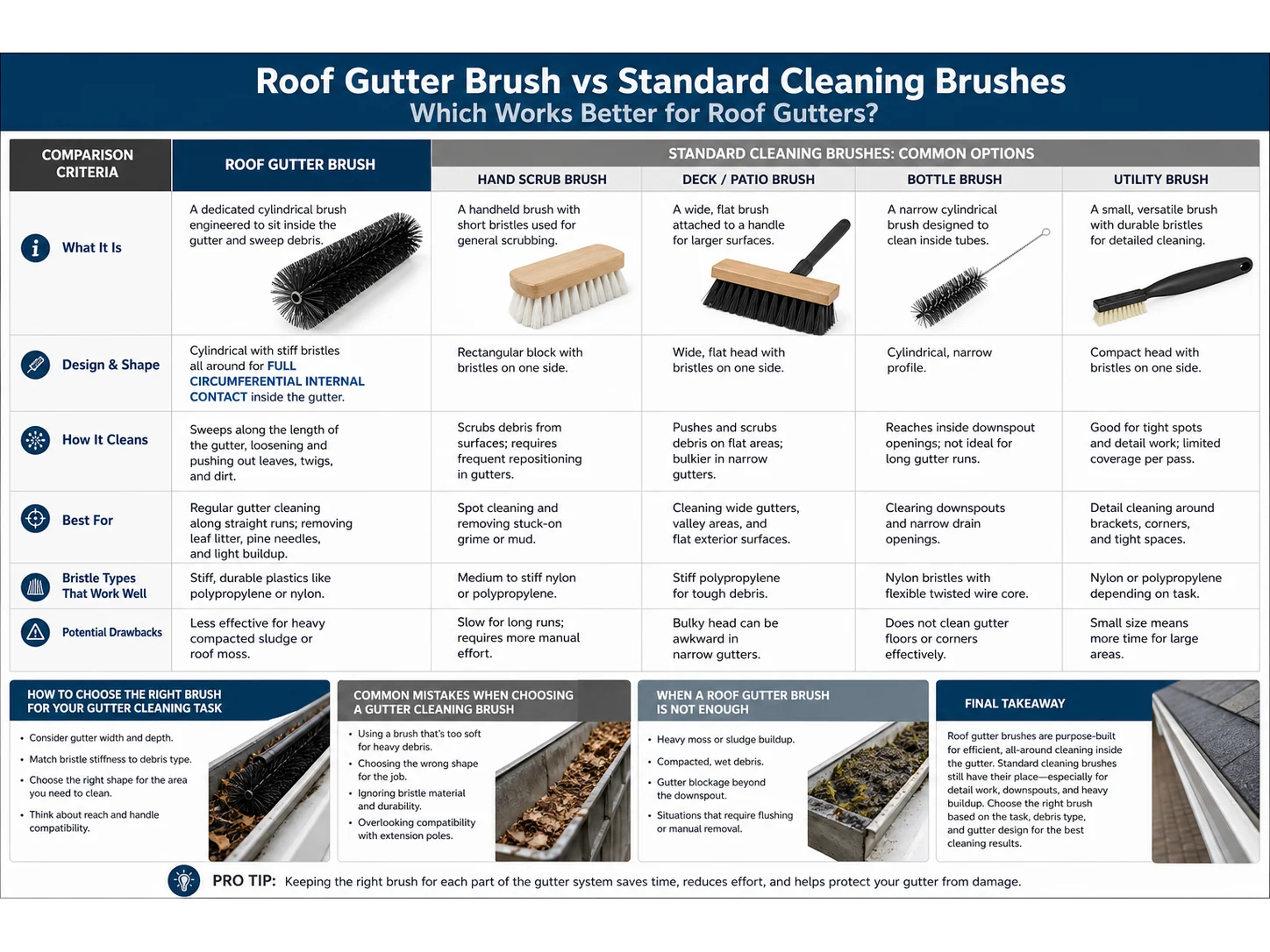
A roof gutter brush is a narrow, long-bristled brush engineered to fit inside standard residential or commercial gutters. The bristles are usually made from polypropylene, nylon, or soft wire, and the brush often comes with a threaded handle socket for extension poles. Its shape and stiffness are tailored to conform to the gutter’s internal profile while being gentle enough to avoid marring protective coatings on aluminum, vinyl, or painted steel. Unlike a general-purpose scrub brush, a roof gutter brush prioritizes debris lift-out power with minimal surface abrasion.
Standard Cleaning Brushes for Roof Gutters: What Are the Options?
When a dedicated gutter brush isn’t available, many people reach for common cleaning brushes. The table below summarizes four typical choices.
| Brush Type | Common Material | Stiffness | Best for Gutter Material | Risk of Scratching | Debris Removal Effectiveness |
|---|---|---|---|---|---|
| Dedicated Roof Gutter Brush | Polypropylene, nylon, or soft wire | Medium-soft to medium | Aluminum, vinyl, steel | Low (if soft bristles) | High for loose debris, moderate for compacted sludge |
| Standard Hand Wire Brush | Carbon steel or stainless steel wire | High | Steel, copper, or stainless gutters | High on aluminum/vinyl | High for rust, scale, but can damage soft metals |
| Stiff Nylon Deck Brush | Nylon | Medium-high | Aluminum, vinyl, painted steel | Moderate | Good for dry leaves, may struggle with wet matted debris |
| Roof Cleaning Wire Brush (long handle) | Galvanized or stainless wire | High | Asphalt shingle prep, metal roofs | Very high if used on gutters | Aggressive; not recommended for delicate gutter interiors |
How to Choose the Right Brush for Your Gutter Cleaning Task
Selecting between a roof gutter brush and a standard brush comes down to five practical factors:
- Gutter material sensitivity: Aluminum and vinyl gutters scratch easily. Choose polypropylene or soft nylon bristles. Save wire brushes for unpainted galvanized steel or copper gutters where patina is acceptable.
- Debris type: Dry leaves and loose pollen brush away with medium-soft bristles. Wet, matted leaves, moss, or compacted organic sludge require stiffer bristles—but never metal unless the gutter is metal and uncoated. A polypropylene gutter brush with crimped bristles often balances stiffness and safety.
- Handle or pole compatibility: Most roof gutter brushes have a standard ¾-inch or 1-inch ACME or quick-connect socket for extension poles. Standard deck brushes may use a broom handle thread; wire brushes often lack any socket. Confirm the attachment before buying.
- Chemical or wet exposure: If you use cleaning solutions or degreasers, nylon and polypropylene resist most household chemicals. Natural fiber or low-grade steel bristles can degrade and shed into the gutter.
- Maintenance frequency and hygiene: Brushes used near potable water collection or in food-grade environments should be non-porous and easy to sanitize. Smooth nylon tufts harbor fewer bacteria than natural bristles or rough wire.
Also consider custom size requirements: narrow 4-inch gutters or deep commercial box gutters may need brushes with custom diameter, bristle trim length, or angled head. In such cases, a standard off-the-shelf brush rarely fits well; a configurable roof gutter brush from an industrial brush supplier is a better investment.
Common Mistakes When Choosing a Gutter Cleaning Brush
- Ignoring bristle stiffness: Grabbing the stiffest brush available because “it cleans faster.” On aluminum gutters, this creates deep scratches that collect dirt and speed up corrosion.
- Using long-handle wire brushes (roof cleaning wire brush) inside gutters: These are designed for roofing surface prep, not gutter interiors. The wire gauge is too aggressive and the brush width often exceeds the gutter channel, damaging sidewalls.
- Wrong brush diameter: A brush too large for the gutter gets stuck; one too small leaves residue zones. Most residential gutters need a brush head about 4–5 inches wide and 2–3 inches tall to contact the bottom and sides without binding.
- Overlooking handle attachment: Threaded sockets, push-lock poles, and clamp-style handles all differ. A brush without a secure pole connection wastes time and risks dropping the tool from a ladder.
- Assuming all nylon is safe: Abrasive-impregnated nylon (grit-filled bristles) can scratch nearly as much as wire. Check the manufacturer’s description for abrasion grade.
When a Roof Gutter Brush Is the Wrong Choice
Even the best roof gutter brush has limits. If your gutters have hardened, baked-on organic crust or thick moss that has bonded to the metal, a brush alone will not remove it without excessive scrubbing and potential damage. In those cases, pre-soaking with a gutter-safe cleaning solution or using a low-pressure power washer with a gutter wand attachment may be necessary. Similarly, downspouts clogged with compacted debris require a plumber’s snake or specialized auger; a brush cannot navigate the tight bends. For heavily deteriorated gutters with peeling paint or rust through the metal, mechanical cleaning can accelerate failure—consider replacement instead. When in doubt, a professional inspection or a sample cleaning test on a short gutter section helps validate your approach.
Final Takeaway
A dedicated roof gutter brush—with properly matched bristle material, stiffness, and pole connection—remains the safest and most efficient choice for routine gutter maintenance on most residential and light commercial buildings. Standard wire brushes, deck brushes, or roofing wire brushes sometimes seem like cost-saving alternatives, but they often increase the risk of surface damage, poor fit, and inconsistent cleaning. Match the brush to both the gutter material and the type of debris, and when the task goes beyond routine removal, bring in supplementary tools or professional help.
Frequently Asked Questions
Can I use a standard wire brush on aluminum gutters?
It is not recommended. Even a fine stainless steel wire brush can leave scratches on soft aluminum, removing protective coatings and leading to corrosion. Stick with polypropylene or soft nylon for aluminum and vinyl gutters.
What bristle stiffness is best for removing wet leaves?
Medium-stiff polypropylene bristles (often described as firm or crimped) provide enough aggressive action to pull out wet leaves without gouging the gutter. Avoid the stiffest industrial grit brushes and any metal wire.
How do I attach a gutter brush to an extension pole?
Most dedicated roof gutter brushes come with a standard threaded socket. Look for a ¾-inch or 1-inch ACME thread, which matches most painter’s poles and universal extension handles. Some brushes use a quick-connect button lock; verify before purchase.
Are nylon brushes better than wire for roof cleaning?
For gutter interiors, yes—nylon is safer and still effective. For actual roof surface cleaning (shingles or metal roofing), specially designed soft-wire brushes or poly brushes with roof-appropriate stiffness are common. The term “roof cleaning wire brush” usually refers to a heavy-duty tool for roofing prep, not gutter maintenance.
Can a roof gutter brush also clean downspouts?
Most roof gutter brushes are too wide to fit inside a standard 2×3-inch or 3×4-inch downspout. A separate downspout cleaning brush or a plumbing snake is needed for blockages deep inside the spout.
How often should I replace my gutter brush?
With regular use, a quality polypropylene brush can last one to two seasons. Replace it when bristles become crushed, splayed, or permanently bent, as it will lose cleaning effectiveness and may hold debris instead of releasing it.
What size brush fits standard 5-inch gutters?
A brush head approximately 4 to 5 inches wide and 2.5 to 3 inches tall is ideal for a typical 5-inch K-style gutter. This allows the bristles to reach the bottom corners and sidewalls without binding.
Technical References
Which bristle material fits this job — Nylon PA, AISI 304 Stainless Steel Wire or Polypropylene PP?
| Material | Continuous temperature (°C) | Peak temperature (°C) | Water absorption | Hardness |
|---|---|---|---|---|
| Nylon PA | 93 | 121 | 0.3–9% by PA grade and conditioning | Medium to firm; filament diameter and trim length control bending force. |
| AISI 304 Stainless Steel Wire | 400 | 500 | 0% | Rockwell B 70–95 depending on temper and cold work |
| Polypropylene PP | 80–100 | 120–140 | ≤0.03% | Shore D 65–75 |
| UV-resistant Anti-aging Filament | 140 | 170 | 0.1–1.0% | Defined by the carrier polymer, diameter and weathering condition. |
Figures as published by Brushtec / DuPont; Alleima; Perlon. Confirm the exact grade against the supplier datasheet before ordering.
What should replace Handheld Detail Brushes for gutter?
- Handheld Detail Brushes — Handheld detail brushes cover general precision cleaning; auto-detailing brushes impose tighter controls for painted, polished, leather, display, and trim surfaces.
- Nylon PA — Compare Nylon PA with PP, PBT, PET. Change material when wet stiffness, temperature, chemical resistance, conductivity, particle shedding, or surface marking becomes the limiting factor.
- AISI 304 Stainless Steel Wire — Use AISI 316 stainless steel wire for chloride, marine, dairy, beverage, chemical washdown, or higher pitting-resistance requirements. Use carbon steel for dry aggressive cutting and brass or abrasive nylon for lower marking risk.
- Polypropylene PP — Compare Polypropylene PP with Nylon, PBT, PET. Change material when wet stiffness, temperature, chemical resistance, conductivity, particle shedding, or surface marking becomes the limiting factor.