
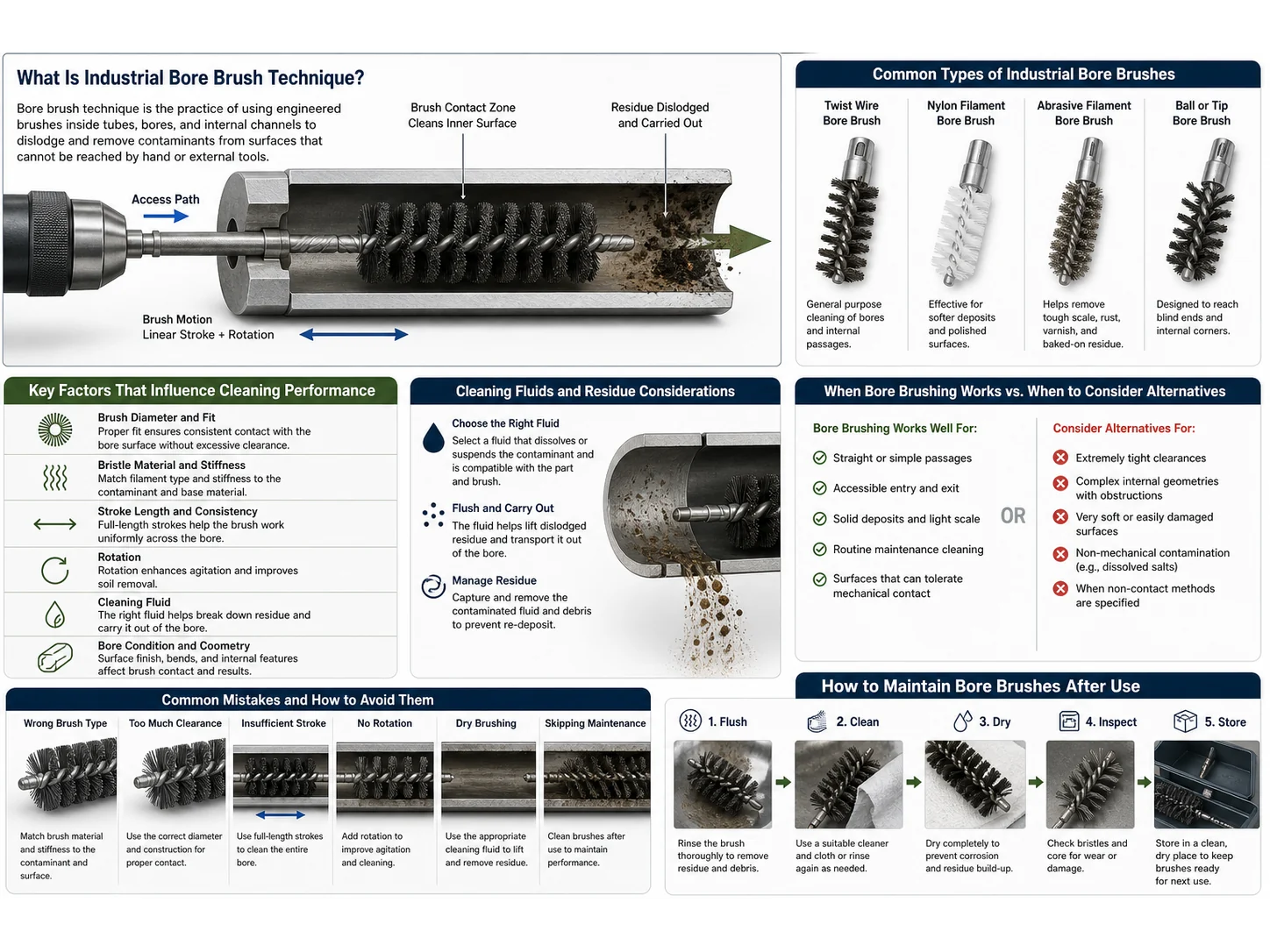
What Is Industrial Bore Brush Technique?
Industrial bore brush technique involves the controlled use of a cylindrical brush—typically driven manually or by a power tool—to remove contamination from the internal surface of a cylindrical passage. The goal may be cleaning, deburring, surface finishing, or preparation for further processing. The technique is distinct from simple rod‑and‑rag methods because the brush conforms to the bore and can reach recessed areas, cross‑holes, and blind passages that other tools cannot. The key parameters include brush diameter relative to the bore, stroke type (reciprocating or one‑pass), rotation speed and direction, and the choice of lubricant or cleaning fluid.
Common Types of Industrial Bore Brushes
Choosing the right brush design is the first step in an effective technique. Each type suits a different residue, base material, and finish requirement.
| Brush Type | Fill Material | Typical Use | Best For |
|---|---|---|---|
| Twisted‑in‑Wire | Carbon steel, stainless steel, brass | Aggressive heavy‑duty cleaning | Removing hard scale, rust, or carbon deposits |
| Nylon Abrasive | Nylon with silicon carbide or aluminum oxide | Deburring, light edge blending | Cross‑hole burr removal without damaging base metal |
| Non‑abrasive Nylon | Nylon, polypropylene | Wiping, applying fluids, light dust removal | Polished or coated bore surfaces where scratching is a concern |
| Tube Brush (Double‑spiral) | Stainless steel, brass, or nylon | Heat exchanger tubes, boiler tubes | Straight tubes with moderate fouling |
| Hole Cleaning Wire Brush | Steel wire, often with a looped handle | Small‑diameter holes,threaded holes | Quick hand cleaning of blind or short holes |
Key Factors That Influence Cleaning Performance
Several operational choices directly affect how well a bore brush cleans and whether it poses a risk to the bore surface.
- Brush Diameter – The brush should be slightly larger than the bore to maintain interference. Too much interference can stall the tool or break the brush; too little leaves residue behind.
- Stroke Direction – Reciprocating strokes are common, but in blind holes, a single direction with controlled retraction may be better to avoid packing debris at the bottom.
- Rotation – Powered rotation improves consistency; slow to moderate speeds are preferred to prevent heat buildup and wire fatigue. Avoid reversing direction under load, especially with wire brushes, as it can splay the wires or cause uneven wear.
- Lubricant/Cleaning Fluid – A compatible fluid flushes away loosened particles and cools the brush. For dryable residues, use a volatile solvent; for oils, a degreaser; for water‑soluble soils, a water‑based cleaner. Always check chemical compatibility with the bore material.
- Residue Type – Soft, oily films may call for nylon brushes and degreasers, while hard scale needs aggressive wire brushes and possibly acidic or alkaline cleaners.
- Bore Finish Requirement – If the bore has a tight surface finish specification, start with non‑abrasive alternatives or test on a scrap piece. Abrasive nylon brushes can be used for controlled surface texturing, but only when the resulting Ra value is acceptable for the application.
Cleaning Fluids and Residue Considerations
The right lubricant or solvent does more than help the brush slide—it captures and transports the debris. Without fluid, you risk embedding particles into the bore wall, overheating the brush, and creating airborne dust. Light machine oils, solvent‑based cleaners, or water‑based degreasers are common choices. Always remove all fluid residue afterward, especially if the bore will later receive a coating or assembly with seals. For food‑grade or medical applications, verify that the fluid meets the necessary hygiene standards.
When Bore Brushing Works vs. When to Consider Alternatives
Bore brushing is effective for routine maintenance cleaning, light to moderate fouling removal, deburring cross‑holes, and surface preparation. However, there are times when other techniques are more appropriate.
- Honing – When precise dimensional correction, surface finish improvement, or cross‑hatch pattern creation is required, honing is a better choice. Brushing can complement honing by removing honing oil residue but does not replace it.
- Flushing – For extremely long, small‑diameter passages or when the bore network is complex, high‑pressure flushing with a fixture may reach areas that a brush cannot.
- Ultrasonic Cleaning – If the part is small enough to be submerged and the contamination is in blind cavities or intricate ports, ultrasonic cleaning provides more uniform coverage than manual brushing.
- Custom Internal Brushes – When a production line processes thousands of identical bores, a custom‑designed brush with a dedicated drive system can improve consistency and reduce operator fatigue.
Common Mistakes and How to Avoid Them
- Forcing the brush – If the brush is too tight, do not hammer it in; select a slightly smaller diameter or a different fill material. Forcing can break the stem inside the bore or gall the bore wall.
- Aggressive reversing under load – Suddenly reversing a wire brush while it is engaged can bend the wires permanently and create uneven cleaning. Always stop rotation before changing direction, or use a brush designed for reversible operation.
- Ignoring cross‑hole burrs – When a bore intersects a cross‑hole, burrs can form on the intersection edges. A standard bore brush may skip over them; consider an abrasive nylon brush or a dedicated deburring tool first.
- Neglecting brush maintenance – A brush loaded with old debris can re‑deposit contamination. Clean the brush after each use (see FAQ) and inspect for loose or broken wires.
- Using the same brush for incompatible materials – Carbon steel brushes may rust‑contaminate stainless steel bores. Use stainless steel brushes for stainless steel applications or dedicated nylon brushes.
How to Maintain Bore Brushes After Use
Proper brush care extends its life and prevents cross‑contamination.
- Remove debris: back‑brush against a clean cloth or use compressed air to blow out trapped particles.
- Wash the brush in an appropriate solvent or detergent to remove residual oil and chemicals.
- Inspect for worn or bent wires, especially near the stem, and replace if damaged.
- Store in a dry, protected location to prevent corrosion and deformation.
Final Takeaway
Effective industrial bore brush technique is not about speed or force—it’s about matching the brush type, diameter, fluid, and motion to the bore material, residue, and finish requirement. By avoiding common mistakes such as forcing the brush or reversing under load, you protect both the tool and the workpiece. When the limitations of brushing are reached, more specialized processes like honing, flushing, or ultrasonic cleaning offer proven alternatives. Applying these principles helps maintenance and production teams keep internal channels clean without sacrificing quality or safety.
When a Bore Brush Is the Wrong Choice
This brush is not enough when the main problem is blocked access, unsafe working conditions, damaged equipment, incompatible chemicals, or a process setting that keeps recreating the residue. In those cases, review bore diameter, brush material, solvent handling, and the equipment maker’s own cleaning procedure and confirm the surrounding cleaning method before increasing brush stiffness or contact pressure.
Frequently Asked Questions
Can I use a bore brush with any cleaning solvent?
No. The solvent must be compatible with both the brush fill material (e.g., nylon may degrade in strong acids) and the bore’s base metal. Always check chemical compatibility charts and follow safety data sheet recommendations.
How do I know if the brush diameter is correct?
As a general guideline, the brush diameter should be 10–20% larger than the bore ID for wire brushes, and slightly less for abrasive nylon types. The correct size provides noticeable drag without stalling a power tool. Test on a scrap piece first.
Should I rotate the brush during manual cleaning?
Yes. Rotation helps the bristles contact the entire circumference and prevents grooving. Even with a hand‑held brush, a twisting motion combined with the stroke improves cleaning uniformity.
What’s the risk of reversing direction aggressively in a tight bore?
Reversing direction while the brush is under load can splay the wires outward, permanently damaging the brush and potentially scratching the bore. Always ease off pressure and stop rotation before reversing, or use a design rated for bidirectional use.
How do I clean a bore brush after use?
Remove loose debris by spinning the brush against a clean rag or using compressed air. Then wash the brush in a suitable solvent or detergent, rinse, and dry. Inspect for broken or bent wires before storage.
When should I switch to ultrasonic cleaning instead of brushing?
Choose ultrasonic cleaning when the part is small enough to submerge and has complex internal passages that a brush cannot fully reach, or when residue is tightly adhered in blind cavities. Ultrasonics also eliminate the risk of mechanical scratching.
Can I use a wire brush for cross‑drilled holes?
Yes, but take care. A standard twisted‑wire brush may snag on the cross‑hole edges. A nylon abrasive brush is often better for deburring these intersections without gouging the bore wall.
Is there a standard speed for power brushing?
There is no universal speed; it depends on bore size, brush material, and residue. Start at a low RPM and increase only until cleaning action is effective. Excess speed generates heat and can fatigue the wires prematurely.
Which bristle material fits this job — Nylon PA, AISI 304 Stainless Steel Wire or Abrasive Nylon?
| Material | Continuous temperature (°C) | Peak temperature (°C) | Water absorption | Hardness |
|---|---|---|---|---|
| Nylon PA | 93 | 121 | 0.3–9% by PA grade and conditioning | Medium to firm; filament diameter and trim length control bending force. |
| AISI 304 Stainless Steel Wire | 400 | 500 | 0% | Rockwell B 70–95 depending on temper and cold work |
| Abrasive Nylon | 120 | 150 | 0.1–1.0% | Abrasive filament; stiffness and cutting level is controlled by PA base, grit type, grit size, filament diameter and trim height. |
| Copper Wire | 150–200 | 250–300 | 0% | Rockwell B 20–80 |
| Brass Wire | 150–200 | 250–300 | 0% | Rockwell B 40–90 |
Figures as published by Brushtec / DuPont; Alleima; Perlon. Confirm the exact grade against the supplier datasheet before ordering.
What should replace Tube & Pipe Bore Brushes for bore brush?
- Tube & Pipe Bore Brushes — Tube and bore brushes work by radial contact inside a confined diameter; wire wheels and cups work mainly on external edges, profiles, welds, and broad surfaces.
- Nylon PA — Compare Nylon PA with PP, PBT, PET. Change material when wet stiffness, temperature, chemical resistance, conductivity, particle shedding, or surface marking becomes the limiting factor.
- AISI 304 Stainless Steel Wire — Use AISI 316 stainless steel wire for chloride, marine, dairy, beverage, chemical washdown, or higher pitting-resistance requirements. Use carbon steel for dry aggressive cutting and brass or abrasive nylon for lower marking risk.
- Abrasive Nylon — Compare Abrasive Nylon with PP, PBT, PET. Change material when wet stiffness, temperature, chemical resistance, conductivity, particle shedding, or surface marking becomes the limiting factor.