
Custom Cleaning Brush
Industrial Roller Cleaning Brush
Custom industrial roller cleaning brushes for conveyors, rollers, chains, rails, and web paths.
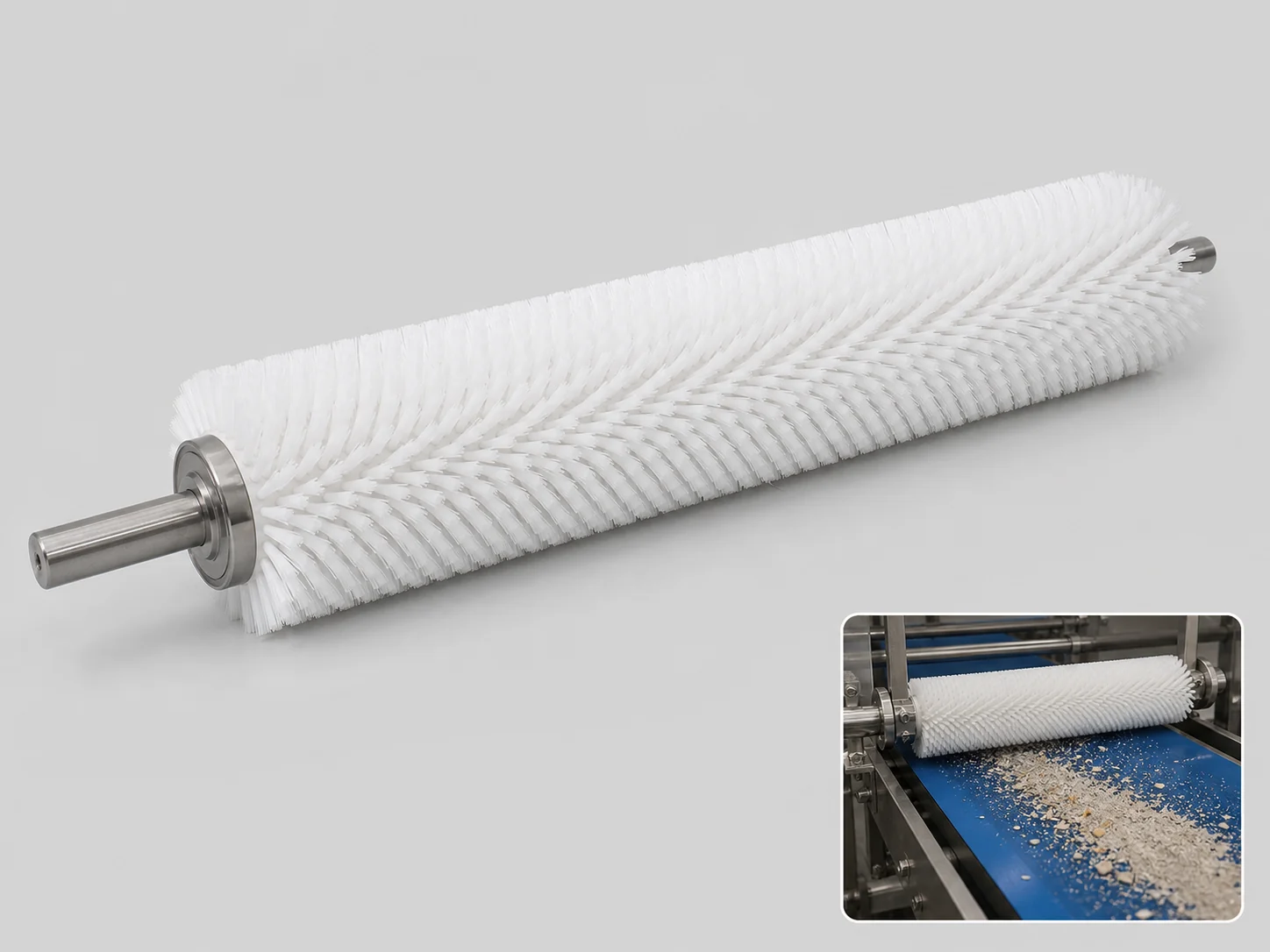
Large-format brush
100 pcs
Minimum order
Built one at a time on a core or channel: full-width rollers, sweeper brooms and long strip.
Production lead time, once the specification is confirmed
- Up to 100 pcsWithin 20 days
- 101–1,000 pcsWithin 30 days
- Over 1,000 pcsConfirmed with your quotation
Peak season can extend these times; the shipping date is confirmed in writing with your quotation. Sampling and shipping are quoted separately.
An industrial roller cleaning brush is a rotating, machine-mounted brush that removes powder, crumbs, fibers, chips, labels, film fragments, oil, and sticky carryback from conveyor belts, rollers, chains, rails, transfer points, web paths, and machine guides while the line keeps running. It is built to the shaft, journals, core, diameter, and mounting envelope of the production equipment it serves, so the brush becomes a replaceable machine component rather than a retrofit guess.
What can this brush do for you?
Keeps carryback off the belt between scheduled shutdowns
A full-width roller brush maintains continuous contact with moving surfaces, so debris is removed where it forms instead of accumulating during a shift. On return-side conveyor belts, this stops fines and sticky material from being transferred to idlers, pulleys, and the plant floor.
Adjustable trim and filament stiffness follow the surface profile
Trim length and filament diameter are matched to the belt, roller, or web so bristles flex enough to stay engaged across crowned rollers, spliced belts, and slightly uneven surfaces without digging into the substrate. The brush cleans the surface that actually passes, not only the high points.
Helical winding moves residue off the working face
Close-wound, pitch-wound, and helical strip construction are available. The winding pattern can be selected so removed material is redirected along the brush axis or thrown clear at the ends, reducing the chance that particles pack into one area and are redeposited on the next pass.
Fill material matches the residue and the surface sensitivity
Nylon PA handles dry powders, crumbs, fibers, and chips. PP stands up to wet, acid, or alkali washdown conditions. PBT adds stiffness and heat resistance. Abrasive nylon scrubs fine films, and wire fill is available for cured or heavy carryback on wear-tolerant substrates. The result is enough cleaning force without unnecessary wear on the belt or machine frame.
Built as a machine component, not a one-size roll
Core diameter, shaft diameter, keyway, journals, bearing centers, rotation direction, and maximum brush OD are taken from the machine drawing. The brush aligns with existing guarding and drive hardware, and long working faces can be split or segmented to reduce deflection and simplify replacement.
What is an Industrial Roller Cleaning Brush?
An industrial roller cleaning brush is a cylindrical brush assembly with filament fill secured to a central core. It mounts adjacent to, above, or below a moving belt, roller, chain, rail, or web and uses rotating bristle contact to dislodge particles and loose deposits from the working surface.
In most installations, the brush is either driven by a motor, chain, gearbox, or belt take-off, or runs as an idler brush that rotates from contact with the moving surface. The brush either counter-rotates against the material path for stronger sweeping action or rotates with the path for gentler cleaning on sensitive webs. Engagement is the overlap between the unrestricted brush OD and the surface that passes through it; it is set for the specific process rather than copied from a fixed rule. Too little engagement leaves residue behind, and too much increases filament stress, drive load, and brush wear without improving the result.
The brush is a production-line cleaning component. It is not a manual scrub tool, a blade scraper for heavy embedded buildup, or a replacement for washdown, vacuum extraction, or sanitizing steps. It works best when the machine geometry, residue type, surface speed, and environment are defined before the brush is built.
Technical Specifications
| Parameter | Value / Options |
|---|---|
| Brush outside diameter | 80–400 mm, matched to available clearance and required engagement |
| Working length (face width) | 100–5000 mm, built to belt, roller, chain, or web width |
| Core diameter | 25–200 mm, sized for shaft loading and filament support |
| Trim length | 10–80 mm, set from surface profile, wear allowance, and required flexibility |
| Fill materials | Nylon PA, PP, PBT, abrasive nylon, or wire, selected from substrate and duty |
| Filament diameters | Nylon PA 0.05–1.2 mm; PP 0.07–2.0 mm; PBT 0.15–0.2 mm; wire diameter per project |
| Winding configuration | Close wound, pitch wound, or helical strip-roller construction |
| Core / shaft | Steel, stainless steel, aluminum, or polymer core with integral or inserted shaft, journals, and keyways per drawing |
| Drive interface | Plain shaft, keyed shaft, taper, or customer-specified bore, sprocket, or pulley mounting |
| Operating speed | Set from line speed, brush OD, and residue type to avoid filament override, flutter, and imbalance |
| Environment | Material grade selected for moisture, washdown chemicals, temperature, dust, oil, and static generation |
| Brush type | Custom Roller and Conveyor Brushes |
| How it is driven | Machine-driven, mounted in the equipment |
| Cleaning target | return-side conveyor belt, roller and idler face, and guide cleaning |
| Surface or part | roller, belts, webs, chains, rails, conveyors, machine guides, and transfer points |
| Residue or debris | chips, crumbs, fiber, powder, film fragments, labels, sticky carryback, and particles |
| Mounting / connection | Plain shaft, keyed shaft, taper, or customer-specified bore, sprocket, or pulley mounting |
All values shown are configurable project ranges. A machine drawing or sketch with shaft journals, bearing centers, available clearance, and rotation direction lets us confirm the exact geometric envelope before production.
Where does this brush work best?
- Return-side conveyor belt cleaning in food processing, snack, bakery, pet food, woodworking, aggregate, and material handling lines, where powder, crumbs, chips, and carryback must not reach idlers or the floor.
- Roller and idler face cleaning in printing, coating, laminating, film extrusion, and converting lines, where fibers, labels, film fragments, and dust disrupt tracking or transfer quality.
- Chain, rail, and guide cleaning on packaging and assembly lines, where spilled product, label residue, or sticky material accumulates on track surfaces.
- Web path and machine guide cleaning for paper, nonwoven, and flexible material processes, where clean rolls keep tension and edge control stable.
- Transfer point and nose bar cleaning, where material drops off the belt and tends to build up on nip points, knife edges, and chute faces.
In each case, the brush provides continuous cleaning while production runs. It is selected when the surface moves, when debris is loose or lightly attached, and when the machine has mounting points for a driven or idler brush.
How do I choose the right one?
Start with mounting and drive geometry
Work from the machine drawing first. Confirm shaft diameter, journal length and spacing, bearing centers, available clearance, maximum allowable brush OD, rotation direction, and the type of drive connection. The brush must fit inside guarding and clear adjacent frames, and the shaft must handle the bending load across the working length.
Define the substrate and its sensitivity
Record what the brush will contact: belt surface material and condition, roller finish, chain type, rail material, or web coating. Soft or coated substrates usually call for softer, smaller-diameter nylon or PP filaments. Wear-tolerant steel surfaces can accept stiffer PBT, abrasive nylon, or wire without damage.
Match fill material to the residue and environment
Dry powders, crumbs, fibers, and chips are well handled by nylon PA. Wet, acidic, or alkaline conditions favor PP. Elevated process temperatures or the need for greater stiffness favor PBT. Fine films and residue that adheres to the surface may require abrasive nylon. Cured, heavy, or mineralized carryback needs wire or a pre-stage scraper before brushing. Moisture, chemicals, temperature, and static generation all influence the final filament grade.
Set engagement and trim from the actual process
Do not apply a fixed engagement such as 2–10 mm to every roller. Start with light contact, run at production speed, and increase engagement in small steps until the target surface is clean. Longer trim provides more compliance and wear allowance but less direct pressure; shorter trim gives firmer, more aggressive contact. Record the final setting for future replacements.
Select the winding for the cleaning action you need
A close winding gives dense, even coverage across the face and works well for fine residue. Pitch or helical winding carries larger particles along the axis and sheds them at the ends, which suits crumbs, chips, and sticky fragments. Strip-roller construction allows individual strip replacement and can be advantageous for wide faces or high-speed lines.
Use a different tool when the job does not fit a roller brush
Choose a blade scraper, air knife, or vacuum system when residue is hard, embedded, or primarily liquid. Choose a wire brush only where the surface can tolerate wire contact and the residue is cured, rust-like, or mineralized. Choose disposable wipes or swabs where cross-contamination is the main concern. The roller cleaning brush is the right choice when continuous mechanical contact with a moving surface is the most practical cleaning method.
Can I customize this brush?
Yes. Industrial roller cleaning brushes are configured from the machine geometry and process. To define the brush, provide the shaft and mounting drawing, surface width, belt or web speed, brush rotation direction, available clearance, residue description, environment, and preferred fill material. A photo or sketch of the current problem area also helps.
We can adjust:
- Working length, brush outer diameter, core diameter, trim length, and total shaft length
- Shaft diameter, material, journal style, keyway, flats, and drive connection
- Fill material and filament diameter: nylon PA, PP, PBT, abrasive nylon, or wire; straight, crimped, or flagged filaments; custom filament density and cluster pattern
- Construction: close wound, pitch wound, helical, multiple strip rows, segmented sections, or split designs for long faces
- Core and hardware: steel, stainless steel, aluminum, or polymer; flanged, welded, or bolted construction as needed
- Color, marking, identification coding, and custom packaging for plant or distribution requirements
If your project requires material documentation, inspection, or third-party testing, we can assist with those requirements as part of the customization process.
When is an industrial roller cleaning brush worn out rather than just dirty?
How do I find the right engagement depth for my belt or roller?
Install the brush with light contact, run the line at production speed, and inspect the surface and downstream rollers. Increase engagement in small increments until the carryback or film is removed. Stop when additional engagement stops improving the result, and watch for excessive filament buckling or increased drive load. Record that setting in maintenance documentation.
Should the brush rotate with or against the surface direction?
Most conveyor and roller cleaning works best in counter-rotation, where the brush tip moves against the surface travel direction to lift and throw debris clear. Some sensitive webs or coated surfaces benefit from with-rotation contact, which is gentler. Confirm the correct rotation direction before startup and make sure the drive wiring or gearbox is set accordingly.
Does a roller cleaning brush replace washdown or sanitizing?
No. The brush removes attached particles, films, and carryback mechanically. It does not replace washing, chemical sanitizing, vacuum extraction, or blade scraper systems. Removed debris must still be collected, and any hygiene step required by the plant process remains a separate operation.
How can I tell when the brush needs replacement?
Measure the brush OD at several points across the face and compare it to the new value. Replace the brush or strip when diameter loss approaches the wear allowance set for the line, when filaments break or pack down and no longer spring back, or when drive current rises because contact has degraded. Uneven wear at the edges or center is also a reason to inspect alignment and mounting before reordering.
What should I check before putting a new roller brush into service?
Confirm shaft alignment, journal fit, rotation direction, guarding, and fastener security. Check that the brush turns freely and that no filaments are trapped or compressed from shipping. Run the brush briefly without contact, then bring it into the working engagement setting while the line is at controlled speed.
Can I mount a roller brush on an existing machine without a new drive?
Often yes. An idler or contact brush can be mounted so the moving belt, roller, or web rotates it directly, provided there is room and the debris is loose or lightly attached. For sticky carryback, heavy fines, or high line speeds, a driven brush usually gives more reliable cleaning. The machine drawing will show which option fits.
Guides that go deeper on this
Abrasive Nylon Grit and Filament Selection
Read this guideGuideBrush Roller Conveyor Mistakes with Dry Dust
Read this guideGuideBrush Speed, Engagement, and Heat
Read this guideGuideCleaning, Drying, and Storing Industrial Brushes
Read this guideGuideConveyor Belt Cleaning Brush Design
Read this guideCustom Manufacturing RFQ
Describe Your Application
Please share the brush dimensions, working area, residue type, material direction, quantity, and a drawing or photo for quotation.
Drawing or photo optional — it speeds things up, it does not gate the enquiry.
Custom Brush RFQ
Send Your Brush Project
Upload a drawing, product photo, or sample photo and provide the core dimensions and cleaning conditions.
“We need a brush to remove wet residue from a stainless steel conveyor, about 800mm wide. The current brush wears quickly. We can send photos.”
“We sell drinkware and need a cleaning brush to include with the product. Quantity around 5,000 pieces.”