
Custom Cleaning Brush
Lipstick Mold Cleaning Brush
Custom lipstick mold cleaning brush with nylon PA or PBT filaments for cavity, split line, and mating surface residue removal.
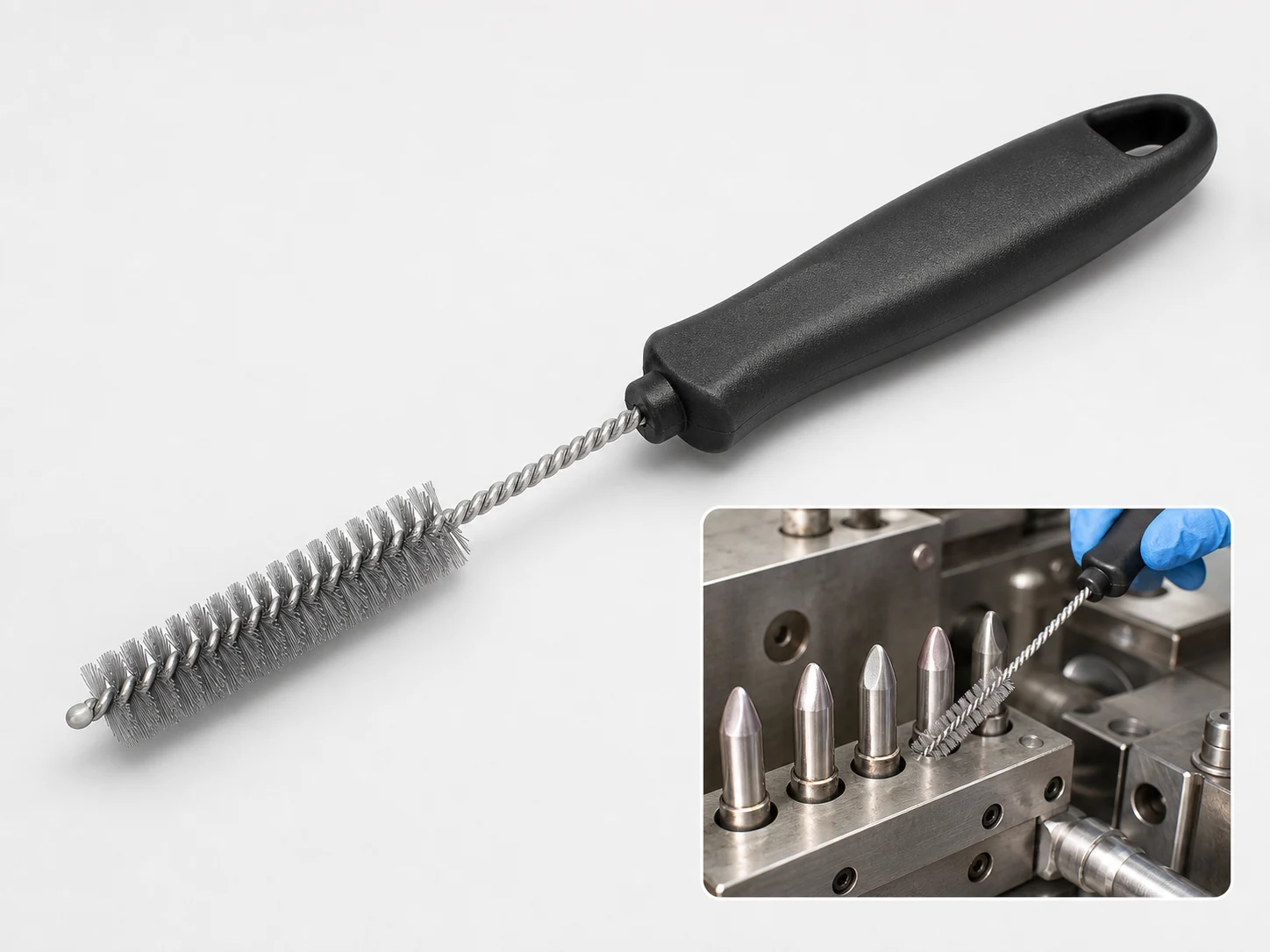
Small brush
500 pcs
Minimum order
Held in one hand: tube, bottle, detail and swab brushes — including long-handled ones with a small head.
Production lead time, once the specification is confirmed
- Up to 500 pcsWithin 7 days
- 501–50,000 pcsWithin 14 days
- Over 50,000 pcsWithin 21 days
Peak season can extend these times; the shipping date is confirmed in writing with your quotation. Sampling and shipping are quoted separately.
A precision detail brush for lipstick mold cavities, split lines, and mating faces that removes wax, oil film, and pigment residue without scratching polished cosmetic tooling. Filament material, diameter, trim profile, and handle reach are matched to cavity geometry and approved cleaning chemistry.
What can this brush do for you?
Reaches the deepest point of a bullet cavity without oversizing the entry
The brush head diameter and trim length are set to the cavity opening and internal depth, so the filament bundle enters freely and the tips contact the bottom without jamming against the sidewall. Operators do not have to force the brush into a tight cavity or leave a dead zone at the tip.
Lifts wax and pigment film instead of polishing it into the mold surface
Nylon PA or PBT filaments with controlled diameter and rounded or crimped tips loosen residue through mechanical action rather than abrasion. On mirror-polished brass, aluminum, or plated cavities, this protects the finish while still removing the build-up that causes shade contamination.
Stands up to alcohol and solvent-based mold cleaning
PBT filaments resist alcohols, ketones, and many cosmetic-grade solvents; nylon PA handles isopropanol, ethanol, mild alkaline cleaners, and warm wash solutions. The core and handle are selected to match, so the brush does not soften, swell, or shed when used with the customer’s approved cleaner.
Cleans split lines and mating faces with an angled or flat trim
A round filament bundle only contacts the top of a parting line. A flat or angled trim follows the split line and sealing surfaces where color bleed starts, helping the mold halves seat cleanly and reducing sticking between shades.
Covers multi-cavity mold sets without repositioning the block
When the mold has several bullet cavities, the handle and stem can be extended so one brush reaches across the entire block. This shortens cleaning time between batches and keeps the operator’s hand out of the solvent spray path.
What is a Lipstick Mold Cleaning Brush?
A Lipstick Mold Cleaning Brush is a small hand-guided filament brush built specifically for the cavity and accessible surfaces of lipstick bullet molds and related cosmetic forming tools. It is not a general-purpose acid brush or bottle brush. The filament material, diameter, density, trim profile, and handle reach are engineered around the mold’s cavity shape, the residue it leaves, and the cleaner used to remove it.
In a typical changeover, the operator wets the brush or the mold with an approved solvent or detergent cleaner, inserts the head into the cavity, and uses short push-pull or rotating strokes to loosen waxes, oils, and pigment film. The same brush then works across the split line, top plate, and any accessible ejector pin recesses. A final rinse or wipe removes the loosened material.
Because the brush contacts production tooling, two operating rules matter. The brush must not shed filaments into the cavity, and it must not scratch the finished surface. Filament ends are selected and treated for the mold finish, and any metal ferrule is recessed or covered. The tool is designed for regular color changes and preventive cleaning, not for removing baked-on, polymerized, or hardened deposits; those residues require soaking, ultrasonic cleaning, or a more aggressive process first.
Technical Specifications
The values below are typical starting points for lipstick mold detail brushes and are adjusted for each project.
| Parameter | Value / Options |
|---|---|
| Filament material | Nylon PA 6/6, PBT, or a nylon-PBT blend selected for cleaning chemistry and mold finish |
| Filament diameter | 0.10 to 0.30 mm (0.004 to 0.012 in); finer for mirror-polished cavities, thicker for matte surfaces or heavier wax |
| Head diameter | 6 to 15 mm typical, matched to the smallest cavity opening |
| Trim length | 8 to 25 mm from ferrule, adjusted to cavity depth and required stiffness |
| Overall length | 150 to 300 mm, handle reach matched to mold block depth and operator control |
| Stem / core | Twisted stainless steel wire, coated stainless wire, or molded plastic for metal-free use |
| Handle material | Polypropylene, nylon, or stainless steel; ergonomic grip and color coding available |
| Trim profile | Round, flat, angled, tapered, radiused, or custom profile to match cavity contour |
| Tip treatment | Standard cut, rounded, crimped/shaped, or flagged tips for finish-sensitive cavities |
| Operating temperature | Up to 150 degrees C (302 degrees F) for PBT; up to 120 degrees C (248 degrees F) for nylon PA under intermittent exposure |
| Chemical compatibility | PBT recommended for strong solvents, ketones, and heated alkaline cleaners; nylon PA for general cosmetic cleaners, isopropanol, and mild degreasers |
| Packaging | Bulk for production use, individual poly bags for hygiene control, or kit configurations |
| Brush type | Custom Handheld Detail Brushes |
| How it is driven | Machine-driven, mounted in the equipment |
| Cleaning target | lipstick bullet mold and lip balm, mold base plate, and small cosmetic tooling cleaning |
| Surface or part | molds, cavities, tooling, metal, profiles, pins, recesses, and grooves |
| Residue or debris | mold, wax, lipstick, oil, pigment, oil film, cream, and filler |
| Mounting / connection | Fixed |
Where does this brush work best?
- Lipstick bullet molds and lip balm or filler molds where cavities collect wax, oil, and pigment between shade changes.
- Mold base plates, split lines, and mating surfaces with visible residue or oil film that affects mold closing and color separation.
- Small cosmetic tooling such as concealer, cream blush, and lip gloss molds with similar waxy or oily formulations.
- Ejector pin recesses, vent grooves, and accessible features inside the cavity block that need light mechanical cleaning.
- Plated or highly polished mold surfaces where metal brushes, abrasive pads, or stiff scrapers are not permitted.
How do I choose the right one?
Start from the mold, not from a standard brush size. The cavity opening, depth, finish, and cleaning solvent determine the correct configuration.
Measure cavity access first
Record the smallest opening the brush must enter and the deepest point it must reach. The head diameter should pass freely without jamming, and the trim length should contact the base without forcing the filaments to fold. A brush that is too small cleans only the top half of the cavity; one that is too large folds at the opening and stops cleaning.
Match filament material to the cleaning chemistry
Nylon PA is a good general choice for isopropanol, ethanol, mild alkaline cleaners, and warm water. PBT is preferred when the process uses stronger solvents, ketones, or repeated heated washing because it keeps its stiffness and shape longer. If the brush is immersed or soaked between uses, confirm both the filament and handle materials are rated for that exposure.
Choose filament diameter and tip treatment for the surface finish
For mirror-polished brass, aluminum, or chrome plating, start with 0.10 to 0.15 mm filament and rounded or crimped tips. For matte textures or heavier wax build-up, 0.20 to 0.30 mm filament provides more mechanical action without becoming an abrasive. Always confirm that no metal ferrule or core end can contact the cavity wall.
Set handle and stem length for full mold coverage
A single-cavity mold may need only a short handle; a multi-cavity block may need 200 to 300 mm of reach. The operator should be able to hold the brush without changing grip while cleaning every cavity, split line, and mating face in one pass.
Know when another cleaning method is better
If residue is baked on, carbonized, or polymerized, use a solvent soak, heated wash, or ultrasonic cleaning before brushing. For deep blind undercuts where a filament bundle cannot reach, use a foam swab, cotton applicator, or automated cavity flushing. For cleanroom or single-use validation, disposable wipes or swabs may be the right choice instead of a reusable brush.
A quick selection reference:
| Situation | Recommended configuration |
|---|---|
| Mirror-polished cavity | 0.10 to 0.15 mm nylon PA, rounded or crimped tips |
| Matte or textured cavity with waxy residue | 0.20 to 0.30 mm PBT, standard or shaped tips |
| Strong solvent or heated cleaning | PBT filament, plastic or coated core |
| Isopropanol or mild cleaner | Nylon PA filament, twisted steel core acceptable if ferrule recessed |
| Deep multi-cavity mold | Extended handle, 200 to 300 mm overall length |
Can I customize this brush?
Lipstick mold brushes are project-specific because cavity diameter, depth, mold finish, and cleaning chemistry change from line to line. We will need the cavity drawing or a sample mold, the minimum opening, internal depth, surface finish, cleaning solvent, and whether the brush must be metal-free. We can then adjust:
- Filament material and blend — Nylon PA, PBT, or blended filament with specific diameter, stiffness, and density
- Filament tip treatment — rounded, crimped/shaped, flagged, or untreated cut ends
- Head geometry — diameter, trim length, trim profile, and custom profiles for undercuts or domed cavity ends
- Stem and core — twisted stainless wire, coated wire, molded plastic, or complete metal-free construction
- Handle — length, diameter, grip shape, hanging hole, color coding by shade family or production line, and custom marking
- Ferrule and junction — recessed, covered, or shaped so metal never contacts polished mold surfaces
- Packaging — bulk pack, individual poly bags, multi-brush mold kits, or private label retail packaging
- Project support — material documentation, cleaning chemical compatibility checks, inspection records, or third-party testing for your validation requirements
When is a lipstick mold cleaning brush worn out rather than just dirty?
How can I verify that a brush will not scratch my polished mold?
Run a trial on a non-critical polished coupon or an old mold half using the exact cleaner, pressure, and stroke motion from production. Inspect under magnification for any marks. A finer filament diameter with rounded or crimped tips is the safest starting point for mirror finishes.
What should I do if the brush sheds filaments during cleaning?
Take the brush out of service immediately. Loose filaments become a contamination risk in cosmetic product. Inspect the ferrule, twist core, and filament bundle at the start of each shift, and discard any brush that shows shedding, corrosion, or permanent deformation.
Can this brush remove oil-based pigment residue from the previous shade?
Yes, when the filament and solvent are matched to the oil system. Waxy and oily lipstick residues usually release with the right cleaner and light mechanical action. If the pigment has polymerized or baked on, brushing alone will not clean the cavity; solvent soaking or ultrasonic cleaning must be done first.
How do I confirm the cavity is fully clean after brushing?
After the final rinse, wipe the cavity with a clean white lint-free swab and inspect under good light or low magnification. Any visible color on the swab, remaining film, or residual odor means the brush, solvent, or procedure is not completing the job and should be adjusted.
Can one brush be used across multiple shade families?
It can, but color-code or dedicate brushes by shade family if cross-color contamination is a concern. Clean the brush itself in the approved solvent between families, inspect the filament base for pigment build-up, and replace the brush when it no longer rinses clear.
What cleaner is safe to use with the brush?
Compatibility must be confirmed against the chosen filament. Nylon PA is generally compatible with isopropanol, ethanol, and mild alkaline cleaners; PBT handles stronger solvents and ketones. Avoid concentrated acids, chlorinated solvents, and boiling water unless the manufacturer has confirmed the specific filament and handle grade for that condition.
Guides that go deeper on this
Custom Manufacturing RFQ
Describe Your Application
For an accurate quotation, please provide the main dimensions, material preference, working surface, residue, quantity, and a drawing or photo.
Drawing or photo optional — it speeds things up, it does not gate the enquiry.
Custom Brush RFQ
Send Your Brush Project
Upload a drawing, product photo, or sample photo and provide the core dimensions and cleaning conditions.
“We need a brush to remove wet residue from a stainless steel conveyor, about 800mm wide. The current brush wears quickly. We can send photos.”
“We sell drinkware and need a cleaning brush to include with the product. Quantity around 5,000 pieces.”