
Custom Cleaning Brush
Mining Automatic Boot Cleaning Brush
Custom automatic boot cleaning brushes for mining boot wash stations: stiff PP/PET/nylon sole rollers and side brushes with 316 stainless cores for wet.
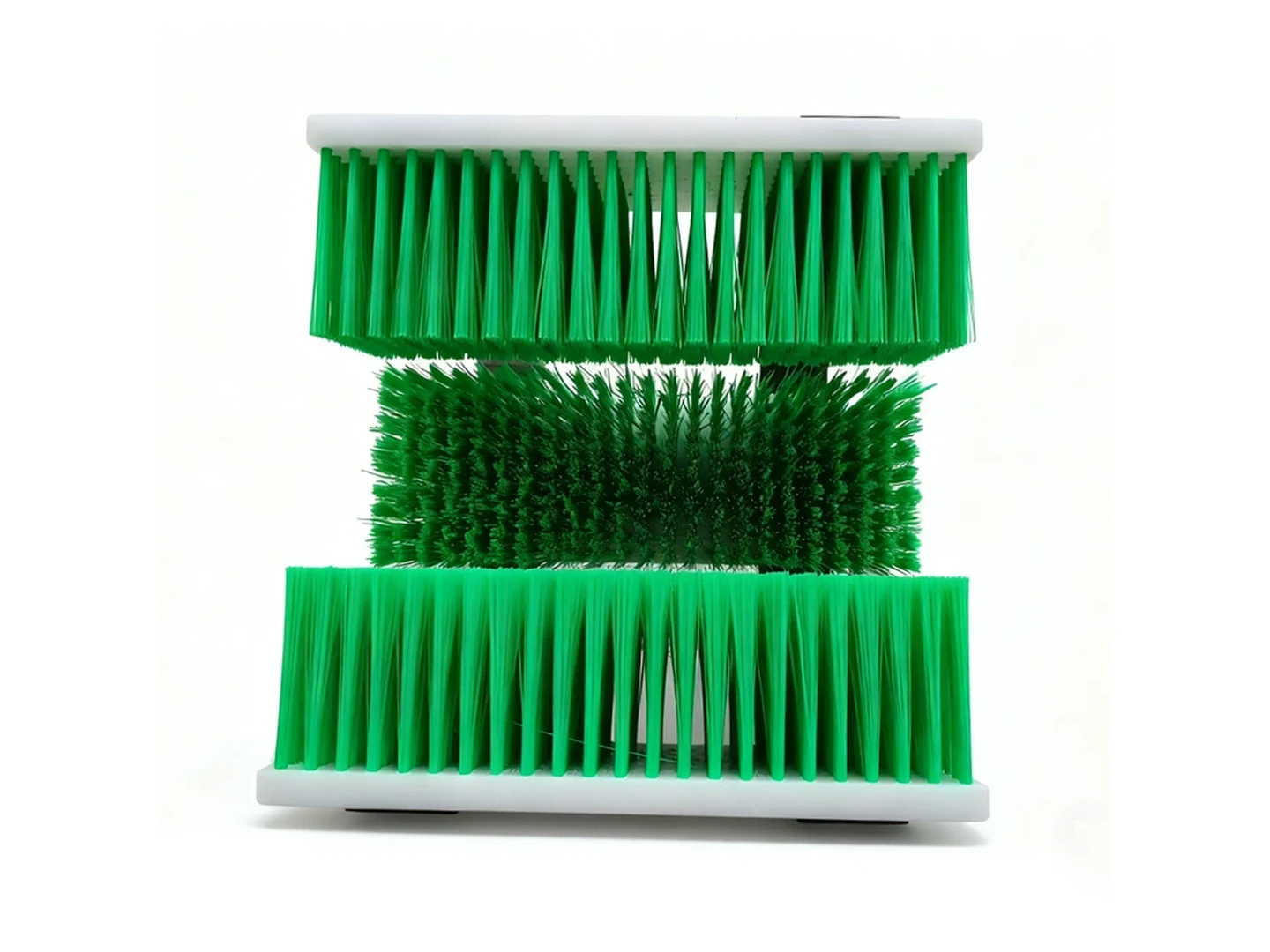
Large-format brush
100 pcs
Minimum order
Built one at a time on a core or channel: full-width rollers, sweeper brooms and long strip.
Production lead time, once the specification is confirmed
- Up to 100 pcsWithin 20 days
- 101–1,000 pcsWithin 30 days
- Over 1,000 pcsConfirmed with your quotation
Peak season can extend these times; the shipping date is confirmed in writing with your quotation. Sampling and shipping are quoted separately.
A machine-mounted brush assembly for automatic boot cleaning stations at mining site entries. The powered sole roller and side brushes strip compacted mud, coal fines, and ore dust from boot treads and uppers while the operator stands in place.
What can this brush do for you?
Dig packed material out of deep lug soles
Mining boots carry deep, aggressive treads that collect clay, coal fines, and rock dust. Stiff PET, PP, or PBT filaments are trimmed to a penetration depth that reaches the bottom of the lug grooves, sweeping out compacted material instead of skimming only the raised tread surface. The set penetration keeps the shaft and housing away from contact with the boot while the filament tips do the work.
Clean sole, heel, toe, and upper in one automated pass
The sole roller rotates under the boot while side brushes contact the heel, toe, and side surfaces. One operator can clean both boots in seconds rather than stopping to scrub by hand. This matters at shift change when dozens of miners move through the same entry point.
Survive continuous wet, abrasive duty
A 316 stainless steel shaft and end caps resist corrosion in wash water, detergent, and de-icing fluids. The filament is selected for repeated contact with abrasive mineral particles, so the brush keeps its scrub action through shift after shift instead of matting down or losing fill.
Mount directly into your existing boot cleaner
Shaft length, bearing seats, keyways, and drive coupling are matched to the machine. Replacement is a direct mechanical swap; you do not need to modify the station frame or guards. Side brush hubs and positions are also built to the existing opening.
Contact stays on the boot, not the machine frame
Roller width and side brush position are set to cover the full sole profile and the main upper contact zones without the shaft, hub, or guard touching the boot. Trim length is balanced between reaching deep tread grooves and clearing the machine enclosure.
What is a Mining Automatic Boot Cleaning Brush?
A Mining Automatic Boot Cleaning Brush is the consumable brush set inside an automatic boot cleaning station used at mine entry and exit points. It is not a handheld brush. The assembly includes a powered sole roller that the miner stands on, plus side brushes that contact the toe, heel, and sides of the boot as the roller turns. Many stations run water or dilute detergent spray at the same time, so the brushes work wet.
During a cleaning cycle, the operator positions the boot on the roller and the drive system rotates it. The filaments sweep caked material off the sole and out of the tread, while side brushes remove buildup from the upper surfaces. The filament tips, not the shaft or side brush hubs, should make the only contact with the boot. Correct penetration is set by filament trim length and side brush position.
This brush set is a maintenance item. Filament shortens as it works against rough soles and abrasive mineral particles. Replacement timing is usually judged by visible filament length or loss of groove contact, not by a fixed calendar value.
Technical Specifications
Dimensions, filament, core material, and drive interface are sized to the boot cleaner machine and the boot type. The table below shows the typical production configuration for mining boot wash stations.
| Parameter | Typical configuration |
|---|---|
| Brush assembly | Powered sole roller with two side brushes; optional upper, toe, or heel brushes per machine layout |
| Sole roller width | 300–600 mm, matched to the boot cleaner opening and the largest boot sole |
| Sole roller OD | 100–180 mm, selected with shaft clearance for the drive enclosure |
| Side brush OD | 150–300 mm disc or cup brush, face width 30–80 mm depending on contact zone |
| Filament material | Stiff PET, PP, or PBT for wet mud and mineral debris; nylon PA where a slightly softer side-brush contact is specified |
| Filament diameter | 0.50–1.20 mm for sole roller tufts; 0.30–0.80 mm for side brushes, project-specific |
| Filament layout | High-density linear or spiral tufting; density and trim profile set to reach tread grooves |
| Core and shaft | 316 stainless steel shaft with welded end caps and keyed, hex, or threaded drive ends; alternate core options available |
| Mounting interface | Shaft length, bearing seats, keyways, and drive coupling matched to the existing machine |
| Wet duty | Components selected for continuous wet exposure, wash water, detergents, and de-icing fluids |
| Contact geometry | Filament trim length set to reach lug and tread grooves without rigid-part contact; side brush position adjustable to boot profile |
| Brush type | Custom Floor Scrubber Sweeper Brushes |
| How it is driven | Machine-driven, mounted in the equipment |
| Cleaning target | surface and underground mine entry station, longwall and development section facility, and processing plant and crib room cleaning |
| Surface or part | soles, roller, grooves, hubs, frames, roads, process areas, and guards |
| Residue or debris | dust, fines, clay, mud, slurry, coal dust, and particles |
| Mounting / connection | Shaft length, bearing seats, keyways, and drive coupling matched to the existing machine |
Where does this brush work best?
- Surface and underground mine entry stations — bathhouse entrances, lamp room access, portal crossings, and dry entries where muddy boots must be cleaned before entering clean areas.
- Longwall and development section facilities — boot wash points at gate road entries and material stations where coal dust and clay follow personnel.
- Processing plants and crib rooms — transition zones between process areas and admin or control rooms where ore fines and slurry are tracked on soles.
- Fixed boot cleaning gates or tunnel-type washers — machines where a worker walks through a station and the brush set is part of an automated or semi-automated cleaning line.
- Portable or skid-mounted boot washers — brush modules used at haul road access gates or temporary mine infrastructure.
How do I choose the right one?
The right configuration depends on the boot cleaner frame, the boot sole, and what the mine tracks through the station. Work through these five checks before ordering.
Check the machine interface first
The brush has to fit the drive, bearings, and guards before anything else. Confirm shaft diameter, length, keyway or hex detail, rotation direction, and the clearance between the roller OD and the machine housing. A brush that fits the opening but binds the drive will shut the station down.
Match filament stiffness to residue and boot material
Wet clay, coal fines, and ore slurry need stiff PET, PP, or PBT filaments with enough density to scrape the lug bottoms. Dry dust or light surface soil can use medium-stiffness PP or PBT. If the side brushes contact leather or coated uppers, nylon PA or a shorter, more compliant PET trim reduces the risk of cutting seams or abrading the finish.
Set the penetration to the deepest tread groove
Measure the deepest lug on the boots the station serves. Trim length should reach that groove while leaving enough clearance that no shaft or hub surface can touch the boot. Trim too long and the filament whips or wraps; trim too short and compacted material stays in the tread.
Consider the wet and chemical environment
If the station runs continuous water spray, detergent, or de-icing brine, specify a corrosion-resistant core such as 316 stainless steel and check filament compatibility with the chemicals in use. Underground water can be acidic or mineralized; selecting for the actual water chemistry prevents early shaft failure.
Confirm coverage across the whole boot
The roller should sweep the full sole width from edge to edge, and the side brushes should reach the heel, toe, and upper contact zones without hitting the frame. Coverage gaps leave a visible strip of mud that miners then track into clean areas.
If the station uses high-pressure water or chemical spray as the main cleaning force, the brush still removes loosened material but may not replace that hydraulic pre-rinse. For manual, hand-held boot scrubbing, a handled boot brush is more appropriate. If the soles carry hardened cement, bitumen, or cured chemical deposits, pre-soaking or high-pressure removal should come before brushing. This is an industrial contact cleaning brush, not a leather finishing or polishing tool.
Can I customize this brush?
Every mining boot cleaner has its own frame and drive geometry. We build the brush set to your machine and boot exposure. To define the configuration, provide the boot cleaner model or a worn sample, shaft length and OD, end detail, roller width, side brush hub dimensions, the deepest tread groove on the boots, the main residue, and whether the station runs wet or dry. A photo or drawing speeds up matching.
Adjustable elements include:
- Sole roller geometry — width, OD, tube diameter, filament row spacing, spiral angle, and trim length.
- Side brush geometry — disc or cup design, OD, face width, hub mounting, angle, and vertical position.
- Filament — PET, PP, PBT, or nylon PA; diameter, stiffness, color coding, and density.
- Core and drive — 316 or 304 stainless steel shaft, end caps, keyway, set screw, pin, or hexagonal drive; bearing seats to match.
- Contact layout — roller and side brush overlap, penetration depth, and edge guards to prevent frame contact.
- Identification and packaging — molded or printed part numbers, wear-indicator color coding, bulk packing, or individual labeled bags.
We can also support your project with material declarations, dimensional inspection, and third-party testing for filament retention or wear life where your procurement requirements call for it.
What size should a mining automatic boot cleaning brush be, and how long does it last?
How can I tell when to replace the automatic boot cleaning brush?
Compare the filament tips to the original trim length or a built-in wear marker. Replace before the filament length no longer reaches the bottom of the deepest tread groove. Also check for missing tufts, a bent shaft, or side brushes hitting the frame. A brush worn past its set penetration leaves a compacted mud layer in the lug bottoms even when the roller is still spinning.
Does the brush remove frozen mud or ice from boots?
Stiff PET or PP filaments will break off loose frozen crust and chipped mud, but solid ice bonded to the sole usually needs warm water or a chemical de-icing step first. The brush then removes the loosened material; it should not be used as the primary force against a solid ice block.
What clearance should be left between the side brush tips and the boot?
The tips should make light, continuous deflection against the boot surface without flattening. If the motor loads down or the brush stalls, penetration is too deep. If a visible film remains after the boot passes in front of the side brush, the gap may be too wide or the filament is worn. Set the position with a worn boot, not a new one, because tread depth and upper height change with wear.
Can this brush clean steel-toe and rubber mining boots without damaging them?
Yes, when the filament material and trim are selected for the boot construction. The sole roller can be aggressive because the sole is rubber or PU and built for abrasion. For leather or coated uppers, the side brushes should use nylon PA or a shorter, more compliant PET trim to avoid cutting seams or abrading the finish. Boots with exposed lace hooks or eyelets should be specified so the side brush position avoids snagging.
How can we confirm the brush is cleaning the full sole width?
Mark the deepest tread grooves with chalk or a contrasting marker and run the boot through the station once. Inspect where marker remains. Residue left in the center means the roller penetration is too shallow or the filament is worn; residue at the outer edges means the roller width or side brush overlap does not match the boot profile. This same check can be used to set maintenance intervals.
Guides that go deeper on this
Custom Manufacturing RFQ
Describe Your Application
Please include the main sizes, application, residue, preferred material, interface, quantity, and any drawing or sample available.
Drawing or photo optional — it speeds things up, it does not gate the enquiry.
Custom Brush RFQ
Send Your Brush Project
Upload a drawing, product photo, or sample photo and provide the core dimensions and cleaning conditions.
“We need a brush to remove wet residue from a stainless steel conveyor, about 800mm wide. The current brush wears quickly. We can send photos.”
“We sell drinkware and need a cleaning brush to include with the product. Quantity around 5,000 pieces.”