
Custom Cleaning Brush
Oil Tank Cleaning Brush
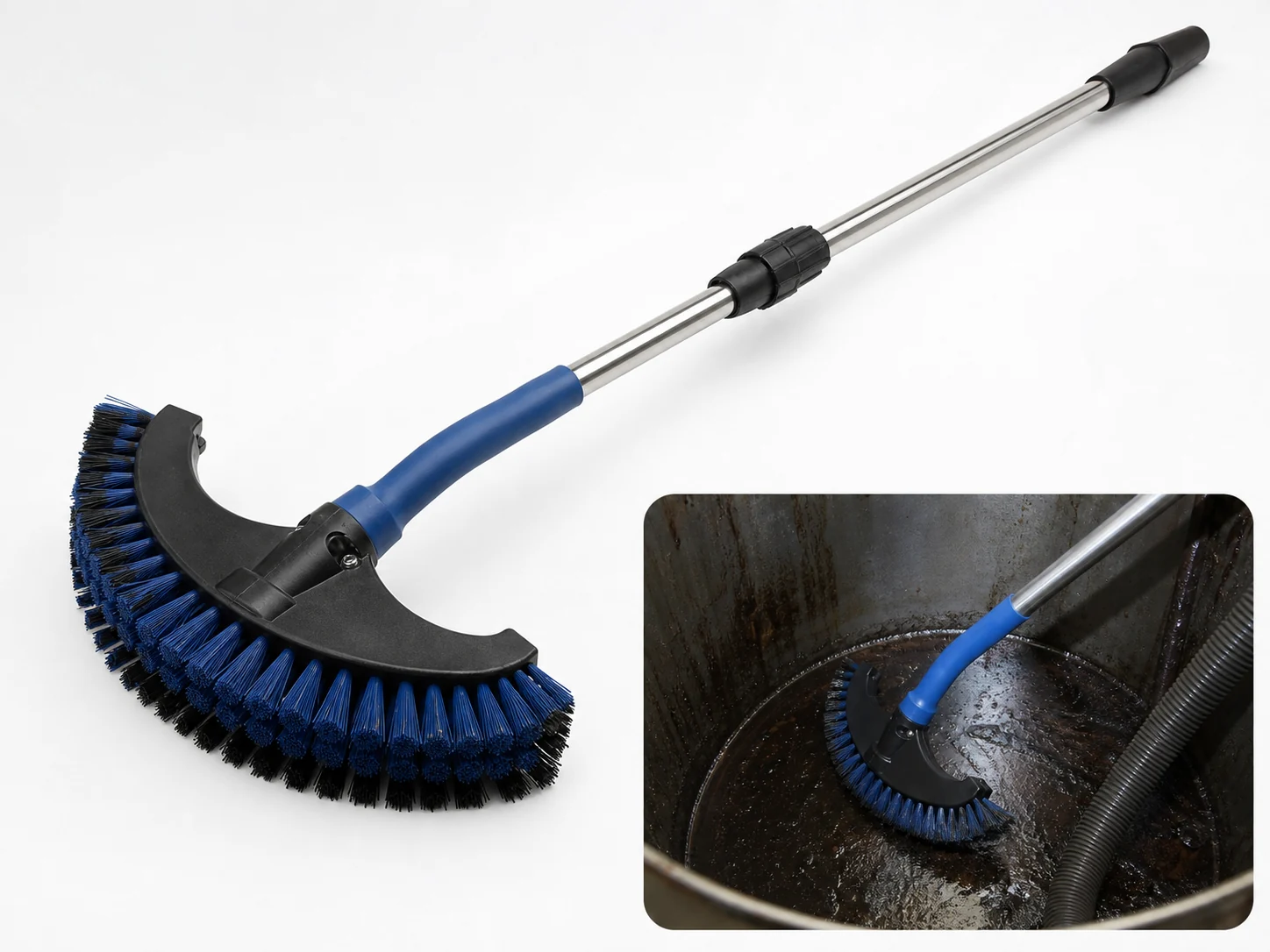
Oil tank cleaning brush for manual or pole-mounted scrubbing of sludge, oil residue and scale in tank interiors. Custom fill, head size and handle.
Small brush
500 pcs
Minimum order
Held in one hand: tube, bottle, detail and swab brushes — including long-handled ones with a small head.
Production lead time, once the specification is confirmed
- Up to 500 pcsWithin 7 days
- 501–50,000 pcsWithin 14 days
- Over 50,000 pcsWithin 21 days
Peak season can extend these times; the shipping date is confirmed in writing with your quotation. Sampling and shipping are quoted separately.
An industrial scrub brush for manual and pole-mounted cleaning of storage-tank and process-tank interiors. Head size, trim length, fill material, and handle reach are matched to the tank access opening, the surfaces being cleaned, and the type of oil sludge or scale left behind.
What can this brush do for you?
Covers Large Tank Surfaces Without Loading Up
A brush head of 150–250 mm by 100–150 mm works tank floors and shell plates in fewer passes than a narrow hand brush. Open drainage space between tuft rows lets soft sludge push through as pressure is applied, so the fill keeps contacting the plate instead of packing solid.
Extends Reach Through Manways and Access Hatches
A fixed long handle or threaded pole bracket carries the scrubbing action farther than a hand brush can. Operators can work the far side of a floor, lower shell, or baffle face from the manway without stretching or climbing. Handle length and pole interface are specified from actual tank reach, not from a standard catalog length.
Pairs the Fill With the Lining and the Residue
Nylon 6/6 is the usual starting point for soft sludge and oil film on steel. Polyester handles water and detergent washes better. Polypropylene gives a softer, more chemical-resistant contact for lined tanks. Stainless steel is reserved for hard scale on unlined steel where the site accepts metallic fill. Matching the fill to the tank reduces damage to coatings while still breaking the surface film.
Flexes Into Welds, Laps, and Sump Corners
Trim length is set between 30 mm and 50 mm. Longer trim rides into weld grooves and lap joints while the block stays flat on the plate. Shorter trim feels stiffer when the operator needs concentrated force on a stubborn deposit, and a narrower or angled head reaches into drain channels and sump pockets.
Stands Up to Oil, Solvent, and Cleaning Agents
The brush block is molded from HDPE or reinforced polypropylene, not wood or absorbent plastic. It does not swell or soften in oil and solvent contact, and it can be rinsed clean between tank jobs. Handle hardware and pole fittings are selected for the same chemical and moisture exposure.
Replacement Parts Are Built Into the Design
The head, fill, handle, and pole bracket can be specified as separate or replaceable assemblies. When trim length wears down, the head can be replaced on the same handle or pole fitting, so the tool stays in service with less downtime and lower replacement waste.
What is an Oil Tank Cleaning Brush?
An Oil Tank Cleaning Brush is a hand-guided scrub brush made for the internal surfaces of storage tanks, process tanks, and other large vessels. It combines a rigid or semi-rigid block, dense filament fill, and a handle or pole bracket that reaches the places a hand brush will not.
In a common tank-cleaning sequence, this tool is used after the tank has been drained, vented, and made safe for entry or remote work. The operator works it across tank floors, sidewalls, baffle faces, sump pockets, and drain channels with push-pull and side-to-side strokes. The brush loosens sludge, residual oil film, water-bottom sediment, and loose scale so those materials can be flushed, vacuumed, or removed separately.
This is not a powered cleaning system. It is a manually driven contact tool for accessible surfaces. Hard, cemented, or carbonized deposits usually need chemical softening, hydroblasting, or powered rotary cleaning before the brush will be effective. The brush’s role is the controlled mechanical contact step, removing film and loose deposits without grinding or sparking.
Because fill and block materials contact both the stored product and the cleaning agent, material selection is part of the product. The same head shape performs very differently with nylon, polyester, polypropylene, or stainless steel fill, and the right version is the one specified for the tank and its lining.
Technical Specifications
The values below are typical starting points for an oil tank cleaning brush project. We finalize every parameter only after reviewing the tank access opening, lining, residue condition, cleaning agent, and the site’s static-control and non-sparking rules.
| Parameter | Value / Options |
|---|---|
| Brush form | Manual tank/scrub brush or pole-mounted scrub head for accessible internal surfaces |
| Head size | 150–250 mm × 100–150 mm; narrower or angled profiles available for sump and baffle pockets |
| Trim length | 30–50 mm, adjusted for weld seams, plate laps, and residue thickness |
| Fill material | Nylon 6/6, polyester, polypropylene, or stainless steel; final selection based on tank lining and residue |
| Filament diameter | Synthetic: 0.5–1.0 mm; stainless steel: 0.25–0.40 mm, project-specified |
| Block material | HDPE or reinforced polypropylene; oil-, solvent-, and water-resistant |
| Handle / pole interface | Fixed handle up to 1,000 mm; threaded socket or clamp bracket for extension poles; two-hand grip optional |
| Access opening fit | Head selected to pass through the tank manway or hatch without forcing; compact heads available for small openings |
| Working position | For drained tanks; manual brushing only after the site has completed gas-free and confined-space procedures |
| Brush type | Custom Handheld Detail Brushes |
| How it is driven | Hand-guided |
| Cleaning target | crude oil and fuel storage tank, waste oil, and sump pocket cleaning |
| Surface or part | tanks, baffles, sumps, floors, channel, drain, walls, and plates |
| Residue or debris | oil, sludge, oil film, scale, sediment, oil sludge, carbonized deposits, and lubricant |
| Mounting / connection | Fixed handle up to 1,000 mm; threaded socket or clamp bracket for extension poles; two-hand grip optional |
Where does this brush work best?
- Crude oil and fuel storage tanks — removing waxy sludge, asphaltene residue, and oil film from tank floors and lower shell plates between inspection and maintenance cycles.
- Diesel, lubricant, and hydraulic fluid tanks — scrubbing polymerized oil film, varnish, and settled sediment from walls, bottoms, and drain channels.
- Waste oil, slop, and process tanks — loosening accumulated sludge and soft solids before flushing, vacuuming, or pumping the tank out.
- Marine fuel and bunker tanks — manual scrubbing of accessible floors, baffles, and stringers during dry-dock or gas-free tank entry where powered tools are not allowed.
- Sump pockets, drain channels, and bottom-to-shell transitions — using a smaller or angled head to reach the low points where sediment concentrates.
The brush is made for accessible surfaces. It is not intended for internal pipe runs, narrow tubing, or areas that cannot be reached from the manway or a safe position. If deposits are cemented, carbonized, or thicker than the fill can penetrate, the tank needs chemical, thermal, or high-pressure treatment before manual brushing is useful.
How do I choose the right one?
Start with access and reach
Measure the smallest opening the brush must pass through, the farthest surface it must reach, and the free space between baffles or internal supports. The head must fit through the opening without being forced, and the handle or pole must hold the head in contact at full reach. If the operator works from outside the tank, handle length is decided by geometry, not by hand comfort.
Match the fill to the residue and the lining
- Nylon 6/6 — strong and springy for soft sludge, oil film, and waxy buildup on carbon steel and many coated interiors. It loses stiffness after prolonged water or strong alkaline exposure, so confirm the wash procedure first.
- Polyester — stable in water and detergent washes with good abrasion resistance; a practical choice when hot water or cleaning chemicals follow the oil removal.
- Polypropylene — softer and chemically inert; preferred on epoxy, phenolic, or other lined tanks where surface protection matters more than aggressive scraping.
- Stainless steel — for hard scale on unlined steel only, and only where the site accepts metallic fill. It will mark or remove coatings and must pass the site’s non-sparking and static review.
Set the head and trim for the surface
A rectangular head covers flat floors and walls efficiently. A narrower or angled head follows sump pockets and baffle webs. Around 40–50 mm of trim flexes into weld grooves and plate laps; 30 mm feels stiffer and applies more force to stubborn film. Unflagged filament tips scrub harder, while flagged tips spread cleaning solution more softly.
Choose the handle or pole interface
Use a fixed handle when the operator works inside the tank or close to the manway. Use a pole-mounted head when the brush must be pushed from outside or extended across a large floor. Specify the actual extension pole thread or diameter used on site so the brush stays tight and does not rotate out of line during push-pull strokes.
Check the site safety and static-control rules
Manual brushing happens only after the tank has been drained, vented, and confirmed safe. Within that condition, fill, block, and handle still need to fit the site’s static-control and non-sparking procedure. Confirm cleaning agent, temperature, and water exposure, because synthetic filaments soften at sustained high temperature and can be attacked by some solvents.
When another tool is the better answer
If the tank has cemented, crystalline, or carbonized deposits, use a chipping hammer, needle scaler, or powered rotary cleaner. Use hydroblasting for full-area removal where water handling is already part of the job. Use a tube brush or flexible shaft brush for internal piping or tight baffle pockets. If the tank cannot be made gas-free, manual brushing is not the right method regardless of brush material.
Can I customize this brush?
Every oil tank cleaning brush is configured around the tank and the job. Head dimensions, fill, block, handle or pole fitting, color, and packaging are all set at project level.
- Head geometry — rectangular, square, angled, chamfered, or split profile sized for the manway and baffle spacing; custom shapes for sumps and drain channels.
- Fill material and density — nylon 6/6, polyester, polypropylene, or stainless steel; filament diameter, end treatment, tuft spacing, and row layout adjusted for drainage or stiffness.
- Trim length — 30–50 mm standard, with shorter or longer options depending on weld seams, plate laps, or deposit type.
- Block material — HDPE, reinforced polypropylene, or another polymer selected for solvent and cleaning-agent resistance.
- Handle / pole interface — fixed handle length and grip, threaded pole socket, clamp bracket, two-handed handle, or replaceable head-and-bracket assembly.
- Color and marking — custom block color, laser marking, pad print, label, or part identification code.
- Packaging — bulk, individually tagged, shrink-wrapped, or job-pack configuration.
To define the right configuration, provide the minimum access opening, tank diameter and depth, baffle spacing, the surfaces to be cleaned, the lining material, the oil or residue involved, the cleaning agent and wash temperature, and any site static-control or non-sparking restrictions. A photo or simple sketch of the manway and the areas to be brushed shortens the selection.
If your project requires material declarations, documentation, inspection, or third-party testing, we can support those requirements during specification. That support is arranged per project and does not change the brush design itself.
How do you tell when an oil tank cleaning brush is worn out?
Can the brush be used inside a tank that still contains oil or vapor?
No. Manual brushing should take place only after the tank has been drained, vented, and confirmed safe for work by the site. A brush material choice does not make a confined space or flammable atmosphere safe to enter.
How can we tell whether the chosen fill will damage the tank lining?
Run a short test on a clean, accessible section of the same lining or on a coated test plate. Use the same pressure and motion planned for the tank, then inspect under good light. Scratches, coating removal, or a change in surface gloss mean the fill is too aggressive. Switching to polyester or polypropylene, reducing filament diameter, or changing the end treatment is the usual correction.
Does the brush remove sludge from the tank on its own?
No. The brush loosens and dislodges sludge and residue, but the loosened material still has to be removed by vacuum, pumping, flushing, or manual shoveling. Brushing is one step in the cleaning sequence; it does not replace the removal and disposal step.
How do we know when to replace the brush head?
Compare the used head with the original trim length. If the filament ends are flattened, curled, melted, or broken so that less than about half the original trim remains, the brush has lost most of its working pressure. Also check the block for cracks and the handle for stripped threads. A brush that no longer springs back after a stroke should be replaced.
Can one brush be used for different oil tanks?
Only with caution. A brush used for one product can carry residue into another, and fill that works on steel may damage a lined interior. Confirm material and chemical compatibility every time the brush moves between tanks. If the linings or residue types differ, assign separate brushes or plan a fill change.
What should be checked before each use?
Confirm the handle or pole connection is tight, the block has no cracks, and the fill is not packed with dried sludge. Clean the block and trim with the approved cleaning agent and let them dry. Follow the site entry procedure and verify the internal atmosphere before any brushing begins.
Guides that go deeper on this
Custom Manufacturing RFQ
Describe Your Application
For a custom quote, we need the key dimensions, surface or part, residue, material preference, quantity, and reference image or drawing.
Drawing or photo optional — it speeds things up, it does not gate the enquiry.
Custom Brush RFQ
Send Your Brush Project
Upload a drawing, product photo, or sample photo and provide the core dimensions and cleaning conditions.
“We need a brush to remove wet residue from a stainless steel conveyor, about 800mm wide. The current brush wears quickly. We can send photos.”
“We sell drinkware and need a cleaning brush to include with the product. Quantity around 5,000 pieces.”