
Custom Cleaning Brush
PP Chemical Resistant Hand Brush
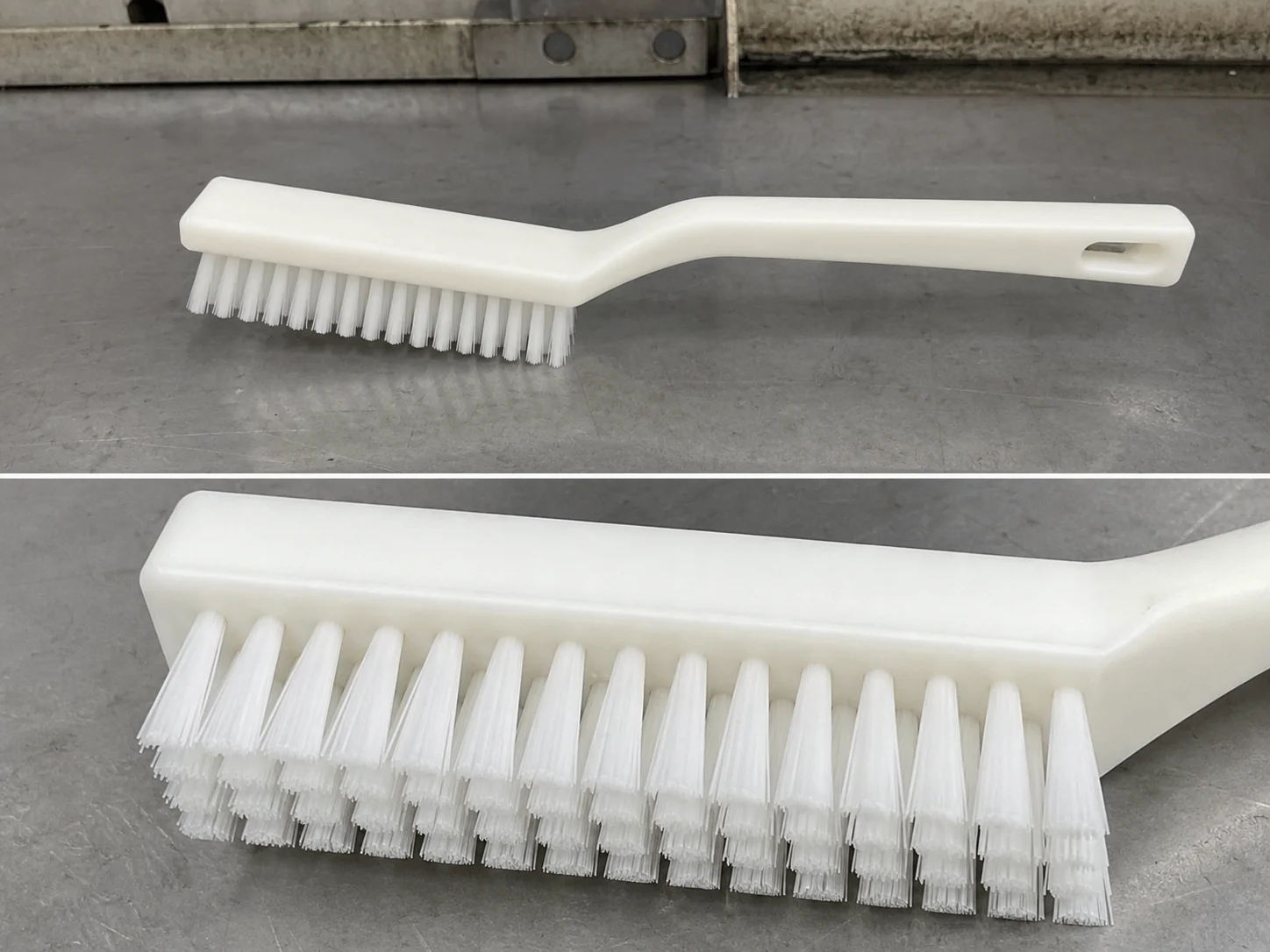
Chemical-resistant polypropylene hand brush for manual cleaning of acid pickling tanks, degreasing baths, plating racks, sumps, and baffles.
Small brush
500 pcs
Minimum order
Held in one hand: tube, bottle, detail and swab brushes — including long-handled ones with a small head.
Production lead time, once the specification is confirmed
- Up to 500 pcsWithin 7 days
- 501–50,000 pcsWithin 14 days
- Over 50,000 pcsWithin 21 days
Peak season can extend these times; the shipping date is confirmed in writing with your quotation. Sampling and shipping are quoted separately.
A molded polypropylene hand brush for manual cleaning of acid pickling tanks, degreasing baths, and other chemical process equipment. The rectangular 45 x 120 mm head and fixed PP handle put chemical-resistant scrubbing power directly on tank walls, pipes, baffles, racks, and sump areas.
What can this brush do for you?
Survives the chemical bath that kills ordinary brushes
Polypropylene bristles, base, and handle are molded as one chemically resistant unit. The brush tolerates many mineral acids, alkaline degreasers, and aqueous process baths where wood swells, metal staples corrode, and natural or mixed-fiber brushes fail. Fewer brush changes and no stray metal corrosion products entering your bath.
Does not absorb or carry chemicals from one tank to the next
PP is hydrophobic and low-absorbing. The brush does not soak up acid or solvent, dries quickly, and rinses almost completely clean. That reduces cross-bath contamination and means the brush does not act as a reservoir for the deposits it just removed.
Stiff enough for sludge, film, and soft oxide without wire-level scratching
Medium-stiff PP bristles cut through chemical film, oil sludge, oxide scale softened by the process, and loose deposits. Because PP is softer than steel, it applies scrubbing pressure to stainless tanks, plastic or rubber linings, and coated surfaces with a much lower risk of gouging or scratching than a wire brush.
Rectangular head covers flat walls and reaches into corners
The 45 mm wide by 120 mm long flat face covers wide areas on tank walls, floors, weirs, and baffles. The square corners of the head help work deposits out of corner seams, weld joints, and the joint between wall and floor. You get broad coverage and a defined edge for detail work in the same tool.
Fixed handle transfers force directly to the bristle tips
The 160 mm handle with a 32 mm grip stays short and rigid, which means operator push and pull effort goes into the deposit instead of bending a long stem. It is sized for gloved hands and close-range work on drained tanks, racks, and sumps where control matters more than reach.
What is a PP Chemical Resistant Hand Brush?
A PP Chemical Resistant Hand Brush is a manual scrubbing tool whose bristles, brush back, and handle are molded from polypropylene. It is built for maintenance crews and line operators who clean exposed metal and process equipment in acid pickling, degreasing, electroplating, and other chemical treatment operations.
In practice, you hold the fixed handle, press the bristle face against the surface, and work with short push-pull or circular strokes. The bristle tips flex just enough to follow weld seams, minor curvature, and surface irregularities while breaking up chemical film, oil sludge, and soft oxide deposits. Loose material is then rinsed away with water or the next process solution.
The brush is intended for manual use on drained or partially drained tanks and on equipment under maintenance. It is not a mechanical conveyor brush, not an immersion tool for continuously running machinery, and not a substitute for acid treatment, blasting, or powered descaling. Its job is controlled surface cleaning in an aggressive chemical environment.
Technical Specifications
| Parameter | Value / Options |
|---|---|
| Head width | 45 mm |
| Head length | 120 mm |
| Head shape | Rectangular, flat scrubbing face |
| Bristle material | Polypropylene (PP) |
| Bristle trim length | 25 to 35 mm, adjustable for access or stiffness |
| Bristle stiffness | Medium to stiff; set by filament diameter and trim |
| Handle / base material | Polypropylene (PP), single molded body |
| Handle length | 160 mm |
| Grip diameter | 32 mm |
| Connection | Fixed, no separate metal fasteners |
| Overall length | About 280 mm from head front to handle end |
| Operating temperature | -20 to 80 °C continuous; short-term up to 100 °C where chemical combination allows |
| Chemical resistance | Broad resistance to many dilute and concentrated mineral acids, alkaline cleaners, and aqueous process baths at ambient temperature; not recommended for strong oxidizing acids, hot chlorinated or aromatic solvents |
| Color | Natural PP white / gray; custom colors available |
| Brush type | Custom Handheld Detail Brushes |
| How it is driven | Hand-guided |
| Cleaning target | metal acid pickling line, electroplating and surface treatment tank, and chemical preparation and spill containment area cleaning |
| Surface or part | tanks, sumps, baffles, racks, walls, tank walls, metal, and pipes |
| Residue or debris | chemical film, sludge, oil sludge, oxide, process deposits, soap film, fiber, and scale |
| Mounting / connection | Fixed, no separate metal fasteners |
All dimensions can be changed for your tank geometry, operator reach, or deposit type. Send the chemical list, concentration, and bath temperature and we will confirm the PP grade and bristle configuration before production.
Where does this brush work best?
- Metal acid pickling lines: after bath draining, scrub tank walls, solution line marks, weir edges, baffles, and floor joints to remove oxide, chemical film, and process sludge.
- Degreasing and parts-washing lines: remove oil sludge, emulsifier build-up, and soap film from immersion tanks, rinse sumps, and overflow channels.
- Electroplating and surface treatment tanks: clean plating racks, jigs, electrical contact areas, and tank linings without shedding metal fibers that could contaminate the bath.
- Chemical preparation and spill containment areas: wipe down sumps, spill decks, and accessible pump or valve housing surfaces where chemical film collects.
- Racks and fixtures between process stages: remove dried or gelled process deposits before they are carried into the next bath.
How do I choose the right one?
Confirm the chemical environment first
Get the SDS or chemical list for every solution the brush will contact, including concentration and temperature. Polypropylene handles many mineral acids, alkaline cleaners, and water-based degreasers well, but it is not the right material for strong oxidizing acids such as concentrated nitric or chromic acid, for hot aromatic or chlorinated solvents, or for sustained service above about 100 °C. If you are unsure, run a 24 to 48 hour soak test with a sample bristle or a corner of the handle in the worst-case solution.
Match bristle stiffness to the deposit
The standard medium-stiff PP bristle is good for oil sludge, chemical film, softened oxide, and loose scale. If the deposit is hard, mineralized, baked, or carbonized, a PP hand brush will not provide enough mechanical action; in that case switch to a nylon/PBT, wire, or abrasive brush, accepting the trade-off in scratch and contamination risk.
Check head fit against your access and surfaces
Measure the minimum opening or the width of the tightest area you need to clean. The 45 x 120 mm rectangular head needs open flat or gently curved surfaces. For pipe interiors, narrow gaps under 45 mm, or deep sumps, a tube brush, angled brush, or longer-handle configuration will work better. Head length and width can be modified for your tank.
Set handle reach and grip for operator safety
The fixed 160 mm handle is designed for close work with gloved hands. For deep tanks or hot surfaces where the operator needs to stay back, specify a longer handle or an extension interface. A textured grip or hanging hole can be added if operators wear chemical gloves or need to store the brush outside the bath.
| Condition | Configuration guidance |
|---|---|
| Dilute acid or alkali, ambient temperature | Standard PP brush as specified |
| Oil sludge, chemical film, soft oxide | Standard medium-stiff PP bristles |
| Hard scale or baked-on deposits | Use nylon/PBT, wire, or abrasive brush; PP is not suited |
| Scratch-sensitive lining or polished surface | Test PP on a small area; reduce trim length or choose a softer bristle grade |
| Hot process above 80 °C continuous | Confirm heat-stabilized PP grade or select another material |
| Narrow gap or pipe interior under 45 mm | Use a tube brush, spiral brush, or custom narrow head |
Can I customize this brush?
Yes. The brush is built to the line, not picked from a catalog. Common changes include:
- Head dimensions: width, length, overall thickness, and corner radius to fit tanks, baffles, and access openings.
- Bristle characteristics: filament diameter, trim length, density, stiffness, and cut pattern for aggressive or gentle scrubbing.
- Handle and grip: length, grip diameter, shape, textured surface, hanging hole, or an extension interface for deep-tank reach.
- Color coding: different body or bristle colors for separate process baths to prevent cross-contamination.
- Marking and identification: molded part number, pad-printed label, laser marking, or embossed process zone code.
- Packaging: bulk cartons, individually bagged units, or line-kit packaging with replacement intervals.
To define the right configuration, send the chemical list and SDS, operating temperature, residue description, surface material, available access space, handle reach requirements, and a sketch or photo of the work area. If your project needs material declarations, inspection documentation, or third-party testing, we can support those requirements during the customization process.
When is a PP chemical resistant hand brush worn out rather than just dirty?
How do I test whether this PP brush is compatible with my process chemicals?
Provide the SDS and a worst-case concentration and temperature. Then soak a sample bristle or a small cut corner of the handle in the solution for 24 to 48 hours. Look for softening, swelling, cracking, discoloration, or loss of stiffness. If the sample stays firm and clean, the brush will generally survive the same exposure.
Can I use this rectangular brush inside a small pipe or narrow drain?
No. The 45 mm wide head is designed for open flat or slightly curved surfaces. For pipe interiors, narrow passages, or deep drain lines, choose a tube brush, spiral brush, or a custom narrow-head version only if the opening is wide enough for the head to enter and move.
Should I leave the brush hanging in the acid tank between shifts?
It is better not to store the brush continuously submerged in the chemical. PP resists many solutions, but prolonged immersion concentrates residue and can eventually weaken the material. Rinse the brush after use, shake off excess liquid, and hang it by a hole or rack in a ventilated area.
Does this brush remove heavy oxide scale before acid pickling?
It removes loose, softened, or partially dissolved surface deposits. It does not replace acid treatment, mechanical descaling, or blasting. If the scale is hard and tightly bonded, those steps should be done first; the brush then handles the film and sludge left after the chemical works.
How can I tell when the brush is too worn to clean effectively?
Check the bristle trim. If more than about 30 percent of the original trim length is worn away, bristles are matted flat, or the handle and base show cracks or chemical whitening, replace the brush. Worn bristles require more operator force and leave residue in low spots.
Guides that go deeper on this
We have not written a guide specific to this one yet. The material that covers selection, filament, dimensions, maintenance and sourcing is collected in the technical resources library.
Custom Manufacturing RFQ
Describe Your Application
To prepare the correct quotation, provide the dimensions, cleaning task, residue, material, mounting details, quantity, and a drawing or photo.
Drawing or photo optional — it speeds things up, it does not gate the enquiry.
Custom Brush RFQ
Send Your Brush Project
Upload a drawing, product photo, or sample photo and provide the core dimensions and cleaning conditions.
“We need a brush to remove wet residue from a stainless steel conveyor, about 800mm wide. The current brush wears quickly. We can send photos.”
“We sell drinkware and need a cleaning brush to include with the product. Quantity around 5,000 pieces.”