
Custom Cleaning Brush
Pressure Foot Brush
Custom pressure foot brush for PCB CNC routing and drilling. Nylon PA, PBT and conductive filaments hold boards flat, contain dust and dissipate static.
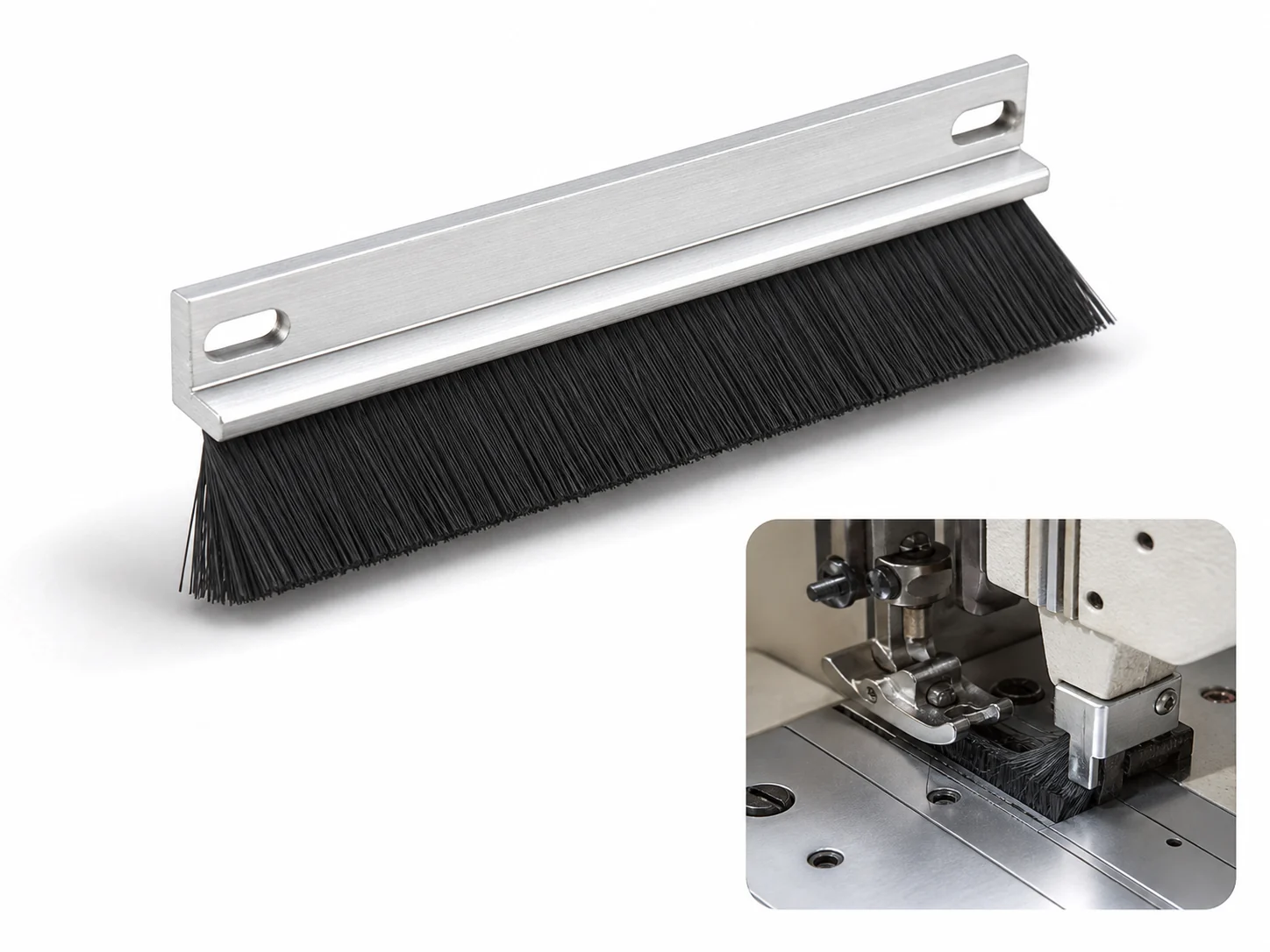
Large-format brush
100 pcs
Minimum order
Built one at a time on a core or channel: full-width rollers, sweeper brooms and long strip.
Production lead time, once the specification is confirmed
- Up to 100 pcsWithin 20 days
- 101–1,000 pcsWithin 30 days
- Over 1,000 pcsConfirmed with your quotation
Peak season can extend these times; the shipping date is confirmed in writing with your quotation. Sampling and shipping are quoted separately.
A machine-mounted filament brush that fits the pressure foot of PCB CNC routing and drilling spindles to hold thin laminates flat against the table, seal the extraction zone around the cutting tool, and control conductive dust at the point of generation.
What can this brush do for you?
Keeps Thin Laminates Flat While the Tool Cuts
The filament ring applies a controlled, distributed pressure around the bit, preventing the board edge from lifting or vibrating during routing and drilling. That reduces breakout on the exit side, minimizes burr formation, and keeps small geometries from shifting under tool load. For panels below 0.8 mm or flexible circuits, this hold-down force is often the difference between a clean cut and a scrapped panel.
Contains Dust and Chips at the Source
Routing and drilling generate fine fiberglass, epoxy, and copper dust that spreads across the machine, the panel, and the surrounding electronics. The brush skirt forms a localized containment ring around the tool, guiding debris directly into the pressure foot vacuum stream. Better containment means higher extraction efficiency, less dust on the board surface, and fewer contamination-related defects downstream.
Dissipates Static Instead of Building It
Standard nylon filaments can accumulate triboelectric charge as they wipe across the laminate, creating an ESD risk for sensitive boards. Conductive nylon filaments with embedded carbon or metal fibers carry a surface resistivity of 103–109 ohms, allowing charge to flow to the machine ground through the mounting plate instead of discharging into the circuit. This protects ESD-sensitive assemblies during the cutting process itself.
Survives Continuous Production Runs
Nylon PA and PBT filaments are selected because they resist the abrasive action of fiberglass and phenolic dust, maintain stiffness through millions of contact cycles, and tolerate the warm environment near a high-speed spindle. A well-matched filament density and trim length can reduce brush changes from every shift to every maintenance interval, improving machine uptime.
Fits Existing Pressure Foot Geometry
The brush can be supplied as a replaceable strip, a continuous ring, a segmented plate, or a custom holder matched to your spindle foot bolt pattern. It replaces worn OEM skirt material or upgrades a machine that came with a solid foot to a filament hold-down solution without re-engineering the spindle assembly.
What is a Pressure Foot Brush?
A Pressure Foot Brush is a filament seal installed on the pressure foot of a PCB CNC router or drilling spindle. It sits between the foot and the top surface of the laminate. As the spindle descends to its programmed working height, the filaments deflect 1–6 mm and apply a distributed downward force that holds the panel against the vacuum table while still allowing the cutting tool to pass through the center opening.
During operation, the brush acts as both a mechanical clamp and an airflow guide. The rotating router bit or drill generates dust and chips inside the ring formed by the filaments. The vacuum system pulls air through the brush and toward the extraction port, so the debris is collected before it can escape into the machine or settle on the panel. The brush also prevents loose dust from being thrown outward by centrifugal force from the spinning tool.
Unlike a conventional cleaning brush, this product is not used to scrub a surface. It is a process tool that contacts the board only at the outer perimeter of the cutting zone, never along the tool path itself. Its filament length, stiffness, density, and material are all tuned to the machine’s spindle speed, vacuum pressure, panel thickness, and ESD requirements.
The brush is a wear component. The filaments flatten, set, or break over time, and when the brush can no longer maintain the designed deflection or containment, it should be replaced. Because the mounting plate and geometry are normally matched to the machine model, replacement brushes can be stocked as drop-in parts with no spindle modification.
Technical Specifications
Dimensions, filament configuration, and mounting interface are matched to the pressure foot and spindle model. The following table gives the typical ranges and standard options.
| Parameter | Value / Options |
|---|---|
| Working width / ring diameter | 5–620 mm, matched to pressure foot inner diameter and tool clearance |
| Trim length (filament length) | 10–40 mm, selected for required deflection and vacuum flow |
| Filament materials | Nylon PA (standard), PBT (higher stiffness and wear resistance), conductive nylon with carbon or metal fiber |
| Standard filament diameter | 0.15–0.50 mm, depending on stiffness target |
| Conductive nylon filament diameter | 0.045 mm, with embedded conductive fiber 0.008–0.012 mm diameter |
| Surface resistivity (conductive option) | 103–109 ohms, measured from filament tip to mounting surface |
| Mounting | Grounded handle, strip, plate, shaft, or machine-matched holder with bolt pattern |
| Working deflection | 1–6 mm when the foot is at cutting height; load distributed across the filament plate |
| Operating temperature | Continuous service up to 100°C (PA) or 120°C (PBT); brief higher excursions acceptable |
| Chemical exposure | Dry process, light oil, isopropyl alcohol, and common PCB wash-down solutions |
| Brush type | Custom Machine Table Brush Plates |
| How it is driven | Machine-driven, mounted in the equipment |
| Cleaning target | pcb routing machine, cnc drilling system, and depaneling router cleaning |
| Surface or part | panels, boards, edges, holes, slots, metal, and ports |
| Residue or debris | dust, chips, burrs, loose dust, carbon, and fiber |
| Mounting / connection | Grounded handle, strip, plate, shaft, or machine-matched holder with bolt pattern |
The most decision-critical values are the outer filament ring ID, the trim length, and the mounting bolt circle. If the brush does not clear the collet and bit, or if the filaments cannot reach the recommended deflection, the hold-down and dust control will be compromised.
Where does this brush work best?
- PCB routing machines that separate panels, mill slots, or cut complex board outlines where edge lifting and breakout are common.
- CNC drilling systems for multilayer boards, HDI panels, and thin laminates that need stable hold-down around each hole location to prevent smear and burr defects.
- Depaneling routers used on assembled flex and rigid-flex circuits where ESD protection and dust containment are critical.
- Vacuum table applications where the brush ring improves the seal around the tool and increases effective vacuum hold-down force on small or warped panels.
- Machines that already run a filament pressure foot and need replacement skirts, upgraded ESD-safe skirts, or a custom plate for a new spindle model.
How do I choose the right one?
Start with the pressure foot geometry
Measure the inner diameter of the pressure foot, the collet and bit clearance, and the bolt pattern used to attach the foot to the spindle. The brush ring must sit outside the tool path without touching the rotating collet, and it must leave enough center opening for chips to be pulled upward into the vacuum stream.
Match the filament material to the job
Nylon PA is the standard choice for general routing and drilling where ESD protection is not required. PBT is stiffer, more wear-resistant, and better suited to higher-temperature spindles or abrasive laminate materials. Conductive nylon with carbon or metal fiber is the right option when the panel or the process demands static dissipation; the mounting plate must then be tied to machine ground.
Set the trim length and deflection
The filament length should allow 1–6 mm of working deflection at the programmed foot height. Too little deflection means weak hold-down and dust leakage around the base. Too much deflection compresses the filaments into a solid mat, blocks vacuum airflow, and wears the brush prematurely. The load should be spread evenly across the plate rather than concentrated on a few high tufts.
Balance hold-down force with extraction airflow
Dense, long filaments hold the board firmly but can choke the vacuum. Sparse or short filaments allow more airflow but give less containment. The practical target is a brush that seals the cutting zone while still letting the extraction system move enough air to carry chips away. Test the vacuum reading at the foot before and after brush installation.
When a pressure foot brush is not the right tool
If the panel is extremely thin, flexible, or has a delicate surface finish that cannot tolerate any filament contact, a solid PTFE or phenolic foot with vacuum channels may be better. If the spindle applies a very high downforce, a spring-loaded or pneumatic pressure foot gives more control than a filament skirt. For wet or flood-cooled cutting processes, use a solid foot or a replaceable elastomer seal, because wet filaments lose stiffness and can hold coolant against the panel.
Can I customize this brush?
Pressure foot brushes are normally built to a specific machine and process. To define the configuration, provide the pressure foot drawing with inner and outer diameters, the bolt circle, bit clearance, spindle model, panel thickness range, vacuum pressure, and any ESD requirement. A photo of the existing foot and brush also helps verify the interface.
We can adjust:
- Ring geometry — inner diameter, outer diameter, width, continuous ring, segmented ring, strip, or custom plate shape to match the foot.
- Filament configuration — material (PA, PBT, conductive nylon), filament diameter, trim length, density, angle, and tuft pattern.
- Mounting interface — bolt pattern, clip, adhesive backing, clamp ring, or machine-specific holder; split design for quick change.
- Backing material — aluminum, stainless steel, POM, or other substrate compatible with the spindle foot.
- ESD path — conductive filaments, conductive backing, grounding tabs, or a specified resistance band to match your process.
- Color and marking — filament color for machine identification, engraved part number, or color-coded plates for different spindle sizes.
- Packaging — bulk pack for maintenance stock, individual bags, or kits with installation hardware.
If your project requires material declarations, inspection reports, or third-party testing for the finished brush, we can support those requirements during the customization process.
What speed and pressure keep a pressure foot brush from wearing early?
How do I know when the pressure foot brush needs to be replaced?
Check the filament height and shape at the start of each shift. If the filaments are permanently flattened to less than half their original trim length, if the ring shows gaps where tufts have broken out, or if the vacuum reading at the foot has dropped noticeably, the brush is no longer doing its job. Uneven contact around the ring is also a sign that the plate or the filaments have worn out of square and need replacement.
Can I cut or trim the filaments myself to adjust the contact pressure?
You can trim a standard filament brush in the field, but it must be done evenly across the entire ring. Uneven trimming creates high and low tufts that concentrate the load and reduce dust containment. If you need a different trim length, it is usually more reliable to order the brush pre-trimmed to the exact length so the factory can control the cut and the tuft pattern.
Does the brush damage the copper traces or the laminate surface?
No. The brush contacts only the outer perimeter area around the cutting zone, not the tool path or the intended circuit features. The filaments apply a light, compliant pressure that is far below the level that would scratch or mark a normal FR-4, polyimide, or coated laminate. For very delicate surface finishes, a softer filament or a shorter deflection should be selected.
Does the brush need a separate ground wire?
If you are using conductive filaments, the brush backing plate must have a continuous conductive path to the machine earth. The mounting bolts or a dedicated grounding tab should connect the plate to the spindle foot or machine frame. After installation, measure the resistance from the filament tips to the machine ground to confirm it is within the specified 103–109 ohm range.
Will this brush work with coolant or lubrication during cutting?
This brush is designed for dry routing and drilling operations. Wet or lubricated processes cause the nylon and PBT filaments to absorb liquid, lose stiffness, and hold coolant against the panel. For wet cutting, use a solid pressure foot, a PTFE seal, or a sealed extraction system instead of a filament brush.
Can the pressure foot brush replace a vacuum table gasket?
No, these are different components. The vacuum table gasket seals the panel to the table surface to create overall hold-down force. The pressure foot brush applies local pressure only around the cutting tool and contains the dust at the source. Both work together in a typical PCB routing setup, but one does not replace the other.
Guides that go deeper on this
Custom Manufacturing RFQ
Describe Your Application
To prepare the correct quotation, provide the dimensions, cleaning task, residue, material, mounting details, quantity, and a drawing or photo.
Drawing or photo optional — it speeds things up, it does not gate the enquiry.
Custom Brush RFQ
Send Your Brush Project
Upload a drawing, product photo, or sample photo and provide the core dimensions and cleaning conditions.
“We need a brush to remove wet residue from a stainless steel conveyor, about 800mm wide. The current brush wears quickly. We can send photos.”
“We sell drinkware and need a cleaning brush to include with the product. Quantity around 5,000 pieces.”