
Custom Cleaning Brush
Sieve Brush
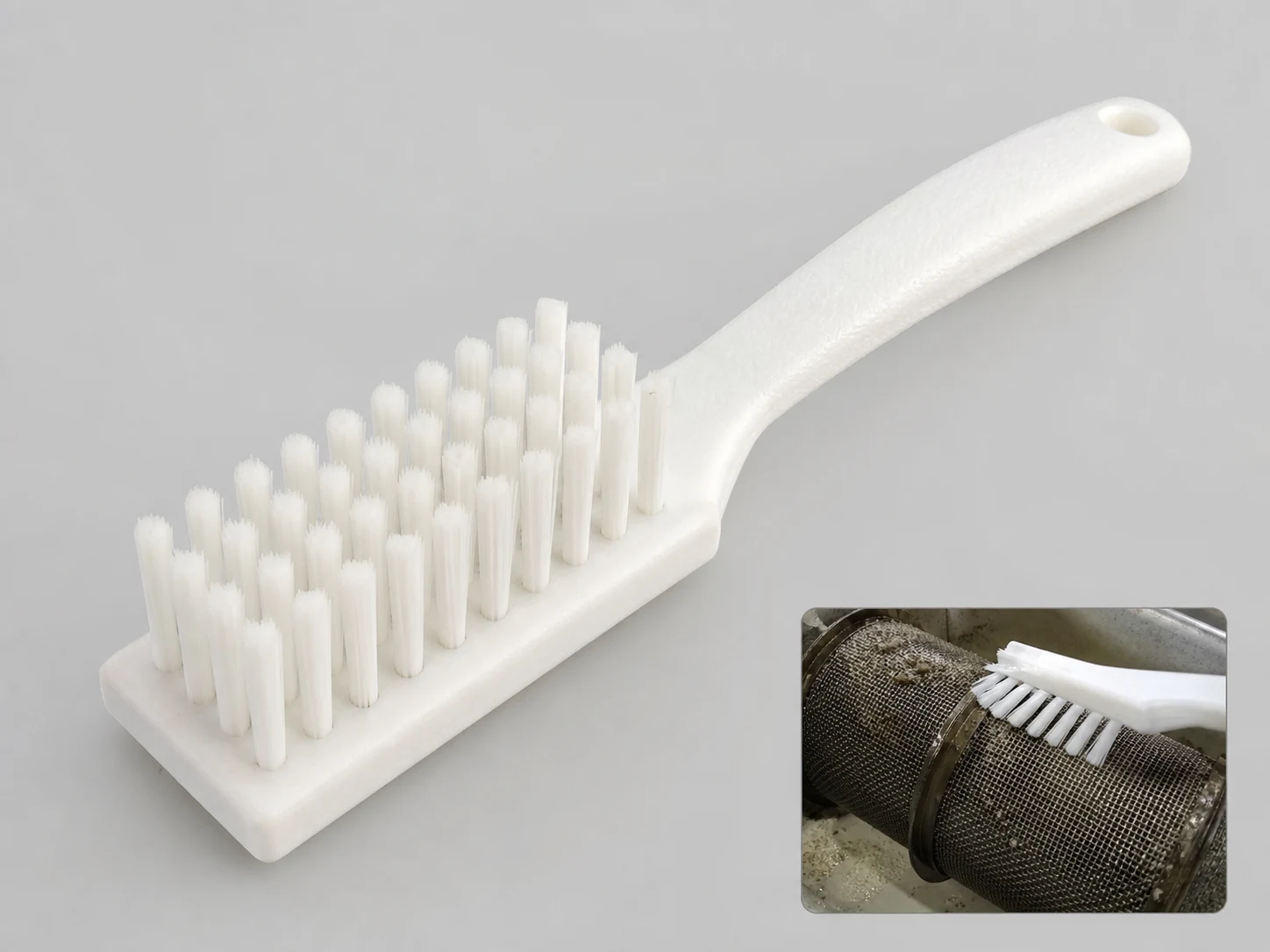
Handheld sieve-cleaning brush for test sieves, filter screens, and mesh media. Nylon PA for 120 mesh and finer, brass wire for 100 mesh and coarser.
Small brush
500 pcs
Minimum order
Held in one hand: tube, bottle, detail and swab brushes — including long-handled ones with a small head.
Production lead time, once the specification is confirmed
- Up to 500 pcsWithin 7 days
- 501–50,000 pcsWithin 14 days
- Over 50,000 pcsWithin 21 days
Peak season can extend these times; the shipping date is confirmed in writing with your quotation. Sampling and shipping are quoted separately.
A handheld sieve-cleaning brush for clearing lodged powder, fibers, and dust from test sieves, filter screens, and mesh media. Nylon PA fill protects fine mesh from 120 count and finer, while brass wire fill handles 100 mesh and coarser screens with caked residue.
What can this brush do for you?
Clear fine-mesh apertures without distorting the screen. The nylon PA bristles have a fine, rounded tip profile that slides into 120-mesh and finer openings, pushing out lodged particles from the back side without bending or enlarging the wires. This keeps aperture size consistent for repeatable sieving results.
Two fill hardness levels for different clogs. Brass wire bristles provide extra stiffness to break through dust cake, oil film, and hardened powder on screens from 100 mesh down to coarse industrial cloth. Nylon stays softer for delicate fine mesh and synthetic filter media.
Contoured head matches sieve shape. Heads are available in round, oval, or rectangular profiles matching the sieve frame, which puts more bristle tips into the corners and along the rim where material tends to accumulate after shaking.
Short handle gives precise pressure control. The 120–200 mm overall length lets the operator work close to the screen with thumb or finger pressure, reducing the risk of forcing particles deeper into the weave.
Lifts embedded fibers and residue that tapping leaves behind. Bristle tips reach into the apertures and flick out material that air backflow or mechanical tappers only loosen on the surface.
What is a Sieve Brush?
A Sieve Brush is a hand tool specifically engineered to clean the mesh or perforated surface of test sieves, bolting cloth, filter screens, and similar precision apertured components. It is built differently from a utility brush: the fill material, bristle diameter, and trim length are matched to the mesh count so that cleaning removes lodged residue without altering the aperture or scratching the wire. The operator works the brush across the screen, often with the sieve inverted, using short strokes that push particles back out the open side. The brush can be used dry for powder and dust, or with a light solvent for oily films, depending on the handle and ferrule construction. This is a maintenance and deblinding tool, not a heavy scrubbing brush. For large screen decks or fully plugged openings, other cleaning methods may be required before or instead of hand brushing.
Technical Specifications
We can adjust the dimensions, fill material, and trim to fit your specific sieve series or screen deck. Provide your mesh count, sieve diameter, and residue type for a matched configuration.
| Parameter | Value / Options |
|---|---|
| Product form | Handheld sieve-cleaning brush |
| Fill material | Nylon PA (for 120 mesh and finer) or Brass wire (for 100 mesh and coarser) |
| Head diameter / width | 40–80 mm, selected to cover the working area of the sieve |
| Overall length | 120–200 mm, adjusted for operator reach and sieve frame depth |
| Bristle trim length | 10–25 mm, matched to aperture size and clog depth |
| Bristle diameter | 0.10–0.40 mm for nylon; 0.08–0.20 mm for brass, selected by mesh count |
| Head shape | Round, oval, or rectangular to match the sieve frame |
| Handle material | Hardwood, polypropylene, or stainless steel; custom options available |
| Ferrule | Nickel-plated steel or stainless steel, depending on wet/dry use |
| Mesh compatibility | Nylon: 120 mesh and finer; Brass: 100 mesh and coarser; other meshes on request |
| Operating condition | Dry or light solvent; temperature resistance depends on fill and handle material |
| Brush type | Custom Handheld Detail Brushes |
| How it is driven | Hand-guided |
| Cleaning target | laboratory test sieve, pharmaceutical and nutraceutical sifting line, and food processing bolting cloth cleaning |
| Surface or part | screens, filters, baskets, frames, and rims |
| Residue or debris | powder, dust, particles, fiber, flour, paint, pigment, and sugar |
| Mounting / connection | Shaft-Mounted / Fixed |
Where does this brush work best?
- Laboratory test sieves (ASTM E11 / ISO 3310) for particle size analysis, especially fine series from 120 mesh to 400 mesh.
- Pharmaceutical and nutraceutical sifting lines where sticky powders blind the screen between batches.
- Food processing bolting cloth in flour milling, spice grinding, and sugar refining.
- Paint, coating, and ink filtration screens where pigment agglomerates lodge in the mesh.
- Powder coating recovery screens and cyclone discharge screens.
- Water treatment and chemical basket strainers with accessible screen surfaces.
How do I choose the right one?
Match fill to mesh count
For 120 mesh and finer, use nylon PA. The fine, flexible bristle tips enter small apertures without bending wires. For 100 mesh and coarser, brass wire provides the stiffness needed for heavier dust cake and oil-bound particles. If you are unsure, provide the mesh count and the described residue, and we will recommend the safest fill.
Make the brush match the residue, not just the mesh
Dry and loose particles respond to nylon. Caked or sticky films may need brass, but brass can leave metallic traces or scratch polished cloth. For sensitive screens, stay with nylon and add a compatible solvent.
Head size and shape
The head should cover about one-quarter to one-third of the sieve diameter in a single stroke; too large reduces maneuverability near the rim, too small makes cleaning tedious. Round heads suit round sieves, rectangular heads suit flat screen decks and frames.
Handle length and environment
Shorter handles (120–160 mm) give precise control in laboratory hoods; longer handles (160–200 mm) keep hands away from oily or wet screens. If the cleaning area involves solvents or high temperature, specify so the handle and ferrule are selected accordingly.
When a sieve brush is not enough
If the screen is fully blinded with hardened scale, mineral deposits, or baked-on polymer, hand brushing may not restore flow. Start with a soak, ultrasonic cleaning, or compressed air backflush, then use the brush for final deblinding. For large continuous screen decks, a rotary brush or automated cleaning system is more efficient. A sieve brush is for routine maintenance and changeover cleaning, not heavy reconditioning.
Can I customize this brush?
We can adjust the head shape, width, and trim length to match your sieve diameter and aperture pattern. The fill material (nylon PA or brass wire) and bristle diameter can be changed to suit your mesh count and residue type. Handle material, length, and grip ergonomics are configurable, as is the ferrule material for wet or chemical environments. Color coding by mesh size, laser marking, pad printing, or labeling for identification is available. Packaging can be bulk, individually bagged, or kit-based.
Provide your sieve specifications, cleaning process, and any regulatory or documentation needs. We can support project-specific certification, material declarations, inspection reports, and third-party testing where required.
Which filament survives the cleaning and still lasts on a sieve brush?
How do I know if the brush is damaging my sieve mesh?
After cleaning, inspect the screen under magnification or backlight. Look for bent or broken wires, enlarged apertures, or shiny polished spots on the cloth. If any appear, switch to a softer fill material, reduce pressure, or increase the brushing angle so bristle tips enter the openings straight rather than sideways.
Can I use the same sieve brush for wet and dry screening processes?
It depends on the handle and ferrule. Hardwood handles can swell or crack with frequent wet use; stainless steel and polypropylene hold up better. Nylon bristles tolerate water and most mild solvents, but brass wire should be dried after wet use to prevent corrosion. Specify your cleaning media so we can build the brush accordingly.
How do I clean the sieve brush after it becomes loaded with residue?
Tap the brush head against a hard surface to dislodge trapped particles, then rinse with a compatible solvent and allow it to air-dry. For fine mesh residues, a soft air blow can remove what tapping misses. Check that no particles remain lodged between bristle rows before storing; retained residue can transfer to the next sieve.
When should I replace a sieve brush?
Replace when the bristles become bent, flattened, or no longer spring back after use, or when the tips are worn smooth and cannot enter the apertures. A worn brush will glide over clogs instead of removing them and may leave residue behind. Depending on frequency, inspect after every 20–30 cleaning cycles.
Will the brush remove every particle from the sieve?
No. The brush clears particles that are mechanically lodged or lightly adhered in the apertures, but it does not dissolve chemical deposits or remove particles bonded by static or oil. If particles remain after brushing, consider an ultrasonic bath, solvent soak, or compressed air backflush before a final brush pass.
What is the practical difference between nylon and brass fill on the same mesh?
On the same mesh count, nylon is softer and leaves no metallic residue, making it suitable for fine test sieves and food/pharma screens. Brass is stiffer and removes heavier caked material faster, but it can scratch polished cloth and may leave small brass traces. Brass is typically reserved for coarser screens where those drawbacks are acceptable.
Guides that go deeper on this
Custom Manufacturing RFQ
Describe Your Application
An accurate custom quote starts with the dimensions, working surface, residue, material choice, connection, quantity, and reference files.
Drawing or photo optional — it speeds things up, it does not gate the enquiry.
Custom Brush RFQ
Send Your Brush Project
Upload a drawing, product photo, or sample photo and provide the core dimensions and cleaning conditions.
“We need a brush to remove wet residue from a stainless steel conveyor, about 800mm wide. The current brush wears quickly. We can send photos.”
“We sell drinkware and need a cleaning brush to include with the product. Quantity around 5,000 pieces.”