
Custom Cleaning Brush
Spray Gun Cleaning Brush
Precision spray gun cleaning brushes with brass wire and nylon PA filaments. Clean paint gun nozzles, fluid passages, and air caps.
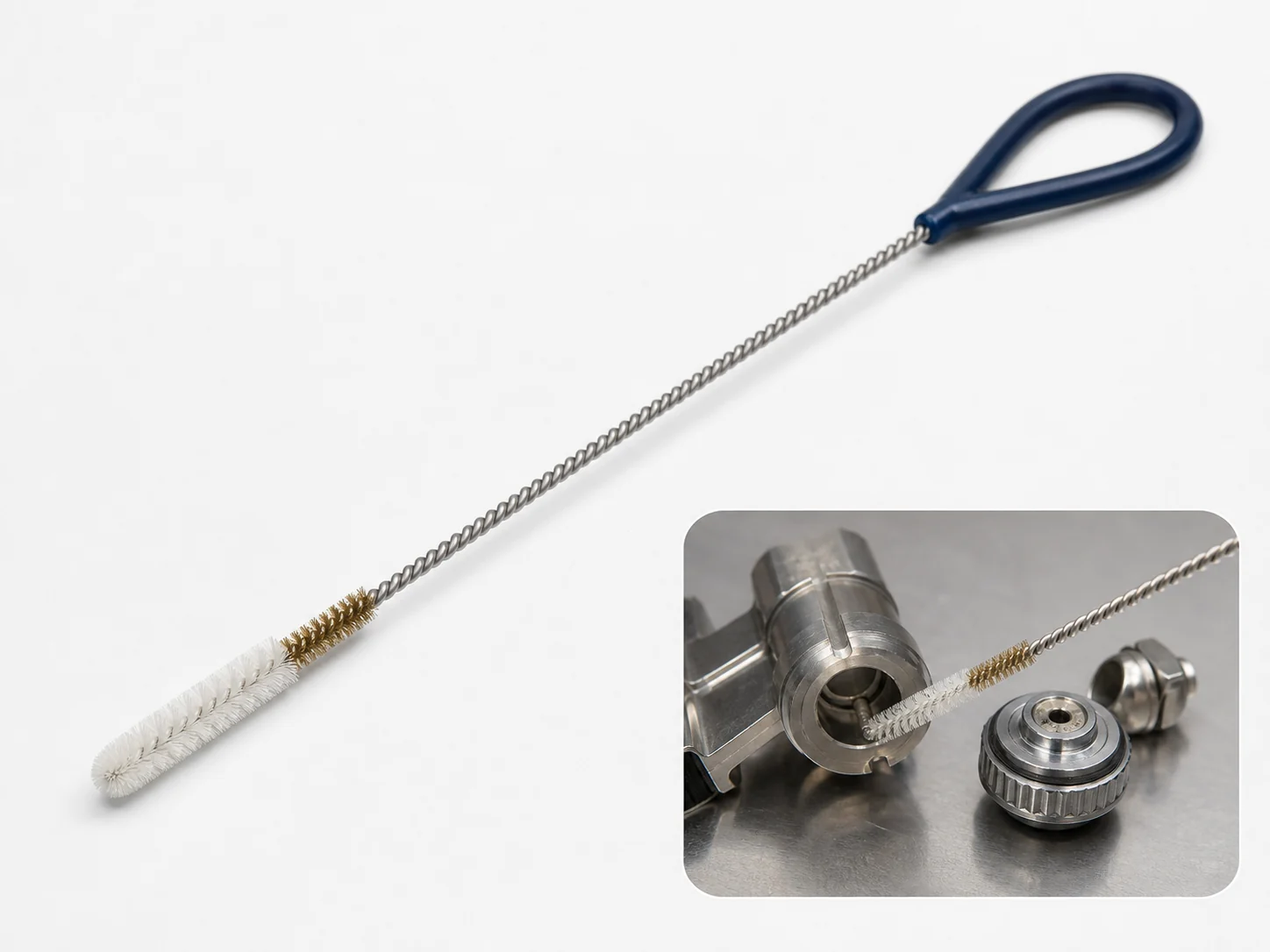
Small brush
500 pcs
Minimum order
Held in one hand: tube, bottle, detail and swab brushes — including long-handled ones with a small head.
Production lead time, once the specification is confirmed
- Up to 500 pcsWithin 7 days
- 501–50,000 pcsWithin 14 days
- Over 50,000 pcsWithin 21 days
Peak season can extend these times; the shipping date is confirmed in writing with your quotation. Sampling and shipping are quoted separately.
Precision twisted-wire brushes for removing dried paint, coating residue, and solvent-softened deposits from spray gun nozzles, fluid passages, air cap holes, and internal threads. Available with brass wire or nylon PA filaments to match both the residue and the bore material.
What can this brush do for you?
Reaches the small passages other brushes can’t
Spray gun internals often have bores under 2 mm, including nozzle orifices, fluid tip passages, and air cap holes. These brushes are built with bristle diameters that match those small openings, held on a twisted wire stem that can follow the short angled path inside a nozzle. The operator pushes the working end through the passage, rotates it by hand, and pulls loosened residue back out.
Removes dried paint without damaging precision surfaces
Brass wire is softer than the hardened steel used in many spray gun bodies, so it clears dried paint and cured coating build-up while limiting the risk of scoring fluid passages. For aluminum components, air caps with fine orifices, or internally coated surfaces, nylon PA filaments provide a non-metallic contact that will not scratch. A set containing both materials covers the full range of passage sensitivity.
Works with the solvents you already use in the spray booth
Both brass wire and nylon PA are compatible with common cleaning solvents such as acetone, lacquer thinner, mineral spirits, and waterborne gun cleaners. The stem wire is plated or stainless to resist corrosion during repeated wet solvent exposure, so the brush can be used as part of normal gun cleaning without a separate cleaning system.
Sets cover multiple bores in one purchase
A spray gun has different bore sizes in the nozzle, air cap, fluid tip, and cup connection. A multi-brush set with graduated diameters lets the technician select the right size for each opening instead of forcing one brush into every hole. Typical sets group five to eight brushes from fine air cap orifices up to larger fluid passages, often with a mix of brass and nylon.
Twisted-wire stem flexes around short bends
The twisted-wire construction is not completely rigid. In small diameters, the stem can flex slightly to follow the shallow angles between the fluid inlet and the nozzle bore. This keeps the brush in contact with the passage wall rather than jamming at the first corner and leaving residue behind the bend.
Reusable across many cleaning cycles
After use, the brush can be wiped clean, rinsed in solvent, and stored dry. The wire stem returns to its original shape, and the bristles remain anchored in the twist. Unlike brushes with molded plastic handles that soften in solvent, these sets are built for daily use in a professional spray environment.
What is a Spray Gun Cleaning Brush?
A spray gun cleaning brush is a hand tool for clearing dried coating residue from the internal passages of paint spray guns, airbrushes, and similar precision fluid-handling equipment. It is not a broad-bristle brush for wiping down the outside of the gun. It is a bore-cleaning tool built around a twisted wire stem with short bristles held between the two twisted wires. The working end forms a brush diameter matched to a specific passage inside the gun.
Typical construction starts with a steel wire loop. Bristle material—brass wire, nylon PA, or less commonly natural bristle—is laid across the loop, and the wire is twisted to lock the filaments in place. The result is a cylindrical brush with a plain stem, straight wire, or loop handle on the opposite end. The brush is inserted into the fluid nozzle, air cap passage, or cup connection, rotated by hand, and withdrawn along with loosened residue. Solvent or gun cleaner is used as the carrier during the operation.
This tool fits into the disassembly-and-clean step of the spray gun maintenance sequence. Most technicians remove the air cap, fluid nozzle, needle, and cup before brushing. Brushing removes the attached deposit that solvent alone will not lift, particularly dried paint at the nozzle throat, threads, and sealing faces. It does not replace solvent soaking, ultrasonic cleaning, or calibration after reassembly.
The brush is selected by the bore diameter, not by the gun model alone. Two guns from different manufacturers may have nozzles with different internal diameters, so the set approach is common: several brush sizes cover the majority of passages. For OEM or production environments, brushes can be matched exactly to the gun’s fluid and air passage dimensions.
Technical Specifications
The following table lists the common production range for spray gun cleaning brushes. Dimensions and materials can be adjusted to your specific passage dimensions.
| Parameter | Specification / Options |
|---|---|
| Brush diameter (bristle OD) | 1.5–6.0 mm standard; 0.5–12 mm available on request |
| Working length (bristle section) | 25–100 mm, passage-specific |
| Overall length | 150–300 mm typical; extended stems on request |
| Fill material | Brass wire (0.08–0.15 mm filament), nylon PA 6.6 (0.10–0.20 mm filament), natural bristle |
| Stem material | Zinc-plated carbon steel, 304 stainless steel, or brass |
| Handle | Twisted loop, straight shaft, or plain stem end |
| Set composition | 3–8 brushes per set; mixed diameters and fill materials |
| Bore match principle | Brush diameter selected 0.1–0.3 mm below bore ID for clearance and wall contact |
| Solvent exposure | Compatible with acetone, lacquer thinner, mineral spirits, waterborne gun cleaners |
| Rotation / drive | Hand rotation intended; powered use requires matched twist direction and speed rating |
| Brush type | Custom Tube & Pipe Bore Brushes |
| How it is driven | Hand-guided |
| Cleaning target | automotive collision repair shop, industrial finishing line, and woodworking and furniture finishing cleaning |
| Surface or part | passages, nozzles, bores, air caps, holes, thread, aluminum, and internal passages |
| Residue or debris | paint, coating residue, and cured coating |
| Mounting / connection | Brush diameter selected 0.1–0.3 mm below bore ID for clearance and wall contact; Hand rotation intended; powered use requires matched twist direction and speed rating |
The brush diameter is the most critical specification. It must pass through the narrowest access opening while still contacting the passage wall. If your gun has unusual bore dimensions, we can produce brushes in custom diameters and working lengths.
Where does this brush work best?
Spray gun cleaning brushes are most valuable where dried paint and coating residue collect in small, hard-to-reach internal areas that solvent alone cannot clear. Typical use environments include:
- Automotive collision repair shops — cleaning HVLP and conventional spray guns between basecoat and clearcoat jobs, especially nozzle orifices and air cap holes.
- Industrial finishing lines — maintaining air spray and air-assisted airless guns used with primers, enamels, and two-component coatings.
- Woodworking and furniture finishing — clearing lacquer, varnish, and stain build-up from spray equipment used in cabinet and millwork shops.
- Airbrush and model painting — cleaning fine nozzles and needle passages where brush diameters under 2 mm are required.
- Paint manufacturing and testing labs — maintaining small spray and sample equipment between formula changes.
- General precision cleaning — any small threaded bore, orifice, or fluid passage where a small wire brush set is useful, including fuel passages, lubrication points, and air tool maintenance.
How do I choose the right one?
Start with the smallest bore you need to reach
Measure the internal diameter of the nozzle, air cap hole, or fluid passage. The brush diameter should be slightly smaller than the bore—typically 0.1–0.3 mm clearance—so it enters without binding but still contacts the wall. A brush that is too large will jam or bend; one that is too small will spin without scrubbing.
Choose bristle material by deposit and surface
- Brass wire — best for dried paint, cured coatings, and heavy build-up on hardened steel or stainless components. Brass is non-sparking and less aggressive than steel wire.
- Nylon PA — best for aluminum parts, anodized surfaces, plated components, and fine orifices where any metal contact is a risk. Nylon works well with solvent-softened residue.
- Natural bristle — for very fine passages or delicate surfaces where even nylon is too stiff; lower scrubbing force but compatible with most solvents.
Confirm the working length reaches the build-up
Measure from the cleaning access point to the deepest residue location. The bristle section must extend past the deposit, and the overall length must allow comfortable hand control. A stem that is too long flexes and reduces control; a stem that is too short leaves residue in the bottom of the passage.
Buy a set when passages vary in size
Single brushes work when every gun in the shop is the same model. When several gun brands or nozzle sizes are in use, a set with graduated diameters and both brass and nylon options is more practical. A set also covers future gun purchases without a second order.
When a brush is not enough
If the nozzle is completely plugged with catalyzed or baked-on coating, a brush may not clear it. First soak the parts in the recommended gun cleaner or use an ultrasonic cleaner. If the passage remains blocked, the nozzle may need replacement. Brushing is for routine residue removal, not for salvaging severely damaged parts. For aluminum or brass internal surfaces, always use nylon or natural bristle; brass wire is reserved for steel or stainless passages.
Can I customize this brush?
Spray gun cleaning brushes are rarely off-the-shelf for every OEM specification. We build to your nozzle and passage dimensions. The following attributes can be adjusted for your application:
- Brush diameter — custom sizes from 0.5 mm to 12 mm, in 0.1 mm increments when required.
- Working length and overall length — matched to passage depth and handle clearance.
- Fill material — brass wire, nylon PA (6.6 or 6.12), natural bristle; filament diameter chosen for stiffness and wear.
- Stem material — carbon steel with zinc or nickel plating, 304 stainless steel, or brass for non-magnetic environments.
- Handle — twisted loop, straight wire, plastic-dipped handle, or plain stem for insertion into a holder.
- Set composition — number of brushes, sizes, and material mix chosen for a specific gun platform.
- Color coding — different handle dip colors to identify brush diameter at a glance.
- Packaging — bulk, individual bags, retail cards, or workshop sets.
To define the custom configuration, provide the bore ID, passage length, access opening, component material, residue type, solvent, and any handle preference. A drawing or sample gun part speeds up the process. If your project requires material compliance documentation, inspection reports, or third-party testing, we can support those requirements as part of the customization process.
Which filament survives the cleaning and still lasts on a spray gun cleaning brush?
How do I clean a spray gun cleaning brush after use?
Rinse the bristle section in clean solvent or gun cleaner, then wipe with a clean cloth. Allow the brush to dry before storing. Do not pull the bristles with pliers or try to straighten bent filaments; replace the brush when bristles are splayed or missing.
Can I use these brushes to clean the spray gun while it is still assembled?
No. Passage access, especially around the fluid needle and air cap, requires the nozzle and air cap to be removed. Trying to brush through the gun without disassembly can push residue deeper or damage the needle and seals. Always follow the gun manufacturer’s disassembly process.
How do I verify the passage is clean after brushing?
Flush the passage with clean solvent and inspect the solvent as it exits. Repeat brushing and flushing until the solvent runs clear. For the nozzle, hold it up to a light and check for an even, round orifice with no residue at the edges.
What are the signs that a brush is worn out and should be replaced?
Look for bristles that are bent flat, missing, or no longer uniform around the stem. A reduced brush diameter means less wall contact. Check the stem for kinks or corrosion. If the brush diameter has decreased or the stem is damaged, replace it to avoid leaving residue or scratching the bore with exposed wire.
Will brass wire brushes leave metal particles in the paint system?
Brass wire can shed fine particles if aggressively worked or worn. For passages that must remain metal-free, use nylon PA brushes. If brass wire is used, flush the passage thoroughly with solvent after brushing and inspect the flush for metallic debris.
Can these brushes be used in a rotary tool or drill?
Standard hand brushes are not designed for powered rotation. High-speed rotation can unwind the twist, break wires, and oversize the bore. If powered cleaning is required, specify a brush built with the correct twist direction and a speed rating. Hand rotation with the twist direction is sufficient for routine nozzle cleaning.
Guides that go deeper on this
We have not written a guide specific to this one yet. The material that covers selection, filament, dimensions, maintenance and sourcing is collected in the technical resources library.
Custom Manufacturing RFQ
Describe Your Application
Please include the main sizes, application, residue, preferred material, interface, quantity, and any drawing or sample available.
Drawing or photo optional — it speeds things up, it does not gate the enquiry.
Custom Brush RFQ
Send Your Brush Project
Upload a drawing, product photo, or sample photo and provide the core dimensions and cleaning conditions.
“We need a brush to remove wet residue from a stainless steel conveyor, about 800mm wide. The current brush wears quickly. We can send photos.”
“We sell drinkware and need a cleaning brush to include with the product. Quantity around 5,000 pieces.”