
Custom Cleaning Brush
Spring Brush
Order custom spring brushes for cleaning bores, tubes, threads, and shafts. Spiral-wound construction with PBT or stainless steel wire fill.
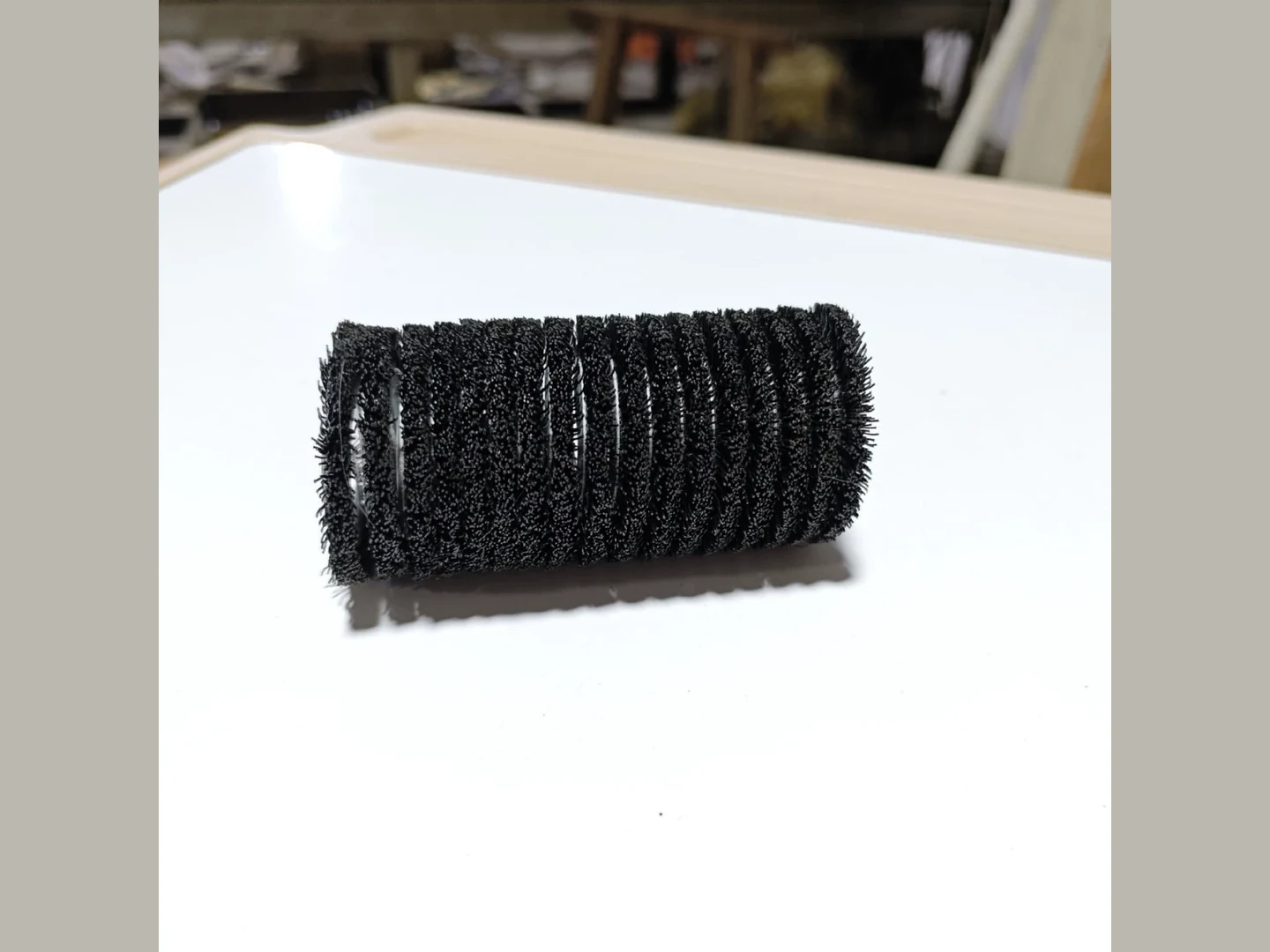
Medium brush
100 pcs
Minimum order
Worked with two hands or on a pole: chimney, gutter and pond-filter brushes, discs, cups and tank brushes.
Production lead time, once the specification is confirmed
- Up to 100 pcsWithin 7 days
- 101–5,000 pcsWithin 14 days
- 5,001–50,000 pcsWithin 21 days
- Over 50,000 pcsConfirmed with your quotation
Peak season can extend these times; the shipping date is confirmed in writing with your quotation. Sampling and shipping are quoted separately.
A spring brush is a spiral-wound cleaning tool built around a flexible wire core, with filament or wire bristles captured between the coils. It reaches into bores, tubes, threads, and around shafts to remove chips, scale, dust, and residue where straight brushes cannot follow the contour.
What can this brush do for you?
Conforms to curved and offset internal paths
The flexible wire core bends and recovers, so the brush follows slight bends or offset bores without losing contact. This makes it suitable for applications where a rigid rod brush would bind or skip, such as curved tubing, angled ports, or bores with minor misalignment.
Adjustable radial interference for controlled cleaning pressure
Because the outside diameter and bristle trim length are set against the bore or shaft dimension, you get a known amount of radial engagement. The bristle tips contact the surface with predictable pressure — enough to dislodge residue without excessive wear on the brush or the workpiece.
Works in wet, dry, and high-temperature processes
Select PBT filament for chemical resistance and gentle scrubbing in wet environments, or stainless steel 316 wire fill for aggressive scale removal and continuous operation at elevated temperatures. The stainless core withstands corrosion and maintains spring recovery in most industrial fluids.
Long continuous cleaning without joints or splices
The spiral is wound as a single continuous element up to 3000 mm. There are no couplings or welded joints along the working length, so nothing catches on the bore wall or snaps under torque. Long tubes, pipe runs, and deep mold channels can be cleaned in one pass.
Open spiral releases debris instead of packing it in
The gaps between coils form natural channels for chips, dust, and loosened scale to exit the brushing area. The brush does not plug itself with the material it removes, which is a common failure mode with dense, wound-strip or twisted-in-wire brushes.
Fast installation and replacement
Simple end loops, straight shanks, or formed tangs mount directly into drill chucks, pull-through rods, manual handles, or automated spindles. When a brush wears out, replacement is a matter of pulling one and inserting another — no special tooling required.
What is a Spring Brush?
A spring brush uses a continuous wire core, typically stainless steel, around which a second wire is coiled to trap filament or wire bristles between adjacent coils. The bristles extend radially outward, and the resulting helix provides both the structural spine and the cleaning surface. Depending on the wound direction and bristle placement, the brush can be made as an outer-spiral for cleaning bores or an inner-spiral for cleaning shafts and external diameters.
The brush is intended for rotary or push-pull use inside a restricted space. When rotated, centrifugal force helps the bristles stand outward and maintain contact with the bore wall. When pushed or pulled by hand or machinery, the spring core follows the available path, allowing the brush to travel through slight curves or around obstacles. The working action is generated by the bristle tips scraping or wiping the surface, not by the core itself.
Because the core is a spring, the brush has a limited ability to support heavy radial loads. It is not designed to be used as a structural reamer or as a substitute for a rigid shaft brush in straight, short bores where aggressive cutting is required. The spring core flexes to follow geometry, but this same flexibility means that excessive side pressure or oversized interference will cause the core to deflect and the bristles to fold over rather than clean effectively.
Typical use begins after drilling, tapping, reaming, or during scheduled maintenance when loose material, light scale, or residue must be removed quickly and consistently from internal or around-shaft surfaces. The brush is inserted, rotated or stroked along the axis, then withdrawn. For through-holes, a pull-through loop allows cleaning from one side. For blind holes, a shank-mounted brush is advanced and retracted.
Technical Specifications
| Parameter | Options / Typical Range |
|---|---|
| Brush form | Single-spiral (outer), double-spiral, inner-spiral for shaft OD, or custom wound |
| Outside diameter | 10–200 mm, adjusted to bore ID with required interference |
| Core diameter | 3–20 mm wire core, selected for stiffness and bending requirement |
| Overall length | 100–3000 mm continuous spiral, no intermediate joints |
| Fill materials | PBT, nylon PA, PP, stainless steel 316 wire, or project-specific combination |
| Filament / wire diameter | 0.1–0.5 mm for fine cleaning; 0.5–1.2 mm for aggressive deposit removal |
| Spiral pitch | Adjustable; tighter pitch for higher bristle density, looser pitch for flexibility and debris clearance |
| Bristle trim length | Set by gap between core OD and cleaning diameter; radial interference typically 0.5–5 mm per side |
| End configuration | Loop, straight shank, threaded, quick-connect, tang, or formed to match driver |
| Operating temperature | PBT up to approximately 120°C continuous; nylon up to 90°C; stainless steel wire up to 400°C+ |
| Maximum recommended RPM | Depends on OD and balance; smaller diameters can run up to 3000 RPM, larger diameters require derating |
| Wet / chemical compatibility | PBT resists many oils, solvents, mild acids and alkalis; stainless steel wire for harsh chemical and high temperature service |
| Brush type | Custom Spring Brushes |
| How it is driven | Hand-driven on rods or a flexible shaft |
| Cleaning target | post-machining chip and burr removal, cleaning internal thread and sealing surface, and removing scale cleaning |
| Surface or part | bores, spring, thread, holes, coils, tubes, blind holes, and bends |
| Residue or debris | scale, chips, dust, carbon, rust, mold, carbon deposit, and pitch |
| Mounting / connection | Threaded Removable / Fixed |
All dimensions are project-configurable. The table shows typical ranges for industrial spring brushes; the exact values are defined during the quoting process based on your bore or shaft dimensions, residue type, and operating conditions.
Where does this brush work best?
- Post-machining chip and burr removal from drilled, tapped, or reamed holes, including blind holes and cross-drilled passages.
- Cleaning internal threads and sealing surfaces in hydraulic manifolds, valve bodies, and pneumatic components where contamination can cause leaks.
- Removing scale, rust, and carbon deposits from inside pipes, tubes, and exhaust systems, including sections with moderate bends.
- Cleaning around shafts, splines, keyways, and bearing seats where a flat brush or wheel cannot wrap around the diameter.
- Surface preparation of bores and internal cavities before coating, plating, adhesive bonding, or seal installation.
- Maintenance of heat exchangers, condensers, and small-diameter tubing where internal fouling must be removed without dismantling the entire unit.
- Mold and die cleaning for internal cooling channels, ejector pin holes, and other difficult-to-access passages.
How do I choose the right one?
Start with the bore or shaft geometry. Measure the minimum and maximum internal diameter, the total depth to be cleaned, and any entry restrictions such as thread roots or step changes. The brush OD must be larger than the bore ID to create radial interference, but not so large that the core deflects or the brush jams. For shaft cleaning, the core ID must clear the shaft OD while the bristle tips reach the surface.
Select the fill material based on the residue and the surface you need to protect. PBT filament is stiff enough to dislodge soft deposits, yet forgiving on machined surfaces and resistant to many chemicals. Nylon offers better water absorption but is softer and lower temperature. Polypropylene provides excellent chemical resistance at low cost but has a lower heat limit. Stainless steel 316 wire removes hard scale, rust, and baked carbon, and it survives high temperatures, but it will mark soft metals and may require careful RPM control to avoid wire fatigue.
Filament or wire diameter controls stiffness. Thicker bristles produce more aggressive cutting action; thinner bristles give finer contact and less surface damage. Bristle trim length is equally important: short trim lengths create a stiffer brush for heavy deposits, while long trim lengths are more compliant and better for conforming to irregular bores.
Spiral pitch affects both cleaning density and debris removal. A tight pitch packs more bristle tips per unit length, giving a smoother finish and faster cleaning on uniform surfaces. A loose pitch opens channels for chips and scale to exit, improves flexibility in curved paths, and reduces material cost. Choose the tightest pitch that still allows the debris to clear in your specific application.
Match the end configuration to the drive method. A loop end is ideal for pull-through cleaning of pipes; a straight shank suits hand drills or machine spindles; a threaded end integrates with automated equipment. If the brush must be changed frequently, a quick-connect feature reduces downtime.
Consider the operating environment: temperature, chemical exposure, wet or dry service, rotational speed, and duty cycle. The core wire grade, fill polymer, and any coating must survive continuous exposure without losing spring recovery or bristle stiffness. Stainless steel cores are standard for corrosion resistance, but other core materials can be specified if weight or cost is critical.
When a spring brush is not the best choice: For very hard, welded-on deposits, use a rigid shaft brush, wire wheel, or abrasive tool. For extremely tight bend radii that approach the core diameter, the brush may not turn and instead scrape on the core. For high-speed automated production lines with tight balance requirements, a custom balanced brush with a machined hub may be more suitable than a standard spiral. And for wet processes that require high contact force, a twisted-in-wire brush with a solid core may outperform a spring core.
Can I customize this brush?
Spring brushes are inherently project-specific, and nearly every dimension can be adjusted. We will need the bore ID or shaft OD, cleaning depth, entry restrictions, residue type, surface material, operating temperature, chemicals present, rotational speed, and preferred end fitting. A sketch or sample photograph accelerates the process.
We can alter:
- Geometry — outside diameter, core diameter, overall length, spiral pitch, bristle trim length, single or double spiral, inner or outer spiral, stepped diameters, or two-diameter brush for dual-size bores.
- Fill material — PBT, nylon, polypropylene, stainless steel 304/316 wire, brass wire, abrasive-impregnated nylon, or a combination of materials in one brush.
- Filament details — diameter, color, crimped or straight, and density per coil.
- End configuration — loop, straight shank, threaded, quick-connect, welded tang, or a formed end that matches your existing driver.
- Special features — pilot tip for blind hole entry, static-dissipative fill for electronics cleaning, metal-detectable fill for food processing, or color coding for size identification.
- Packaging and marking — bulk boxes, individual sleeves, custom labels, barcodes, or kitting with other brush sizes.
If your project requires material documentation, third-party testing, or inspection support, we can assist with those requirements during the customization process.
Which filament survives the cleaning chemicals a spring brush meets?
How do I know if I need an inner or outer spring brush?
If you are cleaning a hole or the inside of a tube, you need an outer spiral where the bristles point outward. If you are cleaning the outside of a shaft or pin, you need an inner spiral where the bristles point inward toward the core axis. Some applications use both in sequence: an outer brush for the bore and an inner brush for the mating shaft.
Can this brush be used in a hand drill?
Yes, for small diameters and light duty, a spring brush with a straight shank can be chucked into a hand drill. Keep RPM moderate and avoid heavy side pressure. For larger diameters, extended production runs, or automated equipment, mount the brush in a spindle or dedicated drive that maintains alignment and controls speed.
What is the difference between PBT and stainless steel wire fill in actual use?
PBT filament is softer and will not scratch aluminum, brass, or plated surfaces. It removes dust, chips, light oil film, and loose scale. Stainless steel 316 wire is much more aggressive and removes baked carbon, rust, and hard mineral deposits, but it can leave fine scratches on soft metals and may break wires under high RPM or heavy interference. Choose PBT for finish protection, wire for heavy deposits.
How do I clean the spring brush after use?
For PBT or nylon fill, rinse with a compatible solvent or water-based cleaner, then blow dry with compressed air. Avoid pressing the bristles against a hard surface, which permanently bends them. For stainless wire fill, rinse and allow to air dry; if wire bristles become packed with debris, use a fine pick or compressed air to clear the spiral. Never expose polymer fill to temperatures above its rated limit during cleaning.
How do I determine the correct spiral pitch for my application?
Start with the standard pitch offered for your diameter. If you see streaking or incomplete cleaning, try a tighter pitch to increase bristle density. If the brush clogs with chips or binds, switch to a looser pitch to open debris channels. For curved bores, a looser pitch improves flexibility. A test sample is the most reliable way to confirm pitch before ordering production quantities.
Can a spring brush clean a curved tube?
Yes, as long as the bend radius is large enough. As a general rule, the bend radius should be at least three to five times the brush outside diameter for reliable tracking without core damage. For tighter bends, a special core wire or a reduced-diameter brush may be required, or a different cleaning method such as a flexible shaft or cable brush may be more appropriate.
Guides that go deeper on this
Custom Manufacturing RFQ
Describe Your Application
To quote this brush accurately, send the size, material, cleaning target, residue, quantity, and any available drawing or sample photo.
Drawing or photo optional — it speeds things up, it does not gate the enquiry.
Custom Brush RFQ
Send Your Brush Project
Upload a drawing, product photo, or sample photo and provide the core dimensions and cleaning conditions.
“We need a brush to remove wet residue from a stainless steel conveyor, about 800mm wide. The current brush wears quickly. We can send photos.”
“We sell drinkware and need a cleaning brush to include with the product. Quantity around 5,000 pieces.”