
Custom Cleaning Brush
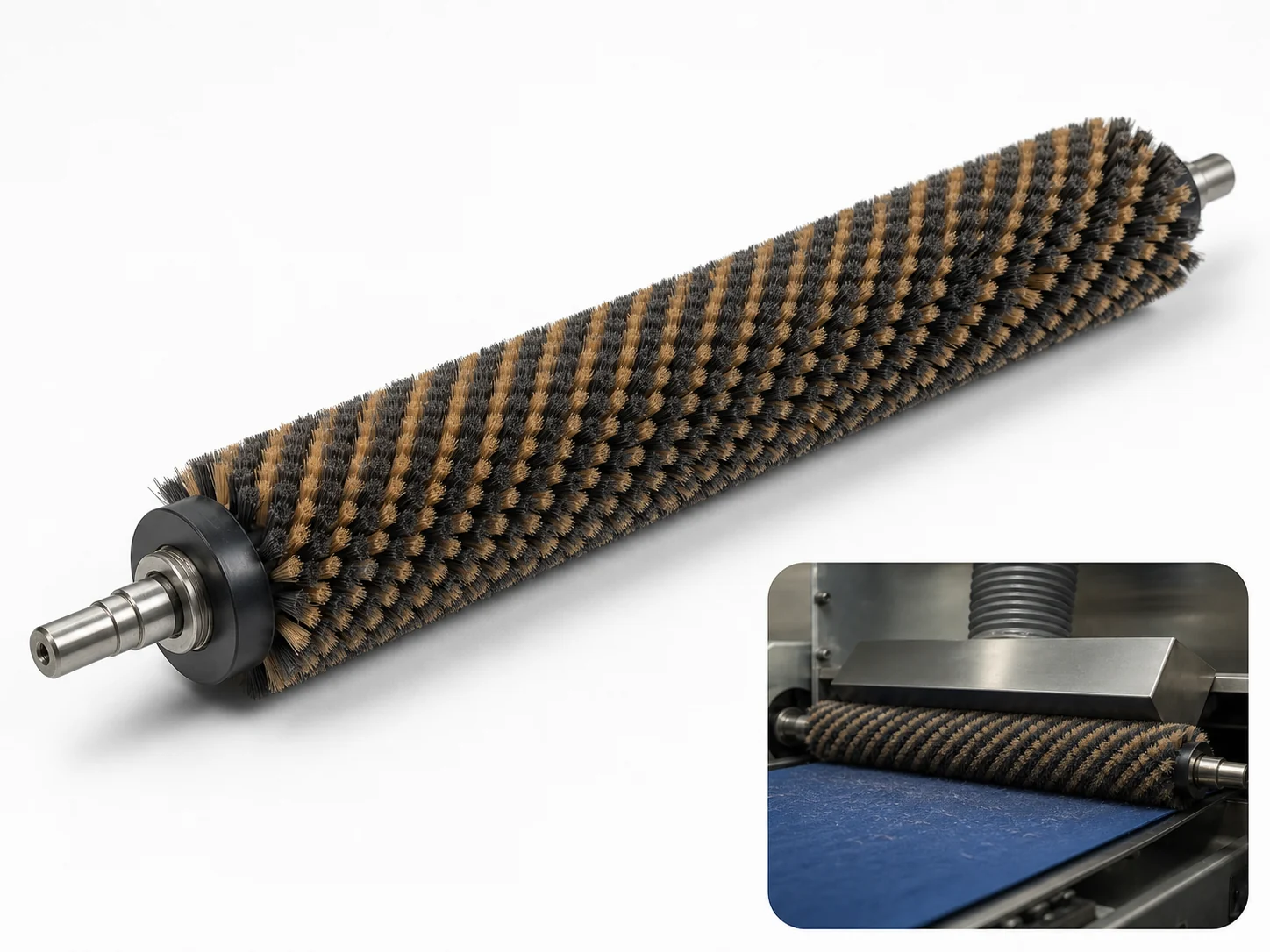
Textile Dyeing Finishing Brush Roller
A full-width roll built to your core, shaft and working length, with fill stiffness chosen for the substrate, chemistry and line speed it runs against.
Large-format brush
100 pcs
Minimum order
Built one at a time on a core or channel: full-width rollers, sweeper brooms and long strip.
Production lead time, once the specification is confirmed
- Up to 100 pcsWithin 20 days
- 101–1,000 pcsWithin 30 days
- Over 1,000 pcsConfirmed with your quotation
Peak season can extend these times; the shipping date is confirmed in writing with your quotation. Sampling and shipping are quoted separately.
Textile Dyeing Finishing Brush Roller is a full-width rotating brush roll that mounts into continuous dyeing and finishing machinery to remove lint, loose fibers, dust, nap and light process residue from the moving fabric web. The roller is built around your machine’s core, shaft and working-length dimensions, with fill material and filament stiffness selected for the substrate, chemical environment and line speed.
What can this brush do for you?
Full-width lint removal without edge gaps
Because each roller is produced to the machine’s exact working face length — up to 5000 mm — the fill runs continuously from one fabric edge to the other. Fabric edges do not escape brushing, so loose fibers are removed evenly instead of collecting along the selvage and transferring downstream.
Stops loose fiber before it reaches drying cans and coating heads
The rotating fill lifts and carries lint, dust and loose fibers away from the fabric before they can deposit on padder rolls, heated cylinders, coating equipment or inspection stations. This reduces matted fiber buildup on machine rollers and reduces stop-and-clean downtime on the line.
Filament package selected for the actual substrate
Fill can be nylon PA, PBT, PP or natural boar bristle, each supplied in the filament diameter and trim length that produces the right contact for the fabric. Fine nylon or boar bristle gives a soft cleaning touch on sensitive wovens; stiffer PBT or thicker nylon handles heavy lint on durable constructions. The cleaning action follows the fabric, not a fixed pressure setting.
Built for wet and chemically active finishing environments
Filament and core materials are selected for continuous exposure to moisture, dye liquors, finishing chemicals and elevated wash temperatures. Dense close or pitch winding resists set and flattening, so the roller holds its working diameter and contact level over long production runs.
Replaceable brush strips reduce long-term roll cost
When the roller is built as a helical strip-wound unit, worn sections or full strips can be replaced on the existing core without sending the complete roll back. Shafts, journals and drives stay in place; only the consumable brush fill changes. Fully assembled replacement rollers are also available.
What is a Textile Dyeing Finishing Brush Roller?
A Textile Dyeing Finishing Brush Roller is a cylindrical brush roll installed at a specific contact point on a continuous textile dyeing or finishing line. It consists of a steel or aluminum core with brush fill wound around the outside in close, pitch or helical strip construction, and it mounts to the machine through shaft ends, journals or bearing blocks that match the existing frame.
In operation, the fabric web passes over, under or tangentially past the rotating roller. The dense filament surface sweeps the fabric and carries lint, loose fibers, dust, nap and light process residue into the fill. A companion suction slot, stationary comb or scheduled manual cleaning then strips the collected material from the roller so it can continue working.
This is not a shear roll, abrasive napping drum or high-force scraping tool. It provides controlled filament contact for fabric surface cleaning, light finishing action and protection of downstream machine elements. The roller can be line-driven or run as an idler that rotates from web movement; drive, mounting and orientation details follow the customer’s machine drawing.
Technical Specifications
| Parameter | Value / Options |
|---|---|
| Roller diameter | 50–500 mm, matched to machine space and required wrap or contact arc |
| Working face length | Up to 5000 mm, set from fabric width and machine frame |
| Core | Steel or aluminum tube; metal or polymer core options available |
| Shaft / journal | Diameter, keyway, bearing centers and drive coupling per customer machine drawing |
| Fill material | Nylon PA, PBT, PP, natural boar bristle; abrasive nylon for heavier deposits |
| Filament diameter | Nylon 0.05–1.2 mm, PP 0.07–2.0 mm, PBT 0.15–0.2 mm, boar natural grade |
| Fill construction | Close wound, pitch wound or helical strip; strip width, pitch and groove specified per project |
| Trim length / engagement | Set from substrate, residue type and process; no fixed engagement depth is applied |
| Operating environment | Material grade selected for moisture, dye/finishing chemicals, wash temperature and line speed |
| Brush type | Custom Roller and Conveyor Brushes |
| How it is driven | Machine-driven, mounted in the equipment |
| Cleaning target | drying cylinder, brushing, and laminating or calendering cleaning |
| Surface or part | roller, substrates, webs, rolls, moving fabric webs, cylinders, aluminum, and comb |
| Residue or debris | fiber, lint, loose fibers, dust, light process residue, and pitch |
| Mounting / connection | Shaft-Mounted / Fixed |
All roller dimensions and interface details are confirmed from the machine drawing before production. The values above represent the standard production range for this product.
Where does this brush work best?
- Before drying cylinders, stenters or sanforizing units, where fibers left on the fabric would transfer to heated surfaces and scorch or build up.
- After brushing, sueding or napping operations, to pick up raised loose fibers and reduce lint carryover into later finishing steps.
- Before coating, printing, laminating or calendering, where a clean fabric surface prevents embedded contamination in the final product.
- As a machine-roller cleaning brush, contacting transfer rolls or guide rolls to keep them free of fiber and finish buildup.
- On continuous ranges processing woven, knitted or nonwoven substrates that can accept controlled filament contact without surface damage.
How do I choose the right one?
Start with the machine interface
Record the roller diameter, working face length, core outside diameter, shaft or journal size, bearing centers and drive connection from the existing machine drawing. If this is a replacement, send the drawing or the worn roll for measurement. Fit comes first; even the best fill material cannot correct a roller that does not mount or rotate properly.
Match the fill material to the fabric and residue
| Material | Best use |
|---|---|
| Nylon PA | General lint, dust and loose fiber removal; resilient in wet dyehouse conditions |
| PBT | Stiffer filaments for heavier or more adhesive residues; good chemical and thermal stability |
| PP | Softer, low-moisture option for delicate fabrics, nonwovens or aggressive chemical environments |
| Boar bristle | Natural, very soft contact for sensitive wovens, nap smoothing and light finishing work |
| Abrasive nylon | When more aggressive removal or mild surface conditioning is acceptable |
Set filament diameter and winding for the residue load
Fine filaments from 0.05–0.25 mm remove fine lint without disturbing the fabric surface. Filaments from 0.3–1.2 mm in nylon, or thicker PP up to 2.0 mm, handle heavier fiber and durable constructions. Close winding gives dense, uniform contact; pitch or helical winding opens the fill, improves airflow and reduces loading when lint volume is high.
Set engagement from the process, not from a fixed rule
Contact depth must come from the substrate, fabric speed and residue type. Light kiss contact works for delicate fabrics and fine dust; deeper engagement removes heavy lint but risks surface glazing or filament set. Trial runs on process material define the correct position before the roller goes into full production.
When to choose a different tool
Use a shear roller, vacuum web cleaner or scraper if the process requires cutting, heavy scraping or non-contact extraction. Use a brush with metal or abrasive fill only if the fabric surface and process can tolerate aggressive action. If the web cannot accept any filament contact, the brush roller is not the right cleaning method.
Can I customize this brush?
Textile dyeing finishing brush rollers are built to order around the machine. To define the configuration, send the machine drawing, existing roller sample or measured dimensions, plus the fabric type, line speed, residue and chemical/temperature conditions.
We can adjust:
- Roller geometry — diameter, working face length, core wall thickness, shaft, journal, keyway and bearing interface
- Fill material — nylon PA, PBT, PP, natural boar bristle or abrasive nylon, selected for the substrate and residue
- Fill construction — close, pitch or helical strip winding; strip width, pitch, groove and direction of lay
- Filament package — diameter, trim length, density and stiffness profile along the face; zoned or staggered fill possible
- Core and surface treatment — core material, corrosion-resistant coating, static or dynamic balancing for higher line speeds
- Supply form — complete roller, replacement brush strip, spare segments or balanced sets
- Marking and packaging — roller identification, handling protection and project-specific packing
If your project requires material documentation, inspection support or third-party testing, we can coordinate those requirements as part of the customization process.
When is a textile dyeing finishing brush roller worn out rather than just dirty?
How do I measure the existing brush roller for replacement?
Measure the brush outside diameter, working face length, core outside diameter, shaft or journal diameter, bearing centers, keyway size and drive connection. A drawing or photo of the installed position helps confirm the winding direction and contact orientation. Send the worn roller if the dimensions are hard to reach.
Will the brush roller damage delicate fabrics?
Not if the fill is selected correctly. For sensitive woven or knitted substrates, choose fine nylon, PP or boar bristle with light engagement. Run a trial on process material and inspect the fabric surface for picks, distortion, gloss change or broken filaments before full production.
How can I tell when the brush fill is worn and needs replacement?
Check for flattened, permanently bent or glossy filaments, a reduced outside diameter, or a visible drop in lint removal at the same engagement position. If the roller no longer cleans consistently, replace the wound strip or the complete fill rather than forcing deeper engagement.
Can one brush roller clean both sides of the fabric in a single pass?
No. A single roller contacts only the fabric side it faces. Both-side cleaning requires two rollers positioned on opposite sides of the web or a turn-bar arrangement between two contact points.
Does the roller require external suction or a comb cleaner?
It can operate without them, but collected lint will build up in the fill and reduce cleaning performance more quickly. For high-lint or continuous operation, a suction slot or stationary comb positioned at the roller back side extends the interval between manual cleaning stops.
Can the brush roller run continuously in wet dyehouse conditions?
Yes, when the filament, core and shaft materials are selected for the specific moisture, chemicals and temperature. Specify the dye or finishing chemicals, typical wash temperature and line speed so the materials are matched to the operating environment rather than selected for dry conditions.
Guides that go deeper on this
Abrasive Nylon Grit and Filament Selection
Read this guideGuideBrush Roller Conveyor Mistakes with Dry Dust
Read this guideGuideBrush Speed, Engagement, and Heat
Read this guideGuideConveyor Belt Cleaning Brush Design
Read this guideGuideFloor Scrubber Brush Selection: Disc Brush vs Roller Brush
Read this guideCustom Manufacturing RFQ
Describe Your Application
For a custom quote, we need the key dimensions, surface or part, residue, material preference, quantity, and reference image or drawing.
Drawing or photo optional — it speeds things up, it does not gate the enquiry.
Custom Brush RFQ
Send Your Brush Project
Upload a drawing, product photo, or sample photo and provide the core dimensions and cleaning conditions.
“We need a brush to remove wet residue from a stainless steel conveyor, about 800mm wide. The current brush wears quickly. We can send photos.”
“We sell drinkware and need a cleaning brush to include with the product. Quantity around 5,000 pieces.”