
Custom Cleaning Brush
Wire Harness Cleaning Brush
Nylon PA wire harness cleaning brush for removing dust, dirt, and flux from cable bundles, terminals, and connectors. Configurable for 3–50 mm diameters.
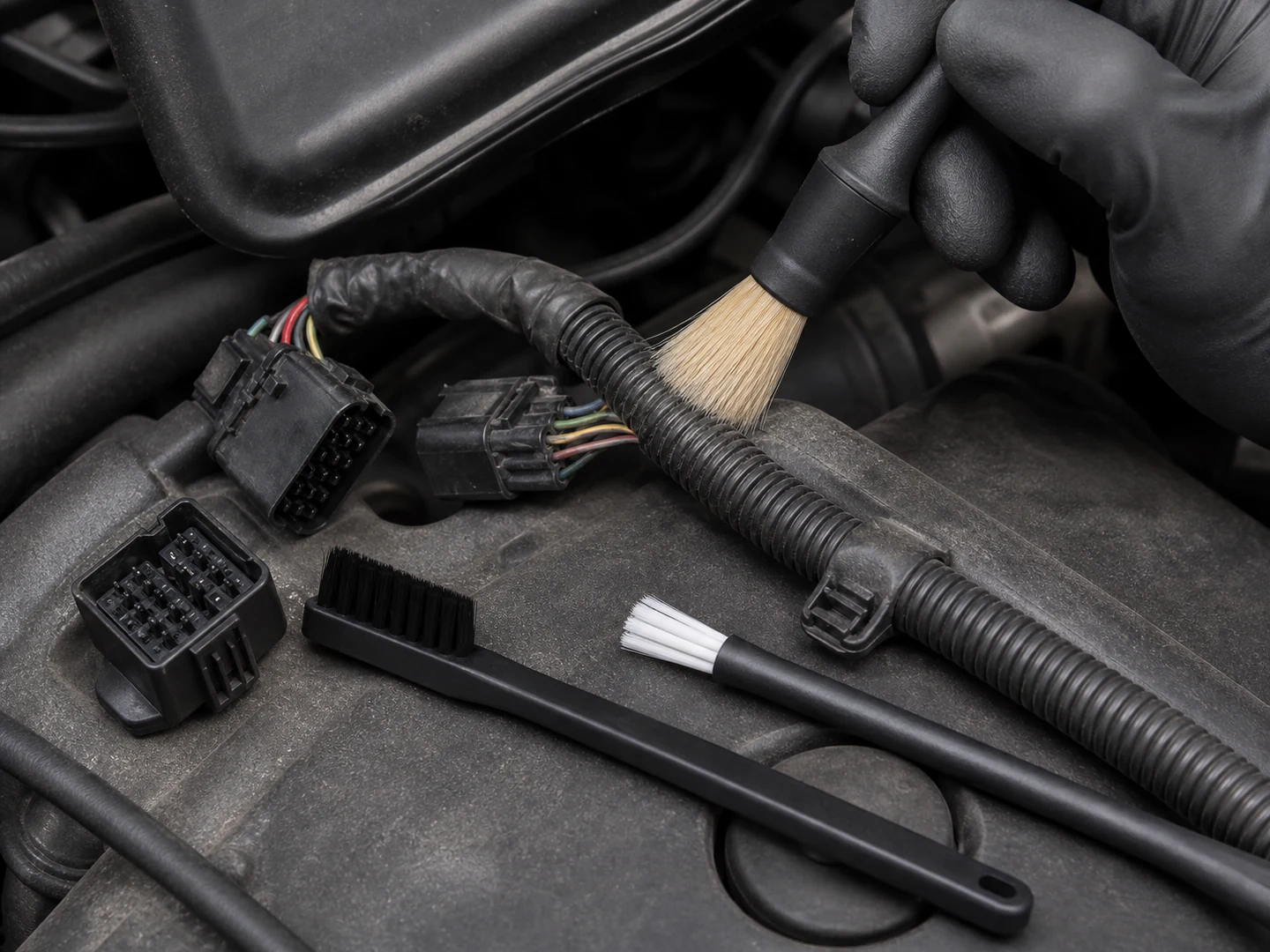
Small brush
500 pcs
Minimum order
Held in one hand: tube, bottle, detail and swab brushes — including long-handled ones with a small head.
Production lead time, once the specification is confirmed
- Up to 500 pcsWithin 7 days
- 501–50,000 pcsWithin 14 days
- Over 50,000 pcsWithin 21 days
Peak season can extend these times; the shipping date is confirmed in writing with your quotation. Sampling and shipping are quoted separately.
A nylon-filament cleaning brush for removing dust, dirt, and flux residue from wire harness bundles, cable assemblies, and connector areas without scratching insulation or terminal plating. It is configurable for bundle diameters from 3 to 50 mm and can be used by hand or mounted in a fixture.
What can this brush do for you?
Fine filaments protect insulation and plating
Filament diameters from 0.10 to 0.40 mm are fine enough to flex around individual wires and slide over connector bodies. That gives you a cleaning action that lifts loose contamination from PVC, PE, cross-linked, and silicone insulation while leaving tin, gold, and silver plating intact. The brush removes surface film without abrading the jacket or terminal finishes.
Adjustable contact area matches your harness diameter
The trim length and filament density can be specified so the working diameter wraps the full circumference of a bundle. Instead of scrubbing one side and rotating the harness, a properly sized brush contacts the entire outer surface in a single pass along the bundle or a single turn of the tool. This is especially useful when you need to clean long continuous runs of harness without repositioning.
Filament pattern reaches between wires and around connectors
Straight, spiral, or custom filament arrangements let the bristles enter the grooves between individual wires and wipe around connector housings, backshells, and strain-relief boots. Dust and flux residue often collect in these recesses where a flat cloth cannot reach. A spiral pattern improves self-cleaning of the brush as it rotates, slinging removed debris outward instead of packing it into the center.
Reusable and compatible with common cleaning solvents
Nylon PA filaments resist isopropyl alcohol, mild detergents, and many flux removers used in electronics assembly. You can rinse or wipe the brush between batches and continue using it for thousands of cycles. The brush does not absorb moisture the way natural fiber does, so it dries quickly and does not introduce contamination into the next harness.
Manual handle or machine-mountable interface
The brush can be supplied with a molded or turned handle for hand cleaning, or with a plain stem, hex shaft, or custom end fitting for integration into a rotating fixture, in-line cleaning station, or handheld rotary tool. This lets you use the same filament configuration for both bench rework and automated production cleaning.
What is a Wire Harness Cleaning Brush?
A Wire Harness Cleaning Brush is a cylindrical or tube-style brush with nylon filaments arranged around a central core. It is designed to clean the exterior surfaces of wire harnesses, cable bundles, connectors, terminals, and routing paths during manufacturing, rework, or maintenance.
In use, the brush is either drawn along the harness or rotated around it. The filaments deflect over the uneven surface of the bundle, dislodging loose particles and wiping away light residues such as dust, dirt, and unhardened flux. Because the filaments are flexible, the brush conforms to variations in bundle diameter and passes over tape, conduit, and connector transitions without snagging.
This is not an abrasive or stripping tool. It will not remove cured adhesives, hardened flux deposits, corrosion, or heavy contamination that requires mechanical scraping. Its role is final cleaning and surface preparation — the step that removes loose debris before taping, looming, mating, or inspection.
Technical Specifications
The table below shows the standard specification ranges for this brush. Dimensions, filament selection, and mounting interfaces are adjusted to your harness geometry and cleaning process.
| Parameter | Specification / Options |
|---|---|
| Harness diameter range | 3–50 mm, selected by filament length and core diameter |
| Active brush section length | 20–150 mm |
| Overall length | 100–400 mm, including stem or handle |
| Trim length | 10–40 mm |
| Filament diameter | 0.10–0.40 mm |
| Filament material | Nylon PA standard; PBT, PP, or anti-static nylon available on request |
| Core / stem | Galvanized steel wire, stainless steel, plastic core, or no core for flexible wrap style |
| Filament pattern | Straight, spiral, or custom; density adjustable |
| Mounting interface | Plain stem, handle, hex shaft, or customer-specified fitting |
| Operating temperature | Up to 80°C with nylon filaments; higher limits available with alternative filament materials |
| Chemical exposure | Compatible with mild detergents, isopropyl alcohol, and common flux removers; verify compatibility for aggressive solvents |
| Brush type | Custom Handheld Detail Brushes |
| How it is driven | Hand-guided |
| Cleaning target | harness manufacturing line, pcb assembly and soldering station, and cable harness rework and repair cleaning |
| Surface or part | connectors, cable, terminals, fixtures, connector areas, panels, and recesses |
| Residue or debris | dust, flux, flux residue, loose debris, light residue, loose particles, adhesive, and corrosion |
| Mounting / connection | Plain stem, handle, hex shaft, or customer-specified fitting |
Where does this brush work best?
- Harness manufacturing lines — removing dust and loose debris from bundles before applying tape, braided sleeving, or conduit.
- PCB assembly and soldering stations — wiping flux residue from wire terminations, connector bodies, and adjacent areas after rework.
- Cable harness rework and repair — cleaning aged or dirty harnesses before inspection, continuity testing, or reinstallation.
- Automotive and aerospace harness preparation — dusting exterior surfaces and routing paths before final assembly into vehicles or equipment.
- Control cabinet and panel maintenance — removing accumulated dust from cable runs, terminal blocks, and connector interfaces in production equipment.
How do I choose the right one?
Match the working diameter to your bundle
Measure the largest and smallest bundle diameters the brush will encounter. The brush working diameter — core diameter plus two trim lengths — should be slightly larger than the bundle so the filaments deflect and contact the full circumference. If the brush is too small, it only cleans one side; if too large, it may snag or fold over and lose contact. For harnesses with wide diameter variation, a flexible core or adjustable filament density may be the better choice.
Select filament fineness for surface sensitivity
Use 0.10–0.20 mm filaments for delicate insulation, fine-gauge wires, and connector plating where even slight abrasion is not acceptable. Use 0.25–0.40 mm filaments when the harness carries heavier dust or when a stiffer feel helps dislodge caked-on but not hardened residue. Anti-static nylon is available for cleaning in ESD-sensitive environments.
Choose trim length for reach and stiffness
Longer trim reaches deeper into recesses, between wires, and behind connector flanges, but gives a softer contact. Shorter trim is stiffer and scrubs more effectively on flat cable surfaces. If the brush needs to clean both the outer bundle and the gaps between individual conductors, a combination of trim lengths or a custom pattern can be specified.
Consider the core and operating environment
If the brush is used with solvents or in humid conditions, choose a stainless steel or plastic core to prevent rust. If the operator needs to wrap the brush around irregular shapes, a wire core with some flexibility is preferable. For straight-line wiping in a fixture, a rigid core or shaft mount gives better repeatability.
When a different brush is the better choice
Use a wire brush if you need aggressive mechanical cleaning, rust removal, or scraping of hardened deposits. Use a micro-brush or lint-free swab to clean inside small connector cavities or terminal sockets. For very long continuous cable runs, a powered cylindrical brush roller may be more efficient than a hand brush. This nylon harness brush is the right tool when you need non-scratching surface preparation on accessible cable and connector exteriors.
Can I customize this brush?
Yes. Provide the minimum and maximum harness diameter, the length of harness to be cleaned, the insulation and connector materials, the type of residue, and whether the brush is for manual or machine use. A drawing or sample harness helps us define the filament geometry correctly.
We can adjust:
- Filament — length, diameter, material (nylon, PBT, PP, anti-static options), density, and pattern (straight, spiral, or custom)
- Core and stem — material, diameter, length, flexibility, and end treatment (plain, threaded, hex, or custom fitting)
- Handle — length, shape, grip material, ergonomic features, hanging loop, or molded marking
- Overall dimensions — brush section length and total length matched to your harness run and operator reach
- Color and marking — custom filament color, handle color, laser marking, pad printing, or identification coding
- Packaging — bulk, individual bag, kit with multiple sizes, or project-specific packing
If your project requires material documentation, inspection reports, or third-party testing for the materials used, we can support those requirements during the customization process.
Which filament belongs on a wire harness cleaning brush, and how is that verified?
How can I confirm that the nylon filaments are gentle enough for my wire insulation?
Run a test on a scrap harness section: pass the brush along the bundle 50 times using the intended pressure and speed, then inspect the insulation under magnification. Look for any visible thinning, gloss change, or surface scratching. The filaments should flex and slide, not dig. If you see damage, reduce filament diameter or increase trim length to soften the contact.
Will this brush remove baked-on or hardened flux?
No. It removes loose flux residue, dust, and light surface films. Hardened or thick flux deposits require solvent pre-treatment, a stiffer brush, or both. This brush is designed for final cleaning after the bulk residue has been softened or removed.
How should I clean the brush between uses?
Rinse the filament area with the solvent used in your process (such as isopropyl alcohol) or a mild detergent solution, then allow the brush to air dry. Check that no particles remain lodged between filaments; if clogging occurs, comb the filaments out with a fine-tooth comb or replace the brush. Do not use high-pressure air that could bend the filaments permanently.
Can the brush be used on energized wire harnesses?
No. Always de-energize and disconnect the harness before cleaning. The brush is intended for cleaning de-energized cables and connectors during manufacturing, rework, or maintenance. It is not rated for use on live electrical circuits.
What should I check before putting the brush into production?
Verify that the brush fits the harness without excessive snagging at connectors or transitions, that no filaments are bent, broken, or flattened, and that the core is securely fixed in the handle or fixture. Run a short cleaning cycle on a known-good harness and inspect for filament loss or visible residue transfer before full production use.
When should I use a powered brush instead of this manual one?
If you are cleaning long continuous cable runs or high volumes of harnesses, a powered cylindrical brush roller mounted on a rotary driver may save time and improve consistency. A manual brush remains the better choice for short sections, rework, connector areas, and situations where the operator needs tactile feedback to avoid damaging delicate terminations.
Guides that go deeper on this
Custom Manufacturing RFQ
Describe Your Application
An accurate custom quote starts with the dimensions, working surface, residue, material choice, connection, quantity, and reference files.
Drawing or photo optional — it speeds things up, it does not gate the enquiry.
Custom Brush RFQ
Send Your Brush Project
Upload a drawing, product photo, or sample photo and provide the core dimensions and cleaning conditions.
“We need a brush to remove wet residue from a stainless steel conveyor, about 800mm wide. The current brush wears quickly. We can send photos.”
“We sell drinkware and need a cleaning brush to include with the product. Quantity around 5,000 pieces.”