
Custom Cleaning Brush
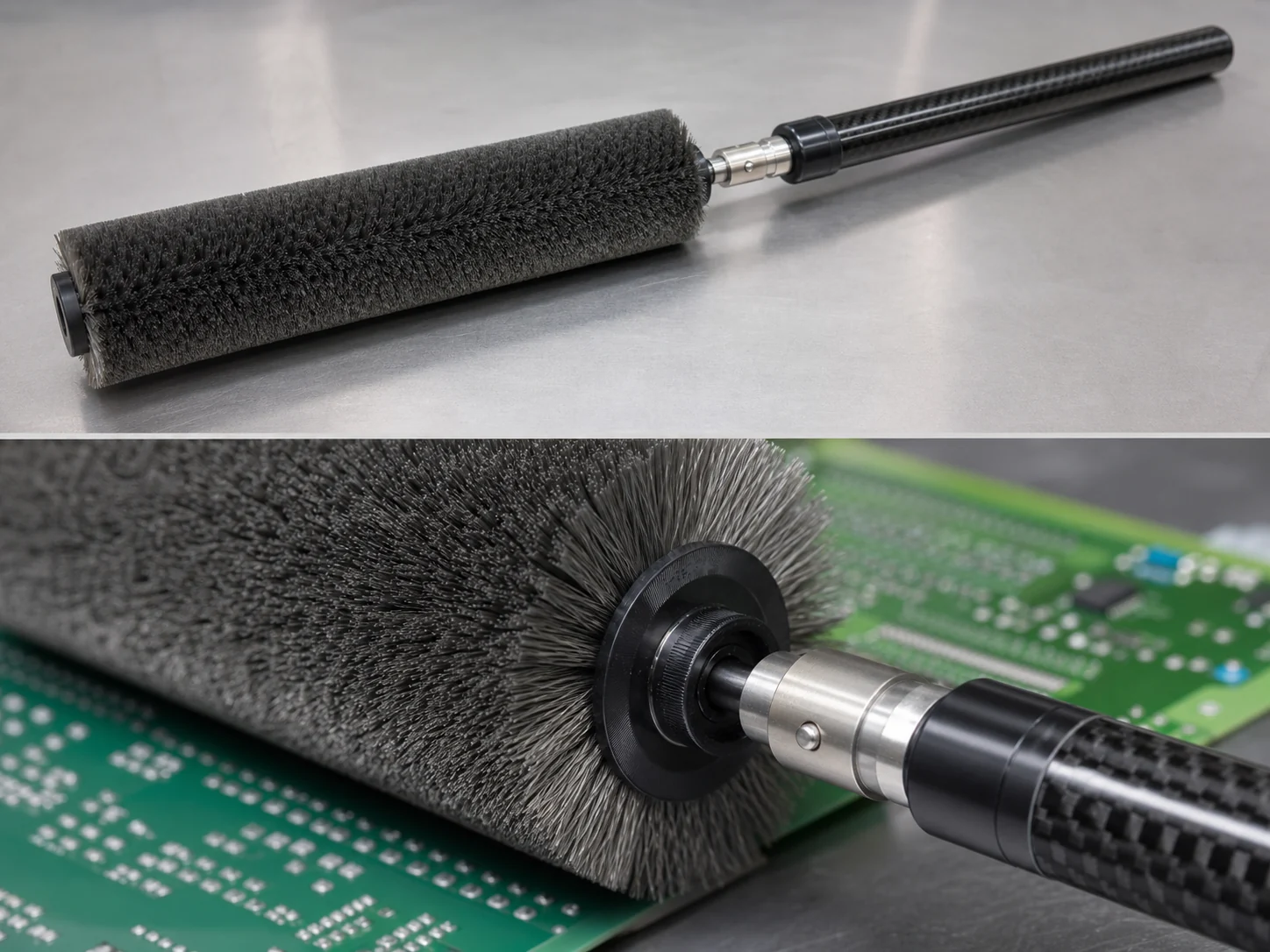
100x600mm Conductive PCB Roller Brush
Order a 100x600mm conductive PCB roller brush for static-dissipative cleaning of printed circuit boards.
Medium brush
100 pcs
Minimum order
Worked with two hands or on a pole: chimney, gutter and pond-filter brushes, discs, cups and tank brushes.
Production lead time, once the specification is confirmed
- Up to 100 pcsWithin 7 days
- 101–5,000 pcsWithin 14 days
- 5,001–50,000 pcsWithin 21 days
- Over 50,000 pcsConfirmed with your quotation
Peak season can extend these times; the shipping date is confirmed in writing with your quotation. Sampling and shipping are quoted separately.
A 100 mm diameter × 600 mm face length conductive roller brush for inline PCB cleaning machines. Conductive nylon filaments and a carbon fiber composite core dissipate static charge while sweeping dust, lint, flux residue, and loose particles from board surfaces, carriers, and assembly fixtures.
What can this brush do for you?
Static Dissipation from Core to Filament Tips
The conductive nylon filaments and carbon fiber composite core create a continuous grounding path from the bristle tips to the machine frame. As the roller rotates against the PCB, electrostatic charges generated by brushing are conducted away instead of accumulating. This prevents the dust and lint the brush removes from re-attracting to the board surface, and it lowers the risk of static discharge damaging sensitive components. For ESD-sensitive assembly lines, this is the key differentiator from ordinary nylon roller brushes.
600 mm Working Width with Consistent Contact
The 600 mm face length covers standard PCB panel widths in one pass without stitching or overlapping. The carbon fiber composite core holds its straightness under rotation, so filament pressure remains consistent from edge to edge. That means uniform cleaning intensity across the entire board, not heavy in the center and light at the ends.
Quick-Change Coupling for Fast Replacement
The integrated quick-change coupling lets an operator remove and replace the roller without realigning or retiming the cleaning station. Worn or saturated brushes can be swapped during a line pause, not a line shutdown. For high-volume PCB cleaning machines, that translates to fewer lost production minutes per maintenance cycle.
Lightweight Stiff Core Reduces Vibration
The carbon fiber composite base weighs substantially less than a steel core of the same length and stiffness. Lower rotating mass reduces spindle load, vibration, and bearing wear, so the cleaning machine can run at higher line speeds without chatter or uneven contact. It also makes the roller easier to handle during changeovers.
Controlled Contact for Delicate Surfaces
The conductive nylon filaments are engineered to sweep away flux residue, dust, lint, oxide, and static-attracted particles without scoring solder resist, abrading exposed copper, or dislodging properly placed components. Filament diameter, length, and stiffness can be tuned so the brush does real cleaning work while remaining safe for the board.
What is a 100x600mm Conductive PCB Roller Brush?
A 100x600mm Conductive PCB Roller Brush is a cylindrical brush roll with a 100 mm outer diameter and a 600 mm face length, built for mounting into inline PCB cleaning machines or brushing stations. The bristles are conductive nylon filaments, the core is carbon fiber composite, and the brush connects to the machine spindle through a quick-change coupling.
During operation, the roller rotates against the moving board, sweeping debris from the surface and, depending on filament configuration, from between low-profile components. It is typically positioned above or below the conveyor, with contact depth adjusted to apply the right amount of brushing pressure.
This brush is designed for light to moderate debris removal on static-sensitive electronic assemblies. It is not intended as a heavy scrub brush for removing baked-on flux, cured adhesives, or large solder balls. The conductive property is the defining feature: ordinary brushing can generate static electricity that attracts more particles or damages sensitive parts. By conducting charge away from the contact point, this roller keeps the cleaning action from creating a new contamination problem.
Technical Specifications
All dimensions and materials can be adjusted for your machine and process. The table lists the standard configuration for this product.
| Parameter | Value / Options |
|---|---|
| Nominal brush diameter | 100 mm (adjustable) |
| Face length | 600 mm (adjustable) |
| Overall length | 660 mm typical, including quick-change couplings (confirm with spindle) |
| Bristle material | Conductive nylon (carbon-filled), surface resistivity typically 103–106 Ω |
| Core / base material | Carbon fiber composite, electrically conductive |
| Connection type | Quick-change coupling, type matched to machine spindle |
| Filament diameter | 0.15–0.35 mm standard (other diameters available) |
| Trim length (bristle free length) | 15–25 mm, determines contact stiffness |
| Bristle pattern | Straight, helical, or custom; density adjustable |
| Operating speed | Up to 500 rpm (line speed up to 20 m/min depending on setup) |
| Operating temperature | -20 °C to 80 °C continuous (bristle limitation) |
| Chemical compatibility | Resists mild solvents, IPA, DI water; avoid strong acids and concentrated alkalis |
| Balance | Dynamically balanced to ISO G2.5 (optional) |
| Direction of rotation | Specify clockwise or counterclockwise |
| Brush type | Custom Roller and Conveyor Brushes |
| How it is driven | Machine-driven, mounted in the equipment |
| Cleaning target | inline pcb cleaning machine, post-reflow / post-soldering cleaning line, and pre-coating / pre-inspection station cleaning |
| Surface or part | boards, roller, composite, carriers, assembly fixtures, conveyors, panels, and fiberglass |
| Residue or debris | flux, particles, dust, flux residue, lint, carbon, fiber, and oxide |
| Mounting / connection | Quick-change coupling, type matched to machine spindle; Specify clockwise or counterclockwise |
Where does this brush work best?
- Inline PCB cleaning machines after depaneling or routing — removes dust and fiberglass particles from board surfaces before solder paste printing or component placement.
- Post-reflow / post-soldering cleaning lines — sweeps away light flux residue and loose solder balls from the board surface (not aggressive enough for heavy baked-on flux).
- Pre-coating / pre-inspection stations — static-free cleaning before conformal coating, AOI, or final inspection.
- Conveyor brushing of panels, carriers, and assembly fixtures — removes lint, dust, oxide, and static-attracted particles from reusable carriers and pallets.
- Cleanroom or ESD-protected areas — where ordinary brushes would generate static and re-contaminate the product.
How do I choose the right one?
Start by confirming machine compatibility. Measure the existing brush or spindle interface: mounting diameter, coupling type, overall length, rotation direction, and available clearance. The quick-change coupling must match the machine’s receiver or adapter, or an adapter must be available.
Then evaluate the contact requirements. The 100 mm diameter and 600 mm face length are standard for many lines, but if your boards are wider than 600 mm, you may need multiple rollers or a custom longer roll. Check that the brush face covers the full board width, including edge clearance.
Filament stiffness is the main cleaning trade-off. Softer conductive nylon filaments are gentle and suitable for dust, lint, and loose debris on delicate surfaces. Stiffer filaments apply more scrubbing force and can remove light flux residue or slightly adhered particles, but they increase the risk of damaging components or lifting edges. Specify the residue type and board sensitivity to get the right balance.
If static dissipation is critical, verify the resistivity of both the filaments and the core. A common upper limit for ESD-protected areas is 106 Ω surface resistivity. Ensure the coupling provides a continuous ground path to the machine frame.
Consider the operating environment: conductive nylon performs well in dry or lightly damp processes with compatible solvents. Avoid continuous exposure to strong acids, concentrated alkalis, or temperatures above 80 °C. For wet cleaning with aggressive detergents, PBT or polypropylene filaments may be more suitable, though they are not conductive.
Below is a quick reference table for common scenarios.
| Condition | Recommended choice |
|---|---|
| Only dust, lint, loose debris | Soft to medium conductive nylon filaments |
| Light flux residue or oxide films | Medium-stiff conductive nylon or PBT |
| Aggressive scrubbing / heavy residue | Switch to a non-conductive abrasive brush or wire brush |
| Static-sensitive boards | Conductive nylon with verified resistivity and grounded core |
| High-speed line | Lightweight carbon composite core, dynamically balanced |
Can I customize this brush?
Yes. Conductive PCB roller brushes are usually configured to the specific cleaning machine and process. To define a custom configuration, provide the machine make and model, existing brush dimensions, spindle/coupling details, line speed, board width and thickness, residue type, and any ESD resistivity requirements. A drawing or sample photo speeds up the process.
We can adjust:
- Dimensions — outer diameter, face length, overall length, core diameter, and trim length.
- Filament material and conductivity — conductive nylon is standard, but other conductive plastics or different resistivity ranges are available.
- Filament geometry — diameter, shape, crimping, and pattern (straight, helical, segmented).
- Core material — carbon fiber composite is standard; aluminum or steel with conductive coating may be offered for special interfaces.
- Coupling type — match your machine’s quick-change system or integrate a custom adapter.
- Color and marking — color coding for identification, laser marking of part number, or custom labeling.
- Packaging — individual anti-static bags, bulk packaging, or project-specific packing.
If your project requires resistivity testing, material documentation, dimensional inspection, or third-party verification, we can assist with those requirements during the customization process.
When is a 100x600mm conductive PCB roller brush worn out rather than just dirty?
How do I know when the roller brush needs to be replaced?
Check for visible filament wear, flattened or bent bristles, loss of tension, buildup that cannot be removed by cleaning, or a reduced contact patch. If the brush is used for static control, periodically measure the resistance from bristle tips to the coupling; if it drifts outside the specified range, replace the brush.
Can this roller be used in wet cleaning processes?
It can be used with light dampness or compatible solvents, but conductive nylon may absorb moisture, which can change its resistivity and mechanical properties. For continuous wet operation, specify the environment so we can recommend suitable filament treatments or alternative conductive materials.
How should I verify that static dissipation is working?
Use a surface resistivity meter or megohmmeter to measure from the bristle tips to the core or coupling. The reading should be within the specified range (typically 103–106 Ω). Also verify that the coupling and machine spindle provide a continuous ground path to earth. Test at several points along the face length.
Does brushing alone remove all contaminants from PCBs?
No. Brushing removes loose particles and light residue from the surface. Final cleaning may still require air blow-off, vacuum extraction, or solvent rinse depending on your process requirements. Brushing is one step in the cleaning sequence, not a replacement for cleaning chemistry.
Can the roller brush damage components or solder joints?
If filament stiffness, contact depth, and rotation speed are correctly matched, it should not. Overly stiff bristles, excessive contact pressure, or very high speeds can cause damage. Always validate on scrap boards first and inspect for component movement, solder mask scuffing, or lifted edges.
What should I check before installing the brush?
Confirm the rotation direction matches the machine setting. Ensure the quick-change coupling is fully engaged and locked. Use a dial indicator to check runout; excessive runout causes vibration and uneven cleaning. Verify that any static grounding straps are connected and that the brush is centered in the machine relative to the conveyor.
Guides that go deeper on this
Abrasive Nylon Grit and Filament Selection
Read this guideGuideBrush Roller Conveyor Mistakes with Dry Dust
Read this guideGuideBrush Speed, Engagement, and Heat
Read this guideGuideConveyor Belt Cleaning Brush Design
Read this guideGuideFloor Scrubber Brush Selection: Disc Brush vs Roller Brush
Read this guideCustom Manufacturing RFQ
Describe Your Application
Please include the main sizes, application, residue, preferred material, interface, quantity, and any drawing or sample available.
Drawing or photo optional — it speeds things up, it does not gate the enquiry.
Custom Brush RFQ
Send Your Brush Project
Upload a drawing, product photo, or sample photo and provide the core dimensions and cleaning conditions.
“We need a brush to remove wet residue from a stainless steel conveyor, about 800mm wide. The current brush wears quickly. We can send photos.”
“We sell drinkware and need a cleaning brush to include with the product. Quantity around 5,000 pieces.”