
Custom Cleaning Brush
150mm Carbon Fiber Wafer Equipment Disc Brush
150mm carbon fiber wafer equipment disc brush with PEEK base and quick-change coupling for static-dissipative cleaning of end effectors, stages, and PCBs.
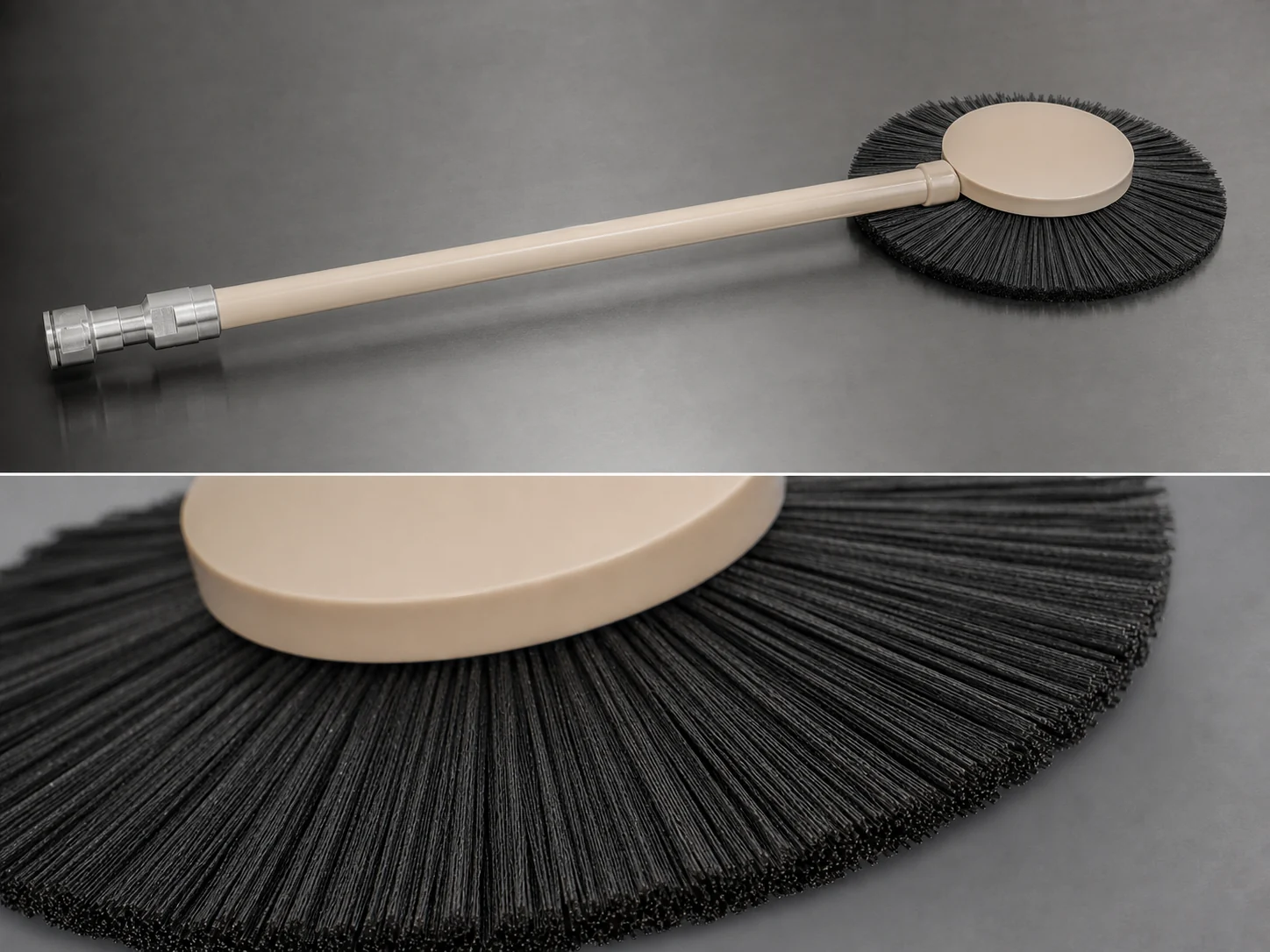
Medium brush
100 pcs
Minimum order
Worked with two hands or on a pole: chimney, gutter and pond-filter brushes, discs, cups and tank brushes.
Production lead time, once the specification is confirmed
- Up to 100 pcsWithin 7 days
- 101–5,000 pcsWithin 14 days
- 5,001–50,000 pcsWithin 21 days
- Over 50,000 pcsConfirmed with your quotation
Peak season can extend these times; the shipping date is confirmed in writing with your quotation. Sampling and shipping are quoted separately.
A machine-mounted 150 mm disc brush with carbon fiber bristles and a PEEK base for static-dissipative cleaning of wafer handling surfaces, end effectors, stages, and other sensitive electronic equipment. It removes static-attracted dust, lint, oxide, flux residue, and polishing particles without building a charge on the workpiece.
What can this brush do for you?
Static-Dissipative Contact Prevents ESD Events During Cleaning
Carbon fiber filaments with a surface resistivity range of 10³–10⁹ Ω create a controlled dissipation path instead of an insulating contact. Brushing a charged end effector or stage with a standard nylon brush can generate triboelectric events; this disc carries charge away through the grounded equipment interface and keeps wafer, PCB, and component surfaces from receiving a damaging discharge.
Low-Shedding Bristles Protect Cleanroom Particle Budgets
The carbon fiber construction has fewer loose fiber ends and less material breakdown than commodity polymer brushes, so it contributes less particulate contamination to the wafer environment. This is important on robot blades and aligners where shed debris can transfer to the next wafer.
150 mm Face Covers Wide Handling Surfaces in Fewer Passes
A full 150 mm diameter working face lets operators clean robot end effector paddles, chucks, and stage platens without leaving untreated bands between narrow swaths. The 15 mm head length keeps the bristles short enough for stable contact while still conforming to minor surface curvature.
PEEK Base Survives Process Chemicals and Heat
The PEEK base resists many semiconductor cleaning solvents and maintains dimensional stability at elevated temperatures, so the disc does not soften, warp, or contaminate the tool during routine PM cycles. Carbon fiber bristles are similarly resistant to many process chemistries, making the assembly suitable for solvent-wiped and lightly dampened cleaning.
Quick-Change Coupling Reduces Maintenance Downtime
The disc mounts to the drive spindle through a quick-change coupling, so a worn brush can be replaced in a PM window without re-aligning the motion path or retorquing multiple fasteners. The repeatable interface helps each replacement run with the same contact envelope and balance characteristics as the previous brush.
What is a 150mm Carbon Fiber Wafer Equipment Disc Brush?
A 150mm Carbon Fiber Wafer Equipment Disc Brush is a rotary, machine-mounted cleaning tool built for semiconductor wafer handling and processing equipment. It is not a hand brush: the circular PEEK base carries carbon fiber bristles on one face and a quick-change coupling on the back, allowing the disc to be driven by a spindle or robot-integrated actuator.
During operation, the rotating face contacts the target surface — an end effector blade, pre-aligner, wafer stage, electrostatic chuck, or cassette contact area — and sweeps away loose particles, lint, oxide, flux residue, and polishing debris. The carbon fiber filaments provide mechanical contact and a dissipative path, while the short 15 mm head length keeps the contact predictable and prevents filament wrapping around surface features.
This brush is intended for dry or lightly dampened cleaning sequences. Heavy chemical immersion, aggressive abrasive action, or contact directly on patterned device surfaces should be validated separately, because those conditions place different demands on the filament chemistry, base material, and particle release behavior.
Technical Specifications
The table below gives the standard configuration for this disc brush. Dimensions, filament parameters, base material, and coupling interface can be adjusted for the specific equipment; final values are confirmed from your application drawing or sample.
| Parameter | Value / Options |
|---|---|
| Disc diameter | 150 mm (customizable approximately 40–300 mm) |
| Head shape | Round, flat working face |
| Head length / face height | 15 mm |
| Bristle material | Carbon fiber |
| Filament diameter | 0.05–0.20 mm, selected by contact sensitivity and residue type |
| Bristle surface resistivity | 10³–10⁹ Ω, project-specified within this range |
| Base material | PEEK (polyetheretherketone) |
| Connection | Quick-change coupling — thread, keyed hub, or bolt circle to match spindle |
| Handle / grip | None; machine-mount disc with no hand grip |
| Rotational speed | Typically 100–3,000 RPM; final limit validated for the configuration |
| Operating temperature | PEEK base rated for continuous use up to 250°C; confirm filament and adhesive limits for your process |
| Bristle pattern | Full face, outer ring, segmented, or custom arrangement |
| Brush type | Custom Disc Brushes |
| How it is driven | Machine-driven, mounted in the equipment |
| Cleaning target | semiconductor wafer end effector, electrostatic chuck and wafer stage, and pre-aligner and aligner surface cleaning |
| Surface or part | printed circuit boards, electronic assemblies, guide rails, pads, holes, hubs, and pins |
| Residue or debris | fiber, carbon, particles, lint, flux, oxide, flux residue, and dust |
| Mounting / connection | Quick-change coupling — thread, keyed hub, or bolt circle to match spindle |
Where does this brush work best?
The 150 mm face and static-dissipative carbon fiber make this brush a fit for flat and gently curved surfaces in wafer handling and electronic assembly equipment. Typical applications include:
- Semiconductor wafer end effectors: robot blades and transfer paddles that pick up wafers and accumulate backside particles, dust, and oxide residues.
- Electrostatic chucks and wafer stages: contact surfaces where polishing particles, lint, and static-attracted dust would otherwise transfer to the wafer backside.
- Pre-aligners and aligner surfaces: rotating contact areas that need residue-free, charge-controlled cleaning without abrasive damage.
- Printed circuit boards and electronic subassemblies: production and rework areas where flux residue, loose solder debris, and lint must be removed without creating an ESD hazard.
- Wafer cassettes, FOUPs, and transport hardware: guide rails, contact pads, and other static-sensitive surfaces subject to particle accumulation.
- Optical inspection stages and cleanroom equipment: surfaces where low fiber shedding and static dissipation are part of the defect control plan.
How do I choose the right one?
Start by defining the cleaning path, surface material, residue, ESD requirement, and mounting interface. The selection decisions below determine whether this 150 mm disc is the correct configuration and what filament and base options should be specified.
Confirm the 150 mm face covers the contact path. For end effector blades and stages, the disc should sweep the full surface width in one or two passes. If your cleaning surface is narrower than 150 mm, a smaller disc may give better control and avoid removing material from adjacent areas. If the surface is larger, specify a traversing motion or consider a larger diameter disc.
Select filament diameter by residue and surface sensitivity. Finer filaments (0.05–0.10 mm) bend more easily and are gentler on coated or polished surfaces; they remove light dust and lint but may not cut through dried flux or oxide. Coarser filaments (0.12–0.20 mm) provide more scrubbing force and longer wear, suitable for heavier residues but with slightly higher abrasion risk. Match the diameter to the most fragile surface in the cleaning path.
Match head length and trim to the surface profile. The standard 15 mm head length works well on flat and slightly curved surfaces. If your part has edge steps, recesses, or a raised center hub, a customized trim — stepped, scalloped, outer-ring only, or side bristles — can maintain contact inside those features without excessive pressure on the high points.
Specify the static-dissipative requirement explicitly. The carbon fiber can be produced across a 10³–10⁹ Ω resistivity range, but your ESD control plan likely calls for a specific window. Some tools require a low-resistance path to ground; others require a slower dissipative discharge to avoid current spikes. Test the brush in the actual equipment interface and verify continuity through the coupling to the grounded spindle.
Define the coupling and drive interface. Provide the spindle thread, bore, keyway, drive pin, bolt circle, or existing quick-change receiver drawing. The coupling must transmit torque without slip and maintain repeatable axial and radial position. A loose or poorly matched interface will cause vibration, uneven wear, and particle generation.
Review chemical and temperature compatibility. PEEK and carbon fiber tolerate many common cleaning agents, but confirm with the specific solvent concentration and temperature used in your PM procedure. If the process uses aggressive halogenated or strongly oxidizing chemicals at high temperature, request a compatibility review before the disc is placed in service.
When a different brush or cleaning method is more suitable: If the target is heavy metal scale, weld splatter, or requires aggressive mechanical abrasion, use a wire brush or abrasive nonwoven disc instead of carbon fiber. For deep narrow grooves, threaded holes, or internal passages, a tube brush, end brush, or radial brush reaches where a flat disc cannot. If the cleaning process is fully immersed in harsh chemistry, a stainless or PTFE-based brush may be required. And if the residue is baked-on or chemically bonded, pre-treat with solvent, ultrasonic, or plasma cleaning before using the disc as a final particle-removal step.
Can I customize this brush?
This 150 mm disc is a standard starting configuration, not a fixed catalog item. We can adjust the dimensions, filament, base, coupling, and packaging to match your wafer equipment and PM procedure. To define the custom configuration, provide the target surface drawing or sample, residue type, contact pressure, spindle interface, required resistivity window, cleaning chemicals, operating temperature, and cleanroom class.
Adjustable parameters include:
- Dimensions: disc diameter (approximately 40–300 mm), face height, center hole, annular brush face, and overall thickness.
- Filament: carbon fiber grade, filament diameter, fill density, trim pattern (flat, stepped, scalloped, V-groove, outer ring), and static-dissipative target value.
- Base: PEEK standard; alternatives include PPS, UHMW-PE, anodized aluminum, or 316 stainless steel. Thickness, balancing features, and mounting bosses can be incorporated.
- Connection: threaded hub, taper, keyed slot, pin drive, bolt circle, or a quick-change receiver matched to your existing tool interface.
- Marking: laser-marked part number, lot code, date code, directional arrow, or cleanroom identification.
- Packaging: cleanroom double-bag, individual sealed bags, ESD-safe packaging, or multi-unit PM kits.
For project requirements that include material declarations, dimensional inspection data, surface resistance measurements, third-party testing, or cleanroom packaging validation, we can support those documentation needs as part of the customization process.
When is a 150mm carbon fiber wafer equipment disc brush worn out rather than just dirty?
Is this 150 mm disc intended for direct contact with patterned wafer surfaces?
No, it is designed primarily for cleaning wafer handling equipment surfaces such as end effectors, stages, chucks, and cassettes. Direct contact with patterned device areas should be validated on a dedicated sample because device geometry and sensitivity vary. For patterned surfaces you may need a finer filament, lower contact pressure, or a different cleaning method entirely.
How do I verify that the brush is actually dissipating static charge on my equipment?
Use a surface resistance meter to measure from the bristle tips to the mounting hub or grounding point on the spindle. The reading should fall within your facility’s ESD control specification. Also confirm continuity through the quick-change coupling to the grounded equipment chassis — a conductive bristle is only part of the path. If the interface is isolated or painted, the dissipation path may be broken.
What is the maximum rotational speed for a 150 mm disc?
Typical use is 100–3,000 RPM, but the final safe limit depends on filament diameter, fill density, balance class, and base design. We provide a validated maximum speed for your specific configuration after first-article testing. Running above the validated limit can cause filament shedding, base stress, and vibration that adds particles to the process.
Can the brush be used with liquid cleaning agents?
Yes, when compatibility is confirmed for the specific chemical, concentration, temperature, and contact time. Carbon fiber and PEEK tolerate many aqueous and solvent cleaners, but some strong oxidizers or halogenated solvents can attack the base or adhesive system. After wet cleaning, dry the bristles completely and inspect for residue accumulation before returning the disc to dry wafer-contact service.
How do I know when to replace the disc?
Replace when bristle length wears below your process control limit, when broken or shed filaments begin appearing on cleaned surfaces, when the PEEK base shows cracks, discoloration, or chemical attack, or when the quick-change interface develops play or runout. Many fabs use a fixed wafer-transfer count or periodic particle measurement to trigger replacement before visual wear becomes severe.
Does this carbon fiber disc replace chemical or ultrasonic cleaning on end effectors?
No. The disc removes loose particles and light residues mechanically and dissipates static charge, but it is one step in an integrated cleaning sequence. Heavy contamination may still require solvent wipes, CO2 snow cleaning, plasma treatment, or ultrasonic cleaning before brushing. Use the disc as the final particle-removal and surface-conditioning step, not as the sole cleaning method.
Guides that go deeper on this
Custom Manufacturing RFQ
Describe Your Application
Please include the main sizes, application, residue, preferred material, interface, quantity, and any drawing or sample available.
Drawing or photo optional — it speeds things up, it does not gate the enquiry.
Custom Brush RFQ
Send Your Brush Project
Upload a drawing, product photo, or sample photo and provide the core dimensions and cleaning conditions.
“We need a brush to remove wet residue from a stainless steel conveyor, about 800mm wide. The current brush wears quickly. We can send photos.”
“We sell drinkware and need a cleaning brush to include with the product. Quantity around 5,000 pieces.”