
Custom Cleaning Brush
180x1800mm PP Guardrail Cleaning Roller Brush
Machine-mounted polypropylene roller brush, 180 mm diameter × 1800 mm face, for guardrail and roadside edge cleaning.
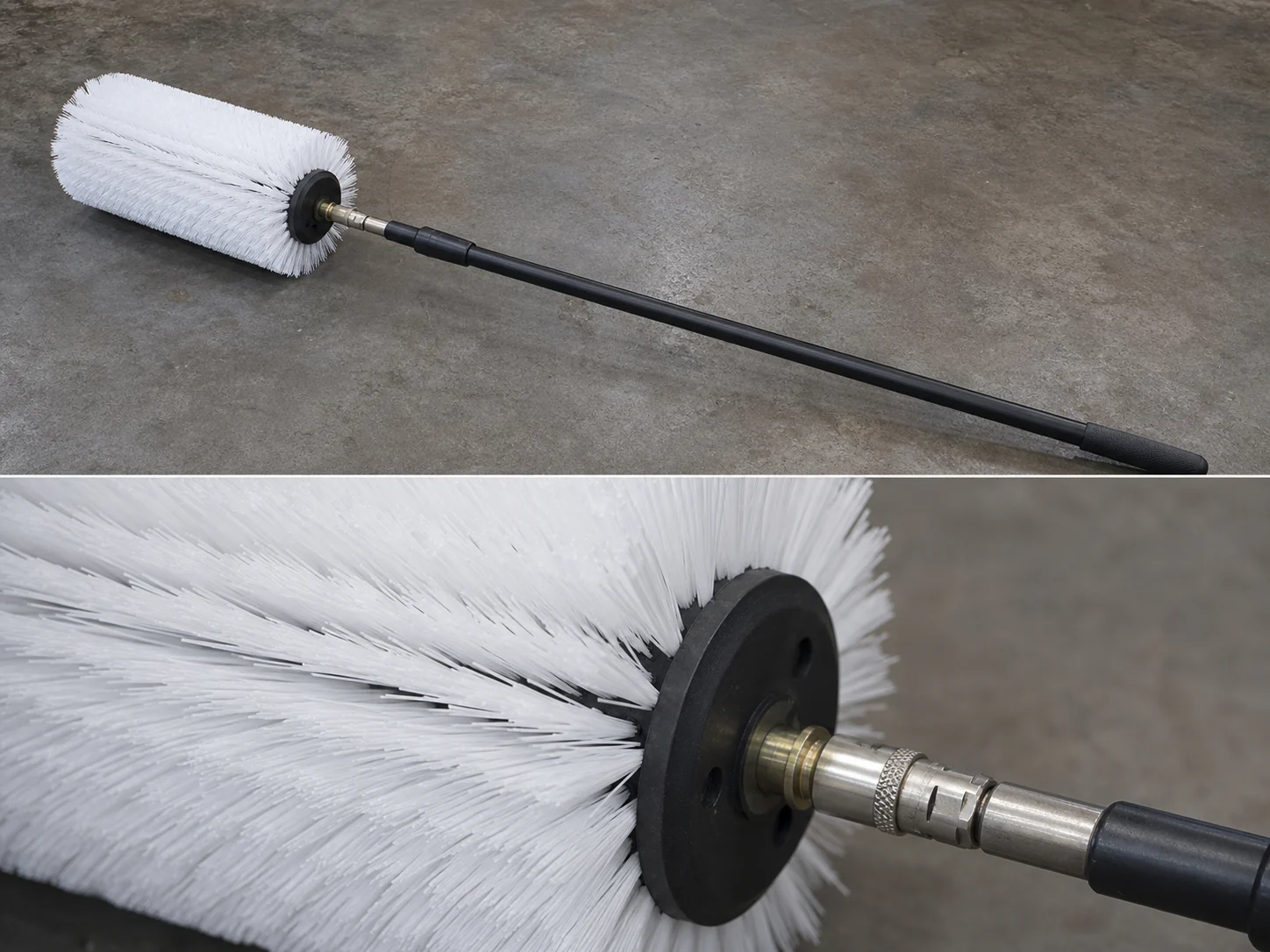
Large-format brush
100 pcs
Minimum order
Built one at a time on a core or channel: full-width rollers, sweeper brooms and long strip.
Production lead time, once the specification is confirmed
- Up to 100 pcsWithin 20 days
- 101–1,000 pcsWithin 30 days
- Over 1,000 pcsConfirmed with your quotation
Peak season can extend these times; the shipping date is confirmed in writing with your quotation. Sampling and shipping are quoted separately.
A machine-mounted 180 mm diameter × 1800 mm working face roller brush with polypropylene filaments engineered for continuous roadside guardrail and edge cleaning. It lifts sand, mud, dust, leaves, and loose road film from W-beam guardrails, curbs, and sweeper housings without scratching galvanized or painted surfaces.
What can this brush do for you?
Clean an 1800mm Band Without Re-Positioning
Because the working face spans 1800 mm, the brush scrubs a long continuous section of guardrail or curb in a single vehicle pass. Operators do not need to stop and reset carrier position for short gaps; the brush stays in contact through rail joints and slight elevation changes.
PP Filaments Stay Lively in Wet, Salty Roadside Conditions
Polypropylene bristles do not absorb water, so they keep their stiffness after rain, washdowns, or puddle contact. They resist road salts, diesel splash, and mild cleaning chemicals far better than natural fiber, and they will not rust or shed metal fragments onto the roadway.
Follows W-Beam Contours Without Removing the Protective Coating
The 180 mm diameter gives the filament field enough reach to work into the troughs and rivet lines of standard backing rail and safety barriers. The compliant PP tips flex over raised hardware and panel edges, removing film and loose material without the aggressive cutting action that wears through galvanizing or powder coat.
Quick-Change Coupling Keeps Carriers in Service
The brush mounts through a quick-change coupling, so replacing a worn roller is a direct swap rather than a shaft teardown. Fleet shops can stock complete replacement brush assemblies and exchange them at the roadside in minutes.
One Brush Covers the Guardrail and the Road Edge
Because the long face can be mounted horizontally or vertically, the same 180×1800 brush assembly can be set to scrub the barrier face, the lower curb line, expansion-joint recesses, or the inside of a sweeper enclosure. This reduces the number of brush configurations a municipality or contractor must carry.
What is a 180x1800mm PP Guardrail Cleaning Roller Brush?
The 180x1800mm PP Guardrail Cleaning Roller Brush is a cylindrical, machine-driven cleaning attachment, not a hand tool. It consists of a central core—a steel tube or engineered plastic hub—fitted with a dense field of polypropylene filaments that extends across a 1800 mm working face. The brush has an overall outside diameter of 180 mm at the filament tips and connects to a sweeper, guardrail cleaner, or similar carrier through a quick-change coupling at one end.
In operation, the carrier rotates the roller while advancing along the barrier. The rotating filament tips mechanically scrub loose particles, dried mud, sand, leaves, and road film from the guardrail face and surrounding surfaces. The material removed drops to the roadway for collection by the carrier vacuum or gutter broom, or is pushed clear by the brush itself.
This brush is designed for regular mechanical removal of loose and lightly adhered roadside debris. It is not a scaling tool for bitumen, set concrete, or heavy corrosion. PP provides good flex fatigue life and moisture resistance, but on routes where debris is heavily compacted or oil-bonded, a denser fill, a stiffer filament, or a combination brush with wire may be required.
Technical Specifications
| Parameter | Specification / Available Configuration |
|---|---|
| Overall diameter | 180 mm at filament tips |
| Working face length | 1800 mm |
| Bristle material | PP (polypropylene) |
| Filament diameter | 0.6 mm – 1.0 mm (0.8 mm standard; other diameters on request) |
| Filament profile | Straight or crimped; selected by residue type and surface contact |
| Core / hub | Steel tube or engineered plastic, sized to span and torque requirements |
| Drive connection | Quick-change coupling; keyed shaft or flange interface matched to the carrier |
| Fill density | Medium to high density, set for loose roadside debris or compacted film |
| Operating exposure | Wet/dry roadside, de-icing salts, road film, general outdoor UV exposure |
| Rotation / speed | Direction and speed per carrier OEM; typical guardrail cleaning range 200–500 rpm |
| Brush type | Custom Roller and Conveyor Brushes |
| How it is driven | Machine-driven, mounted in the equipment |
| Cleaning target | highway and municipal guardrail cleaning trucks removing, roadside edge and curb maintenance vehicle, and bridge and tunnel service equipment cleaning |
| Surface or part | roller, guardrails, roads, carriers, curbs, edges, sweeper housings, and gutters |
| Residue or debris | road film, leaves, sand, dust, mud, dried mud, loose particles, and rust |
| Mounting / connection | Quick-change coupling; keyed shaft or flange interface matched to the carrier; Direction and speed per carrier OEM; typical guardrail cleaning range 200–500 rpm |
Face length, core length, end configuration, filament fill, and coupling details are adjusted to the specific carrier model and cleaning route when the project is defined.
Where does this brush work best?
- Highway and municipal guardrail cleaning trucks removing accumulated dust, grit, leaves, and dried road spray from W-beam and thrie-beam barriers on scheduled routes.
- Roadside edge and curb maintenance vehicles where the roller clears sand, soil, and loose vegetation debris from the gutter line while the carrier advances.
- Bridge and tunnel service equipment that needs a non-sparking, non-corroding brush for aluminum or painted barrier surfaces.
- Industrial sweeper housings and enclosure side frames where a long PP roller prevents material build-up along guard edges and containment walls.
- Parking structures and perimeter fence lines where contractors need to clear road film from barriers without repeated manual labor.
How do I choose the right one?
Start with the carrier, not the brush. The first data points to confirm are the machine-side coupling, shaft diameter, available rotation direction, mounting orientation, and speed range. A brush that fits the application but not the coupling will still cause downtime.
1. Confirm mounting orientation and travel direction. Decide whether the 1800 mm face will run horizontally along the barrier or vertically across the curb and rail height. Horizontal mounting scrubs a continuous band as the vehicle moves; vertical mounting covers a taller curb-to-barrier zone but requires slower, more controlled passes.
2. Match filament stiffness to the residue. Loose sand, dust, leaves, and light road film can be handled with a medium PP diameter and an open fill. Compacted mud, dried clay, and heavy film need larger filament diameters, crimped fill, and higher density. PP is not the right material for set concrete, cured tar, or asphalt patches; choose a wire, nylon, or combination brush for those deposits.
3. Choose core material by span and exposure. A steel tube core offers better rigidity across the 1800 mm length and survives high-torque applications, but a coated or galvanized fill is advisable where de-icing salts are used. An engineered plastic core is lighter, corrosion-proof, and better for low-speed or light-duty carriers, but may deflect more under heavy contact pressure.
4. Check diameter for contour contact. The 180 mm diameter is comfortable for standard flat and shallow W-beam faces. If your route includes deep concave profiles, riveted back plates, or heavy hardware that the bristles must wrap around, a larger diameter or longer bristle may be required. Conversely, for narrow enclosures or compact carrier arms, a smaller diameter may fit better.
5. Keep a spare set ready. Quick-change mounting only saves time if replacement brushes are on hand. Ordering the same coupling interface as the machine OEM prevents rework and lets the crew swap a worn face in minutes.
When to choose a different brush. Use a wire brush or abrasive filament for heavy scale, rust, or hardened asphalt residue. Use a nylon brush for higher-temperature environments or where low-temperature brittleness is a concern at sub-freezing conditions. Use a narrow roller or disk brush when the access area is smaller than the 1800 mm face or the carrier cannot support the long span.
Can I customize this brush?
This brush is rarely an off-the-shelf part because carriers and route conditions differ. We work from the machine-side drawings and route profile to build the roller that fits without adapters.
- Dimensions and geometry — overall diameter, working face length, core length, end plate and flange position adjusted to the machine.
- Filament system — PP filament diameter, straight or crimped profile, trim angle, fill density, and tuft pattern. Mixed-material fills (PP with nylon or wire sections) can be quoted where heavier deposits occur.
- Core and drive — steel tube or engineered plastic, keyed shaft, quick-change coupling, flange plates, or custom end fitting.
- Color, marking, packaging — color-coded filaments or end caps for fleet identification, pad print or embossed marking, bulk pallet or crate packaging.
- Project support — if your site requires material declarations, dimensional inspection reports, or third-party testing for the route or equipment spec, we can work those documentation requirements into the order.
To define the build, provide the carrier make and model, coupling drawing or photos, shaft diameter, rotation direction, required face length, and the types of residue your routes encounter. A sample brush or worn unit also speeds up reverse engineering.
How is a 180x1800mm PP guardrail cleaning roller brush mounted, and how do you confirm the setting?
How can I tell the brush is mounted correctly before starting a route?
Check the rotation direction against the carrier arrow. The bristles should sweep debris downward or away from the barrier and toward the gutter or collection point. Reversed rotation can cause filaments to fold, reduce cleaning action, and wear the core unevenly.
What should I inspect during routine maintenance?
Look for matted or clumped filaments, lost tufts, a cracked core, a loose coupling, and excessive vibration. Bristle wear reduces the effective diameter; when bristle tips are shortened by roughly one-third or fill density drops visibly, schedule a replacement.
Can this brush remove tar, oil-bonded gravel, or hardened mud?
PP alone generally cannot remove cured tar, asphalt, or compacted oil-bonded material. For those deposits, specify a brush with wire, abrasive-impregnated filament, or mixed fill sections. PP is best kept for loose and lightly adhered roadside debris.
Does the brush require special storage?
PP resists moisture, but prolonged UV exposure and repeated freeze-thaw cycles can embrittle the filaments over time. Store spare brushes indoors or under cover, supported along the full face to prevent core sag or permanent set.
What if my fleet uses different carriers with different couplings?
When you standardize on a brush face but need multiple machine interfaces, we can supply the same filament body with adapter plates or split coupling sets. Provide the machine models and shaft drawings, and the brush can be built to each carrier without changing the cleaning face.
How do I verify cleaning results on route?
After a pass, inspect the guardrail face and lower curb line for remaining film and debris under direct light. If film remains in troughs or behind bolt heads while the open face is clean, the trim profile, density, or diameter may need adjustment. If the face itself still shows deposits, the carrier speed or brush pressure is likely too low for the residue.
Guides that go deeper on this
Abrasive Nylon Grit and Filament Selection
Read this guideGuideBrush Roller Conveyor Mistakes with Dry Dust
Read this guideGuideBrush Speed, Engagement, and Heat
Read this guideGuideConveyor Belt Cleaning Brush Design
Read this guideGuideFloor Scrubber Brush Selection: Disc Brush vs Roller Brush
Read this guideCustom Manufacturing RFQ
Describe Your Application
To quote this brush accurately, send the size, material, cleaning target, residue, quantity, and any available drawing or sample photo.
Drawing or photo optional — it speeds things up, it does not gate the enquiry.
Custom Brush RFQ
Send Your Brush Project
Upload a drawing, product photo, or sample photo and provide the core dimensions and cleaning conditions.
“We need a brush to remove wet residue from a stainless steel conveyor, about 800mm wide. The current brush wears quickly. We can send photos.”
“We sell drinkware and need a cleaning brush to include with the product. Quantity around 5,000 pieces.”