
Custom Cleaning Brush
45mm PA66 Lab Bottle Brush
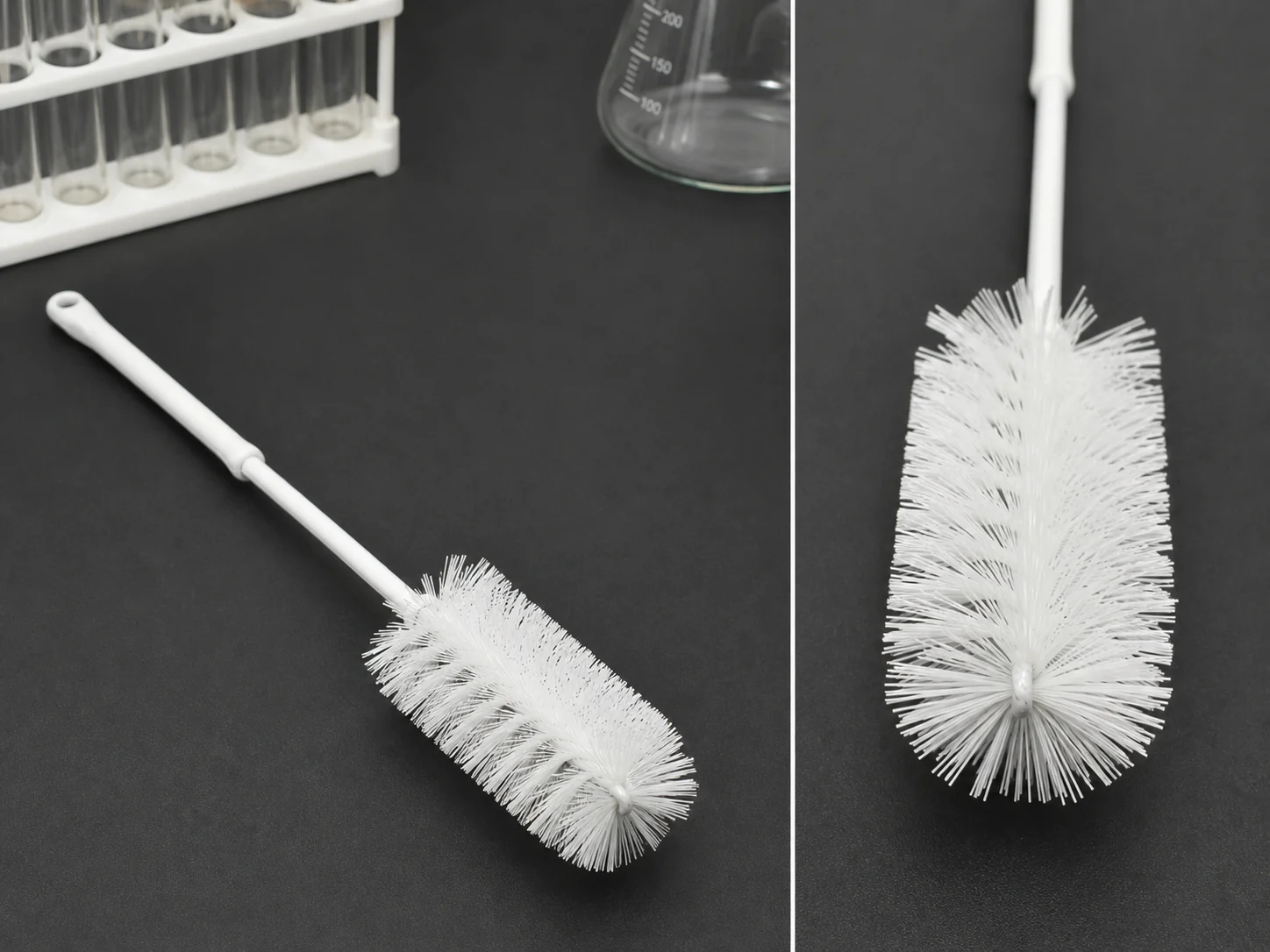
45mm PA66 lab bottle brush for wide-neck glassware. Stiff nylon bristles lift reagent film without scratching glass. 304 stainless stem, custom sizing.
Small brush
500 pcs
Minimum order
Held in one hand: tube, bottle, detail and swab brushes — including long-handled ones with a small head.
Production lead time, once the specification is confirmed
- Up to 500 pcsWithin 7 days
- 501–50,000 pcsWithin 14 days
- Over 50,000 pcsWithin 21 days
Peak season can extend these times; the shipping date is confirmed in writing with your quotation. Sampling and shipping are quoted separately.
The 45mm PA66 Lab Bottle Brush is a round-head nylon bottle brush for medium-width laboratory glassware, built with PA66 nylon bristles on a 304 stainless steel twisted-wire stem. The 45 mm head and 120 mm bristle section scrub internal walls, curved shoulders, and bottle bases to remove reagent film, precipitate, powder, and detergent residue from borosilicate bottles and flasks.
What can this brush do for you?
Cleans the Full Bore, Not Just the Center
The 45 mm round head fills the internal bore of typical wide-neck media and reagent bottles so the bristles contact the sidewall on both push and pull strokes. A narrower brush may clean only a central band and leave wall film behind. Rotation of the handle brings the entire circumference into contact.
Stiff PA66 Nylon Lifts Dried Residue Without Scratching Glass
PA66 filaments are stiff enough to break dried reagent film, settled precipitate, powder rings, and light oil films, yet the filament is softer than borosilicate glass and will not scratch or etch under normal hand pressure. That balance suits reusable glassware where surface clarity and readable graduations remain important after cleaning.
304 Stainless Stem Keeps the Brush Straight in Deep Glassware
The SUS304 twisted-wire stem holds the 220 mm handle section straight under scrubbing force and carries pressure to the bottom of the vessel without flexing away from the wall. The stainless core resists corrosion in ordinary water-based laboratory wash conditions.
Round Head Works Around Shoulders and Curved Transitions
The cylindrical bristle profile lets the filament tips follow curved shoulders, bulb contours, and bottom transitions when the brush is swept in a circular motion. On irregular internal surfaces, rotating the head rolls bristle tips through the transition instead of leaving a straight-line dead zone.
Open Bristle Set Releases Removed Residue During Rinsing
Because there is no sponge or solid absorbent layer, removed deposits and detergent residue rinse out from between the bristles under running water. The brush does not hold reagent film between samples the way an absorbent pad can, which reduces carryover in routine glassware washing.
What is a 45mm PA66 Lab Bottle Brush?
A 45mm PA66 Lab Bottle Brush is a hand-operated cylindrical cleaning brush in which PA66 nylon filaments are anchored into a twisted SUS304 stainless steel wire core. The brush is pushed into the vessel, rotated, and pulled back to scrub the internal bore. The 45 mm head provides positive sidewall contact while the 120 mm bristle section travels the working depth of the bottle.
In laboratory practice, the brush is used as part of a manual cleaning sequence: pre-rinse, brush with laboratory detergent, rinse again, and inspect. The fixed connection means the head and stem behave as one rigid unit, so the operator can apply consistent pressure at the bottom of the vessel without a joint loosening. It is primarily selected for glass vessels whose narrowest opening is around 45 mm or larger and whose internal walls need mechanical scrubbing rather than soak-only cleaning.
This is not a substitute for narrow-neck tube brushes, wire brushes for hard scale, or single-use swabs in trace-analysis workflows. Its role is regular, repeatable cleaning of reusable glassware where a stiff nylon filament can release attached residues while protecting the glass surface.
Technical Specifications
| Parameter | Value / Options |
|---|---|
| Head diameter | 45 mm round profile |
| Head length | 120 mm bristle working section |
| Bristle material | PA66 nylon |
| Stem / core | SUS304 stainless steel, twisted-wire construction |
| Handle length | 220 mm |
| Overall length | Approx. 340 mm, head plus handle |
| Grip diameter | 12 mm, loop, ring, or molded grip per project |
| Connection | Fixed; head and stem are one assembled unit |
| Minimum opening | Approx. 45 mm inside diameter; allow 2 to 3 mm clearance |
| Operating environment | Ambient-to-warm aqueous cleaning with common lab detergents and diluted solvents; not for strong oxidizing acids or prolonged high-temperature alkaline immersion |
| Brush type | Custom Bottle & Container Brushes |
| How it is driven | Hand-guided |
| Cleaning target | wide-neck borosilicate reagent and media bottle, graduated cylinder and mixing cylinder, and sample bottle and carboy cleaning |
| Surface or part | glassware, walls, glass, shoulders, vessels, bores, tubes, and internal walls |
| Residue or debris | reagent film, powder, precipitate, detergent residue, scale, hard scale, and oil film |
| Mounting / connection | Fixed; head and stem are one assembled unit |
Head diameter, brush length, stem material, and overall dimensions are adjusted to the bottle size and cleaning procedure when the order is configured.
Where does this brush work best?
- Wide-neck borosilicate reagent and media bottles with an opening ID of at least about 45 mm and an internal bore close to the 45 mm head, so the bristles maintain positive wall contact.
- Graduated cylinders and mixing cylinders with an internal diameter near 45 mm, where full-circumference contact keeps graduations readable.
- Sample bottles and carboys used in water quality, environmental, food safety, and academic laboratories, where repeat washing is part of the routine workflow.
- Glassware with curved shoulders, bulb contours, or bottom transitions that a straight-sided sponge cannot reach.
- Large test tubes and glass centrifuge bottles with an open end wide enough for the 45 mm head to enter without forcing.
How do I choose the right one?
Start with the narrowest opening
Measure the smallest internal passage the head must pass through, not the outer neck diameter. The standard 45 mm head needs an entrance ID of at least about 45 mm with a small clearance. If an internal graduation, constriction, or rim creates a smaller passage, choose a smaller-diameter brush instead of forcing the head through. Forcing folds the bristles and can expose the steel core to the glass.
Match filament stiffness to the deposit
PA66 is appropriate when the cleaning problem is dried reagent film, settled precipitate, powder rings, oil film, or rinse-agent residue. It is not the right filament for hard mineral scale, carbonized material, or polymerized coatings; those require a wire or abrasive brush, often after a chemical soak. For plastic vessels or coated glass, a softer PP, PTFE, or natural fiber may be the safer contact material.
Set the reach from vessel depth
The standard 340 mm overall length fits vessels within typical benchtop reach. If the brush cannot reach the base while the operator still has secure control, specify a longer stem. Avoid relying on excessive flex; a brush that bends sharply inside the vessel loses wall pressure and can push the core against the glass.
Check the wash environment before committing
The PA66 filament and 304 stainless steel stem are designed for room-temperature to warm water-based cleaning with standard detergents. If your SOP includes repeated autoclaving, hot alkaline wash cycles, strong acids, or chloride-rich media, request PBT or PEEK filament and a 316 stainless or coated stem instead. PA66 absorbs moisture and loses stiffness at elevated temperatures, so hot-process performance should not be assumed from the standard build.
When this brush is not the right choice
Use a smaller tube brush for narrow-neck volumetric flasks or pipettes below 45 mm; use a wire or abrasive brush for hard scale and carbon; use disposable swabs for trace-level or cross-contamination-sensitive work. The 45mm PA66 Lab Bottle Brush is the right selection when a medium-width, reusable glass vessel needs regular mechanical scrubbing with non-scratching filament.
Can I customize this brush?
The 45 mm PA66 version is a project-configurable lab cleaning brush. We adjust the dimensions, filament, stem, grip, and finish to match your glassware and cleaning SOP. To configure it, have these details ready: narrowest neck ID, internal diameter, depth to base, vessel material, residue type, detergent and chemical exposure, wash temperature, and whether a loop handle or color code is needed.
- Head diameter: 45 mm standard; other diameters possible to match your actual bore.
- Brush length and overall length: 120 mm head and 220 mm handle standard; adjust for deeper bottles or longer reach.
- Bristle material and color: PA66 standard; PBT, PP, PEEK, or other engineering filaments for temperature, chemical, or static-control requirements. Color coding for lab zones or acid/alkali separation is available.
- Stem and core: SUS304 standard; SUS316, coated wire, or looped and tipped end to prevent core contact with glass.
- Grip and handle end: 12 mm diameter standard; wire loop, plastic grip, non-slip sleeve, or identification marking.
- Packaging: Bulk cartons, lab kits, individual polybags, or cleanroom-compatible packaging to match receiving and storage.
If your cleaning procedure requires material documentation, inspection records, or third-party testing support for validation, provide those requirements at project start and we will include them in the configuration review.
Which filament survives the cleaning and still lasts on a 45mm PA66 lab bottle brush?
How do I check that the 45 mm head will fit my lab bottle?
Measure the narrowest internal opening with calipers, including any internal lip or constriction. The opening should be at least 45 mm with 2 to 3 mm of clearance. If the head binds at the rim or folds over and does not spring back, the opening is too small. Use a smaller brush rather than forcing the head through.
Will PA66 nylon scratch borosilicate glass?
Under normal hand pressure, no. PA66 filament is softer than borosilicate glass and removes attached residue without etching the surface. The larger risk is metal contact: if the bristles are flattened, worn short, or the twisted-wire tip becomes exposed, the steel core can leave gray or black marks. Inspect the core before each use.
How do I know when to replace the brush?
Inspect the bristle set before each cleaning session. Replace the brush when the head shows permanent flattening in one direction, reduced wall contact, missing or frayed filaments, corrosion spots on the wire, or an exposed core tip. Continued use reduces cleaning effectiveness and increases the chance of core-to-glass contact.
Can this brush be autoclaved or used in hot wash cycles?
The standard PA66 and 304 stainless build is intended for ambient-to-warm aqueous cleaning. Repeated autoclaving or hot alkaline wash cycles above roughly 80°C can soften PA66 filament and shorten brush life. If the cleaning SOP requires high-temperature processing, request PBT or PEEK filament and a 316 stainless or coated stem during configuration.
Does brushing remove all reagent residue, or do I still need a solvent or DI rinse?
Brushing loosens and removes attached film, but loosened debris and dissolved residue must still be rinsed away. Follow the brush step with the solvent or DI water rinse required by the lab protocol. On critical glassware, confirm the result by inspecting the walls and base under good light or by wiping with a clean swab.
What should I do if I see gray or black marks on the glass after cleaning?
Marks usually mean the steel core touched the glass. Stop and inspect the brush: the bristles may be flattened, the head may be undersized for the bore, or the wire end may be exposed. Replace the brush or request a looped and tipped core, and reduce pushing pressure so the bristle tips remain between the metal and the glass.
Guides that go deeper on this
Custom Manufacturing RFQ
Describe Your Application
To quote this brush accurately, send the size, material, cleaning target, residue, quantity, and any available drawing or sample photo.
Drawing or photo optional — it speeds things up, it does not gate the enquiry.
Custom Brush RFQ
Send Your Brush Project
Upload a drawing, product photo, or sample photo and provide the core dimensions and cleaning conditions.
“We need a brush to remove wet residue from a stainless steel conveyor, about 800mm wide. The current brush wears quickly. We can send photos.”
“We sell drinkware and need a cleaning brush to include with the product. Quantity around 5,000 pieces.”