
Custom Cleaning Brush
Anti-Static Brush Plate
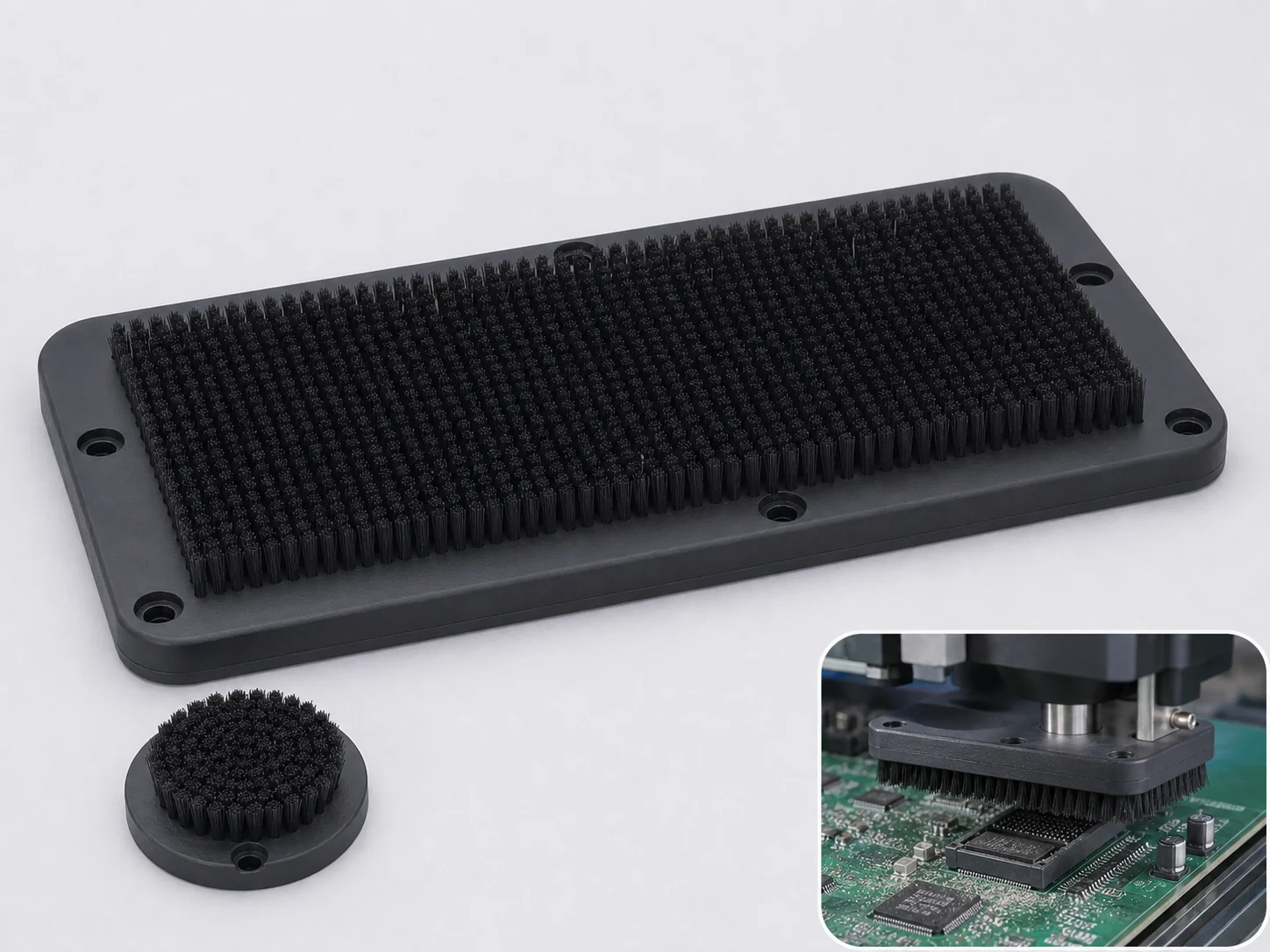
Grounded anti-static brush plate for ESD dust removal on contacts, boards, film, and precision housings.
Medium brush
100 pcs
Minimum order
Worked with two hands or on a pole: chimney, gutter and pond-filter brushes, discs, cups and tank brushes.
Production lead time, once the specification is confirmed
- Up to 100 pcsWithin 7 days
- 101–5,000 pcsWithin 14 days
- 5,001–50,000 pcsWithin 21 days
- Over 50,000 pcsConfirmed with your quotation
Peak season can extend these times; the shipping date is confirmed in writing with your quotation. Sampling and shipping are quoted separately.
A grounded anti-static brush plate with conductive nylon or carbon-fiber filaments for precision electronics, flat-panel, and contact-surface dust removal. It sweeps static-attracted particles from sensitive areas while providing a controlled path to ground.
What can this brush do for you?
Dissipates static charge while it sweeps
Conductive nylon, carbon-fiber, or metal-fiber filaments embedded in the grounded base plate carry charge away from the surface as they pass. This removes the attraction force that normally pulls dust straight back onto the part, so the surface stays cleaner after each pass instead of re-contaminating moments later.
Reaches narrow contacts, slots, and terminal gaps
Fine filament diameters — down to 0.008 mm for carbon or metal fiber and approximately 0.045 mm for conductive nylon — penetrate connector bodies, card-edge slots, terminal openings, and optical end faces without bridging adjacent pins or leaving fiber debris in tight areas.
Protects fragile substrates with a controlled contact load
The plate can be set to a 0.5–3 mm working overlap or kept below 2 N/cm² surface load, so delicate films, coated housings, gold-plated contacts, and optical surfaces stay free of scratches and pressure marks. Trim length and fiber density fix the contact force before the machine runs.
Installs on machines, fixtures, or hand tools
The base plate includes a grounding termination and can be machined for through holes, slots, clamping edges, or a custom mounting bracket. A handle or extension can be added for manual use, and the same grounding path works in both fixed and hand-held configurations.
Gives repeatable sweeping coverage instead of variable hand brushing
The brush plate is supplied as a straight or segmented strip with fiber rows, density, and trim length fixed to the drawing. That produces a defined sweep zone and consistent contact pattern along the full working width, which a loose hand brush cannot maintain.
What is an Anti-Static Brush Plate?
An Anti-Static Brush Plate is a grounded plate or strip with embedded conductive filaments that performs dry, quiet, particle-removal sweeps on electrostatic discharge (ESD)-sensitive surfaces. The plate is mounted to a machine, fixture, or handle; the filaments contact the part and provide a continuous electrical path back to ground through the base plate.
During operation the filaments wipe the surface in a controlled linear or rotary motion, removing lint, oxide particles, loose flux residue, polishing dust, and static-attracted debris. Because the fibers are conductive and the plate is grounded, charge does not accumulate on the wiped area, so the particles do not reattach after being dislodged.
This is not a scrubbing brush for wet cleaning, baked-on deposits, or heavy abrasion. It is a precision static-control cleaning tool for dry or lightly contaminated surfaces where discharge protection and particle removal must happen at the same time.
Technical Specifications
| Parameter | Value / Options |
|---|---|
| Brush plate width | 5–200 mm; wider sections can be joined or machined as one piece on request |
| Filament trim length | 10–40 mm from the plate face; custom lengths available |
| Filament materials | Conductive nylon (Nylon 6.12), carbon fiber, stainless steel fiber |
| Conductive nylon filament diameter | Approximately 0.045 mm |
| Carbon / metal fiber diameter | 0.008–0.012 mm |
| Resistance to ground | 10⁶–10⁹ Ω in static-dissipative configuration; lower-resistance grades available on request |
| Base plate material | Aluminum, stainless steel, or grounded engineering plastic; finish and insert options available |
| Mounting | Pre-drilled holes, slots, clamping edge, or custom bracket; grounding terminal included |
| Fiber layout | Single row, double row, staggered, or dense multi-row pattern |
| Working temperature | -10 to +80 °C for conductive nylon; carbon fiber or metal fiber versions extend the range further |
| Recommended engagement | 0.5–3 mm overlap or less than 2 N/cm² contact load on fragile substrates |
| Brush type | Custom Machine Table Brush Plates |
| How it is driven | Machine-driven, mounted in the equipment |
| Cleaning target | pcb and connector wiping station, flat-panel and optical film line, and semiconductor and microelectronic cleaning |
| Surface or part | fixtures, terminals, edges, slots, housings, bars, connectors, and precision housings |
| Residue or debris | dust, fiber, particles, lint, static-attracted dust, static-attracted particles, flux, and oxide |
| Mounting / connection | Pre-drilled holes, slots, clamping edge, or custom bracket; grounding terminal included |
Working conditions such as line speed, stroke direction, and ambient humidity affect fiber wear and static performance. Include these in the project specification so the plate is built for the actual process.
Where does this brush work best?
- PCB and connector wiping stations where edge fingers, gold contacts, and card slots need dry, particle-free contact before testing or assembly.
- Flat-panel and optical film lines where moving webs accumulate static-attracted dust that recontaminates after ordinary brushing.
- Semiconductor and microelectronics handling areas on cassette edges, carrier surfaces, and inspection fixtures that touch wafers or bare dies.
- Terminal blocks, switch contacts, bus bars, and precision housings after machining, deburring, or polishing operations.
- Cleanroom bench-top wiping fixtures where a mounted brush plate gives repeatable contact and frees the operator from hand brushing.
- Packaging and final-assembly lines for ESD-sensitive devices where lint and fiber fallout cause rejects or field failures.
How do I choose the right one?
Start with the contact geometry. Measure the full width of the area that must be wiped and the clearance height above it. The plate width should cover the contact zone in one pass where possible, and the trim length must leave enough free fiber to flex without bottoming against the base plate.
Select the filament material from surface sensitivity and residue type. Conductive nylon is the softest option and generates the least fiber shedding; it is the usual choice for gold contacts, optical end faces, coated housings, and thin films. Carbon fiber is stiffer and dissipates static faster, but fine carbon fibers can break and shed under high mechanical loads. Metal fiber provides the most aggressive conductive contact and is only appropriate for hard, conductive parts that can tolerate more abrasive contact.
Set the trim length for the required force. Long trim bends more easily and applies less pressure; short trim is stiffer and removes more stubborn static-attracted dust. Start with the longest trim that still removes the residue, then shorten only if necessary.
Confirm the grounding path before installation. The plate terminal must connect to a verified equipment ground. If the plate is mounted on an anodized or coated insulator, expose a clean bonding point or add a ground strap. A floating plate has no static-dissipation function.
When a different tool is more suitable: use a wet-cleaning brush or swab if the contamination contains fluid, dried flux paste, or grease; use a high-force abrasive or wire brush for scale or heavy oxide; add an ionizer if static charge must be neutralized over a large area without physical contact. The anti-static brush plate is for dry, light-contact particle removal on accessible surfaces.
Can I customize this brush?
These plates are project-configured, not off-the-shelf. Send the critical dimensions, substrate material, residue type, line speed or stroke cycle, available ground connection, and ambient conditions. A drawing or sample part shortens the definition cycle.
- Overall plate width, length, thickness, and edge profile
- Hole pattern, slot positions, clamp surface, or custom mounting interface
- Filament material, fiber diameter, trim length, row spacing, and row count
- Base plate material and finish, including anodized aluminum or stainless steel
- Ground terminal type and location — ring lug, threaded stud, grounding bar, or integral lead
- Single or multiple filament rows, staggered patterns, or segmented conductive zones
- Optional handle, extension, or machine holder for fixed or manual operation
- Color, laser marking, or identification coding on the plate or packaging
- Cleanroom or bulk packaging, static-dissipative wrapping, or individual bagging
If your project needs surface-resistance readings, particle-shedding checks, material declarations, or third-party testing support, we can coordinate these as part of the customization scope.
When is an anti-static brush plate worn out rather than just dirty?
How do I verify the plate is actually grounded before production?
Use a surface resistance meter from the filament tips to the plate ground terminal. A reading in the 10⁶–10⁹ Ω range with no open circuit is typical for the static-dissipative configuration. Then confirm the terminal is bonded to a verified equipment ground. Recheck after mounting because anodizing, paint, or adhesive can insulate the interface.
What happens if the plate is left floating (not grounded)?
The bristles can tribocharge the surface and make contamination and ESD risk worse than no brushing at all. Always connect the plate to a verified ground before the line runs.
Will this brush plate eliminate the need for an ionizer?
No. The plate only affects the surfaces the filaments physically touch. Ionizers neutralize charge in the surrounding air and on non-contact surfaces. On many lines the brush plate and an ionizer work together — the plate removes particles, the ionizer prevents re-attraction.
How can I check the fiber engagement on a new installation?
Run a dry pass on a sample part and inspect for excessive fiber deflection or surface marks. If fibers bend more than about half their free length or the substrate shows any contact trace, reduce the overlap. If dust remains at the sweep edges, increase engagement within the 0.5–3 mm working range and check for uneven base mounting.
Can the fibers be used with cleaning solvents or in wet processes?
Not by default. Conductive nylon and carbon fiber are intended for dry contact. Solvent exposure can soften the base bonding, swell fibers, or corrode the grounding path. If the process is wet, specify the solvent, temperature, and exposure time so we can select compatible materials or advise a different cleaning method.
What tells me the plate needs to be replaced?
Look for missing or broken fibers, uneven trim length, loose rows, corrosion at the ground terminal, or resistance readings that drift out of range. Replace the plate when the contact pattern becomes uneven or the grounding path no longer reads correctly.
Guides that go deeper on this
Custom Manufacturing RFQ
Describe Your Application
To quote this brush accurately, send the size, material, cleaning target, residue, quantity, and any available drawing or sample photo.
Drawing or photo optional — it speeds things up, it does not gate the enquiry.
Custom Brush RFQ
Send Your Brush Project
Upload a drawing, product photo, or sample photo and provide the core dimensions and cleaning conditions.
“We need a brush to remove wet residue from a stainless steel conveyor, about 800mm wide. The current brush wears quickly. We can send photos.”
“We sell drinkware and need a cleaning brush to include with the product. Quantity around 5,000 pieces.”